
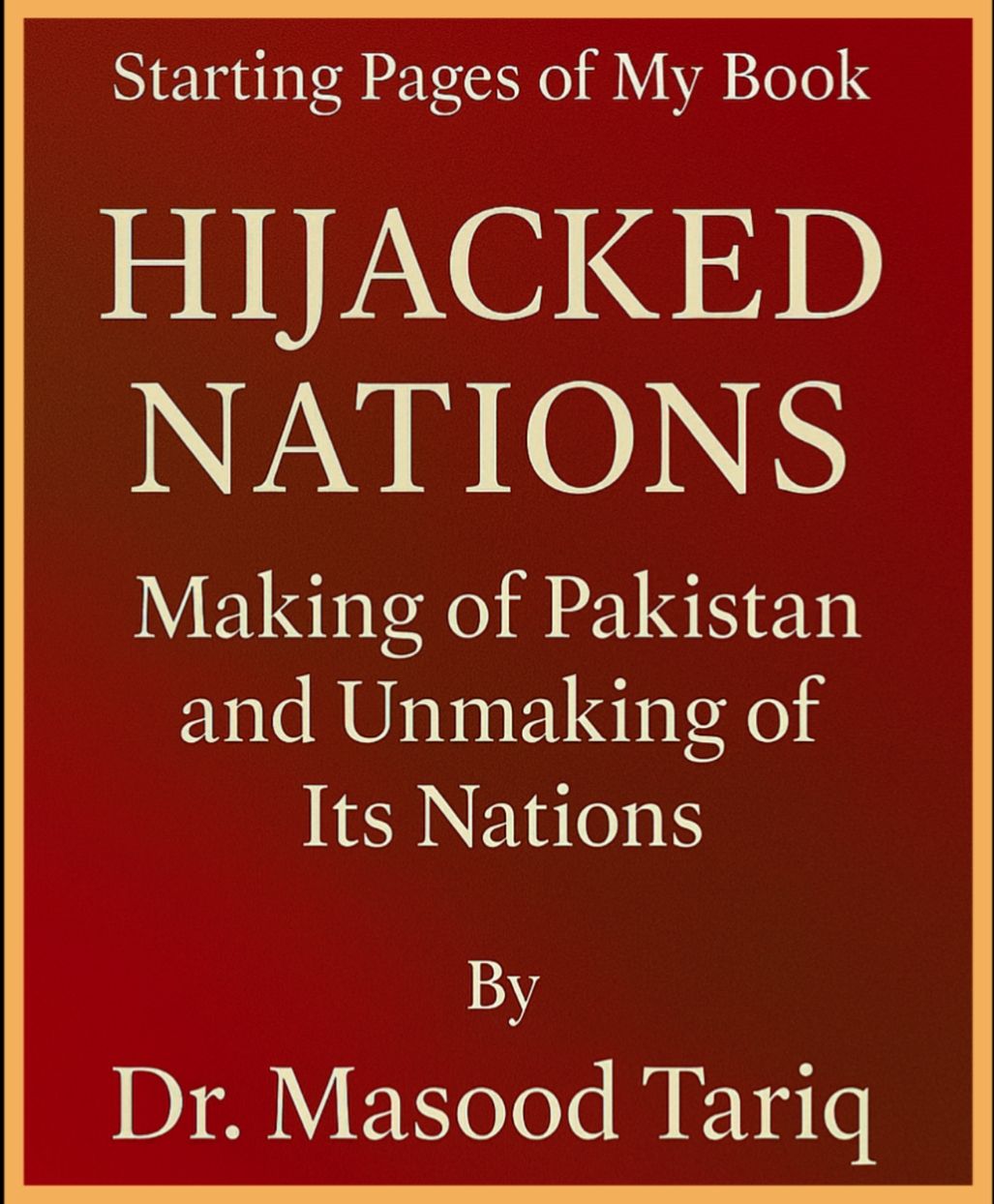
Hijacked Nations: Making of Pakistan and Unmaking of Its Nations (1748–1951)
——————————————–
Dedication
To the peoples of Punjab, Sindh, Balochistan, Pashtun lands, and Bengal —
whose histories were fractured, whose languages were silenced,
and whose nations remain the living heart of South Asia.
——————————————–
Table of Contents
Dedication
Series Preface
Acknowledgements
Preface
Note on Sources and Method
Introduction: The Argument and the Method
Overview of Volume I
Bridge Essay: The Three Pillars of National Progress — Intellectual, Bureaucratic, and Business Classes
Part I · From Abdali to 1857: Nations and Empires Collide
1. Ahmad Shah Abdali and the Geopolitical Shift of Power
2. Sikh Confederacies and the Rise of Ranjit Singh
3. Punjab Under Ranjit Singh: Statecraft and Resistance
4. Colonial Expansion: The East India Company’s Advance
5. The Battle of Plassey and Bengal’s Subjugation
6. Fort William College and the Birth of Urdu Officialdom
7. The 1857 Revolt: Mutiny, War, and National Memory
Part II · 1857 to 1906: Colonies, Canals, and the Rise of Urdu
8. The Fall of the Mughal Ashrafia: From Aristocracy to Refugee Class
9. Deoband, Nadwa, and Aligarh: The Madrasa Projects of the UP/CP Ashrafia
10. Canal Colonies and the Engineering of Punjab
11. Language Politics in the Late 19th Century: Urdu vs Vernaculars
12. Bengal Partition (1905) and the First Language Movement
13. The Muslim League’s Birth and the Search for Patronage
Part III · 1906 to 1930: Experiments in Unity and Awakening
14. The Lucknow Pact and Its Fragile Unity
15. Punjab in the 1910s: Ghadar, Agrarian Unrest, and Jallianwala Bagh
16. Non-Cooperation and the Punjabi Political Awakening
17. Pashtun Awakenings and the Khilafat Movement
18. Bengal in the 1920s: Language, Land, and Political Identity
19. Balochistan Under Colonial Frontier Rule
20. Sindh’s Demand for Separation from the Bombay Presidency
Part IV · 1930 to 1940: Autonomy and Betrayal
21. The Round Table Conferences and the Limits of Negotiation
22. The Rise of Provincial Autonomies (1935 Act in Practice)
23. Sindh’s Separation Achieved: Identity and Autonomy (1936)
24. Bengal in the 1930s: Provincial Experiment and Communal Tensions
25. Punjab Betrayed: Unionist Party, Sikhs, and the Muslim League (1937)
26. The Road to Lahore: 1940 in Context
Part V · 1940 to 1946: The Ashrafia’s Final Push
27. The Lahore Resolution and Its Interpretations
28. Cabinet Mission to Direct Action: Roadblocks on the Last Bridge
29. The Delhi Convention of 1946: UP/CP Ashrafia’s Last Bid for Power
30. The Rise of Partition Violence: From Calcutta to Punjab
31. Madrasas and the Uttar Pradesh Ideology in the 1940s
Part VI · 1946 to 1947: Partition Engineered
32. Partition Debates: Mountbatten, Radcliffe, and Maps of Division
33. Bengal’s Second Partition: Language, Land, and Loss
34. Pashtun Rejection: The Referendum of 1947
35. The Unionist Party’s Collapse and the Fall of Punjabi Pluralism
36. Punjab’s Partition Human Cost: Two Million Dead, Twenty Million Uprooted
Part VII · From Partition to Refugee Rule (1947–1951)
37. Refugees as Rulers: Pakistan’s First Years (1947–1951)
38. Karachi Detached from Sindh: A Capital Without Consent
39. Balochistan Annexed: The Forgotten Accession (1948)
40. Evacuee Property: Engineering Urban Pakistan (1947–1951)
Annexures
Annex I.1 — Chaudhry Rahmat Ali: The Forgotten Founder of Pakistan
Annex I.2 — From Harmony to Holocaust: The Fall of Thoha Khalsa, 1947
Annex I.3 — What If Punjabi Sikhs Had Not Divided Punjab in 1947?
Annex I.4 — The Three Pillars of National Progress (Extended Essay with Notes & References)
Closing of Volume I
Nations Hijacked, Nations Endure
Bibliography
Index
——————————————–
Series Preface
This work is presented in two companion volumes — Hijacked Nations: Making of Pakistan and Unmaking of Its Nations (Volume I) and Pakistan – A Hijacked Dream: Partition’s Legacy, Language and Power (Volume II). Together they are meant to be read as one continuous narrative, but each volume is also complete in itself.
The argument is stark but simple: Pakistan was never allowed to be the federation of nations it was promised to be. Its creation in 1947 was less the fulfilment of a dream than the beginning of a hijack. The peoples who made Pakistan — Punjabis, Sindhis, Baloch, Pashtuns, and Bengalis — found their voices silenced, their lands partitioned, and their languages suppressed. A state that should have rested on the foundations of its historic nations was instead captured by an outsider class: the Urdu-speaking Ashrafia of United Provinces and Central Provinces (UP/CP). Through their command of language, education, bureaucracy, and political manoeuvring, they turned themselves from refugees into rulers.
To understand this, one must step back from state-centric histories. Constitutions, ministries, and generals are the surface. Beneath them lie nations — communities bound by land, language, and memory. A state is an instrument; a nation is a living organism. Pakistan’s tragedy is that its nations were forced to disappear inside a state that denied their existence.
——————————————–
Acknowledgements
This book has been shaped not only by archives and research but also by lived encounters with the men and women who carried the burdens of Pakistan’s unfinished history. My own years of student activism, service in local government, and tenure in the Sindh Cabinet brought me into dialogue with leaders, teachers, and activists across all nations of Pakistan.
I had the privilege of personal interaction and dialogue with leaders who embodied the struggles of their peoples. Pir Pagaro, Shah Mardan Shah II, spiritual leader of the Hur Jamaat and head of the Muslim League (Functional), became my first political teacher in 1978. With G.M. Syed, founder of modern Sindhi nationalism, I held repeated discussions on autonomy and dignity for Sindh. Rasool Bux Palijo, founder of the Sindhi Awami Tehreek, engaged me in debates on socialism, peasant organisation, and women’s rights. Dr. Hamida Khoro, historian and politician, shared with me the challenges of combining scholarship with practical politics. With Ibrahim Joyo, educationist and intellectual, I had the honour of direct conversations that reflected his lifelong commitment to progressive thought and Sindh’s cultural awakening.
In Sindh’s political landscape, I worked closely with Nawab Muzaffar Khan, founder of the Mohajir Punjabi Pathan Muttahida Mahaz (1969); Nawab Yameen Khan, an Urdu-speaking politician from Hyderabad active in provincial and federal politics; and Azad Bin Hyder, President of Urdu Mahaz Karachi (1968) and later Chief Organizer of Anjuman-e-Muhajreen-e-Mashraqi Pakistan. My discussions with them revealed the anxieties and aspirations of the migrant community.
From Punjab, I engaged in personal exchanges with Chaudhry Zahoor Elahi, politician of Gujrat and stalwart of the Muslim League tradition. From Kashmir, I interacted with Sardar Abdul Qayyum Khan, founder of the Muslim Conference and a central figure in Azad Kashmir politics. From the frontier, I held direct dialogue with Air Marshal Asghar Khan, founder of Tehreek-e-Istiqlal, and with Khan Abdul Wali Khan, leader of the National Awami Party, who articulated the Pashtun struggle for federal rights.
Among Punjabi intellectuals, I had close discussions with Hanif Ramay, Chief Minister of Punjab and ideologue of “Islamic socialism.” Finally, Benazir Bhutto, twice Prime Minister of Pakistan, was the last political leader with whom I worked directly, serving as Advisor to the Chief Minister and as a member of the Sindh Cabinet.
Beyond these names, I remain indebted to countless unnamed political activists, journalists, students, and community members with whom I spoke and worked. Their experiences remind us that history is not only written in parliaments and palaces but also in villages, neighbourhoods, and assemblies where ordinary people insist on dignity.
This book is dedicated to the peoples of Punjab, Sindh, Balochistan, Pashtun lands, and Bengal — but it is also indebted to all those who struggled, spoke, and resisted, so that their nations would not be forgotten.
——————————————–
Preface
Hijacked Nations tells the first half of a long story — the slow making of Pakistan and the rapid unmaking of its nations — stretching from Ahmad Shah Abdali’s invasions in 1748 to the refugee rule of Liaquat Ali Khan’s era (1947–1951). Within this arc lie the roots of the hijack: how a subcontinent of nations was drawn into the colonial order; how the Ashrafia of United Provinces and Central Provinces (UP/CP) fashioned their project through madrasas, Aligarh, and Urdu; and how Punjabis, Sindhis, Baloch, Pashtuns, and Bengalis were reduced from nations into provinces.
This is not only a history of suppression but also of resistance. It recovers the voices of poets, peasants, unionists, and provincial leaders who imagined a plural federation. Silenced in their own time, their vision endured in memory and later struggles. Annexures at the close of this volume carry lessons forward: how history was erased, how alignments were manufactured, and why national progress depends on the cooperation of three essential classes — intellectuals, bureaucrats, and business leaders — working with integrity.
The book is organised in seven parts. It begins with Abdali’s invasions and the shifting balance of regional power; follows the rise of Ranjit Singh, the Company’s expansion, and the fall of the Mughal Ashrafia; traces the madrasa–Aligarh project and the emergence of the Muslim League; analyses the decade of constitutional experiments, betrayals, and Lahore 1940; and finally turns to Partition’s fires, its human cost, and the early years of Pakistan’s refugee state (1947–1951).
The guiding argument is stark but simple: Pakistan was not the fulfilment of the Indus nations, it was their hijack. The UP/CP Ashrafia captured the state through language, bureaucracy, and political manoeuvring. A possible federation became a centralised state.
This volume is a ledger of promises broken. It prepares the ground for Volume II, where the hijack deepens through Cold War alignments, Islamisation, and the cycles of dictatorship and democracy — and where, despite repression, the nations refuse to vanish.
——————————————–
Note on Sources and Method
Sources
This volume draws primarily on colonial and Partition-era archives: East India Company records, British parliamentary papers, provincial reports, court judgments, memoirs of colonial officers, and testimonies from nationalist leaders. It also relies on newspapers, pamphlets, and oral histories of families who lived through Partition. Over four decades, my published research on language politics, provincial suppression, and South Asian geopolitics provides the scaffolding for this narrative, here revised into a continuous form.
Method
The method is “nation history,” not state chronicle. Where official histories focus on ministries, constitutions, and governors-general, this book restores agency to the nations that predate the state — Punjabis, Sindhis, Baloch, Pashtuns, and Bengalis. States are instruments; nations, bound by land, language, and memory, are living agents.
Perspective
This approach deliberately resists the homogenising lens of state nationalism. By foregrounding Punjabi dialects, Sindhi literary traditions, Baloch confederacies, Pashtun jirgas, and Bengali cultural movements, the book re-inserts voices silenced in the official record. It also treats the UP/CP Ashrafia as an outsider class whose madrasa networks, Aligarh pipeline, and Urdu project transformed them from refugees into rulers.
Continuity
The perspective of this volume is historical and longue durée — from Abdali’s invasions (1748) through the Partition’s fires (1947) to the first years of refugee rule (1947–1951). But it is also preparatory. By showing how a plural federation was denied, and how suppression became the state’s organising logic, Volume I sets the stage for Volume II, where the hijack deepens in the Cold War, Islamisation, and the twenty-first century.
——————————————–
Introduction: The Argument and the Method
Pakistan was created in 1947 as the supposed homeland of South Asia’s Muslims. Yet the Muslims of Punjab, Sindh, Balochistan, Pashtun lands, and Bengal were never directly asked if they desired such a state. The demand was articulated by the Ashrafia of the United Provinces and Central Provinces (UP/CP), who, through their madrasa networks, the Aligarh pipeline, the promotion of Urdu, and strategic conventions in Delhi and Lucknow, scripted an ideology that would later dominate Pakistan.
The Argument
This book advances a stark claim: Pakistan was not the fulfilment of the Indus nations but their hijack. A federation of historic nations — Punjabi, Sindhi, Baloch, Pashtun, and Bengali — could have formed the foundation of a viable state. Instead, a centralised structure was imposed that denied their identities, suppressed their languages, and fragmented their political agency.
The roots of this hijack lie in colonial restructuring and the social engineering of the UP/CP Ashrafia, who reinvented themselves from a displaced aristocracy into a ruling class. By 1947, they had positioned themselves as the “founders” and “saviours” of Pakistan. From the moment of independence, the state was captured not by its indigenous nations but by an outsider class that turned itself from refugee into ruler.
The Method
The method of this book is nation history, not state chronicle. Constitutions, ministries, and generals are only the surface. Beneath them lie nations — living communities bound by language, land, and memory. To write the history of Pakistan only from the perspective of its state is to accept the erasure of its nations.
This book instead restores agency to those nations. It draws on colonial and postcolonial archives, government reports, memoirs, party records, oral histories, and my own decades of political experience. It also integrates interdisciplinary frames — world-systems theory to situate colonialism and the Cold War, sociolinguistics to analyse language suppression, and comparative politics to trace the fate of federations.
Roadmap
Volume I unfolds in seven parts. It begins with the geopolitical shifts of Abdali and Ranjit Singh, tracks the rise of the UP/CP madrasa–Aligarh project, explores the betrayals of Punjab and Bengal in the 1930s and 1940s, and follows Partition’s fires in 1947. It concludes with the aftermath of Pakistan’s creation under refugee rule (1947–1951) — Karachi’s detachment from Sindh, Balochistan’s annexation, and the Evacuee Property regime.
At its heart, the argument is simple: repression can impose borders, but it cannot erase nations. Punjabis, Sindhis, Baloch, Pashtuns, and Bengalis endured as nations even when reduced to provinces. Volume I is their story — the making of Pakistan, and the unmaking of its nations.
——————————————–
Overview of Volume I
This first volume follows the long arc from the mid-eighteenth century to the early years of Pakistan. It begins with the collapse of Mughal authority and the rise of new regional powers, moves through colonial conquest and the creation of a new bureaucratic-linguistic order, and ends with the Partition of 1947 and the refugee rule of Pakistan’s formative years (1947–1951).
The story unfolds in seven parts. Part I situates the power shifts of the eighteenth century: Ahmad Shah Abdali’s invasions, the rise of the Sikh Confederacies, and the statecraft of Ranjit Singh, set against the advance of the East India Company and Bengal’s subjugation.
Part II turns to the post-1857 order: the fall of the Mughal Ashrafia, the madrasa projects of Deoband, Nadwa, and Aligarh, and the colonial transformation of Punjab through canal colonies and recruitment.
Part III explores the early twentieth century — the Lucknow Pact, the rise of agrarian and nationalist politics in Punjab and Bengal, Pashtun mobilisation during the Khilafat Movement, and Sindh’s demand for separation from Bombay.
Part IV focuses on the 1930s: the Round Table Conferences, the 1935 Act and provincial autonomies, Sindh’s emergence as a province, and the betrayals of Punjab and Bengal that foreshadowed Partition.
Part V follows the decisive years from Lahore 1940 to Direct Action 1946, including the Delhi Convention and the embedding of the “Uttar Pradesh ideology” through madrasas and Urdu.
Part VI moves into 1946–47: the Partition debates, Bengal’s second partition, the NWFP referendum, the collapse of the Unionist Party, and the immense human cost of Punjab’s division — two million dead, twenty million uprooted.
Finally, Part VII traces the aftermath: Pakistan’s creation under refugee rule, Karachi’s detachment from Sindh, the forced accession of Balochistan, and the Evacuee Property regime that transformed the urban map. These early years showed clearly that the new state was not built as a federation of its historic nations, but as a centralised order captured by an outsider class.
At the centre of this volume lies a simple truth: repression can forge a state, but it cannot erase nations. Punjabis, Sindhis, Baloch, Pashtuns, and Bengalis carried their memory, language, and culture forward even in the face of suppression.
Volume I is their story — of how nations were fractured but endured — and it prepares the ground for Volume II, which follows the continuity of the hijack into the Cold War, Islamisation, and the struggles of the twenty-first century.
——————————————–
Bridge Essay: The Three Pillars of National Progress
Every nation requires three pillars to sustain progress: an intellectual class to provide vision, a bureaucratic class to ensure honest administration, and a business class to generate wealth. Where these work in harmony, nations prosper. Where they fracture, decline follows.
In Pakistan’s early years, the triangle was already broken. Intellectuals from Bengal, Sindh, Punjab, Balochistan, and Pashtun lands were marginalised, while the UP/CP Ashrafia imposed their madrasa–Aligarh–Urdu project as the sole voice of “Muslim identity.” Bureaucracy, rather than serving the nations, fused with the military and became a ruling caste. Business assets, reshaped through Evacuee Property and patronage, concentrated into a few families tied to state power.
The result was a hollow state. Vision collapsed into rhetoric, administration into control, and economy into dependency. This broken triangle explains why the federation promised in 1940 became a centralised state after 1947 — and why, despite repression, the historic nations endured in dissent.
——————————————–
Closing of Volume I
Nations Hijacked, Nations Endure
From Abdali’s invasions in the eighteenth century to the refugee rule of Pakistan’s first years, this volume has traced how a federation of historic nations was dismantled and replaced by a centralised state. The story is one of collisions and continuities: the rise of Ranjit Singh and the fall of the Sikh empire, the colonial engineering of Punjab through canals and recruitment, the madrasa–Aligarh–Urdu project of the UP/CP Ashrafia, the fragile experiments of the Lucknow Pact and provincial autonomies, and finally the fire of Partition in 1947.
The creation of Pakistan promised freedom but delivered a hijack. The Urdu-speaking Ashrafia of United Provinces and Central Provinces, refugees in demographic terms but rulers in political terms, turned language into a weapon and bureaucracy into an empire. Punjabis, Sindhis, Baloch, Pashtuns, and Bengalis — the nations who created Pakistan — were immediately reduced to provinces inside it. Karachi was detached from Sindh; Balochistan was annexed without consent; Pashtuns were given a referendum between two denials; Punjab was amputated and then blamed for “dominance”; Bengal, though a majority, was placed under refugee rule.
And yet the deeper lesson is not one of despair. Nations endure longer than states. Beneath the centralisation and suppression, the languages, songs, and memories of these nations survived. Bengal’s resistance, Sindh’s insistence on identity, Balochistan’s demands for dignity, Pashtun struggles for autonomy, and Punjab’s buried pluralism all show that the state’s attempt at erasure never fully succeeded.
This volume has been a ledger of promises broken. It ends with Pakistan’s first phase (1947–1951), where the rhetoric of unity masked the reality of refugee dominance, urban re-engineering, and the silencing of languages. But it also ends with the seeds of resistance.
Volume II begins where this story leaves off. It follows the continuity of the hijack into Cold War alignments, Islamisation, the cycles of democracy and dictatorship, and the renewed struggles of the twenty-first century — from the streets of Karachi and Quetta to the digital networks of a new generation.
If Volume I has shown how nations were hijacked; Volume II will show how they endured — and how, in enduring, they continue to demand a federal future.
——————————————–


Leave a Reply