
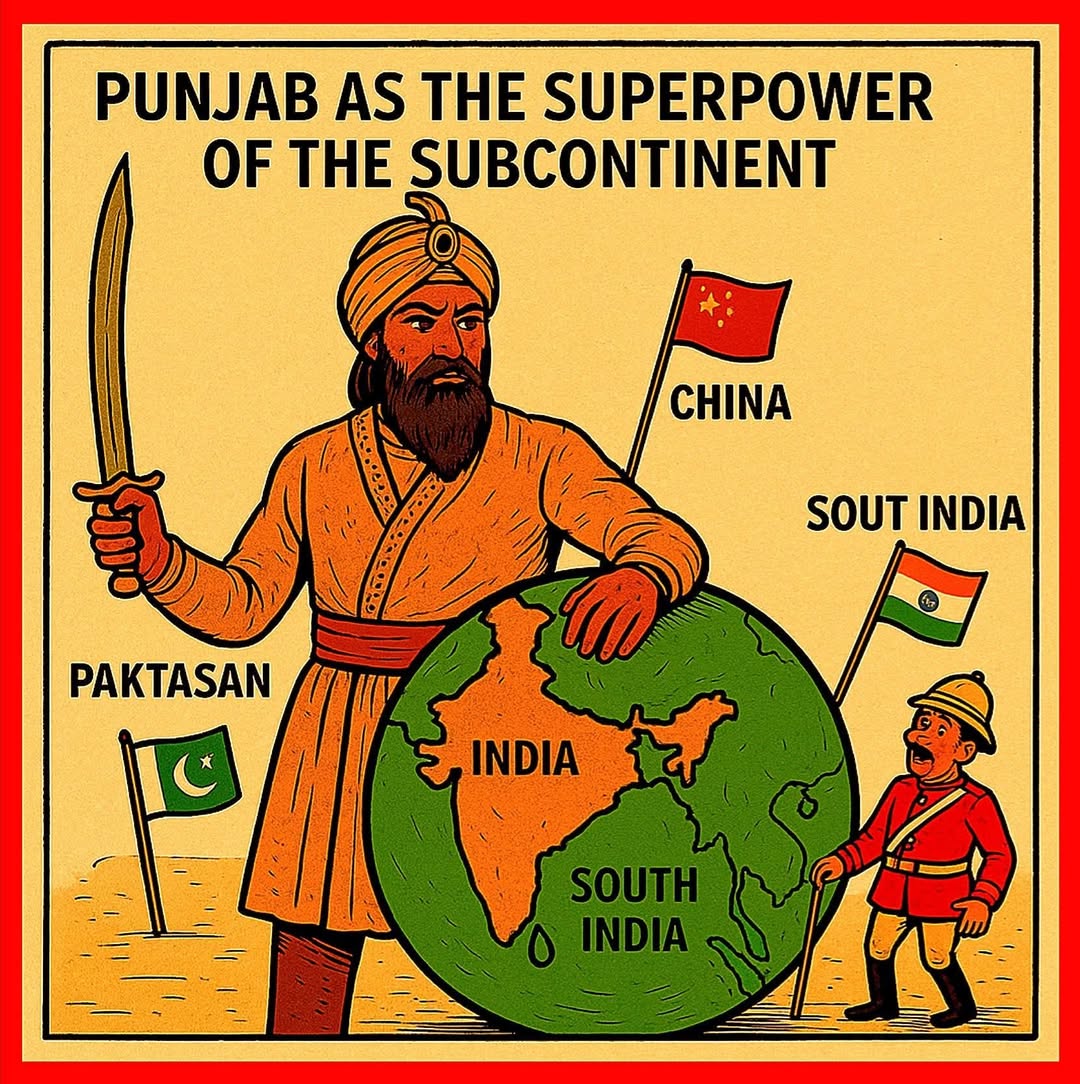
Punjab as the Superpower of the Subcontinent:
Author:
Dr. Masood Tariq
Independent Political Theorist
Karachi, Pakistan
Date: June 10, 2025
drmasoodtariq@gmail.com
——————————————–
Abstract:
This research paper argues that Punjab—historically, geographically, demographically, and militarily—is the true superpower of the Indian subcontinent. Drawing from historical episodes such as Maharaja Ranjit Singh’s reign during the Great Game, present-day geopolitical realities involving the India-Pakistan water conflict, and the demographic-economic dominance of Punjabi populations in both India and Pakistan, the paper demonstrates that the Punjabi nation, fragmented yet central to South Asia, holds the key to the region’s political equilibrium and strategic future. This paper reevaluates Punjab’s historical role, its military-industrial and administrative strength, its geopolitical centrality, and its contemporary political weight in South Asia.
——————————————–
Table of Contents
1. Introduction: Punjab—From a Region to a Strategic Axis
2. Maharaja Ranjit Singh and the Strategic Ascent of Punjab
3. Punjab in the Modern Geopolitical Chessboard
4. Punjab: The Germany of the Subcontinent
5. The Three Determinants of Victory in Indo-Pak Wars
6. A Fragmented Nation and the Case for Reunification
7. Conclusion: Punjab as the Key to Subcontinental Destiny
8. References
——————————————–
1. Introduction: Punjab—From a Region to a Strategic Axis
Punjab is more than a province; it is a civilisational heartland, a geopolitical fulcrum, and a strategic command centre Spanning from Delhi to Peshawar and Kashmir to Kashmor, Punjab has historically been the bridge between Central Asia and South Asia, and today, it remains the key to peace or war in the subcontinent. This paper explores how Punjab has historically acted as a strategic buffer, a military-industrial powerhouse, and a cultural-political nucleus—attributes that now qualify it as the superpower of the subcontinent.
——————————————–
2. Maharaja Ranjit Singh and the Strategic Ascent of Punjab
Maharaja Ranjit Singh’s rule (1799–1839) marked the golden age of Punjab as an autonomous regional superpower. By consolidating a fragmented post-Mughal region into a sovereign empire, Maharaja Ranjit Singh placed Punjab at the forefront of the Great Game between the British and Russian empires.
i). Military Modernization: Maharaja Ranjit Singh employed European generals like Jean-Baptiste Ventura and Claude Auguste Court to transform the Punjab Army into a disciplined and technologically advanced force.
ii). Diplomatic Prowess: Through cautious treaties and frontier diplomacy, Maharaja Ranjit Singh maintained Punjab’s independence while playing Britain and Afghanistan off against one another.
iii). Buffer State Role: Punjab was seen by British strategists as the first line of defence against Russian advancement through Central Asia.
“The British were acutely aware of the importance of Punjab in any forward policy concerning Central Asia.” – Hopkirk, 1990.
——————————————–
3. Punjab in the Modern Geopolitical Chessboard
3.1 Control of Water and Economic Sovereignty
Since 1947, Punjab’s partition has led to water insecurity for Pakistan, with India controlling key rivers originating in occupied Kashmir:
i). Chenab and Jhelum: India’s dam projects threaten Pakistan’s agricultural backbone.
ii). Indus Diversion Plans: The strategic attempt to redirect the Indus into Sutlej could collapse Pakistan’s agrarian economy.
This makes Punjab not only the food basket but also the pressure point that can spark or end wars in South Asia.
3.2 Population and State Control
Punjabi Demographic Weight: With 200 million people, the Punjabi nation—Muslim, Sikh, Hindu, and Christian—forms the largest ethnonational bloc in the region.
Pakistani Punjab’s Dominance: 60% of Pakistan’s population lives in Punjab, controlling key institutions:
i). Military and intelligence services
ii). Civil bureaucracy and diplomacy
iii). Agricultural and industrial output
iv). Educational and media establishments
“If Pakistan Punjab were an independent country, it would be the 11th most populous nation in the world.”
——————————————–
4. Punjab: The Germany of the Subcontinent
Just as Germany’s industrial and military power has historically shaped Europe, Punjab functions as the strategic and civilisational core of South Asia.
i). Geographical Positioning: Borders with China, Central Asia, and Iran enhance its connectivity.
ii). Economic Potential: With irrigated agriculture, industrial clusters, and a large skilled workforce, Punjab can independently sustain a national economy.
iii). Military Influence: The Pakistani military is predominantly Punjabi; the Sikh regiments are among India’s most battle-hardened.
This dual presence—on both sides of the Indo-Pak divide—makes Punjab the pivot in any major conflict or peace process.
——————————————–
5. The Three Determinants of Victory in Indo-Pak Wars
According to strategic calculations, success in any war between India and Pakistan will hinge not on superpower intervention but on three decisive forces:
i). Sikh Punjabi Support
ii). Chinese Geostrategic Alignment
iii). Support from Southern Nations (Tamil, Telugu, Marathi, etc.)
Punjab, specifically, is the first and foremost among these determinants.
i). If the Sikh-Punjabi population in India revolts or refuses allegiance in a war scenario, India’s internal cohesion collapses.
ii). If Punjabi-majority Pakistan loses Punjab’s internal cohesion, its military collapses.
Thus, the Punjabi factor is not just important—it is existential for both states.
——————————————–
6. A Fragmented Nation and the Case for Reunification
Partition divided the Punjabi nation into Muslim, Sikh, and Hindu political camps—one in Pakistan, one in Indian Punjab, and a diaspora across the globe. However, cultural, linguistic, and historical continuities remain intact.
i). Khalistan Movement: Advocates for an independent Sikh-Punjabi state challenge the Indian federation.
ii). Confederal Alternatives: Some scholars propose a Punjab confederation to stabilize the region.
iii). Diaspora Capital: The Punjabi diaspora in Canada, the UK, and the US is economically and politically influential.
Punjab’s reunification—culturally or geopolitically—would dramatically alter South Asia’s strategic map.
——————————————–
7. Conclusion: Punjab as the Key to Subcontinental Destiny
Punjab is not merely a province; it is the heart, sword, and brain of South Asia. Whether under Maharaja Ranjit Singh during the Great Game or today in the form of its demographic weight and strategic positioning, Punjab remains the only power in South Asia that can challenge superpower narratives, shape Indo-Pak politics, and lead a regional transformation.
If unity and strategic clarity emerge within the Punjabi nation—whether through Khalistan and Pakistan confederal arrangements, or institutional reform—Punjab will become the superpower of the subcontinent in both name and fact.
——————————————–
8. References
Grewal, J. S. (1990). The Sikhs of the Punjab. Cambridge University Press.
Hopkirk, P. (1990). The Great Game: The Struggle for Empire in Central Asia. Kodansha International.
Lafont, J. M. (2002). Maharaja Ranjit Singh: Lord of the Five Rivers. Oxford University Press.
Singh, K. (2008). A History of the Sikhs. Oxford University Press.
Yapp, M. E. (2001). Strategies of British India: Britain, Iran and Afghanistan 1798–1850. Oxford University Press.
——————————————–
Author Biography
Dr. Masood Tariq is a Karachi-based politician and political theorist. He formerly served as Senior Vice President of the Pakistan Muslim Students Federation (PMSF) Sindh, Councillor of the Municipal Corporation Hyderabad, Advisor to the Chief Minister of Sindh, and Member of the Sindh Cabinet.
His research explores South Asian geopolitics, postcolonial state formation, regional nationalism, and inter-ethnic politics, with a focus on the Punjabi question and Cold War strategic alignments.
He also writes on Pakistan’s socio-political and economic structures, analysing their structural causes and proposing policy-oriented solutions aligned with historical research and contemporary strategy.
His work aims to bridge historical scholarship and strategic analysis to inform policymaking across South Asia, Central Asia, and the Middle East.


Leave a Reply