
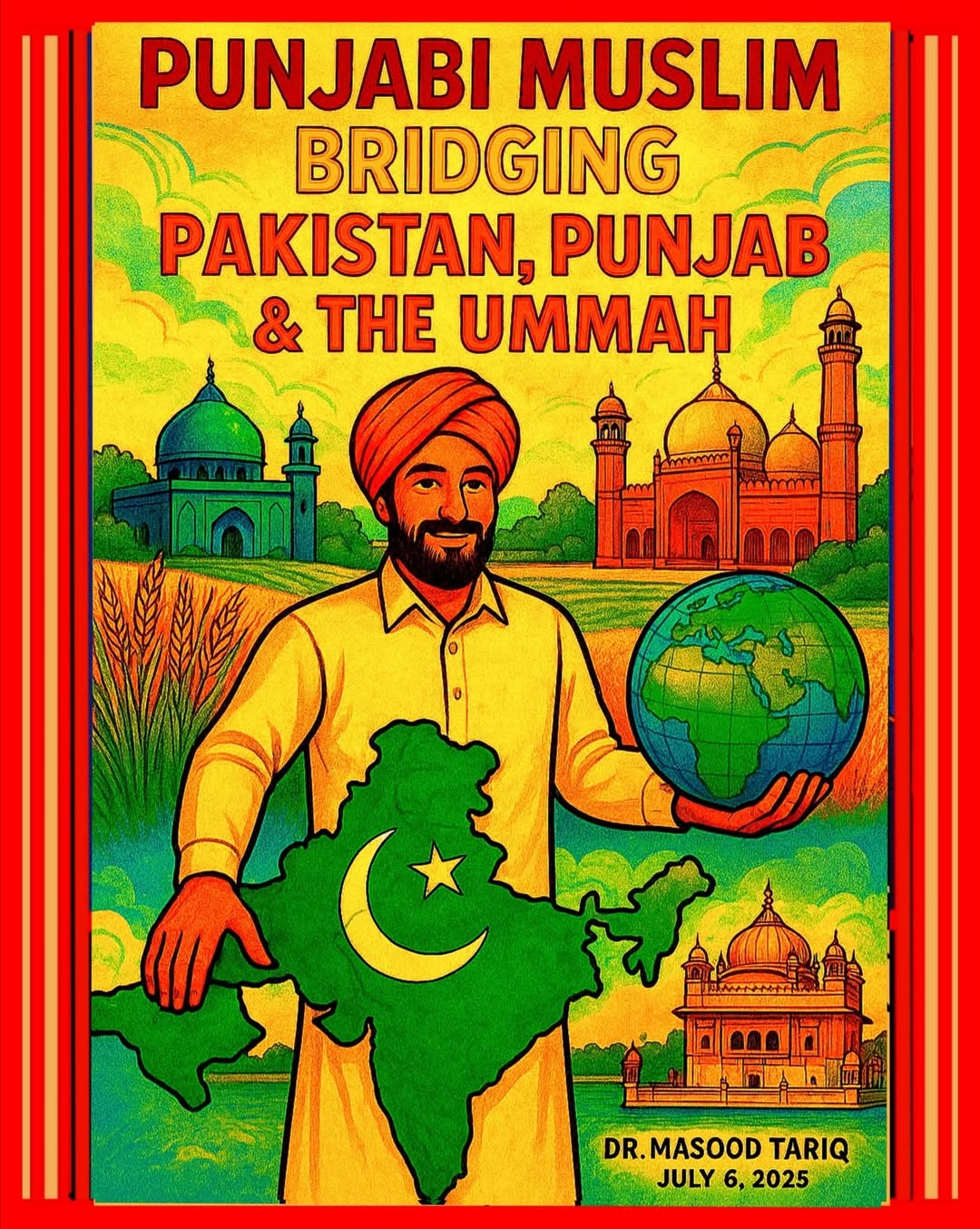
Punjabi Muslim as a Bridging and Binding Force in Pakistan, Punjabi Nation, and Muslim Ummah
Dr. Masood Tariq
Independent Political Theorist
Karachi, Pakistan
drmasoodtariq@gmail.com
Date: July 6, 2025
——————————————–
Abstract
This paper examines the pivotal role of the Punjabi Muslim in South Asia’s political, cultural, and civilizational matrix, arguing that the Punjabi Muslim constitutes a bridging and binding force between Pakistan, the Punjabi Nation, and the broader Muslim Ummah.
While Punjabis have historically excelled across agricultural, industrial, services, and military sectors, their potential remains unfulfilled due to the loss of linguistic identity, religious fragmentation, and continued cultural subordination.
Through a multi-sectoral analysis and civilizational framework, this study contends that unless the Punjabi Muslim reclaims his linguistic and cultural roots, his demographic strength will remain strategically neutralized.
The paper proposes a reorientation of educational and cultural policy toward Punjabi identity to enable leadership, coordination, and development across Pakistan, the Punjabi homeland, and the Muslim world.
Keywords: Punjabi Muslim, Pakistani identity, Muslim Ummah, Punjabi language, ethno-religious politics, regional integration
——————————————–
Table of Contents
1. Introduction
2. Framework of National Power: The Four Sectors
3. Linguistic and Cultural Dispossession
4. Religious Fragmentation and Strategic Neutralization
5. Civilizational Legacy of Punjab
6. Demographic Centrality and Strategic Potential
7. Pathways to Cultural and Political Leadership
8. Strategic Diplomacy: Inter-Ethnic and Civilizational Engagement
9. Conclusion
10. References
——————————————–
1. Introduction
The contemporary discourse on South Asian geopolitics often overlooks the Punjabi Muslim’s unique position as a demographic majority in Pakistan, a core ethnic constituent of the broader Punjabi Nation, and the substantial population within the Muslim Ummah.
This paper posits that the Punjabi Muslim is not merely a sociological category but a civilizational asset capable of integrating state, nation, and ummatic frameworks—provided his identity is allowed to flourish.
Despite forming 60% of Pakistan’s population, 56% of the Punjabi Nation globally and 3rd biggest ethnic population of Muslim Ummah, the Punjabi Muslim’s role has been undermined through systemic religious divisions, cultural alienation, and linguistic marginalization.
These conditions prevent the emergence of a unified Punjabi political consciousness and render the largest stakeholder in Pakistan geopolitically underutilized.
——————————————–
2. Framework of National Power: The Four Sectors
Nation-building rests on the development and integration of four critical sectors:
i). Agricultural Sector
ii). Industrial Sector
iii). Services Sector
iv). Military Sector
The Punjabi Nation—across its historic territory spanning from Delhi to Peshawar and from Kashmir to Kashmore— has demonstrated historic and structural strength across all four domains. Whether through its fertile plains, industrial hubs like Lahore, Faisalabad, Sialkot, Amritsar and Ludhiana, military contributions to regional conflicts, or its growing role in the services economy, Punjab is fundamentally resilient.
Yet this strength has not translated into a stable or self-assertive national identity. The core challenge is internal: Punjabi society has failed to consolidate its power due to fragmentation along religious lines and the adoption of externally imposed languages and cultural norms.
——————————————–
3. Linguistic and Cultural Dispossession
Language is the vessel of identity and civilizational continuity. In both India and Pakistan, Punjabis have been subordinated to external linguistic hegemonies—Hindi in Indian Punjab and Urdu in Pakistani Punjab. This subordination has rendered the Punjabi people symbolically mute in their own homeland.
Urdu, in particular, is not indigenous to the land of the five rivers. Originating in the Gangetic plains of North India, it is a sister language of Hindi and has historically served as an instrument of centralization and cultural erasure in Pakistan. The imposition of Urdu as the national language played a direct role in the disintegration of Pakistan in 1971, alienating Bengali speakers. Today, it remains a source of interethnic tension within Pakistan.
The rejection of the Punjabi language in education and administration has marginalized the majority population. Simultaneously, the loss of cultural traditions, historical narratives, and indigenous modes of expression has led to psychological and civilizational inferiority, making Punjabis vulnerable to both internal manipulation and external disdain.
——————————————–
4. Religious Fragmentation and Strategic Neutralization
The Punjabi Nation is internally divided along religious lines—Sikh, Hindu, Christian, and Muslim. This division has been weaponized by non-Punjabi Muslim actors in Pakistan to prevent ethnic cohesion. Attacks on Sikh, Hindu, Christian Punjabi minorities are often framed in religious terms, while attacks on Punjabi Muslims emphasize ethnic identity, branding them as “Punjabis” rather than fellow Muslims.
This dual-pronged strategy—religious segmentation and ethnic isolation—reflects a continuation of the colonial “divide and rule” policy, now internalized within Pakistan’s state structure. It sustains the political dominance of smaller, more ideologically cohesive groups over the Punjabi majority, who are kept divided, muted, and shamed.
——————————————–
5. Civilizational Legacy of Punjab
The centrality of Punjab in South Asian history cannot be overstated. From the Indus Valley Civilization to contemporary Pakistan, Punjab has served as the political, military, and spiritual heartland of the region. The following figures exemplify its historical leadership:
Raja Porus, Raja Jaipal, Dullah Bhati, Maharaja Ranjit Singh and Rai Ahmad Khan Kharal in military resistance
Baba Farid, Guru Nanak, Shah Hussain, Sultan Bahu, Bulleh Shah, Waris Shah and Mian Muhammad Bakhsh in spiritual enlightenment
Sir Ganga Ram, Udham Singh and Bhagat Singh in modernist reform and revolutionary struggle
This civilizational lineage stretches from Delhi to Peshawar and from Kashmir to Kashmore— has historically acted as a buffer, a frontier, and a bridge. Yet today, this heritage is largely unrecognized within national narratives and textbooks in both India and Pakistan.
——————————————–
6. Demographic Centrality and Strategic Potential
Punjabi Muslims form:
60% of Pakistan’s total population
56% of the total Punjabi Nation (including India and diaspora)
6% of the global Muslim Ummah
Such demographic dominance gives the Punjabi Muslim a unique opportunity to act as a civilizational coordinator—leading internal consolidation within Pakistan, fostering ethnic revival across the Punjabi world, and serving as a link to the global Muslim community.
However, this potential remains dormant due to a lack of identity recognition and policy-level neglect.
——————————————–
7. Pathways to Cultural and Political Leadership
To activate the Punjabi Muslim’s bridging and binding capacity, the following interventions are proposed:
i). Language Revival: Punjabi should be re-established as the medium of instruction and official communication in Punjab.
ii). Cultural Reclamation: Indigenous traditions, festivals, attire, and literature must be promoted in public life.
iii). Educational Reform: Curriculum should include Punjabi history, heroes, and contributions to Islamic civilization.
iv). Religious Cohesion: Interfaith Punjabi unity must be prioritized over sectarian or denominational conflict.
These changes will allow the Punjabi Muslim to become a more active, effective, and respected actor across Pakistan, the Punjabi Nation, and the Muslim Ummah.
——————————————–
8. Strategic Diplomacy: Inter-Ethnic and Civilizational Engagement
The Punjabi Muslim must constructively engage:
i). Non-Punjabi Muslims within Pakistan (e.g., Sindhis, Baloch, Pashtuns, Muhajirs)
ii). Non-Muslim Punjabis (e.g., Sikhs, Hindus, Christians)
iii). The Muslim Ummah globally
These engagements must be governed by reciprocity and mutual respect. The extent to which Punjabi Muslims are embraced or excluded will determine their orientation—whether cooperative or resistant—toward these groups.
——————————————–
9. Conclusion
The Punjabi Muslim remains a critical yet underutilized force within Pakistan, the Punjabi homeland, and the global Muslim community. As the largest stakeholder, the Punjabi Muslim has both the legitimacy and responsibility to lead integration, reconciliation, and development. However, this role can only be played if the Punjabi Muslim is recognized not just as a statistical majority but as a civilizational actor—rooted in his own language, culture, and spiritual tradition.
The future of Pakistan’s stability, the Punjabi Nation’s unity, and the Muslim Ummah’s cooperation may well depend on whether this bridging and binding force is allowed to fulfill its historical role—or continues to be suppressed by systemic neglect and cultural amnesia.
——————————————–
10. References
Ahmed, Ishtiaq. 2013. The Punjab Bloodied, Partitioned and Cleansed. Karachi: Oxford University Press.
Gilmartin, David. 1988. Empire and Islam: Punjab and the Making of Pakistan. Berkeley: University of California Press.
Grewal, J. S. 1990. The Sikhs of the Punjab. Cambridge: Cambridge University Press.
Jalal, Ayesha. 1995. Democracy and Authoritarianism in South Asia. Cambridge: Cambridge University Press.
Rahman, Tariq. 1996. Language and Politics in Pakistan. Karachi: Oxford University Press.
Shaikh, Farzana. 2009. Making Sense of Pakistan. New York: Columbia University Press.
Talbot, Ian. 2009. Pakistan: A New History. London: Hurst.
Talbot, Ian, and Gurharpal Singh. 2009. The Partition of India. Cambridge: Cambridge University Press.
Waseem, Mohammad. 2010. Ethnic Conflict in Pakistan: The Rise of Muhajir Separatism. Karachi: Oxford University Press.
——————————————–
Author Biography
Dr. Masood Tariq is a Karachi-based politician and political theorist. He formerly served as Senior Vice President of the Pakistan Muslim Students Federation (PMSF) Sindh, Councillor of the Municipal Corporation Hyderabad, Advisor to the Chief Minister of Sindh, and Member of the Sindh Cabinet.
His research explores South Asian geopolitics, postcolonial state formation, regional nationalism, and inter-ethnic politics, with a focus on the Punjabi question and Cold War strategic alignments.
He also writes on Pakistan’s socio-political and economic structures, analysing their structural causes and proposing policy-oriented solutions aligned with historical research and contemporary strategy.
His work aims to bridge historical scholarship and strategic analysis to inform policymaking across South Asia, Central Asia, and the Middle East.


Leave a Reply