
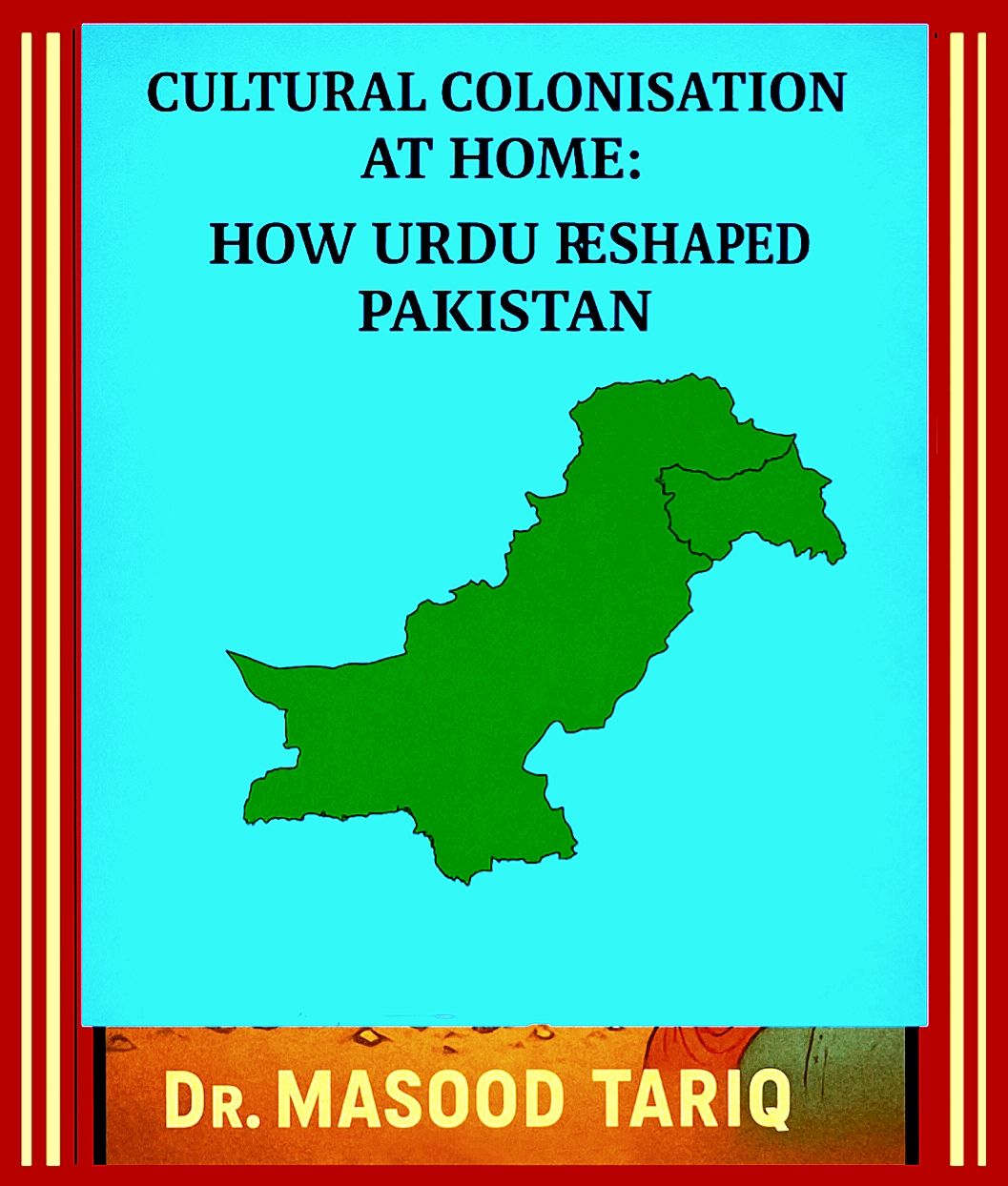
Cultural Colonisation at Home: How Urdu Reshaped Pakistan
Date: September 5, 2025
In the history of nations, language is never merely communication. It is the mirror of culture, the keeper of memory, and the instrument of power. To weaken a nation, one must first weaken its tongue.
The British wielded English and the ICS exam to manufacture a loyal elite. The Mughals used Persian to consolidate their empire. After 1947, the Urdu-speaking Ashrafia from UP and CP — without land, tribal base, or demographic majority — relied on one weapon: Urdu. Through it, they sought to dominate a state of many nations.
Urdu was declared Pakistan’s official and later national language immediately after independence. The centrality of Urdu was dramatized in Dhaka in March 1948, when Muhammad Ali Jinnah, speaking in English, told an audience of Bengali students:
> “Urdu, and only Urdu, shall be the state language of Pakistan.”
For Bengalis, who made up 56% of the country’s population, this was a profound insult. Bengali, one of South Asia’s richest languages and the language of Rabindranath Tagore, was dismissed as unfit for a Muslim nation. To reject the language was to reject the people themselves.
The Bengali Martyrs of 1952
On 21 February 1952, Bengali students in Dhaka defied curfew to demand recognition of their mother tongue. Police opened fire. Salam, Rafiq, Barkat, and Jabbar fell dead.
One mother, holding her slain son, cried out:
> “They killed my boy because he spoke my language. What kind of country kills its children for speaking the words of their mothers?”
Her cry became immortal. It reminds us that language is not merely politics but love, belonging, and dignity.
Punjab: The Silenced Majority
If Bengalis resisted loudly, Punjabis were silenced quietly. Courts, schools, and offices expelled Punjabi. Lahore, once the city of Bulleh Shah and Waris Shah, was reshaped into an Urdu-speaking center.
A displaced farmer from Amritsar in 1947 later recalled:
> “In Lahore, I could not claim my land in my own tongue. The court clerk told me: ‘Speak Urdu, or your file will not move.’ That day I felt a refugee in my own Punjab.”
Punjabis gained power through numbers and the military but lost their cultural soul. Their mother tongue became invisible in schools, courts, and government.
Sindh: Pride Under Siege
Sindhi had ancient roots: the poetry of Shah Latif, a script older than Urdu, and schools where Hindus and Muslims alike studied in their mother tongue. Partition, however, shattered this balance. Sindhi Hindu Sammats — teachers, publishers, professionals — were driven out. Migrants filled the vacuum.
A Sindhi schoolteacher in Hyderabad remembered 1949:
> “My Sindhi textbook was taken from my hands. The inspector said: ‘From now, only Urdu.’ I felt as if my tongue had been cut out in front of my students.”
In 1972, Sindh’s assembly passed the Sindhi Language Bill to assert its heritage. But Urdu-speaking groups rioted. Karachi and Hyderabad burned. The struggle for Sindhi identity turned violent in Sindh’s own homeland.
Balochistan: Excluded from the Beginning
Balochi was almost entirely absent from schools and administration. Urdu monopolized official life. For Baloch children, the classroom became a site of shame.
A student from Kalat later wrote:
> “On the blackboard the teacher wrote in Urdu. I could not read a single word. He called me stupid. I walked home crying, ashamed not of ignorance but of being Baloch.”
Such exclusion planted the seeds of long-term alienation and resistance.
Pashtun Lands: Tradition Marginalised
Pashto, rich in oral poetry and resistance literature, was dismissed as unsuitable for governance. The dismissal of Dr. Khan Sahib’s elected government in 1947 underlined this marginalisation.
A Pashtun elder from Charsadda told a researcher:
> “Our children recite Khushal Khan Khattak at home, but in school they are punished if they speak Pashto. The state teaches them that their father’s language is a crime.”
For many Pashtuns, language suppression was inseparable from political suppression.
The Human Cost of Linguistic Domination
The voices of a Bengali mother, a Punjabi farmer, a Sindhi teacher, a Baloch child, and a Pashtun elder reveal a common truth: the suppression of language is the suppression of dignity. Identity is not just politics; it is love, family, and belonging.
Consequences of Linguistic Hegemony
The imposition of Urdu fractured Pakistan’s federal compact:
1. Bengali Alienation — The 1952 Language Movement planted the seeds of 1971.
2. Punjabi Silence — Political strength was gained, but cultural voice was lost.
3. Sindhi Resistance — The 1972 Language Bill defended Sindhi but provoked ethnic riots.
4. Baloch and Pashtun Anger — Exclusion deepened alienation and insurgency.
Conclusion: A Hijacked Identity
Colonizers have always imposed their languages. In Pakistan, the colonizers were not Europeans but Urdu-speaking migrants from UP and CP. Their conquest was cultural rather than territorial. By elevating Urdu as superior, they excluded Punjabi, Sindhi, Balochi, Pashto, and Bengali from state power.
The echoes of mothers, farmers, teachers, children, and elders across these nations testify that Pakistan’s tragedy was not only political but cultural. The survival of its nations depends on reclaiming their voices.


Leave a Reply