
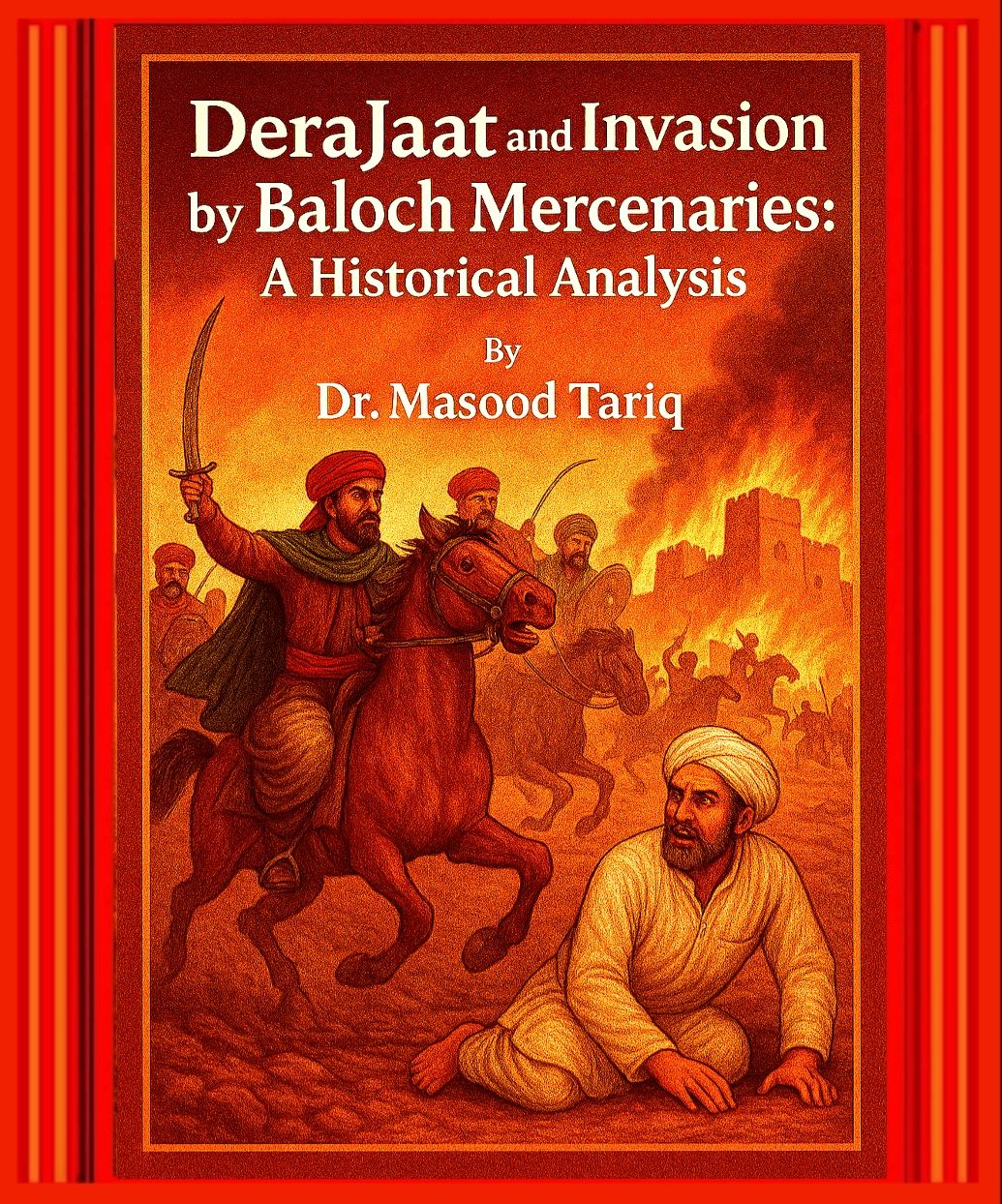
DeraJaat and Invasion by Baloch Mercenaries: A Historical Analysis
Dr. Masood Tariq
Independent Political Theorist
Karachi, Pakistan
drmasoodtariq@gmail.com
Date: August 31, 2025
——————————————–
Abstract
This paper examines the historical trajectory of the DeraJaat region of Punjab, focusing on its transformation following the invasion of Baloch mercenaries in the late fifteenth and early sixteenth centuries.
The study highlights how the arrival of Malik Sohrab Dodai and his sons reshaped the demographic and political landscape of southern Punjab.
It further analyzes the alliances between Afghan Langah rulers, Mughal emperors, and Baloch tribes, as well as the subsequent rise and decline of Baloch dominance under Mughal, Afghan, Sikh, and British rule.
Finally, it contextualizes the fate of the indigenous Derawali Punjabis, who were progressively marginalized in their ancestral homeland, leading up to Partition and into the politics of postcolonial Pakistan.
——————————————–
Table of Contents
1. Introduction
2. Historical Background
2.1 The Langah Dynasty of Multan
2.2 The Founding of the Deras
3. Baloch and Mughal Alliances
3.1 Babur and the Baloch
3.2 Humayun and Akbar’s Patronage
4. Decline of Baloch Dynasties and Shifting Powers
4.1 Kalhoras and Durranis
4.2 Sadozais and the Sikh Conquest
5. Colonial Transformations (1849–1947)
5.1 Colonial Administration and the Reinforcement of Feudal Power
5.2 Partition and the Displacement of Derawali Punjabis
6. Postcolonial Continuities (1947–Present)
6.1 Feudal Dominance in Postcolonial Punjab
6.2 Cultural Memory as Testimony of Subjugation
7. Conclusion
8. References
——————————————–
1. Introduction
DeraJaat, located at the confluence of Punjab, Balochistan, and Khyber Pakhtunkhwa, holds a unique place in South Asian history. Bounded by the Indus River to the east and mountains to the west, the region includes three principal districts: Dera Ghazi Khan, Dera Ismail Khan, and Rajanpur. Its native inhabitants, the Derawal Punjabis, spoke Derawali Punjabi, a dialect of western Punjabi.
The identity and control of this region underwent dramatic changes in the late medieval period, especially after the Afghan Langah dynasty’s weakening grip on Multan and the subsequent invitation extended to Baloch mercenaries. What followed was a long history of external domination, shifting alliances, and the gradual displacement of the original Punjabi inhabitants. This paper traces these transformations and assesses their political, cultural, and demographic consequences.
——————————————–
2. Historical Background
2.1 The Langah Dynasty of Multan
The Langah Afghans, who accompanied Sultan Mahmud of Ghazni, established their rule over Multan in the fifteenth century. Their reign lasted nearly eighty years before being weakened by internal revolts and external threats.¹ Sultan Hussain Langah, the last significant Langah ruler, struggled to maintain authority across the Indus due to persistent uprisings of the native Derawali Punjabis.
2.2 The Founding of the Deras
To counter Punjabi unrest, Sultan Hussain invited Malik Sohrab Dodai and his Baloch followers in 1486, granting them jagirs in southern Punjab.² Malik Sohrab Dodai’s sons founded three principal Deras:
Dera Ghazi Khan (Ghazi Khan Mirani)
Dera Fateh Khan (Fateh Khan Dodai)
Dera Ismail Khan (Ismail Khan Dodai)
This marked the beginning of systematic Baloch settlement in Punjab, which expanded further under Mughal patronage.
——————————————–
3. Baloch and Mughal Alliances
3.1 Babur and the Baloch
When Babur conquered northern India in 1526, Punjabi resistance forced him into alliances with Baloch tribes in southern Punjab. The Hooth Baloch emerged as dominant rulers of Dera Ghazi Khan and Dera Ismail Khan, establishing dynasties that endured for generations.³
3.2 Humayun and Akbar’s Patronage
Under Humayun (r. 1530–1556), Baloch presence expanded into Sahiwal under Mir Chakar Khan Rind, who received jagirs from the Mughals.⁴ During Akbar’s reign, the Punjabi rebel Dulla Bhatti’s activities encouraged the Mughals to settle more Baloch tribes around Bhakkar and DeraJaat. The Hooth Nawabs, recognized as local rulers, consolidated their authority over the region for fifteen generations.
——————————————–
4. Decline of Baloch Dynasties and Shifting Powers
4.1 Kalhoras and Durranis
In the eighteenth century, the Kalhora dynasty of Sindh displaced the Hooth Baloch in Dera Ismail Khan. Later, Nadir Shah’s conquest in 1739 and Ahmad Shah Abdali’s rise in 1747 altered regional authority. Abdali appointed Mahmud Khan Gujjar governor of Dera Ghazi Khan, marking the decline of autonomous Baloch rule.⁵
4.2 Sadozais and the Sikh Conquest
The Sadozais controlled Dera Ismail Khan until the Sikh expansion under Maharaja Ranjit Singh. By the early nineteenth century, Ranjit Singh annexed Dera Fateh Khan, imposed tribute on Dera Ismail Khan, and appointed Sikh administrators such as Diwan Lakhi Mal and Diwan Daulat Rai.⁶
——————————————–
5. Colonial Transformations (1849–1947)
5.1 Colonial Administration and the Reinforcement of Feudal Power
After the Anglo-Sikh Wars, the British annexed Punjab in 1849 and extended their administrative framework to the DeraJaat. On Herbert Edward’s recommendation, General Van Cortlandt was appointed Kardar of the region, marking the beginning of direct colonial oversight.⁷
The British administration sought to consolidate its authority by working through loyal tribal and landed elites. In Dera Ghazi Khan and Dera Ismail Khan, they confirmed the privileges of influential Baloch clans, granting them revenue-collecting rights in exchange for political loyalty. The system of jagirdari was thus reinforced, with chiefs like the Legharis and Mazaris entrenched as intermediaries between the colonial state and the local peasantry.
At the same time, British officials introduced modern revenue systems and irrigation projects that altered land use patterns. While canal expansion transformed parts of central Punjab, the DeraJaat remained a frontier zone where state investment was limited. The result was uneven development: powerful Baloch landlords consolidated large estates, while Derawali Punjabis were reduced to tenants bound by debt and customary obligations.
By the early twentieth century, DeraJaat had been integrated into the wider colonial framework of “martial races.” Many Baloch and Pathan families were recruited into the colonial army, while Derawali Punjabis were rarely enlisted, further marginalizing them in both economic and political terms. In 1901, the creation of the North-West Frontier Province divided the region between Punjab (Dera Ghazi Khan, Rajanpur) and NWFP (Dera Ismail Khan), further fragmenting the identity of the Derawali Punjabis.
5.2 Partition and the Displacement of Derawali Punjabis
The Partition of India in 1947 brought dramatic upheavals to Punjab, though the experience of DeraJaat differed from that of central districts like Lahore, Amritsar, or Multan. Hindu and Sikh Derawali Punjabis, who had long been an integral part of the region’s economy and culture, migrated en masse to East Punjab, taking with them networks of trade, education, and skilled labor. Their departure left the region culturally and economically diminished.
Unlike in central Punjab, where Muslim refugees from East Punjab resettled in large numbers, DeraJaat did not experience significant refugee influx. The absence of large-scale resettlement meant that the demographic vacuum created by the departing Hindu and Sikh Derawalis was not filled by new Punjabi settlers. Instead, the vacuum strengthened the dominance of Baloch landlords, who were already well positioned to consolidate control through landownership and political influence.
Partition also intensified the divide between the indigenous Derawali Punjabis and the ruling clans. While Derawalis carried the memory of displacement and humiliation, the Baloch families leveraged their historic position to secure representation in Pakistan’s early political institutions. Independence therefore did not liberate the Derawalis but rather reinforced their marginalization under a national framework that privileged landed elites over peasant communities.⁸
——————————————–
6. Postcolonial Continuities (1947–Present)
6.1 Feudal Dominance in Postcolonial Punjab
The creation of Pakistan in 1947 brought an end to colonial rule but did not dismantle the feudal structures entrenched in South Punjab. The same Baloch families whose ancestors had been settled in DeraJaat under Langah and Mughal patronage continued to dominate politics and landownership.
The Leghari, Mazari, Dreshak, and Khosa clans—descendants of the jagirs distributed in the sixteenth century—entered Pakistan’s electoral politics as the landed elite of South Punjab. Their large estates, coupled with their influence over peasant tenants, translated into enduring political power in both provincial and national assemblies. These families not only commanded local loyalty through traditional patron-client ties but also aligned themselves with central governments in Karachi and later Islamabad, often being rewarded with ministerial positions.
This continuity highlights the deep-rooted nature of Derawali subjugation. Whereas colonialism replaced Sikh sovereignty with British administration, independence left the social hierarchy intact: the indigenous Derawali Punjabis remained tenants and laborers on lands historically seized by mercenary settlers.
6.2 Cultural Memory as Testimony of Subjugation
The political history of DeraJaat cannot be fully understood without considering the cultural memory of its indigenous inhabitants. Local poets have described the condition of Derawali peasants as one of continued servitude under feudal elites who trace their roots to mercenary invasions.
The modern Derawali Punjabi poet Ramesh Qadri captures this long history of subjugation in his verses:
Roman Punjabi
Asāṅ kaī naslāṅ tūṅ nokar hāṅ
Sāḍe gal paṭṭā sardārī dā
Asāṅ pāltū kutte khose de
Sāḍe dil vic ḵẖauf Laghārī dā
Asāṅ paṭṭo Khān Dreshak de
Sāḍā z̤iḥn ghulām Mazārī dā
Asāṅ Rāmish evēṅ rul marṇe
Koī ḥal naīṅ eīṅ bīmārī dā
English Translation
> We have been servants for generations,
The collar of feudal bondage is around our necks.
We are the obedient dogs of the Khosa,
Fear of the Laghari grips our hearts.
We are pawns of the Dreshaks,
Our minds enslaved by the Mazaris.
We, says Ramesh, are fated to die wandering,
For there is no cure to this disease.
These verses illuminate the persistence of feudal structures established during the Baloch ascendancy in DeraJaat. The Khosa, Laghari, Dreshak, and Mazari clans—descendants of Baloch settlers originally patronized by Langah rulers and Mughal emperors—remain powerful landlord families in South Punjab today. Their dominance reflects the continuity of a system rooted in conquest, whereby the original Derawali Punjabis were reduced to tenants, laborers, and dependents.
——————————————–
7. Conclusion
The history of DeraJaat illustrates the interplay of conquest, state patronage, and migration in shaping Punjab’s frontier. Originally inhabited by Derawali Punjabis, the area became a Baloch-dominated stronghold through Afghan and Mughal strategies. For centuries, Baloch Nawabs consolidated authority under imperial protection, while the native Punjabis were relegated to subordinate roles in their own land.
Although Sikh and British conquest eventually dismantled autonomous Baloch rule, the structures of subjugation remained intact. By 1947, the demographic and political balance had shifted irreversibly, leaving Derawali Punjabis marginalized in their homeland. Independence did not transform this hierarchy; it merely transferred power into the hands of entrenched feudal families who continued to dominate the region under Pakistan’s state system.
This continuity of feudal power is not only a political fact but also a cultural memory, preserved in Punjabi verse. Ramesh Qadri’s lament of “no cure for this disease” captures the endurance of historical injustices that transformed free communities into hereditary tenants. His poetry demonstrates that the story of DeraJaat is not merely one of shifting rulers—Langah, Mughal, Durrani, Sikh, British—but of a silenced Punjabi majority whose agency was systematically eroded.
To reevaluate Punjab’s frontier history is to restore these voices: the Derawalis who endured conquest, displacement, and feudal domination. Their memory—expressed in poetry, oral tradition, and cultural resistance—reminds us that the past is not only recorded in chronicles of power but also inscribed in the lived experience of those left voiceless.
——————————————–
8. References (Chicago Bibliography)
Ali, Imran. The Punjab under Imperialism, 1885–1947. Princeton University Press, 1988.
Digby, Simon. War-Horse and Elephant in the Delhi Sultanate. Oxford University Press, 1971.
Griffin, Lepel. The Panjab Chiefs. Lahore: Civil and Military Gazette Press, 1890.
Ibbetson, Denzil. Punjab Castes. Lahore: Government Printing, 1916.
Lal, K. S. History of the Khaljis (1290–1320). New Delhi: Munshiram Manoharlal, 1967.
Malik, Iftikhar H. A History of Pakistan. Greenwood Press, 2002.
Rose, H. A. A Glossary of the Tribes and Castes of the Punjab and North-West Frontier Province. Vol. II. Lahore: Civil and Military Gazette Press, 1911.
Talbot, Ian. Punjab and the Raj, 1849–1947. New Delhi: Manohar, 1988.
——————————————–
Author Biography
Dr. Masood Tariq is a Karachi-based politician and political theorist. He formerly served as Senior Vice President of the Pakistan Muslim Students Federation (PMSF) Sindh, Councillor of the Municipal Corporation Hyderabad, Advisor to the Chief Minister of Sindh, and Member of the Sindh Cabinet.
His research explores South Asian geopolitics, postcolonial state formation, regional nationalism, and inter-ethnic politics, with a focus on the Punjabi question and Cold War strategic alignments.
He also writes on Pakistan’s socio-political and economic structures, analysing their structural causes and proposing policy-oriented solutions aligned with historical research and contemporary strategy.
His work aims to bridge historical scholarship and strategic analysis to inform policymaking across South Asia, Central Asia, and the Middle East.


Leave a Reply