
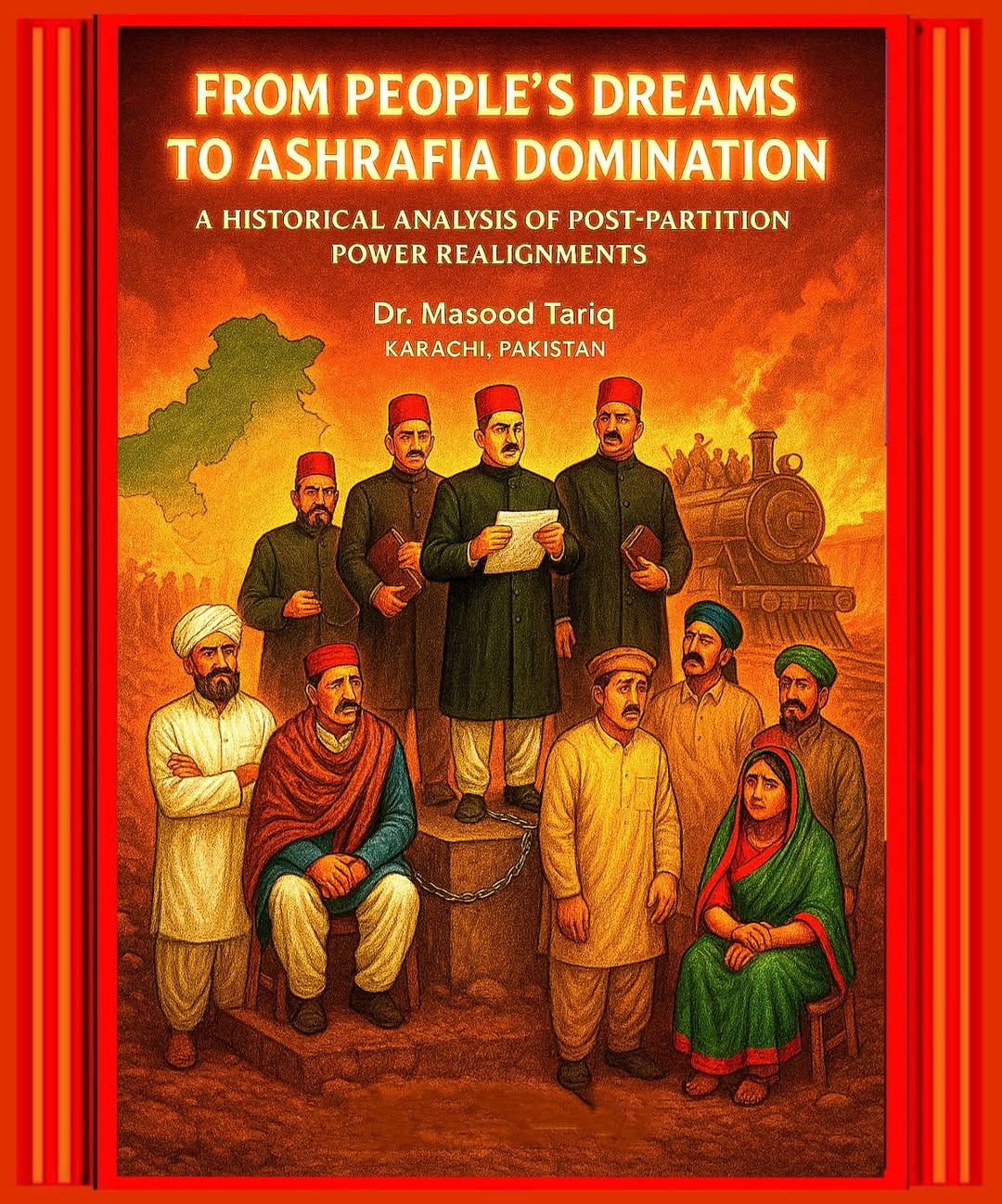
From People’s Dreams to Ashrafia Domination:
A Historical Analysis of Post-Partition Power Realignments
Author
Dr. Masood Tariq
Independent Political Theorist
Karachi, Pakistan
drmasoodtariq@gmail.com
Date: August 27, 2025
——————————————–
Abstract
The story of Pakistan’s birth is often told as the triumph of Muslim nationhood, a dream realized after decades of political struggle. Yet behind this narrative lies another, less comfortable truth. Pakistan’s creation in 1947 was not primarily the outcome of the will of the Punjabi, Sindhi, Baloch, Pashtun, and Bengali peoples who inhabited its territory, but the project of a small elite of Urdu-speaking Muslims from North India. These migrants — the Ashrafia of United Provinces and Central Provinces — reinvented themselves as the natural leaders of all Muslims, and after Partition, captured Pakistan’s fragile institutions, reshaping the state in their own image (Alavi, 1988; Jalal, 1985).
This paper traces how the rise of Pakistan’s migrant elite was rooted in the decline of North Indian Muslim aristocracy after 1857, the invention of Muslim “nationhood” through Urdu and religious homogenization, and the transfer of power in 1947. It highlights the catastrophic consequences: the exodus of Sindh’s Sammat Hindu intelligentsia (Zamindar, 2007), the suppression of Bengali and Punjabi linguistic rights (Rahman, 1996), and the centralization of power in Karachi. It also shows how Cold War geopolitics reinforced these distortions, embedding Pakistan into Western alliances while deepening domestic divisions (Talbot, 1998).
The tragedy of 1947 was thus twofold: the immense human suffering of Partition itself, and the hijacking of Pakistan’s state structure by an elite disconnected from its soil. These dynamics fractured Pakistan’s federal compact, alienated its nations, and left legacies of instability that persist today.
——————————————–
Table of Contents
1. Introduction: A New Country and an Ancient Elite
2. Inventing Muslim Nationhood: From Aristocracy to Religious Nationalism
3. Historical Context: Decline of the Muslim Ashrafia Post-1857
4. Post-Partition Power Dynamics and Migrant Ascendancy
5. Linguistic Imperialism: Urdu and the Cultural Rewriting of Pakistan
6. Settler Colonialism: Selective Migration and the Liaquat–Nehru Pact
7. The Greatest Brain Drain: The Exodus of Sindhi Hindus
8. Political Monopoly and Systematic Exclusion
9. Long-Term Consequences: Alienation and Ethnonationalism
10. From Central Power to Marginalisation
11. Towards a Historical Reckoning
12. Conclusion: A Hijacked Dream
——————————————–
1. Introduction: A New Country and an Ancient Elite
Pakistan emerged in August 1947 in the midst of one of the greatest tragedies of modern history. Nearly two million people were killed and over 14 million displaced in Punjab alone (Talbot & Singh, 2009). Amidst this devastation, the structure of the new state was quietly captured by outsiders. The real architects of Pakistan’s early statehood were not the peoples of Punjab, Sindh, Balochistan, NWFP, or Bengal — the provinces that actually formed the country — but Urdu-speaking elites from UP and CP.
These Ashrafia families, steeped in the courtly traditions of Delhi and Lucknow, feared democracy in India because it meant permanent minority status. By championing the demand for Pakistan through the Muslim League, they preserved their influence under a new banner of Muslim solidarity (Jalal, 1985). Once Pakistan was created, they migrated in large numbers, filled the bureaucratic and political vacuum, and reconstructed Pakistan’s culture around their own memory of North India (Alavi, 1988).
——————————————–
2. Inventing Muslim Nationhood: From Aristocracy to Religious Nationalism
Before 1857, North India’s Muslim aristocracy defined itself by lineage, culture, and class. They lived within the Ganga-Jamuni tahzib, sharing spaces with Hindu elites in courts, poetry, and festivals (Metcalf, 1990). Religion was part of their lives but not the sole basis of political identity.
The revolt of 1857 changed everything. The British dismantled Muslim power, confiscated estates, and abolished Persian as the language of administration (Metcalf, 1990). Excluded from bureaucracy and the army, the Ashrafia faced decline. Out of this crisis came a reinvention: Muslims, they now argued, were a distinct nation. Three pillars were built for this new identity:
(i). Muslims across India were one indivisible nation.
(ii). Urdu was the natural language of this nation.
(iii). Islamic practice had to be standardized through Deobandi-Barelvi reformism.
These claims ignored the lived realities of Bengal, Punjab, and Sindh, where most Muslims spoke other languages and followed diverse traditions (Rahman, 1996). Yet they gave the Ashrafia a new legitimacy. Through the Muslim League, they positioned themselves as leaders of “all Muslims” — a claim that later justified their dominance in Pakistan.
——————————————–
3. Historical Context: Decline of the Muslim Ashrafia Post-1857
The fall of Delhi in 1857 marked the collapse of Muslim aristocratic privilege. Landed families lost estates, nobles were barred from the colonial army, and Muslims became underrepresented in the new English-educated bureaucracy (Metcalf, 1990).
Sir Syed Ahmad Khan’s Aligarh Movement sought to rebuild influence by urging Muslims to adopt English education while remaining loyal to the Crown. Aligarh College became a training ground for a new elite who promoted Urdu and Muslim distinctiveness (Lelyveld, 1993).
By 1906, the All-India Muslim League was founded, dominated by landlords and professionals from UP and CP. Ironically, the League’s strongest base lay in provinces where Muslims were a minority, while its demand targeted Muslim-majority provinces where it had little grassroots support (Jalal, 1985). This mismatch highlights how “Muslim nationhood” was less a social reality than a political invention by a threatened elite.
——————————————–
4. Post-Partition Power Dynamics and Migrant Ascendancy
Partition devastated Punjab and Bengal, but in Pakistan, the migrant elite turned crisis into opportunity. The new state inherited only a fraction of India’s administrators — just 1,200 officers out of 4,000 (Alavi, 1988). Into this vacuum stepped Urdu-speaking migrants, disproportionately educated in Aligarh, Deoband, and Nadwa. Liaquat Ali Khan, from UP, became Pakistan’s first Prime Minister, symbolizing this ascendancy.
Within months, elected provincial governments were dismissed: NWFP in 1947, Sindh in 1948, Punjab in 1949. Central authority, controlled by migrants, silenced local leadership (Talbot, 1998). Meanwhile, Urdu — spoken by less than 4% of Pakistanis — was imposed as the national language, alienating East Bengal and marginalizing Punjabi, Sindhi, Pashto, and Balochi (Rahman, 1996).
——————————————–
5. Linguistic Imperialism: Urdu and the Cultural Rewriting of Pakistan
Declaring Urdu the sole national language was more than a cultural preference — it was an act of domination. Urdu symbolized the migrants’ claim to superiority, their refined tahzib of Delhi and Lucknow elevated above indigenous languages (Rahman, 1996).
School curricula were rewritten to glorify Delhi Sultans and Mughal emperors, erasing Punjab’s, Sindh’s, and Bengal’s histories. East Pakistan erupted in protest. On 21 February 1952, students were shot dead in Dhaka for demanding Bengali — a moment that laid the foundations of Bangladesh (Umar, 2006).
Language thus became the battlefield where Pakistan’s identity was contested — and where migrant cultural hegemony provoked rebellion.
——————————————–
6. Settler Colonialism: Selective Migration and the Liaquat–Nehru Pact
Migration after Partition was not accidental but engineered. The Liaquat–Nehru Pact of 1950, officially designed to protect minorities, facilitated selective settlement of Urdu-speaking Muslims from UP, CP, and Bihar into Karachi and Sindh (Zamindar, 2007).
Special trains, job quotas, and entire housing colonies such as PIB Colony were created for these migrants. Sindh’s Chief Minister Ayub Khuhro resisted but was removed in 1948 (Khan, 2007).
The result was dramatic. Karachi, once 60% Sindhi and 6% Urdu-speaking, became nearly 50% Urdu-speaking by 1951 (Talbot, 1998). This was not organic refugee movement but demographic engineering — the implanting of a North Indian elite into Sindh’s heart.
——————————————–
7. The Greatest Brain Drain: The Exodus of Sindhi Hindus
Sindh’s Sammat Hindus — heirs of the Indus Valley Civilization and integral to Sindh’s culture — formed over one million of the province’s 3.9 million population in 1947 (Markovits, 2000). They were bankers, teachers, doctors, and merchants, tied deeply to Sindhi society.
Yet within years, they were gone. Targeted violence, state neglect, and official encouragement pushed them out. When Khuhro tried to protect them, Liaquat Ali Khan rebuked him: “What kind of Muslim are you to protect Hindus while Muslims die in India?” (Zamindar, 2007).
Their departure decapitated Sindh’s intellectual and commercial class. Migrants replaced them in business, bureaucracy, and education. Karachi lost its Sindhi character, transformed into a Muhajir-dominated city. This was one of the greatest brain drains in South Asian history.
——————————————–
8. Political Monopoly and Systematic Exclusion
By the 1950s, the migrant elite monopolized Pakistan’s institutions. Governors were outsiders, bureaucratic quotas favored Urdu speakers, and provincial autonomy was routinely suppressed (Alavi, 1988).
Culturally, Urdu was made the gateway to upward mobility, excluding the majority. The histories of Punjab, Sindh, and Bengal were erased from textbooks. Pakistan became less a federation than a settler-colonial state, where a migrant minority ruled over indigenous nations.
——————————————–
9. Long-Term Consequences: Alienation and Ethnonationalism
The legacies were severe:
In East Bengal, suppression of Bengali fueled the secession of 1971 (Umar, 2006).
In Sindh, the exodus of Sammats and domination of Karachi provoked Sindhi nationalism (Markovits, 2000).
In Balochistan and Pashtun areas, denial of autonomy sparked repeated insurgencies (Axmann, 2008).
Even Punjab, though central in the military, saw its language silenced and identity suppressed.
Every nation of Pakistan was alienated, a direct result of migrant monopoly.
——————————————–
10. From Central Power to Marginalisation
By the 1960s, power shifted. The Punjabi military-bureaucratic nexus under Ayub Khan displaced the Muhajirs. Once rulers, they became just another ethnic minority (Alavi, 1988).
In the 1980s, the MQM arose, giving Muhajirs their own ethnic identity — the very thing they had denied to others. Karachi became the center of violence between Sindhis and Muhajirs (Verkaaik, 2004).
The irony was complete: the architects of centralization became victims of it.
——————————————–
11. Towards a Historical Reckoning
Pakistan’s history shows that imposed unity produced division. Suppressing Sindhi Hindus, Bengali culture, Baloch and Pashtun autonomy, and Punjabi language created fractures that never healed (Talbot, 1998).
A reckoning requires honesty:
Pakistan was shaped by migrant dominance, not indigenous will.
The dispossession of native nations was deliberate.
Survival requires federal pluralism, not homogenization.
Without this, alienation and instability will continue.
——————————————–
12. Conclusion: A Hijacked Dream
Pakistan was created with promise, but the promise was hijacked. For Punjabis, Sindhis, Baloch, Pashtuns, and Bengalis, it was meant to be self-rule. For Urdu-speaking Ashrafia, it was survival. They won in the early years, monopolizing power, imposing Urdu, and reshaping Pakistan.
Later, they themselves were sidelined by the Punjabi military. But the damage remained: Sindh lost its Hindus, Bengal left in 1971, Balochistan rebelled, Pashtuns resisted, and Punjab lived without its language.
Yet hope remains. Pakistan’s nations endure — their languages, cultures, and aspirations alive. A new future is possible, but only if the state embraces plurality, recognizes its nations, and rebuilds the federal dream. Only then can the hijacked dream of 1947 be reclaimed.
——————————————–
References
Alavi, H. (1988). Pakistan and Islam: Ethnicity and ideology. In F. Halliday & H. Alavi (Eds.), State and ideology in the Middle East and Pakistan (pp. 64–111). London: Macmillan.
Axmann, M. (2008). Back to the Future: The Khanate of Kalat and the Genesis of Baloch Nationalism, 1915–1955. Oxford University Press.
Jalal, A. (1985). The Sole Spokesman: Jinnah, the Muslim League and the Demand for Pakistan. Cambridge University Press.
Khan, Y. (2007). The Great Partition: The Making of India and Pakistan. Yale University Press.
Lelyveld, D. (1993). Aligarh’s First Generation: Muslim Solidarity in British India. Oxford University Press.
Markovits, C. (2000). The Global World of Indian Merchants, 1750–1947: Traders of Sind from Bukhara to Panama. Cambridge University Press.
Metcalf, B. D. (1990). Islamic Revival in British India: Deoband, 1860–1900. Princeton University Press.
Rahman, T. (1996). Language and Politics in Pakistan. Oxford University Press.
Talbot, I. (1998). Pakistan: A Modern History. St. Martin’s Press.
Talbot, I., & Singh, G. (2009). The Partition of India. Cambridge University Press.
Umar, B. (2006). The Emergence of Bangladesh: Class Struggles in East Pakistan (1947–1958). Oxford University Press.
Verkaaik, O. (2004). Migrants and Militants: Fun and Urban Violence in Pakistan. Princeton University Press.
Zamindar, V. F. (2007). The Long Partition and the Making of Modern South Asia: Refugees, Boundaries, Histories. Columbia University Press.
——————————————–
Author Biography
Dr. Masood Tariq is a Karachi-based politician and political theorist. He formerly served as Senior Vice President of the Pakistan Muslim Students Federation (PMSF) Sindh, Councillor of the Municipal Corporation Hyderabad, Advisor to the Chief Minister of Sindh, and Member of the Sindh Cabinet.
His research explores South Asian geopolitics, postcolonial state formation, regional nationalism, and inter-ethnic politics, with a focus on the Punjabi question and Cold War strategic alignments.
He also writes on Pakistan’s socio-political and economic structures, analysing their structural causes and proposing policy-oriented solutions aligned with historical research and contemporary strategy.
His work aims to bridge historical scholarship and strategic analysis to inform policymaking across South Asia, Central Asia, and the Middle East.


Leave a Reply