
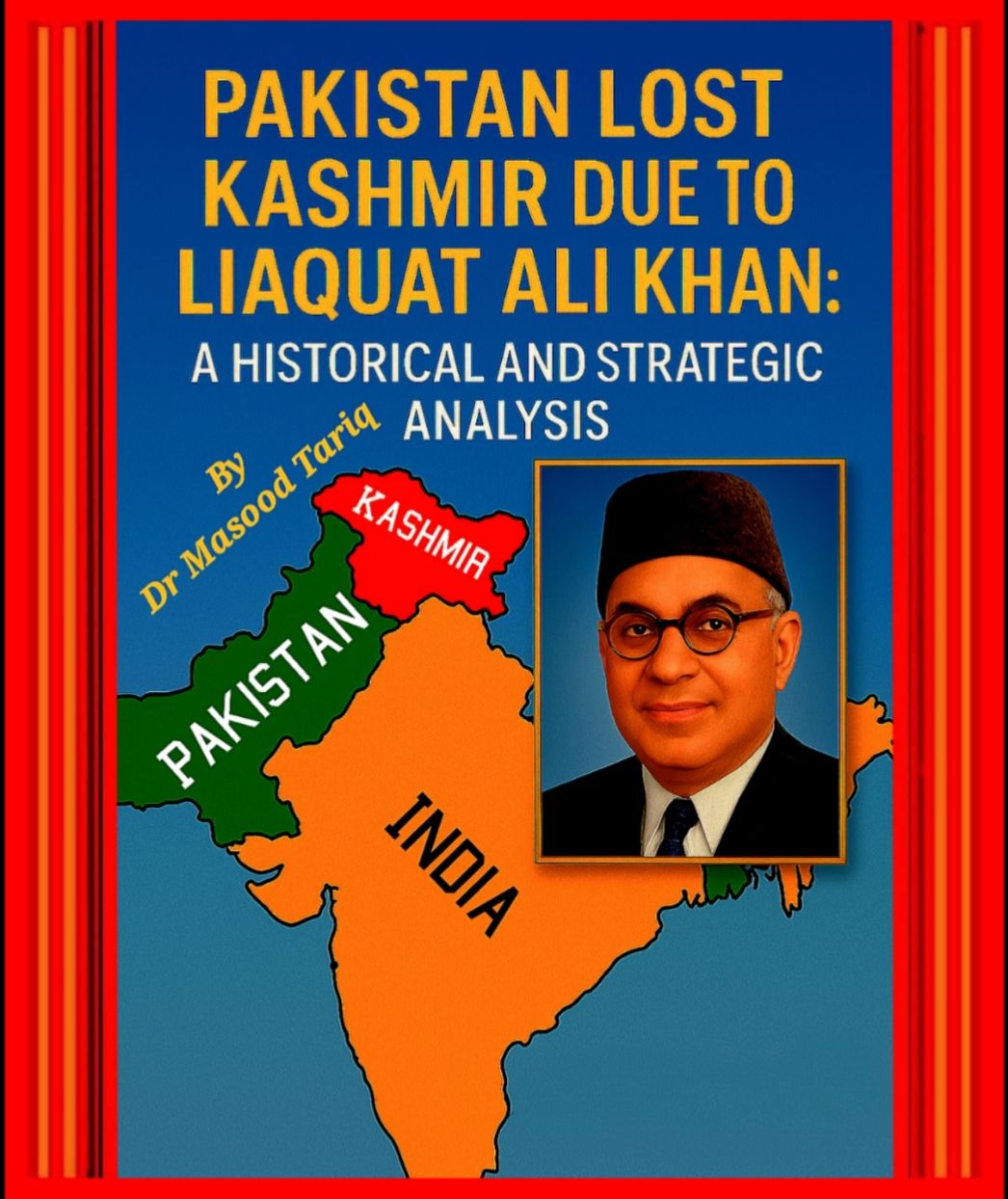
Pakistan Lost Kashmir Due to Liaquat Ali Khan: A Historical and Strategic Analysis
Dr. Masood Tariq
Independent Political Theorist
Karachi, Pakistan
drmasoodtariq@gmail.com
Date: August 21, 2025
——————————————–
Abstract
This paper reexamines the critical juncture of 1947–48, when Pakistan’s leadership under Prime Minister Liaquat Ali Khan mishandled historic opportunities to secure Kashmir. Drawing on memoirs, political testimonies, archival records, and scholarly analyses, it contends that the loss of Kashmir was not predetermined but stemmed from Liaquat Ali Khan’s flawed political judgment, strategic miscalculations, and his misplaced prioritization of Hyderabad-Deccan over Kashmir.
The paper further situates this failure within Liaquat Ali Khan’s broader political orientation as a non-Punjabi, Urdu-speaking migrant from Uttar Pradesh, a leadership dynamic that estranged the new state from its Punjabi heartland and its strategic imperatives. It also examines the expulsion of Choudhry Rahmat Ali in 1948, illustrating how dissenting voices were deliberately silenced in order to consolidate a narrow migrant-led ideological monopoly in Pakistan’s formative years. By situating Kashmir’s loss within this broader framework of Liaquat Ali Khan’s political decisions, the paper contributes to debates on postcolonial state formation and Pakistan’s strategic miscalculations.
——————————————–
Table of Contents
1. Introduction
2. Liaquat Ali Khan’s Miscalculation: Hyderabad versus Kashmir
3. The Missed Patel–Mountbatten Proposal
4. Eyewitness Accounts: Shaukat Hayat Khan, Chaudhry Mohammad Ali, and Colonel Akbar Khan
5. Liaquat Ali Khan and the Suppression of Alternative Voices
6. Why Choudhry Rahmat Ali was Expelled from Pakistan
7. Consequences: Kashmir, Rawalpindi Conspiracy, and Pakistan’s Strategic Losses
8. Conclusion
9. Primary Sources
10. References
——————————————–
1. Introduction
The Partition of 1947 reshaped South Asia’s political geography, creating Pakistan amidst crises of survival: disputed borders, refugee migrations, communal violence, and fragile security institutions. Among the earliest and most consequential challenges was the fate of Jammu and Kashmir, a Muslim-majority princely state whose accession would determine not only territorial boundaries but also Pakistan’s long-term strategic posture.
This paper argues that Pakistan’s failure to secure Kashmir in 1947 was not inevitable but the direct result of Prime Minister Liaquat Ali Khan’s misplaced priorities and flawed political judgment. At a moment when geography, demography, and strategic necessity all pointed toward Kashmir’s accession to Pakistan, Liaquat chose instead to prioritize Hyderabad-Deccan—a Hindu-majority state located deep within Indian territory, surrounded on all sides by India, and entirely detached from Pakistan’s strategic imperatives. By privileging a quixotic claim over Hyderabad, Liaquat Ali Khan squandered a historic opportunity to consolidate Pakistan’s northern frontier and secure its most vital source of water and defense.
——————————————–
2. Liaquat Ali Khan’s Miscalculation: Hyderabad versus Kashmir
Eyewitness testimonies leave little doubt that Prime Minister Liaquat Ali Khan fundamentally misread the strategic calculus of 1947–48. Sardar Shaukat Hayat Khan, one of the leading figures involved in the Kashmir operations, recalls Liaquat’s astonishing words:
> *“Sardar Sahib, have I gone mad to give up Hyderabad, which is much larger than Punjab, for the sake of the rocks of Kashmir?”*¹
This remark, made at the height of Pakistan’s military engagement in Kashmir, illustrates both a striking ignorance of geography and a detachment from Pakistan’s immediate security imperatives. Hyderabad-Deccan, though geographically large, was a Hindu-majority state lying a thousand miles away from Pakistan and encircled on all sides by Indian territory. Its incorporation into Pakistan was a geopolitical impossibility.
By contrast, Kashmir was contiguous with Pakistan, shared deep cultural and economic ties, and—most critically—commanded the headwaters of the Indus river system, the very lifeline of Pakistan’s agriculture and economy. Liaquat’s preference for Hyderabad over Kashmir thus represented not only a diplomatic miscalculation but also a catastrophic failure to grasp Pakistan’s existential dependence on Kashmir’s geography and rivers.
——————————————–
3. The Missed Patel–Mountbatten Proposal
Archival evidence reveals that one of the most consequential diplomatic opportunities in South Asian history was offered to Pakistan in October 1947. India’s Deputy Prime Minister and Home Minister, Sardar Vallabhbhai Patel, privately communicated his willingness to concede Kashmir to Pakistan if Pakistan abandoned its claim to Hyderabad-Deccan. Partition Council minutes of 27 October 1947 record Patel as stating that “Kashmir’s natural place was with Pakistan” but that Hyderabad, located deep within Indian territory, was non-negotiable.²
This proposal was not merely rhetorical. Lord Louis Mountbatten, Governor-General of India, personally carried Patel’s message to Lahore on 27–28 October 1947—the very days when Indian troops were being airlifted into Srinagar to secure the Maharaja’s accession to India. Archival notes preserved in the Mountbatten Papers (MB1/E296, British Library) confirm his meetings with Muhammad Ali Jinnah and Prime Minister Liaquat Ali Khan, during which Patel’s terms were directly conveyed.³
Instead of recognizing the immense strategic advantage of accepting Kashmir in exchange for Hyderabad, Liaquat Ali Khan flatly rejected the offer. His insistence on pressing the Hyderabad claim—an enclave surrounded entirely by Indian territory—amounted to political wishful thinking.
By discarding Patel’s concession, Liaquat not only missed a fleeting but decisive diplomatic window but also ensured that India consolidated its hold over Kashmir at the very moment Pakistan might have secured it.
——————————————–
4. Eyewitness Accounts: Shaukat Hayat Khan, Chaudhry Mohammad Ali, and Colonel Akbar Khan
The disastrous implications of Liaquat Ali Khan’s Kashmir policy were recognized not only by political insiders but also by senior military officers directly involved in the campaign. Their testimonies collectively reveal how opportunities were squandered and how disillusionment spread within Pakistan’s ranks.
Sardar Shaukat Hayat Khan, entrusted with political oversight of Kashmir operations, resigned in protest against the Prime Minister’s obstinacy. He later recalled with disbelief:
> *“I was stunned by the Prime Minister’s reaction and ignorance of our geography and his lack of wisdom. I thought he was living in a fool’s paradise and did not understand the importance of Kashmir to Pakistan while hoping to get Hyderabad, which at best, was only quixotic wishful thinking.”*⁴
Shaukat’s resignation signified more than personal frustration; it exposed the widening rift between Pakistan’s Punjabi leadership class—who understood Kashmir’s existential centrality—and the migrant political elite in Karachi, whose priorities were detached from strategic realities.
Chaudhry Mohammad Ali, then Pakistan’s Secretary-General and later Prime Minister, corroborates this pattern in his memoirs. Recalling Partition Council negotiations, he cites Patel’s irritation at Liaquat’s insistence on Hyderabad:
> *“Why do you compare Junagadh with Kashmir? Talk of Hyderabad and Kashmir and we could reach an agreement.”*⁵
Archival records of the Partition Council, preserved in CAB 134/7 (UK National Archives), confirm that Patel repeatedly emphasized Kashmir as Pakistan’s “natural” claim, while Hyderabad was indefensible.⁶ The proposal was on the table—yet Liaquat dismissed it.
The military’s frustration was voiced most starkly by Major General Akbar Khan, later the principal accused in the Rawalpindi Conspiracy Case. In his memoir Raiders in Kashmir (published posthumously in 1970), he recalled the confusion and lack of direction emanating from Karachi:
> *“The government was divided and indecisive. While the Indian Army landed in Kashmir with full force, our leaders in Karachi were still dreaming of Hyderabad. It was a fatal blunder which left our men in the field without clear political backing.”*⁷
Akbar Khan’s testimony is especially significant: it shows that those fighting on the ground perceived Liaquat’s policies as not merely misguided but disastrous. His subsequent disillusionment with the civilian leadership directly contributed to the Rawalpindi Conspiracy (1951), Pakistan’s first attempted coup, where frustrated officers sought to seize control of the state from what they saw as inept politicians.
Taken together, these three voices—Shaukat Hayat Khan (political insider), Chaudhry Mohammad Ali (bureaucratic record-keeper), and Major General Akbar Khan (military commander)—form a compelling triangulation of evidence. All pointed to the same conclusion: Liaquat Ali Khan’s fixation on Hyderabad at the expense of Kashmir was a strategic miscalculation with irreversible consequences.
——————————————–
5. Liaquat Ali Khan and the Suppression of Alternative Voices
Liaquat Ali Khan’s rejection of Patel’s Kashmir–Hyderabad proposal was not an isolated misjudgment. It reflected a broader pattern of centralization, ideological rigidity, and the suppression of dissenting voices that defined his premiership. From the earliest days of independence, Liaquat sought to consolidate power by privileging Urdu-speaking migrants from Uttar Pradesh and the Central Provinces—his own social class—over indigenous Bengali, Punjabi, Sindhi, Baloch, and Pashtun elites.
This exclusionary orientation was visible in the debates of the Constituent Assembly in 1948, when Bengali members demanded recognition of their mother tongue. On 25 February 1948, during discussion on the national language, Liaquat Ali Khan flatly declared:
> “Pakistan has been created because of the demand of a hundred million Muslims in this subcontinent, and the language of a hundred million Muslims is Urdu. Pakistan is a Muslim state and it must have as its lingua franca the language of the Muslim nation, and that language can only be Urdu and no other language.”⁸
In response to Bengali objections, Liaquat went further, framing Urdu not as a regional language but as the very essence of Pakistan’s identity. His dismissal of Bengali—spoken by the majority of Pakistan’s citizens—paralleled his disregard for Punjabi, which despite being the demographic and economic backbone of West Pakistan, was excluded from state policy and even from primary education in its own province.⁹
The silencing of Choudhry Rahmat Ali epitomizes this same intolerance. Rahmat Ali, who coined the very name Pakistan in his 1933 pamphlet Now or Never, envisioned a federated Muslim homeland rooted in regional nations—Punjab, Sindh, Afghania, and Baluchistan. Yet upon his return to Pakistan in 1948, he was treated as an outcast. Liaquat Ali Khan’s government confiscated his passport, expelled him from the country, and banned his writings.¹⁰ In Home Department files of 1948 (National Archives of Pakistan), Rahmat Ali was described as a “troublemaker” whose ideas were “inconsistent with the unity of the new state.”
Taken together, these episodes demonstrate a consistent political logic: dissent, diversity, and regional autonomy were to be subordinated to an Urdu-speaking migrant elite’s vision of a centralized Islamic state. The same mindset that dismissed Kashmir in favor of Hyderabad also dismissed Bengali claims to linguistic equality and Rahmat Ali’s federalist imagination. In both foreign and domestic affairs, Liaquat Ali Khan closed off avenues for pluralism, weakening Pakistan’s foundations at its inception. The same political rigidity that dismissed Patel’s offer on Kashmir also dismissed linguistic federalism at home.
——————————————–
6. Why Choudhry Rahmat Ali was Expelled from Pakistan
Choudhry Rahmat Ali, who had coined the very name Pakistan in his 1933 pamphlet Now or Never, returned to Lahore in April 1948 with the expectation of acknowledgment for his role in the country’s conception. Instead, he found himself branded a nuisance. His public condemnation of the new dominion as a “mutilated, moth-eaten Pakistan”¹¹ directly contradicted the triumphalist narrative Liaquat Ali Khan’s government was seeking to impose in order to consolidate unity and authority.
The state’s response was swift and punitive. In October 1948, Liaquat Ali Khan personally ordered Rahmat Ali’s expulsion, the seizure of his belongings, and the freezing of his papers. Official statements denounced him as a “traitor” to the new state.¹² This act was not an isolated administrative measure but a calculated attempt to delegitimize alternative visions of Pakistan—visions that emphasized federated autonomy and regional nationalism rather than the centralized, Urdu-speaking construct advanced by the ruling elite.
Archival evidence confirms the political weight of this expulsion. Foreign Office files in the UK record the event as a matter of acute sensitivity. A dispatch from the British High Commissioner in Karachi, dated 5 November 1948, noted Rahmat Ali’s forced removal from Lahore and observed that “the Government of Pakistan regards him as a political embarrassment and prefers his permanent exile.”¹³ British officials further remarked that Rahmat Ali’s critique threatened to resonate with Punjabi and Bengali politicians already uneasy with Liaquat’s centralization.
Rahmat Ali’s final years in exile were marked by poverty, isolation, and neglect. He died in Cambridge in February 1951, his burial funded not by the state he had named but by local well-wishers.¹⁴ His fate illustrates a tragic irony: Pakistan’s founding leadership silenced not only strategic opportunities, such as Kashmir, but also intellectual pluralism within its own ideological sphere. By casting Rahmat Ali out, Liaquat Ali Khan ensured that Pakistan’s foundational narrative would exclude the very man who had first imagined its name. By casting out the man who gave Pakistan its name, Liaquat symbolically disowned both the intellectual father of the state and its pluralist possibilities.
——————————————–
7. Consequences: Kashmir, Rawalpindi Conspiracy, and Pakistan’s Strategic Losses
The rejection of Patel’s overture and the mishandling of the Kashmir crisis carried consequences far beyond the territorial battlefield. These decisions created political fissures that destabilized Pakistan from within and locked it into a trajectory of strategic disadvantage.
1. The Loss of Kashmir.
By refusing Patel’s offer, Pakistan lost the only realistic opportunity to secure Kashmir through negotiation. India consolidated its control over the state following the Instrument of Accession (27 October 1947) and subsequent UN mediation. This transformed Kashmir into a frozen conflict that has since remained at the core of South Asia’s instability.¹⁵
2. Alienation of the Military.
The disillusionment of Pakistan’s military establishment with civilian leadership was immediate. General Akbar Khan—who had commanded irregulars in the 1947–48 operations—expressed deep frustration at Liaquat’s vacillation and political opportunism. His subsequent involvement in the Rawalpindi Conspiracy of 1951 reflected not simply a personal grievance but a structural rift between the military and civilian authority, rooted in the failures of Kashmir policy. Archival transcripts of the Rawalpindi Conspiracy Trial Proceedings (1951, Lahore High Court Archives) document Akbar Khan’s testimony, where he explicitly linked his radicalization to “betrayals at the highest political level.”¹⁶
3. Institutionalization of Long-Term Instability.
The Kashmir dispute became a permanent fault line in South Asia’s geopolitics. Liaquat’s choices locked Pakistan into a cycle of confrontation with India while simultaneously weakening domestic consensus. The opportunity for a negotiated settlement at Partition’s inception was permanently lost, ensuring decades of militarization and mistrust.
4. Suppression of National Voices.
The silencing of Choudhry Rahmat Ali exemplified a parallel cost. By branding Rahmat Ali a “traitor” and forcing him into exile, Liaquat established a precedent of suppressing intellectual diversity and alternative visions of nationhood.¹⁷ This narrowed the ideological field to a rigid, Urdu-dominated nationalism that marginalized regional identities and foreclosed more pluralist possibilities.
Taken together, these consequences underscore how Liaquat Ali Khan’s leadership not only squandered a decisive geopolitical opportunity but also destabilized Pakistan’s domestic political architecture. The failures of 1947–48 created a legacy of external insecurity and internal authoritarianism that continues to shape Pakistan’s trajectory.
——————————————–
8. Conclusion
Pakistan’s failure to secure Kashmir in 1947–48 was neither inevitable nor predetermined by the circumstances of Partition. It was the direct result of Liaquat Ali Khan’s political misjudgment—his fixation on Hyderabad-Deccan, an unattainable objective, at the expense of Kashmir, the state most vital to Pakistan’s survival. This failure foreclosed a historic opportunity and entrenched the Kashmir dispute as a permanent fault line in South Asia.
This same pattern of shortsighted leadership extended into Pakistan’s internal politics. The expulsion of Choudhry Rahmat Ali—whose vision had given Pakistan its very name—symbolized a deliberate suppression of dissent and the imposition of a narrow, migrant-led conception of the nation. By silencing alternative voices, Liaquat not only weakened Pakistan’s ideological foundations but also alienated its Punjabi heartland, thereby deepening internal fractures.
The tragedy was twofold: Pakistan lost Kashmir to India, and it lost its visionary thinker Choudhry Rahmat Ali to exile and neglect. These twin losses—territorial and intellectual—continue to shape Pakistan’s trajectory: a state insecure abroad and centralized at home. By revisiting these foundational miscalculations, this study argues that Pakistan’s early leadership choices not only foreclosed historic opportunities abroad but also entrenched authoritarian centralization at home, leaving a legacy of unresolved disputes and silenced voices that continues to shape the state’s trajectory.
——————————————–
9. Primary Sources
Partition Council Minutes, 27 October 1947. CAB 134/7, Records of the Cabinet Office, The National Archives (UK), London.
Mountbatten Papers, File MB1/E296, October 1947. British Library, London.
Foreign Office Files, “Expulsion of Choudhry Rahmat Ali,” 1948. FO 371/68346, Foreign Office Records, The National Archives (UK), London.
Rawalpindi Conspiracy Trial Proceedings, 1951. Lahore High Court Archives, Lahore.
——————————————–
10. References
Ali, Chaudhry Rahmat. Now or Never: Are We to Live or Perish Forever? Cambridge: Pakistan National Movement, 1933.
Ali, Chaudhry Mohammad. The Emergence of Pakistan. Lahore: Services Book Club, 1967.
Ali, Tariq. The Duel: Pakistan on the Flight Path of American Power. New York: Scribner, 2008.
Dar, Farooq. Chaudhry Rahmat Ali: Founder of the Pakistan National Movement. Lahore: Sang-e-Meel Publications, 1998.
Jalal, Ayesha. The Sole Spokesman: Jinnah, the Muslim League and the Demand for Pakistan. Cambridge: Cambridge University Press, 1985.
Khan, Sardar Shaukat Hayat. The Nation That Lost Its Soul. Lahore: Jang Publishers, 1976.
Malik, Iftikhar H. The History of Pakistan. Westport, CT: Greenwood Press, 2010.
Nayar, Kuldip. Beyond the Lines: An Autobiography. New Delhi: Roli Books, 2012.
Soz, Saifuddin. Kashmir: Glimpses of History and the Story of Struggle. New Delhi: Rupa Publications, 2018.
——————————————–
Footnotes
1. Sardar Shaukat Hayat Khan, The Nation That Lost Its Soul (Lahore: Jang Publishers, 1976), 145.
2. Partition Council Minutes, 27 October 1947, CAB 134/7, Records of the Cabinet Office, The National Archives (UK), London.
3. Mountbatten Papers, File MB1/E296, October 1947, British Library, London.
4. Sardar Shaukat Hayat Khan, The Nation That Lost Its Soul, 152.
5. Chaudhry Mohammad Ali, The Emergence of Pakistan (Lahore: Services Book Club, 1967), 210.
6. Partition Council Notes, CAB 134/7, Records of the Cabinet Office, The National Archives (UK), London.
7. Liaquat’s Urdu-only speech (25 February 1948, Constituent Assembly of Pakistan Debates, Vol. I, p. 37–39).
8. Choudhry Rahmat Ali, quoted in Farooq Dar, Chaudhry Rahmat Ali: Founder of the Pakistan National Movement (Lahore: Sang-e-Meel Publications, 1998), 133.
9. Iftikhar H. Malik, The History of Pakistan (Westport, CT: Greenwood Press, 2010), 77.
10. Foreign Office Files, “Expulsion of Choudhry Rahmat Ali,” FO 371/68346, Foreign Office Records, The National Archives (UK), London.
11. Rawalpindi Conspiracy Trial Proceedings, 1951, Lahore High Court Archives, Lahore.
——————————————–
Author Biography
Dr. Masood Tariq is a Karachi-based politician and political theorist. He formerly served as Senior Vice President of the Pakistan Muslim Students Federation (PMSF) Sindh, Councillor of the Municipal Corporation Hyderabad, Advisor to the Chief Minister of Sindh, and Member of the Sindh Cabinet.
His research explores South Asian geopolitics, postcolonial state formation, regional nationalism, and inter-ethnic politics, with a focus on the Punjabi question and Cold War strategic alignments.
He also writes on Pakistan’s socio-political and economic structures, analysing their structural causes and proposing policy-oriented solutions aligned with historical research and contemporary strategy.
His work aims to bridge historical scholarship and strategic analysis to inform policymaking across South Asia, Central Asia, and the Middle East.



Leave a Reply