
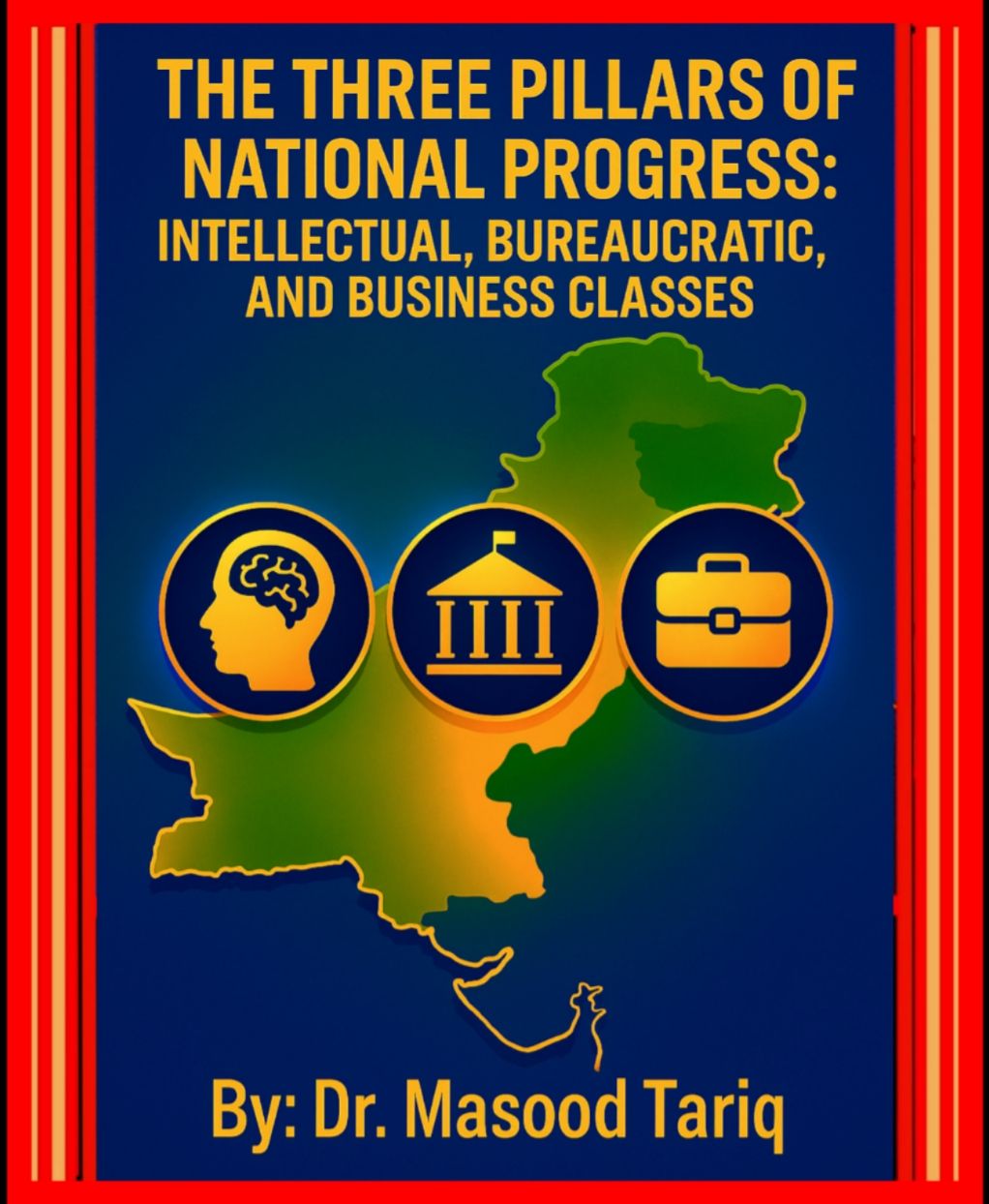
The Three Pillars of National Progress: Intellectual, Bureaucratic, and Business Classes
Dr. Masood Tariq
Independent Political Theorist
Karachi, Pakistan
drmasoodtariq@gmail.com
Date: September 11, 2025
——————————————–
Abstract
The progress of nations does not depend on armies or accidents of history alone. It rests upon three essential classes: the intellectual class, which provides vision and ideas; the bureaucratic class, which ensures honest administration; and the business class, which generates wealth and opportunity. Without this sequence of leadership — ideas, administration, and economy — no nation can achieve balanced development.
This paper examines the role of each class in Pakistan’s history. It argues that the weakness, distortion, or capture of these three classes has prevented Pakistan from realizing the promise of 1947. By reclaiming their integrity, independence, and interconnectedness, Pakistan can still chart a path toward a more just and prosperous future.
——————————————–
1. The Intellectual Class: Vision and Conscience
The Role of the Intelligentsia
The intellectual class — scholars, writers, teachers, journalists, and critical thinkers — serves as the compass of society. It generates ideas, challenges injustices, and connects the past to possible futures. Antonio Gramsci emphasized that intellectuals are not neutral observers but active shapers of social life (Gramsci, 1971), while Jean-Paul Sartre saw them as the moral conscience of their time (Sartre, 1965).
Pakistan’s Intellectual Vacuum
In Pakistan, this role was absent at the nation’s birth. Bengal had a rich literary tradition and middle-class intelligentsia, but in West Pakistan, the intellectual space was captured by migrants from UP and CP. Sindh’s Hindu Sammat intelligentsia was exiled (Zamindar, 2007), Punjabi voices silenced, and Baloch and Pashtun intellectuals marginalized. Instead of nurturing plurality, the state imposed Urdu as the sole cultural narrative (Rahman, 1996).
Consequences
The result was a weak and co-opted intelligentsia. Instead of bridging nations, it became a tool of centralization. Those who resisted — such as Faiz Ahmed Faiz and Habib Jalib — were jailed, censored, or exiled (Jalal, 1985). This suppression weakened democracy and deepened alienation.
The Need for Renewal
Pakistan must cultivate a rooted intelligentsia, grounded in Punjabi, Sindhi, Baloch, and Pashtun traditions. Such intellectuals must defend languages, expose injustices, and connect knowledge with the struggles of ordinary people. Without them, vision remains empty.
——————————————–
2. The Bureaucratic Class: Administration and Service
The Role of Bureaucracy
Once intellectuals define vision, the bureaucratic class translates ideas into governance. Bureaucrats — administrators, civil servants, planners — are responsible for revenue, law, services, and institutional stability. Where intellectuals provide direction, bureaucrats provide machinery.
Bureaucracy in Pakistan
At Partition, Pakistan inherited only 1,200 officers from India’s 4,000 ICS cadre (Alavi, 1988). In this vacuum, bureaucracy became disproportionately powerful. Instead of serving the people, it became a ruling class. Migrants dominated key positions, reinforcing Urdu-centric policies and centralization (Jalal, 1985).
Failures and Centralization
Bureaucracy deepened alienation:
In East Bengal, economic and cultural neglect fueled resentment that exploded in 1971 (Talbot & Singh, 2009).
In Sindh, outsiders replaced locals in administration, compounding the loss of indigenous intelligentsia (Zamindar, 2007).
In Balochistan and Pashtun areas, bureaucracy worked with the military to suppress demands for autonomy (Axmann, 2008).
Rather than a neutral service class, Pakistan’s bureaucracy became partisan and privileged.
Reform and Renewal
A reformed bureaucracy must be:
1. Merit-based — appointments by ability, not patronage.
2. Decentralized — serving provinces and districts, not only the center.
3. Accountable — answerable to people and law, not elites.
4. Culturally sensitive — respecting the languages and identities of the nations it serves.
Without honest administration, even the best ideas remain unrealized.
——————————————–
3. The Business Class: Wealth and Opportunity
The Role of Business
The business class sustains nations materially. It creates wealth, generates employment, innovates, and provides financial independence. Where intellectuals give direction and bureaucrats provide order, businessmen supply the fuel for progress (Sowell, 2009).
Pakistan’s Business History
At independence, Pakistan had little industry. A few families — Saigols, Dawoods, Habibs — pioneered business but soon concentrated wealth. By the 1960s, 22 families controlled two-thirds of industrial assets (Papanek, 1967). Business became tied to state patronage rather than free enterprise.
Instead of fostering self-reliance, Pakistan’s business elite often looked abroad — exporting capital, depending on foreign loans, or importing luxuries. This left Pakistan vulnerable to IMF and World Bank dependence (Haq, 1998).
The Missed Opportunity
Unlike Japan or South Korea, Pakistan did not cultivate a patriotic business class that reinvested in the nation. The entanglement of business, bureaucracy, and military produced privilege, not prosperity (Siddiqa, 2007).
The Need for a Patriotic Business Class
For renewal, Pakistan needs a business community that is:
1. Broad-based — strengthening small and medium enterprises.
2. Innovative — investing in technology and modern industries.
3. Fair — distributing development across provinces.
4. Responsible — rejecting corruption and tax evasion.
5. Global — competitive in exports and world markets.
Without wealth creation and administration, vision remain hollow.
——————————————–
4. Conclusion: The Triangle of Progress
The progress of nations requires balance and harmony among three classes:
The intellectual class defines the vision.
The bureaucratic class ensures honest administration.
The business class generates wealth and opportunity.
In Pakistan, this triangle has remained broken. Intellectuals were silenced, bureaucracy politicized, and business dependent. The result is a state unable to fulfill the promise of its creation.
The future demands renewal. Intellectuals must speak truth, bureaucrats must serve with integrity, and businessmen must build patriotic prosperity. Only then can Pakistan move beyond imposed narratives and fragile institutions toward a nation of living voices, fair governance, and shared prosperity.
——————————————–
References
Alavi, H. (1988). Pakistan and Islam: Ethnicity and ideology. In F. Halliday & H. Alavi (Eds.), State and ideology in the Middle East and Pakistan (pp. 64–111). Macmillan.
Axmann, M. (2008). Back to the Future: The Khanate of Kalat and the Genesis of Baloch Nationalism, 1915–1955. Oxford University Press.
Gramsci, A. (1971). Selections from the Prison Notebooks. International Publishers.
Haq, M. (1998). Reflection on Human Development. Oxford University Press.
Jalal, A. (1985). The Sole Spokesman: Jinnah, the Muslim League and the Demand for Pakistan. Cambridge University Press.
Papanek, G. F. (1967). Pakistan’s Development: Social Goals and Private Incentives. Harvard University Press.
Rahman, T. (1996). Language and Politics in Pakistan. Oxford University Press.
Sartre, J.-P. (1965). Between Existentialism and Marxism. Seagull Books.
Siddiqa, A. (2007). Military Inc.: Inside Pakistan’s Military Economy. Oxford University Press.
Sowell, T. (2009). Intellectuals and Society. Basic Books.
Talbot, I., & Singh, G. (2009). The Partition of India. Cambridge University Press.
Zamindar, V. F. (2007). The Long Partition and the Making of Modern South Asia: Refugees, Boundaries, Histories. Columbia University Press.
——————————————–
Author Biography
Dr. Masood Tariq is a Karachi-based politician and political theorist. He formerly served as Senior Vice President of the Pakistan Muslim Students Federation (PMSF) Sindh, Councillor of the Municipal Corporation Hyderabad, Advisor to the Chief Minister of Sindh, and Member of the Sindh Cabinet.
His research explores South Asian geopolitics, postcolonial state formation, regional nationalism, and inter-ethnic politics, with a focus on the Punjabi question and Cold War strategic alignments.
He also writes on Pakistan’s socio-political and economic structures, analysing their structural causes and proposing policy-oriented solutions aligned with historical research and contemporary strategy.
His work aims to bridge historical scholarship and strategic analysis to inform policymaking across South Asia, Central Asia, and the Middle East.


Leave a Reply