
Ethnic Preferences, Punjabi Marginalization, and the Rise of Muhajir Dominance (1947–1972)
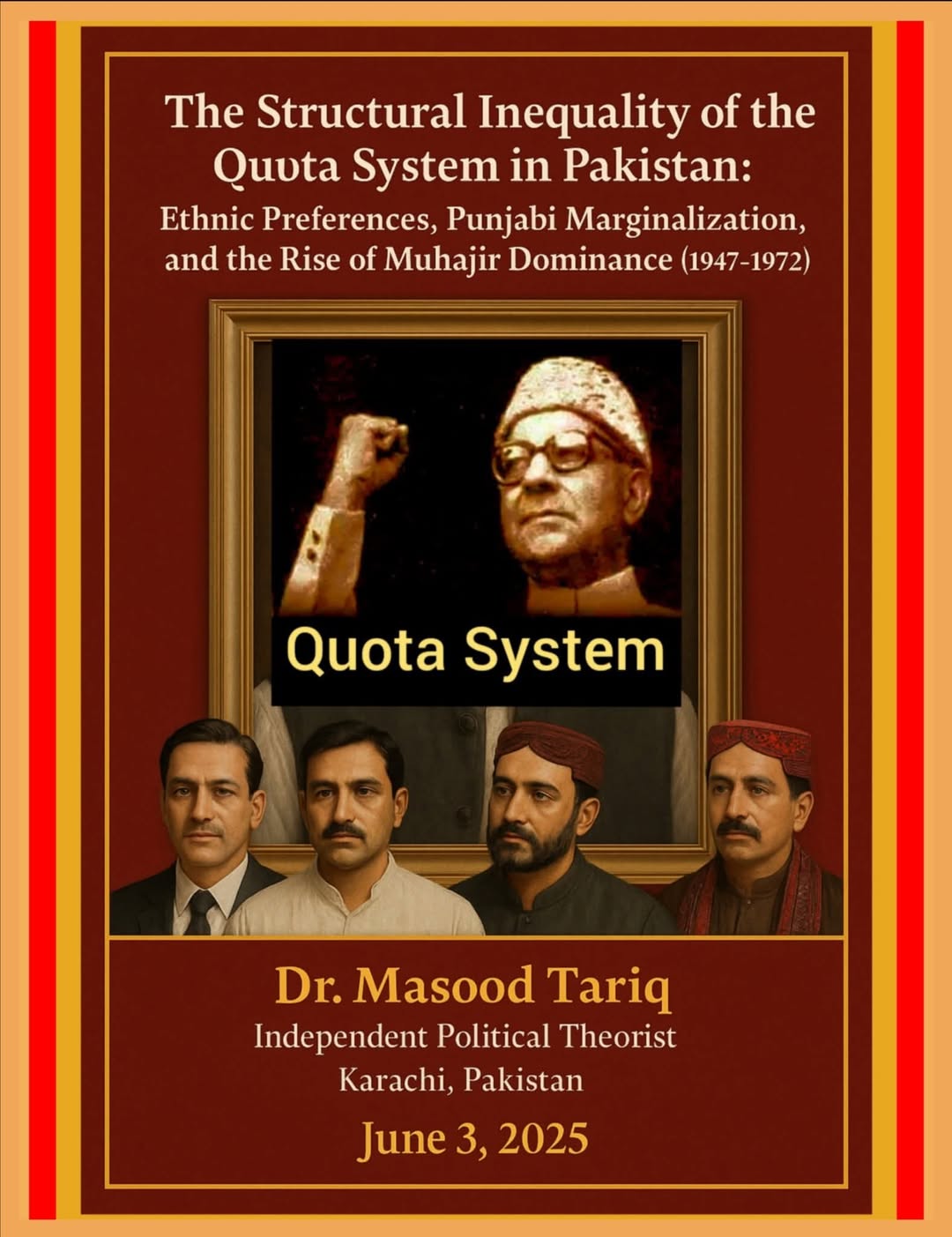
The Structural Inequality of the Quota System in Pakistan:
Ethnic Preferences, Punjabi Marginalization, and the Rise of Muhajir Dominance (1947–1972)
Author:
Dr. Masood Tariq
Independent Political Theorist
Karachi, Pakistan drmasoodtariq@gmail.com
Date: June 3, 2025
——————————————–
Abstract
This research paper investigates the institutionalization of ethnic hierarchies and political inequalities in Pakistan through the quota system introduced in 1948. While ostensibly designed to ensure regional representation, the policy disproportionately favored Urdu-speaking Hindustani Muhajirs over indigenous ethnic groups, particularly Punjabis, Sindhis, Baloch, and Pashtuns.
The paper examines the historical evolution of the quota policy, demographic realities, and bureaucratic representation, drawing on official records and census data to expose how state structures systematically privileged a small migrant elite to the detriment of the native population.
——————————————–
Table of Contents
(1). Introduction
(2). The Quota System: Origins and Implementation
(3). Demographic Analysis of 1951 Census
(4). Bureaucratic Disproportion and Muhajir Ascendancy (1947–1958)
(5). Post-1971 Adjustments and Sindhi-Muhajir Conflict
(6). Conclusion: Institutionalizing Inequality and Ethnic Tensions
——————————————–
(1). Introduction
In the formative years of Pakistan, the civil-military bureaucracy played a dominant role in shaping the structure of the new state. One of the most consequential administrative decisions was the introduction of the quota system in September 1948 by Prime Minister Liaquat Ali Khan, a move that radically altered the ethnic dynamics of state power. Framed as a mechanism to ensure fair representation across regions and ethnic groups, the policy in practice served to entrench the dominance of Urdu-speaking Hindustani Muhajirs, who had migrated from India at the time of Partition.
——————————————–
(2). The Quota System: Origins and Implementation
Initially, the September 1948 quota system divided civil service recruitment along regional lines:
1. East Pakistan: 42%
2. West Pakistan: 58%, further subdivided as:
3. Punjab: 23%
4. Other Provinces (Sindh, NWFP, Balochistan, Princely States): 17%
5. Potential Immigrants from India: 15%
6. Karachi: 2%
By November 1949, the term “Potential Immigrants” was replaced with “Merit”, allowing Muhajirs—who were often better educated in British-administered India—to disproportionately benefit. The new framework became:
1. Merit (mostly Hindustani Muhajirs): 20%
2. East Pakistan: 40%
3. West Pakistan: 40%, subdivided as:
3-1 Punjab + Bahawalpur: 23%
3-2 Others (Sindh, NWFP, Balochistan): 15%
3-3 Karachi: 2%
Although presented as regional equity, this structure granted Urdu-speaking Muhajirs up to 22% representation, outstripping their actual share in the population, which was just 3.3% of Pakistan’s total population in 1951.
——————————————–
(3). Demographic Analysis of 1951 Census
The 1951 Census revealed the following ethnic distribution in West Pakistan (population: 33.74 million):
Punjab: 20.54 million (60.88%)
Sindh: 6.05 million (17.92%)
NWFP: 4.56 million (13.50%)
FATA: 1.33 million (3.95%)
Balochistan: 1.17 million (3.46%)
Despite Punjab comprising over 60% of West Pakistan’s population, its quota was fixed at just 23%. In contrast, Muhajirs, constituting only 3.3% of the national population, were guaranteed 22% representation through a combination of the “Merit” and Karachi quotas, a policy design that rewarded a politically aligned migrant minority.
——————————————–
(4). Bureaucratic Disproportion and Muhajir Ascendancy (1947–1958)
The practical effect of this quota system was the overwhelming overrepresentation of Urdu-speaking Muhajirs in civil services, especially between 1947 and 1958:
According to Christina Lamb, Muhajirs held up to 40% of government jobs, despite being just 3.3% of the population.
According to Dr. Hasan Askari Rizvi, this figure may have reached as high as 65%.
An analysis of senior bureaucratic positions in 1951 confirms this dominance:
Top 91 Government Jobs:
Urdu-speaking Muhajirs: 33
Punjabis: 40
Pathans (Pashtuns): 3
Bengalis: 5
Sindhis: 1
Foreigners: 9
Breakdown of 13 Secretaries:
Urdu-speaking Muhajirs: 5
Punjabis: 5
Others (Pathan, foreign): 3
Joint Secretaries (19 Total):
Urdu-speaking Muhajirs: 9
Punjabis: 7
Others: 3
Deputy Secretaries (59 Total):
Urdu-speaking Muhajirs: 19
Punjabis: 28
Others: 12
This shows that Muhajirs held 50–70% of high-level federal positions, well above their population share, at the expense of indigenous groups, especially Sindhis, Baloch, and Pashtuns.
——————————————–
(5). Post-1971 Adjustments and Sindhi-Muhajir Conflict
The secession of East Pakistan in 1971 led to a demographic recalibration. The updated quota model introduced after 1972 included:
Merit: 10%
Punjab: 50%
NWFP: 11.5%
Balochistan: 3.5%
FATA: 4%
Azad Kashmir: 2%
Sindh: 19%, subdivided as:
Rural (Sindhi majority): 11.4%
Urban (Muhajir majority): 7.6%
The 60:40 Rural-Urban formula in Sindh was designed to balance Sindhi representation against the entrenched bureaucratic dominance of Urdu-speaking Muhajirs. Yet, the Muhajir community continued to benefit from historical overrepresentation and their dominance in Karachi and Hyderabad.
——————————————–
(6). Conclusion: Institutionalizing Inequality and Ethnic Tensions
This paper establishes that the Quota System, far from promoting equality, institutionalized ethnic privilege for Urdu-speaking Hindustani Muhajirs while disempowering indigenous ethnic majorities, particularly the Punjabis, Sindhis, Baloch, and Pashtuns.
The system facilitated the Muhajir capture of state institutions and centralized governance, deepening ethnic fissures that would later erupt into political conflict and inter-ethnic violence—particularly in Sindh.
The system’s legacy continues to haunt Pakistan’s federation. A transparent re-evaluation of recruitment and representation policies is necessary to restore interethnic trust, federal balance, and democratic integrity in the country’s governance.
——————————————–
References
Government of Pakistan, 1951 Census of Pakistan
National Assembly of Pakistan, Proceedings (1952)
Rizvi, Hasan Askari, Military, State, and Society in Pakistan
Lamb, Christina, Waiting for Allah: Pakistan’s Struggle for Democracy
Constitution of Pakistan (1956, 1962)
Various academic and statistical records from Pakistan Civil Services archives
——————————————–
Author Biography
Dr. Masood Tariq is a Karachi-based politician and political theorist. He formerly served as Senior Vice President of the Pakistan Muslim Students Federation (PMSF) Sindh, Councillor of the Municipal Corporation Hyderabad, Advisor to the Chief Minister of Sindh, and Member of the Sindh Cabinet.
His research explores South Asian geopolitics, postcolonial state formation, regional nationalism, and inter-ethnic politics, with a focus on the Punjabi question and Cold War strategic alignments.
He also writes on Pakistan’s socio-political and economic structures, analysing their structural causes and proposing policy-oriented solutions aligned with historical research and contemporary strategy.
His work aims to bridge historical scholarship and strategic analysis to inform policymaking across South Asia, Central Asia, and the Middle East.


Leave a Reply