
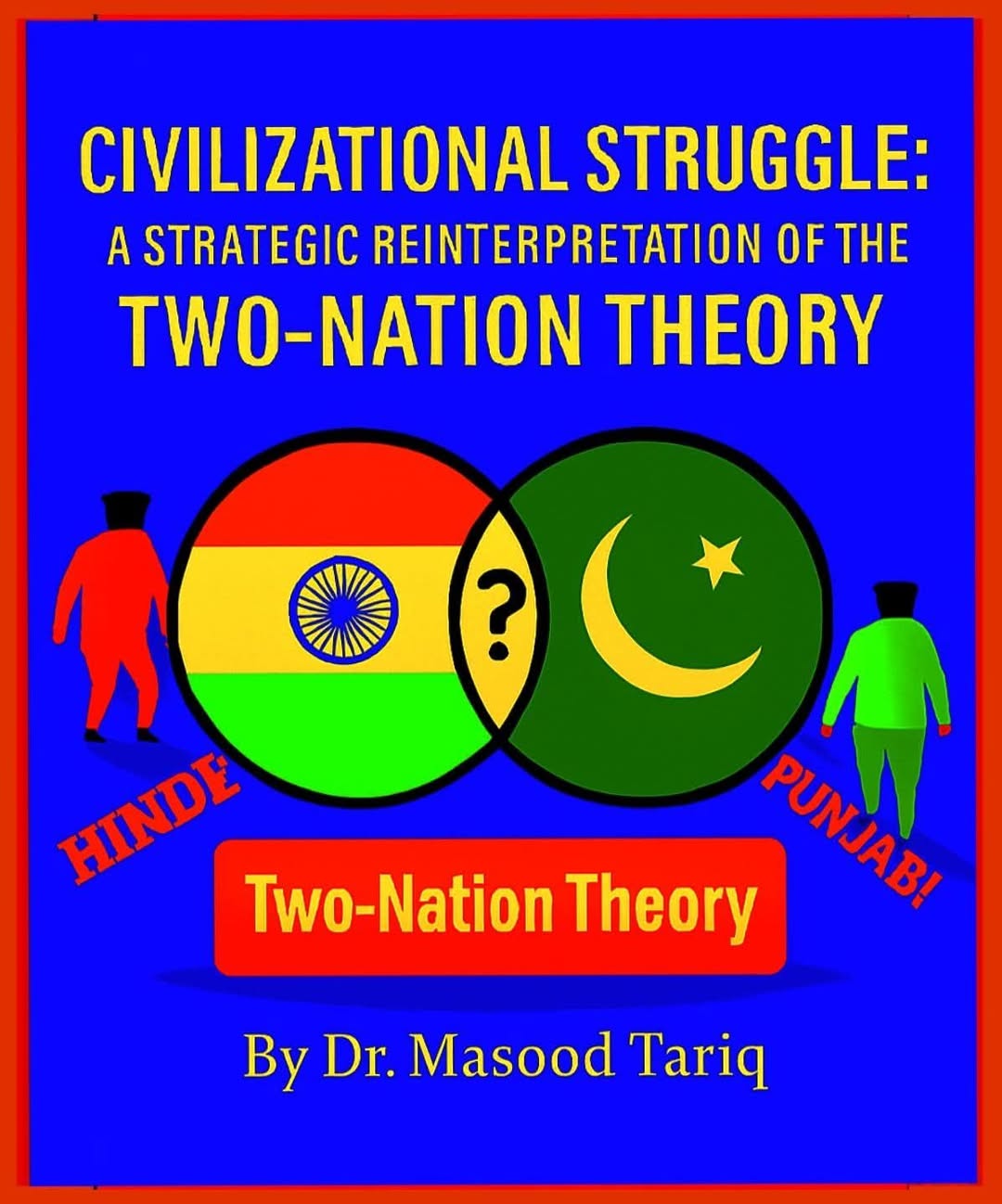
The Punjabi–Hindi Civilizational Struggle:
A Strategic Reinterpretation of the Two-Nation Theory
Author:
Dr. Masood Tariq
Independent Political Theorist
Karachi, Pakistan
drmasoodtariq@gmail.com
Date: May 21, 2025
——————————————–
Abstract
This article advances a civilizational and strategic reinterpretation of the India–Pakistan conflict through the lens of the Two-Nation Theory. Moving beyond the theological framework of Partition (1947), it argues that the fundamental divide lies between the Punjabi Nation, rooted in the Indus Valley Civilization, and the Hindi Nation, centred in the Ganga–Jamuna cultural sphere.
Drawing on contemporary geopolitical theory and historical analysis, the study further examines how other subcontinental nations—such as Bengalis, Dravidians, Marathis, Gujaratis, Odias, and Pashtuns—fit into this emerging realignment.
By reframing the conflict as a struggle between civilizational blocs rather than religious identities, the article highlights critical implications for postcolonial statehood, national identity, and regional stability. Ultimately, it suggests that only through federal or confederal frameworks grounded in civilizational plurality¹ can South Asia achieve a just and durable order.
——————————————–
List of Contents
1. Introduction
2. The British Partition Strategy: Divide and Reconfigure Power
3. Civilizational Geopolitics: From Religious Identity to Strategic Nationhood
4. Subcontinental Nations as Strategic Stakeholders
5. The 2025 Indo–Pak Conflict as Civilizational Realignment
6. Conclusion
7. References
——————————————–
1. Introduction
The Partition of British India in 1947 is most often interpreted through a religious lens, framing Muslims and Hindus as two opposing collectives. Yet a deeper civilizational and geopolitical analysis reveals that the fragmentation of South Asia’s nations was less about theology than about power consolidation, resource control, and cultural hegemony. The British colonial enterprise not only divided territory but also restructured the subcontinental balance of power in favour of the Hindi-speaking core by deliberately fracturing the Bengali and Punjabi nations (Talbot & Singh, 2009).
This article argues that the fundamental cleavage within South Asia lies between two competing civilizational blocs: the Punjabi Nation, centred in the Indus Valley and historically pluralistic, agrarian, and militarily resilient; and the Hindi Nation, rooted in the Ganga–Jamuna plains, culturally dominant and numerically majoritarian. The modern significance of the Two-Nation Theory therefore extends beyond a theological binary, representing instead a civilizational contest that continues to shape the strategic dynamics of the region (Huntington, 1996; Jalal, 2000).
The consequences of this misframing have been profound. The privileging of a Ganga–Jamuna identity in Pakistan marginalized indigenous Punjabi and Bengali cultures, culminating in the secession of East Pakistan in 1971, while reinforcing Hindi dominance within India. Contemporary conflicts—whether in Kashmir, Punjab, or the Dravidian South—reflect unresolved civilizational tensions rather than purely religious disputes. The escalation of the Indo–Pak conflict in 2025 underscores this reality: what appears as a traditional interstate rivalry is in fact a deeper struggle over civilizational sovereignty, cultural identity, and strategic autonomy. Recasting Partition within this broader framework allows the Two-Nation Theory to be understood not as a relic of religious nationalism but as a continuing lens for examining South Asia’s fractured political order.
——————————————–
2. The British Partition Strategy: Divide and Reconfigure Power
During British rule, the Hindi-speaking people constituted the largest linguistic group, followed by Bengalis and Punjabis. Yet rather than recognizing the cultural and political unity of Bengalis and Punjabis, British colonial policy—through the vehicle of the Muslim League and later the Partition—divided these groups on religious grounds (Ansari, 2014; Jalal, 2000).
This division served multiple imperial objectives:
(a). Fragmentation of Potential Competitors:
By dividing the second (Bengalis) and third (Punjabis) largest national groups, British policymakers preempted any unified subcontinental resistance to Hindi or Anglo dominance.
(b). Empowerment of Proxy Elites:
Urdu-speaking Muslims of North Indian origin—culturally closer to the Ganga–Jamuna tradition—were elevated in Pakistan’s early bureaucracy, media, and politics.
(c). Hindustani Hegemony in Pakistan:
The appointment of Liaquat Ali Khan (a product of the Ganga–Jamuna milieu) as Pakistan’s first Prime Minister, the selection of Urdu as the national language, and the adoption of Hindustani attire (sherwani-pajama) embedded a Ganga–Jamuna identity at the heart of a state supposedly created to safeguard Muslim interests (Qasmi, 2017).
These moves marginalized indigenous Punjabi and Bengali cultural identities and planted the seeds of long-term internal discord, culminating in the 1971 secession of East Pakistan.
——————————————–
3. Civilizational Geopolitics: From Religious Identity to Strategic Nationhood
As Huntington’s Clash of Civilizations thesis posits, future conflicts are defined less by ideology or religion than by civilizational identity (Huntington, 1996).
In South Asia, the central civilizational fault line lies between the Punjabi Nation and the Hindi Nation. Language, territory, historical experience, and cultural worldview—not theology alone—constitute the bedrock of nationhood.
The Punjabis, as inheritors of the Indus Valley Civilization, possess a distinct historical consciousness, one consistently marginalized in both Indian and Pakistani national narratives.
With its strategic location, demographic strength, agricultural base, and military tradition, Punjab holds the potential to counterbalance Hindi hegemony and reconfigure the subcontinental order (Ali, 2002).
As Hamza Alavi (1988) observes, postcolonial state structures in Pakistan were designed to empower bureaucratic–military elites at the expense of regional nations³—a process that further weakened Punjabi cultural agency even as Punjabis dominated Pakistan’s army.
——————————————–
4. Subcontinental Nations as Strategic Stakeholders
Beyond Punjab and the Hindi heartland, South Asia is home to multiple nations whose cultural and political agency challenges Hindi centralism:
(a).Bengalis:
Historically cohesive and politically awakened, the Bengali nation was bifurcated by Partition. With Bangladesh asserting independent agency post-1971, modern Bengali nationalism may realign with other civilizational forces (Riaz, 2016; Jalal, 2000).
(b).Dravidian Bloc:
The Tamil, Telugu, Kannada, and Malayalam-speaking peoples have long resisted northern dominance. Demands for cultural autonomy and federal restructuring signal readiness for new alignments (Subramanian, 2007; Chatterjee, 1993).
(c).Marathis and Gujaratis:
Economically powerful, these nations are positioned to reconsider their alignments amid shifting regional equations.
(c).Odias:
With a strong regional identity and growing economic capacity, Odisha could emerge as a pivotal player in a post-Hindi dominance order.
(d).Pashtuns:
Straddling Pakistan and Afghanistan, the Pashtun nation remains strategically significant, with its cultural autonomy shaping regional security dynamics (Alavi, 1988).
These nations, representing the fourth to tenth largest linguistic communities of the subcontinent, were subordinated under Hindi dominance after 1947. Their present-day aspirations for cultural sovereignty and political parity foreshadow a potential redrawing of South Asia’s political map.
——————————————–
5. The 2025 Indo–Pak Conflict as Civilizational Realignment
The Indo–Pak conflict that escalated on May 7, 2025, has reignited fundamental questions of identity, sovereignty, and alignment. Unlike earlier wars driven by territorial disputes or religious rhetoric, this confrontation reflects a deeper civilizational contest.
It is no longer simply Pakistan versus India. It is the Punjabi Nation, embodying the Indus Valley legacy, confronting the Hindi Nation, rooted in Ganga–Jamuna dominance.
Other subcontinental nations are recalibrating their positions based on civilizational affinities and strategic interests. A new order is taking shape, in which:
(a). The Punjabi and Bengali nations may forge a counter-hegemonic alliance.
(b). The Dravidian bloc and other regional nations intensify demands for liberation from Hindi centralism.
(c). A multipolar, confederal subcontinent emerges, replacing the Hindi-dominated federal model.
——————————————–
6. Conclusion
The history of Partition reveals that religion served as a convenient justification for reordering the subcontinent, but the deeper fault line was always civilizational. The real contest lies between the Punjabi Nation, inheriting the pluralistic and martial legacy of the Indus Valley, and the Hindi Nation, entrenched in the Ganga–Jamuna cultural core. Other subcontinental nations—Bengalis, Dravidians, Marathis, Gujaratis, Odias, and Pashtuns—remain vital stakeholders in this balance, each seeking recognition of their cultural sovereignty and political agency (Chatterjee, 1993).
Reinterpreting the Two-Nation Theory through this lens shifts the framework of analysis from theology to strategic nationhood, where language, culture, history, and territory define enduring alliances and conflicts. The marginalization of Punjabi and Bengali nationhood after 1947, the rupture of Pakistan in 1971, and the persistence of Hindi dominance illustrate the destructive consequences of denying civilizational plurality (Alavi, 1988; Jalal, 2000). Contemporary disputes in Kashmir, Punjab, and the Indian South are not isolated struggles but expressions of this unresolved imbalance.
The escalation of the Indo–Pak conflict in 2025 underscores the urgency of moving beyond outdated binaries. What is at stake is not merely state rivalry or territorial claims, but the recognition of South Asia’s civilizational diversity as the foundation of stability. The Punjabi and Bengali nations, the Dravidian bloc, and other regional communities must be acknowledged as equal actors in a multipolar subcontinent. Only through federal or confederal frameworks grounded in civilizational plurality can South Asia escape Hindi centralism and chart a sustainable path forward.
Ultimately, the Two-Nation Theory re-emerges not as a relic of religious nationalism, but as a strategic framework for rethinking sovereignty, alliance, and stability in a post-Hindi hegemony South Asia.
——————————————–
7. References
Ali, T. (2002). The Clash of Fundamentalisms: Crusades, Jihads and Modernity. Verso.
Alavi, H. (1988). “The State in Post-Colonial Societies: Pakistan and Bangladesh.” In H. Goulbourne (Ed.), Politics and the State in the Third World (pp. 144–163). Palgrave Macmillan.
Ansari, S. (2014). Life After Partition: Migration, Community and Strife in Sindh: 1947–1962. Oxford University Press.
Chatterjee, P. (1993). The Nation and Its Fragments: Colonial and Postcolonial Histories. Princeton University Press.
Huntington, S. P. (1996). The Clash of Civilizations and the Remaking of World Order. Simon & Schuster.
Jalal, A. (2000). Self and Sovereignty: Individual and Community in South Asian Islam Since 1850. Routledge.
Qasmi, A. U. (2017). Pakistan: A Modern History. Cambridge University Press.
Riaz, A. (2016). Bangladesh: A Political History Since Independence. I.B. Tauris.
Subramanian, N. (2007). Ethnicity and Populist Mobilization: Political Parties, Citizens and Democracy in South India. Oxford University Press.
Talbot, I., & Singh, G. (2009). The Partition of India. Cambridge University Press.
——————————————–
Notes
Civilizational plurality here refers to recognition of South Asia’s nations as distinct cultural–political communities, not reducible to religion or imposed linguistic homogenization.
Ganga–Jamuna plains signify the Hindi-speaking cultural core of North India, historically dominant in politics, bureaucracy, and narrative-making.
Hamza Alavi’s theory of the postcolonial state explains how Pakistan’s state structure empowered bureaucratic–military elites while disempowering regional nations.
——————————————–
Author Biography
Dr. Masood Tariq is a Karachi-based politician and political theorist. He formerly served as Senior Vice President of the Pakistan Muslim Students Federation (PMSF) Sindh, Councillor of the Municipal Corporation Hyderabad, Advisor to the Chief Minister of Sindh, and Member of the Sindh Cabinet.
His research explores South Asian geopolitics, postcolonial state formation, regional nationalism, and inter-ethnic politics, with a focus on the Punjabi question and Cold War strategic alignments.
He also writes on Pakistan’s socio-political and economic structures, analysing their structural causes and proposing policy-oriented solutions aligned with historical research and contemporary strategy.
His work aims to bridge historical scholarship and strategic analysis to inform policymaking across South Asia, Central Asia, and the Middle East.


Leave a Reply