
From Harmony to Holocaust: The Fall of Thoha Khalsa and the Partition of Punjab
Dr. Masood Tariq
Independent Political Theorist
Karachi, Pakistan
drmasoodtariq@gmail.com
Date: July 9, 2025
——————————————–
Abstract
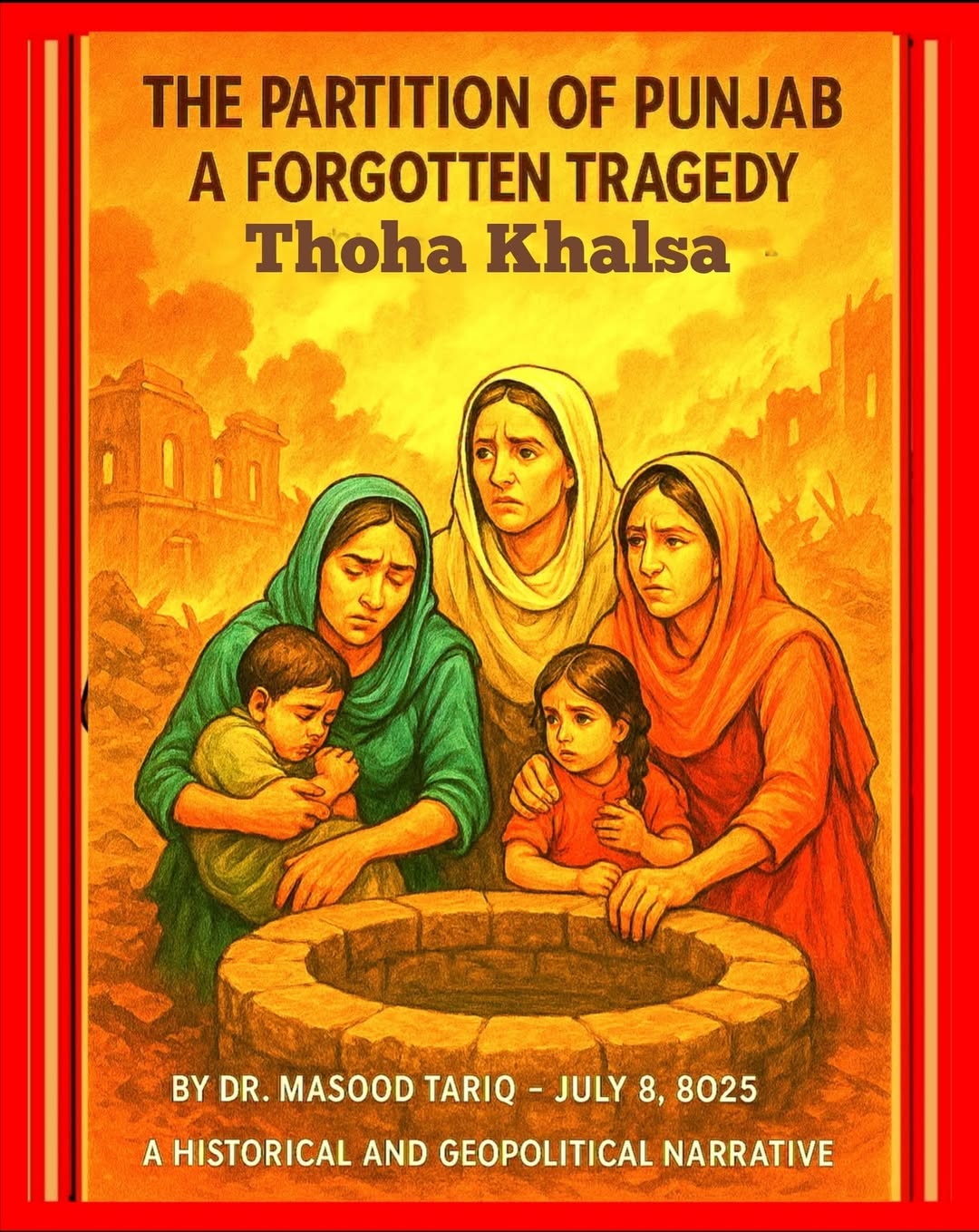
This paper reconstructs one of the most harrowing yet neglected chapters of Partition-era violence—the massacre of Thoha Khalsa in March 1947, located in Kahuta Tehsil of present-day Rawalpindi district. Once a prosperous Punjabi Sikh settlement known for intercommunal harmony, Thoha Khalsa became a site of devastation when Pashtun tribal militias, mobilized in the name of jihad following Master Tara Singh’s protest against Pakistan’s demand, attacked Sikh villages across Northern Punjab.
Drawing on archival records, eyewitness accounts, and postcolonial scholarship, the study traces the progression from pre-Partition coexistence to communal collapse, detailing the siege, betrayal, and mass suicide of Sikh women led by Sardarni Basant Kaur—an episode memorialized as the “Killer Well.” The violence at Thoha Khalsa marked the first large-scale ethnic cleansing of the Punjab Partition, preceding and precipitating retaliatory massacres in East Punjab later that year.
By examining the political vacuum created after the dismissal of the Unionist government, the role of religious incitement, and the logistical organization of armed groups, the paper situates the tragedy within the broader pattern of state breakdown and ideological militarization preceding Partition.
The paper argues that the events of March 1947 shattered Punjab’s pluralistic fabric long before August 1947, and that Pakistan’s historical narrative—centered exclusively on Muslim victimhood—remains incomplete without acknowledgment of Sikh and Hindu suffering in Western Punjab.
Ultimately, this study calls for historical honesty and academic courage: only by recognizing the full spectrum of Partition’s violence can South Asia begin to heal from its buried wounds and reimagine a future grounded in truth, empathy, and reconciliation.
——————————————–
Table of Contents
1. Introduction: Thoha Khalsa and Its Forgotten Past
2. A Harmonious Pre-Partition Society
3. Political Catalysts: Master Tara Singh and Direct Action Day
4. Widespread Violence in Northern Punjab
5. The Siege and Betrayal of Thoha Khalsa
6. Massacre and Martyrdom
7. Aftermath: From Violence to Silence
8. Suppressed Histories: Northern Punjab’s Forgotten Violence
9. Conclusion: A Call for Historical Honesty
——————————————–
1. Introduction: Thoha Khalsa and Its Forgotten Past
Thoha Khalsa is located in Kahuta Tehsil, approximately 30 miles southeast of Rawalpindi in the Punjab region of Pakistan. Today, the population of around 20,000 is composed entirely of Muslims who speak the Pothohari dialect of Punjabi. Dominant clans include Janjua Rajputs, Gakhars, and a few other Punjabi Muslim communities.
Unbeknownst to many of its present-day residents, Thoha Khalsa was once a thriving Punjabi Sikh village prior to the Partition of British India in 1947. Prominent Sikh families from the Bhandra, Dugal, Anand, and Chandoak clans inhabited this area.
——————————————–
2. A Harmonious Pre-Partition Society
During the pre-Partition era, Thoha Khalsa was a prosperous settlement inhabited solely by Punjabi Sikhs. Surrounding villages were predominantly Muslim Punjabi. Social relations between Sikh and Muslim Punjabis were notably peaceful. The haveli (mansion) of Sardar Gulab Singh served as a prominent local landmark, symbolizing the prosperity of Sikh residents. Sikhs were also widely settled throughout Rawalpindi district, while the princely state of Kashmir was governed by a Sikh administration.
Amid efforts by the Muslim League to establish a separate Muslim nation and secure Kashmir’s accession to Pakistan, a tribal force comprising Pashtun fighters from Waziristan was being assembled for jihad.
Though their formal intervention in Kashmir began on October 22, 1947, Pashtun tribesmen had already been moving between Peshawar and Rawalpindi cantonments. One such group arrived in Rawalpindi in late February 1947.
——————————————–
3. Political Catalysts: Master Tara Singh and Direct Action Day
Master Tara Singh, a key Sikh political leader, had earlier embraced Sikhism under the religious guidance of Thoha Khalsa resident Atar Singh. The conversion took place at the Dukh Bhanjani Gurdwara in the village.
On March 3, 1947, Master Tara Singh publicly tore a Pakistan flag in Lahore as a symbolic rejection of the Muslim League’s call for a separate nation. In response, the Pashtun tribal militias declared jihad against the Sikhs.
On March 5, 1947, they launched an attack at Chungi No. 22 in Rawalpindi. However, this area, which straddled the Rawalpindi and Chaklala military zones, witnessed stiff resistance from the well-armed Sikh community. The attackers withdrew after encountering organized defense.
——————————————–
4. Widespread Violence in Northern Punjab
By March 7, the tribal militias had regrouped and begun a campaign of plundering and arson, targeting 110 of the 116 Punjabi Sikh villages across Murree and Kahuta.
On March 9, they turned their attention toward Thoha Khalsa.
At the time, the village’s jewelry market was bustling with activity. It was both post-harvest wedding season and the lead-up to Baisakhi, the springtime Punjabi festival celebrated by Muslim, Sikh and Hindu Punjabis alike.
Traveling south from Islamabad and Rawalpindi, the road past GT Chowk leads to Rawat Bazaar on the Grand Trunk Road. From there, a road branches toward Kallar Syedan. Along this route lie the villages of Sagri—home to Sikh goldsmiths—and Dera Khalsa, situated on a hilltop near Nathiya, which the tribal force bypassed to avoid harming Muslim families living among Sikhs.
——————————————–
5. The Siege and Betrayal of Thoha Khalsa
On the evening of March 9, 1947, Pashtun attackers approached Thoha Khalsa from the west, looting and burning homes near the village entrance. Local Muslim Punjabi residents, who had previously promised protection to their Sikh Punjabi neighbors, remained silent spectators.
Despite the surprise attack, the Sikhs mounted a successful resistance that evening, repelling the attackers. On March 10, with the arrival of reinforcements, a second assault was launched by a force numbering in the thousands but again failed after minor clashes.
On March 11, the militia returned for a third time. The Sikhs abandoned their homes and took refuge in Sardar Gulab Singh’s haveli. Initially, they resisted the siege, but overwhelmed by superior numbers, they raised a white flag to surrender.
In the negotiations that followed, the Pashtuns demanded cash, gold, and weapons. In exchange for their safety, the Sikh villagers surrendered their valuables, including 20,000 rupees in cash. An oath was sworn: no further violence would be inflicted, no homes torched, and the Sikhs could leave peacefully with their belongings.
However, the next day—March 12—at approximately 3:00 p.m., the attackers returned, breaking their oath. They demanded the forced conversion of Sikhs to Islam and the handover of Sikh girls for marriage. The invaders were accompanied by clerics to perform conversions and barbers to cut Sikh men’s hair.
——————————————–
6. Massacre and Martyrdom
The Sikh Punjabis refused. In retaliation, over 200 Sikhs were killed—many hacked to death. Kerosene oil was used to set hundreds of Sikhs on fire. The night resounded with screams of suffering and terror. Sikh women, including mothers and daughters, locked themselves inside Gulab Singh’s haveli.
As attackers breached the premises and murdered Sardar Gulab Singh, a tragic decision was made. Led by Sardarni Basant Kaur, the women emerged with their children, chanting sacred hymns, and walked to the Dukh Bhanjani Gurdwara. In an act of collective sacrifice to preserve their dignity, they jumped into the gurdwara’s well. Sardarni Basant Kaur was the last to jump. The well where this mass suicide occurred is today known as the “Killer Well.”
——————————————–
7. Aftermath: From Violence to Silence
After the massacre, the Pashtun attackers looted and burned the remaining homes in Thoha Khalsa before moving toward Dhamali village. On March 13, the army arrived and began collecting the corpses.
Jawaharlal Nehru, the newly elected Interim Deputy Prime Minister of India, visited Thoha Khalsa on March 14. When the staff photographer captured images of the well, human remains were still visible. On April 8, 1947, Lord Mountbatten—newly appointed Viceroy—also visited the site.
After Pakistan’s formation, the Auqaf Department assumed control of the Dukh Bhanjani Gurdwara. Today, even its foundations and Gulab Singh’s haveli no longer exist. Only the well remains—a haunting testament to the 93 women who gave their lives to preserve their dignity.
——————————————–
8. Suppressed Histories: Northern Punjab’s Forgotten Violence
One of the most neglected aspects of Partition violence—especially in Pakistani political discourse—is the March 1947 assault on Sikh and Hindu Punjabis in Rawalpindi, Campbellpur, Jhelum, and parts of NWFP (now Khyber Pakhtunkhwa).
These events were not isolated but systematically organized. According to Attacks on Sikhs and Hindus by Muslim League in Punjab 1947 (SGPC, 1991), the Rawalpindi Division experienced the first large-scale violence in March 1947. This assessment is corroborated by numerous historians. Ian Talbot and Gurharpal Singh (2009) note that “the violence in Rawalpindi was the earliest and most concentrated episode of ethnic cleansing prior to Partition.” Ishtiaq Ahmed (2011) similarly documents these massacres in his interviews and British archival sources. Urvashi Butalia (1998) and Kirpal Singh (1991) also include testimonies from women survivors, with specific reference to mass suicides in villages like Thoha Khalsa.
A detailed report titled “Attacks on Sikhs and Hindus by Muslim League in Punjab 1947”, compiled in 1991, presents the following findings:
(1). Origins of Communal Violence:
Riots began in 1946 after the Muslim League announced “Direct Action Day” in Calcutta.
(2). Collapse of Governance:
The Unionist government in Punjab was dismissed on March 2, 1947. With the Muslim League unable to form a majority, Governor’s Rule was imposed.
(3). First Attacks:
On March 4–5, the initial waves of violence occurred in Lahore and Amritsar.
(4). Spread Across Districts:
Simultaneous attacks took place in Multan, Rawalpindi, Campbellpur, Jhelum, and Sargodha—mostly targeting defenseless Sikh and Hindu villages.
(5). Weaponization and Funding:
Mobs were supplied with swords, spears, knives, and firearms—reportedly funded by Delhi-based politicians and arms sourced from the Frontier Province.
(6). Organized Killings:
Kill teams worked in groups, with one person attacking and another covering or disposing of the body. Payments were allegedly made based on the number of victims.
(7). Targeted Patrols:
Armed gangs in jeeps hunted lone Sikh and Hindu individuals.
( . Student Protests Attacked:
On March 5, peaceful student protests in Rawalpindi were fired upon by police, while Muslim League supporters joined the violence. Though Muslims also suffered casualties, the cycle of retaliation deepened.
(9). Incitement by Religious Leaders:
The Pir of Golra incited rural Muslims to attack non-Muslim villages.
(10). Systematic Cleansing:
Between March 7 and the end of the month, Sikh and Hindu communities across Rawalpindi, Campbellpur, and Jhelum were eradicated. Survivors were relocated to refugee camps.
(11). Earlier Violence in Hazara:
In Buffa, Shinkari, Balakot, and Mansehra, similar atrocities occurred as early as December 1946.
——————————————–
9. Conclusion: A Call for Historical Honesty
(1). The first casualty of this civil war was not merely human life but the social bonds of community and interfaith harmony.
(2). Thousands of Sikh and Hindu Punjabis—including women and children—were killed by organized mobs, often supported by elements within the Muslim League.
(3). Fearing extinction, Sikh leaders responded with threats of retaliation, leading to a replication of atrocities in Eastern Punjab during July–August 1947. The cycle of violence had been set in motion by the events in Western Punjab.
(4). The dominant narrative in Pakistan—that Muslim Punjabis were the sole victims of Partition-era violence—is historically inaccurate. By omitting Sikh and Hindu Punjabis suffering, a one-sided, ideologically framed history is propagated in textbooks and public discourse.
(5). Policymakers must support rigorous, fact-based historical research and acknowledge all aspects of Partition violence. Without historical honesty, there can be no path to reconciliation or a violence-free society.
——————————————–
References
Ahmed, Ishtiaq. The Punjab Bloodied, Partitioned and Cleansed: Unravelling the 1947 Tragedy through Secret British Reports and First-Person Accounts. Karachi: Oxford University Press, 2011.
Butalia, Urvashi. The Other Side of Silence: Voices from the Partition of India. New Delhi: Viking Penguin, 1998.
SGPC. Attacks on Sikhs and Hindus by Muslim League in Punjab 1947. Amritsar: Shiromani Gurdwara Parbandhak Committee, 1991.
Singh, Kirpal. Select Documents on Partition of Punjab 1947. Delhi: National Book Shop, 1991.
Talbot, Ian, and Gurharpal Singh. The Partition of India. Cambridge: Cambridge University Press, 2009.
——————————————–
Author Biography
Dr. Masood Tariq is a Karachi-based politician and political theorist. He formerly served as Senior Vice President of the Pakistan Muslim Students Federation (PMSF) Sindh, Councillor of the Municipal Corporation Hyderabad, Advisor to the Chief Minister of Sindh, and Member of the Sindh Cabinet.
His research explores South Asian geopolitics, postcolonial state formation, regional nationalism, and inter-ethnic politics, with a focus on the Punjabi question and Cold War strategic alignments.
He also writes on Pakistan’s socio-political and economic structures, analysing their structural causes and proposing policy-oriented solutions aligned with historical research and contemporary strategy.
His work aims to bridge historical scholarship and strategic analysis to inform policymaking across South Asia, Central Asia, and the Middle East.


Leave a Reply