
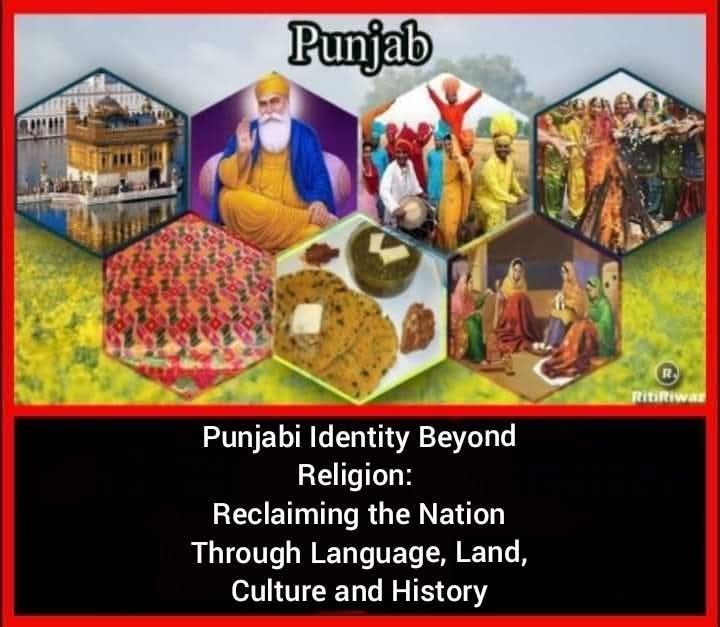
Punjabi Identity Beyond Religion: Reclaiming the Nation Through Language, Land, Culture and History
Dr. Masood Tariq
Independent political theorist
Karachi, Pakistan
drmasoodtariq@gmail.com
Date: May 18, 2025
——————————————–
Abstract:
This paper examines the fragmentation of Punjabi national identity following the 1947 Partition of India. Challenging the reduction of identity to religion, it argues for a reclamation of Punjabi nationhood based on shared language, land, culture, and historical experience.
Through a critique of post-Partition state narratives and political manipulation, the study highlights the strategic marginalization of Muslim Punjabis and the internal colonization of Punjab.
Drawing from historical events, demographic data, and theological interpretation, it calls for the revival of secular Punjabi nationalism as a basis for regional peace and cultural integrity.
——————————————–
Table of Contents
1. Introduction
2. Dharti and Dharma: A Necessary Distinction
3. The Secular Unity of Pre-Partition Punjab
4. Partition and the Human Catastrophe
5. Post-Partition Marginalization and the Rise of Internal Colonization
6. The Narrative of Punjabi Domination and Manufactured Separatisms
7. Demographic Realities and Representation
8. Failure of Muslim National Unity
9. Conclusion: Reviving Secular Punjabi Nationalism
10. Bibliography
——————————————–
1. Introduction
Are Punjabi Muslims not part of the Punjabi nation? Are Sikhs not Punjabis? These rhetorical questions challenge religiously exclusivist narratives that fracture a historically unified cultural and linguistic identity.
This paper argues that the concept of nationhood must be rooted in shared land (dharti), language, culture, and historical continuity, rather than religious affiliation alone.
——————————————–
2. Dharti and Dharma: A Necessary Distinction
Religion (dharma) is inherently individual, whereas language, culture and land are collective.
Arabic, for instance, is spoken by Muslims, Christians, and Jews alike in the Arab world, where all are considered part of the Arab nation.
Islam, in this framework, constitutes an ummah—a spiritual community—not a nation. The Qur’an affirms this by stating:
“We did not send any messenger except [speaking] in the language of his nation (qawm) so that he might clearly convey the message to them.” — Surah Ibrahim (14:4)
This verse establishes language as a foundational principle of communication and, by extension, national cohesion.
A nation (qawm) is thus defined by common linguistic, territorial, and cultural bonds, not solely by religious ones.
——————————————–
3. The Secular Unity of Pre-Partition Punjab
Before 1947, Punjab was a secular and united society of Muslim, Sikh, Hindu, and Christian Punjabis. Coexisted within the same socio-political framework. Participated in shared cultural practices.
Punjab was governed by the Punjabi political party “Unionist.” First Muslim Punjabi Sir Sikandar Hayat, and then Muslim Punjabi Sir Khizr Hayat Tiwana served as the Prime Minister of Punjab. Maintained a collective regional identity despite religious differences.
The Partition was not a Punjabi demand. It was driven by Hindu-Muslim conflict in the Ganga-Jamuna regions and imposed on Punjab through external decisions.
——————————————–
4. Partition and the Human Catastrophe
The Indian Independence Act of 1947, passed by the British Parliament on July 15 and enacted on August 15, led to the division of Punjab on August 17. This resulted in the mass displacement of over 20 million Punjabis and the death of more than 2 million Punjabis in the ensuing violence—the largest human migration and one of the deadliest genocides of the 20th century.
Time magazine (September 1947) estimated over 1 million deaths; by October, the number exceeded 2 million.
According to the UNHCR, this migration remains the largest and fastest in recorded history.
Despite being displaced within their own homeland, Muslim Punjabis were labelled muhajirs—a term misused, as it applies to those migrating into foreign lands.
East-to-West and West-to-East Punjabi migration remained within the same ethno-linguistic territory as a result of the division of Punjab.
——————————————–
5. Post-Partition Marginalization and the Rise of Internal Colonization
While Punjab was divided, no such division occurred in the Ganga-Jamuna regions. Muslims from these areas migrated to Pakistan, settling in the major urban centres of Punjab and Sindh.
Under the label of muhajir, they occupied strategic spaces in Government, Media, Military and civil bureaucracy, Commerce and landholding.
They leveraged the tragedy of displaced Muslim Punjabis to gain political and economic dominance—despite being migrants themselves.
——————————————–
6. The Narrative of Punjabi Domination and Manufactured Separatisms
A deliberate campaign of “intellectual terrorism” was initiated to counter the demographic and institutional influence of Punjabis in West Pakistan, where they made up 60% of the population. This campaign was advanced by:
Pashtuns, through Abdul Ghaffar Khan (1947–),
Baloch, through Khair Bakhsh Marri (1960–),
Sindhis, through G. M. Syed (1972–),
Muhajirs, through Altaf Hussain (1986–).
These figures promoted separatist narratives by demonizing Punjabis, falsifying history, and inciting ethnic violence—driving Punjabi entrepreneurs, professionals, and labourers out of their regions.
——————————————–
7. Demographic Realities and Representation
Punjabis constituted 60% of West Pakistan’s population. The remaining 40% comprised Sindhi, Baloch, Brahui, Gilgiti-Baltistani, Kohistani, Chitrali, Swati, Pashtun, Rajasthani, Gujarati, and Urdu-speaking Indian Muhajirs.
In Punjab, not only Punjabis live—Pashtun, Baloch, and Urdu-speaking Muhajirs from Ganga-Jamuna culture also reside there.
Furthermore, Punjabis are not just the largest group in Punjab, but also the second-largest in Khyber Pakhtunkhwa, Pashtun-majority areas of Balochistan, Baloch-majority areas of Balochistan, rural Sindh, and Karachi.
Shouldn’t a population that makes up 60% of Pakistan be visible in agriculture, industry, trade, craftsmanship, civil and military services, educational institutions, major cities, politics, and journalism?
Shouldn’t Punjabi politicians, bureaucrats, generals, soldiers, journalists, judges, industrialists, traders, landlords, doctors, engineers, lawyers, bankers, and the general public be seen all across Pakistan?
——————————————–
8. Failure of Muslim National Unity
Despite seven decades of efforts by Punjabi Muslims to integrate with non-Punjabi Muslims under Islamic and national identities, experience has proven otherwise:
To Punjabi Muslims, Non-Muslim Punjabis share deeper cultural, linguistic, and territorial bonds. Customs, history, and enemies were common. Only religion remained different.
This underscores the limits of pan-Islamism in constructing a cohesive national identity in a multi-ethnic state.
——————————————–
9. Conclusion: Reviving Secular Punjabi Nationalism
Punjab has always been and will remain the homeland of Punjabis. Its division along religious lines was an externally imposed tragedy. Healing this fracture requires two recognitions:
That religion and land must be decoupled in identity politics.
That Punjabi nationalism, based on secular, linguistic, cultural, and historical foundations, must be revived to restore unity and peace.
A re-secularized Punjab could serve not only as a model of post-colonial reconciliation but also as a bastion of pluralism in a region scarred by ethno-religious violence.
——————————————–
10. Bibliography
Qur’an, Surah Ibrahim, 14:4.
Time Magazine, September 1947 Issue.
United Nations High Commissioner for Refugees (UNHCR).
Refugee Data and Historical Migration Reports, 1947–1950.
Indian Independence Act, 1947. British Parliament Archives.
——————————————–
Author Biography
Dr. Masood Tariq is a Karachi-based politician and political theorist. He formerly served as Senior Vice President of the Pakistan Muslim Students Federation (PMSF) Sindh, Councillor of the Municipal Corporation Hyderabad, Advisor to the Chief Minister of Sindh, and Member of the Sindh Cabinet.
His research explores South Asian geopolitics, postcolonial state formation, regional nationalism, and inter-ethnic politics, with a focus on the Punjabi question and Cold War strategic alignments.
He also writes on Pakistan’s socio-political and economic structures, analysing their structural causes and proposing policy-oriented solutions aligned with historical research and contemporary strategy.
His work aims to bridge historical scholarship and strategic analysis to inform policymaking across South Asia, Central Asia, and the Middle East.


Leave a Reply