
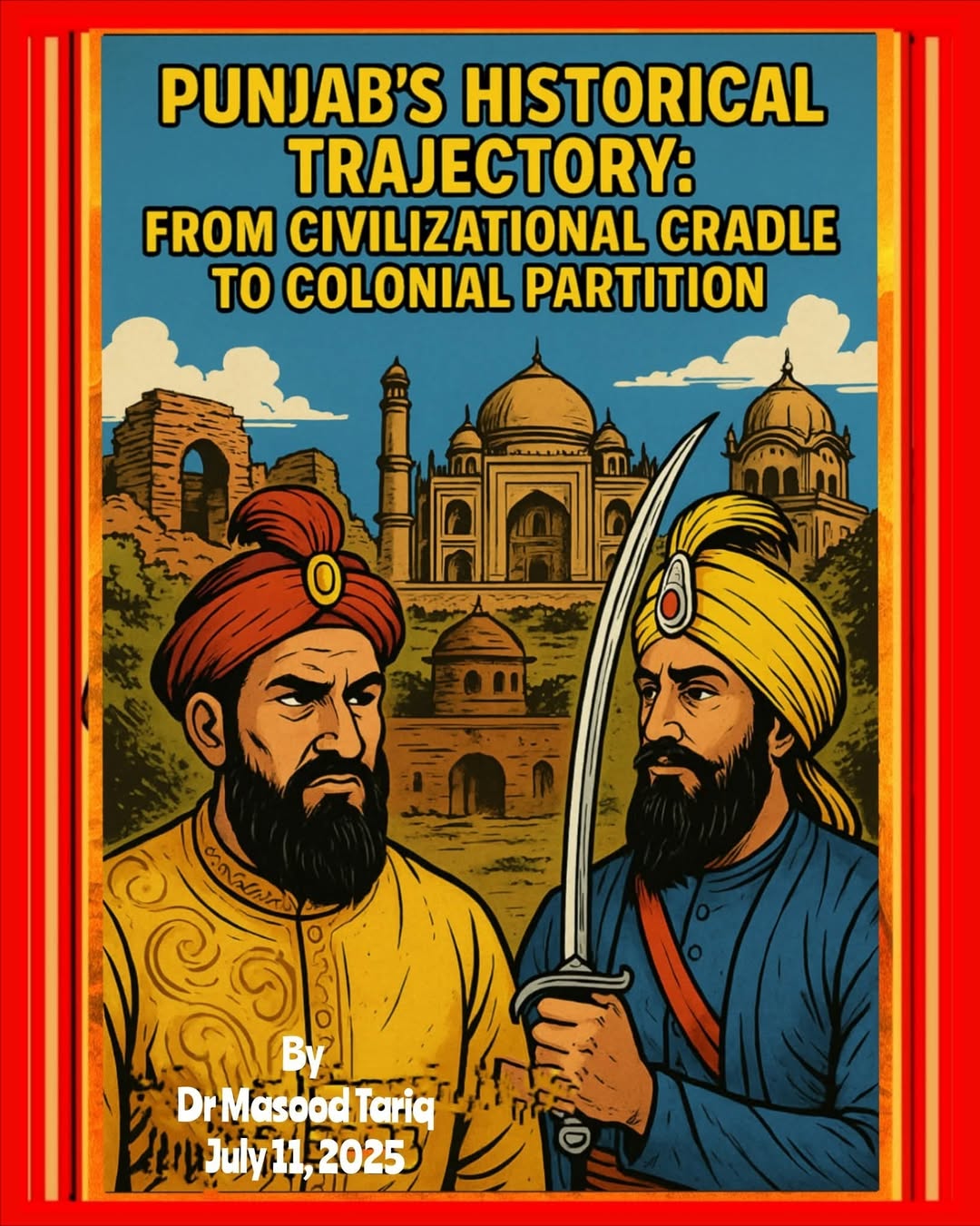
Punjab’s Historical Trajectory: From Civilizational Cradle to Colonial Partition
Dr. Masood Tariq
Independent Political Theorist
Karachi, Pakistan
drmasoodtariq@gmail.com
Date: July 11, 2025
——————————————–
Abstract
This article argues that Punjab’s strategic geography and its history of repeated foreign conquests paradoxically laid the groundwork for a unique sociopolitical synthesis, culminating in the ephemeral but transformative rule of Maharaja Ranjit Singh.
It further posits that the mid-18th century coalition-building by Adina Beg Khan constituted a missed opportunity for secular Punjabi autonomy.
Tracing Punjab’s evolution from the Indus Valley Civilization to the Partition of 1947, the paper emphasizes its centrality in South Asian geopolitics and the long-term implications of its fractured sovereignty.
——————————————–
Keywords:
Punjab, Indus Valley Civilization, Adina Beg Khan, Ranjit Singh, Mughal Empire, British India, Partition of 1947, Sikh Empire, Persian Invasions, State Formation
——————————————–
Table of Contents
1. Etymology and Early Mentions of Punjab
2. Ancient Punjab and the Indus Valley Civilization
3. Invasions and Empires: From Persia to the Mughals
4. Decline of Mughal Authority and Rise of Adina Beg Khan
5. Sikh Confederacy and the Rise of Ranjit Singh
6. British Conquest and Partition of Punjab
7. Conclusion
——————————————–
1. Etymology and Early Mentions of Punjab
The term “Punjab” first appears in Abbas Sarwani’s Tarikh-e-Sher Shah (1580), where it denotes the area encompassing the provinces of Lahore and Multan [1]. Abul Fazl’s Ain-e-Akbari further documents the region as part of the Mughal administrative structure [2]. Earlier conceptual references, however, appear in the Mahabharata, where the region is described as “Pancha-Nanda” or the land of five rivers [4].
——————————————–
2. Ancient Punjab and the Indus Valley Civilization
Archaeological evidence indicates human habitation in Punjab as early as 7000 BCE, with the Neolithic site of Mehrgarh providing early signs of agrarian life. By 3000 BCE, organized settlements culminated in the Indus Valley Civilization, centered around Harappa (Punjab) and Mohenjo Daro (Sindh) [6].
This civilization, marked by urban planning, metallurgy, and trade networks, declined around 1900 BCE due to ecological and sociopolitical changes. The subsequent Vedic period (c. 1500 BCE) saw the composition of the Rig Veda, likely in the Punjab region itself [7].
——————————————–
3. Invasions and Empires: From Persia to the Mughals
Punjab’s location made it a gateway for successive imperial incursions. In 516 BCE, Darius I of Persia annexed the region as the richest satrapy of the Achaemenid Empire [8]. Alexander the Great’s campaign in 321 BCE disrupted Persian influence, initiating a period of Hellenistic and Central Asian domination, including Bactrians, Sakas, and White Huns.
From the 8th century onward, Arab conquests reached Multan [10], followed by Mahmud of Ghazni’s 17 invasions between 1000 and 1030 CE [11], followed by Muhammad Ghori’s conquest in 1186–87, which ended Ghaznavid rule and led to the establishment of the Delhi Sultanate—institutionalized Indo-Islamic governance. [12].
Turkic Dynasties of the Delhi Sultanate (1206–1526):
i). Mamluk Dynasty (1211–1290)
ii). Khalji Dynasty (1290–1320)
iii). Tughlaq Dynasty (1320–1413)
iv). Sayyid Dynasty (1414–1451)
v). Lodhi Dynasty (1451–1526)
These dynasties were succeeded by the Mughal Empire, which began with Babur’s victory over Ibrahim Lodhi at the First Battle of Panipat in 1526 [13], introducing administrative innovations like the mansabdari system and a syncretic Indo-Persian culture.
——————————————–
4. Decline of Mughal Authority and Rise of Adina Beg Khan
By the mid-18th century, Mughal authority in Punjab had diminished. Ahmad Shah Abdali’s crumbling empire had left Punjab in a state of chaos and disorder. Since 1757, Punjab had been under Afghan rule. Adina Beg Khan, who had political influence in Jalandhar Doab, was appointed Nazim (Administrator) of the region by the Mughals. During Taimur Shah’s governorship (1757–58), Adina Beg Khan sought allies to expel the Afghan authorities. He allied with the Sikhs and defeated the Afghans at Mahalpur in Hoshiarpur district.
By 1758, Adina Beg Khan convened a large alliance of Sikh Sardars—Hari Singh Bhangi and his son Jhanda Singh, Gujjar Singh, Lehna Singh, Jassa Singh Ahluwalia, Jassa Singh Ramgarhia, Jai Singh Kanahiya, and Charat Singh Sukerchakia. Adina Beg Khan cleverly invited the Marathas, who had taken Delhi, to come to Punjab by offering one lakh rupees a day. He persuaded the Sikhs to support the Marathas against the Afghans. In April 1758, Raghunath Rao led the Maratha-Sikh-Adina alliance into Lahore. Taimur Shah fled to Afghanistan, and the city fell without much resistance.
Adina Beg Khan was appointed Subahdar of Punjab on the condition of paying 75 lakh rupees annually to the Marathas. Nominally, Punjab had three masters: the Mughals, the Afghans, and the Marathas—but in reality, it was ruled by Adina Beg Khan and the Sikhs. Adina Beg Khan died suddenly from colic in Batala on 10 September 1758 at the age of 48. Had he lived another decade, he might have established a secular Punjabi state in the 1760s. His political strategies had harmonized Muslim and Sikh Punjabis, and his alliance-building with Marathas and Sikhs had driven out both Afghans and Mughals. Adina Beg Khan was a binding force for Punjabi unity. After his death, only the Sikhs remained as defenders of Punjab.
——————————————–
5. Sikh Confederacy and the Rise of Ranjit Singh
The Sikhs united to overthrow Taimur Shah and his chief, Jalal Khan. By 1758, Lahore came under Sikh control. Jassa Singh Ahluwalia became the head of Sikh sovereignty and expanded Sikh influence across Punjab. After his death, Afghan power resurged briefly but was finally neutralized by the emergence of Maharaja Ranjit Singh. One of his major opponents was Shah Zaman, who attempted to retake Lahore but was defeated. The Afghans planned to attack Amritsar, but Ranjit Singh repelled them effectively.
On July 7, 1799, Ranjit Singh entered Lahore, becoming the first Punjabi ruler of Punjab in nearly 777 years—since Mahmud of Ghazni overthrew Raja Tarnochalpal in 1022. Ranjit Singh’s empire extended from the Sutlej River in the east to Peshawar in the west, and from the junction of the Sutlej and Indus in the south to Ladakh in the north. He ruled with religious tolerance and administrative efficiency until his death in 1839.
——————————————–
6. British Conquest and Partition of Punjab
In 1845, the British invaded Punjab, leading to the First Anglo-Sikh War. The Treaty of Lahore (1846) formalized British control over territory between the Sutlej and the Beas, including Kashmir. The annexation of Punjab in 1849 dissolved the Sikh Empire. Dalip Singh, the last ruler, was exiled to Britain. The Jallianwala Bagh Massacre of 1919 in Amritsar catalyzed anti-colonial resistance in Punjab.
The 1940 Lahore Resolution positioned Punjab at the center of the Pakistan Movement. In August 1947, the British partitioned Punjab into West Punjab (Pakistan) and East Punjab (India) under the Radcliffe Award, triggering one of the most violent human displacements in modern history, with over 20 million uprooted and approximately two million deaths [18].
——————————————–
7. Conclusion
The historical trajectory of Punjab reveals a complex and layered evolution shaped by successive waves of external domination and intermittent assertions of indigenous sovereignty. From its foundational role in the Indus Valley Civilization to its strategic significance during the Partition of British India, Punjab has functioned as a critical frontier and corridor for empire-building, trade, and cultural exchange in South Asia. The continuity of foreign rule—whether Persian, Greek, Central Asian, Afghan, or British—demonstrates the region’s enduring geostrategic importance.
However, equally significant are the local attempts to reclaim agency and construct autonomous political orders. In this regard, the mid-eighteenth century career of Adina Beg Khan warrants particular attention. His efforts to forge a strategic alliance with Sikh confederacies and Maratha forces against Afghan control represented a pivotal, though ultimately unrealized, opportunity for the emergence of a secular, indigenous Punjabi state. His untimely death marked a critical rupture in this trajectory, subsequently giving rise to Sikh political consolidation under Jassa Singh Ahluwalia and later, the transformative reign of Maharaja Ranjit Singh.
Maharaja Ranjit Singh’s rule stands as a rare moment of centralized and inclusive Punjabi sovereignty after nearly eight centuries of external control. His empire, characterized by religious pluralism, administrative coherence, and military modernization, remains a unique historical exemplar of regional autonomy in a context dominated by imperial hierarchies.
The British conquest and eventual partition of Punjab in 1947 fragmented this historical unity. The resultant division not only produced one of the most violent episodes of population displacement in modern history but also disrupted the potential for a unified Punjabi political identity. Nevertheless, the legacy of figures such as Adina Beg Khan and Maharaja Ranjit Singh underscores the capacity for intercommunal cooperation and strategic leadership in resisting external domination and constructing indigenous governance.
By situating Punjab within a longue durée framework, this paper underscores the region’s centrality in South Asian history and geopolitics. It also highlights the relevance of Punjab’s historical experiences for contemporary debates on regionalism, federalism, and postcolonial state formation in the subcontinent. Further interdisciplinary research into these trajectories may offer valuable insights for reimagining the political and cultural futures of both Indian and Pakistani Punjabs.
——————————————–
References
[1] Abbas Sarwani, Tarikh-e-Sher Shah, 1580.
[2] Abul Fazl, Ain-e-Akbari, Vol. 1.
[3] Jahangir, Tuzk-i-Jahangiri.
[4] Vyas, Mahabharata, ca. 400 BCE.
[5] Possehl, Gregory. The Indus Civilization: A Contemporary Perspective. Rowman Altamira, 2002.
[6] Wheeler, Mortimer. Civilizations of the Indus Valley and Beyond. Thames & Hudson, 1966.
[7] Witzel, Michael. “Early Sanskritization.” Harvard University Papers, 1995.
[8] Darius I Inscription at Behistun (c. 522–486 BCE).
[9] Arrian, Anabasis of Alexander.
[10] Wink, André. Al-Hind: The Making of the Indo-Islamic World, Vol. 1. Brill, 1991.
[11] Bosworth, C.E. The Ghaznavids: Their Empire in Afghanistan and Eastern Iran 994–1040.
[12] Jackson, Peter. The Delhi Sultanate: A Political and Military History. Cambridge University Press, 1999.
[13] Chandra, Satish. Medieval India: From Sultanat to the Mughals, Vol. II.
[14] Gupta, Hari Ram. History of the Sikhs, Vol. II. Munshiram Manoharlal, 1978.
[15] Singh, Khushwant. A History of the Sikhs, Vol. I.
[16] Grewal, J.S. The Sikhs of the Punjab. Cambridge University Press, 1990.
[17] Metcalf, Barbara and Thomas. A Concise History of Modern India. Cambridge University Press, 2006.
[18] Talbot, Ian and Singh, Gurharpal. The Partition of India. Cambridge University Press, 2009.
——————————————–
Author Biography
Dr. Masood Tariq is a Karachi-based politician and political theorist. He formerly served as Senior Vice President of the Pakistan Muslim Students Federation (PMSF) Sindh, Councillor of the Municipal Corporation Hyderabad, Advisor to the Chief Minister of Sindh, and Member of the Sindh Cabinet.
His research explores South Asian geopolitics, postcolonial state formation, regional nationalism, and inter-ethnic politics, with a focus on the Punjabi question and Cold War strategic alignments.
He also writes on Pakistan’s socio-political and economic structures, analysing their structural causes and proposing policy-oriented solutions aligned with historical research and contemporary strategy.
His work aims to bridge historical scholarship and strategic analysis to inform policymaking across South Asia, Central Asia, and the Middle East.


Leave a Reply