
The Pashtun Question in Pakistan and Afghanistan: A Geopolitical, Ethno-Demographic, and Social Analysis
Dr. Masood Tariq — Independent Political Theorist, Karachi, Pakistan
Email: drmasoodtariq@gmail.com
Date: October 17, 2025
——————————————–
Abstract
This paper examines the deepening social and political crisis of the Pashtuns across Pakistan and Afghanistan. Historically imagined as a single nation divided by the Durand Line, the Pashtuns today face estrangement from both states and contestation from surrounding ethnic groups. In Afghanistan, long cycles of Pashtun predominance—culminating in Taliban rule—rested not only on internal mobilisation but also on episodic strategic support from Pakistan. If relations continue to deteriorate and Islamabad pivots toward Tajik, Uzbek, Hazara, and Turkmen blocs, the Afghan balance of power would invert, exposing Pashtuns to multi-front exclusion.
The paper argues that debates about borders obscure the real issue: Pashtun futures depend less on the Durand Line itself and more on their relationships with neighbouring nations—Punjabis, Samats, Baloch, Brahuis, Gujaratis, Rajasthanis, Swatis, Chitralis, Kohistanis, and Gilgit-Baltistanis in Pakistan; and Tajiks, Uzbeks, Hazaras, and Turkmens in Afghanistan. It further contends that expanding Afghanistan to absorb Pakistan’s Pashtun belt would likely deepen Tajik, Uzbek, Hazara, and Turkmen insecurity inside Afghanistan while placing Pashtuns living in Punjab, Sindh, Balochistan, and non-Pashtun districts of Khyber Pakhtunkhwa in acute social and economic jeopardy—provoking backlash, securitised policing, and exclusionary politics. Absent robust confederal guarantees, the Durand Line’s persistence—or a regulated corridor model—better protects both Afghan minorities and Pakistan’s dispersed Pashtun population. Only a shift from militarised identity to cooperative federalism and shared development can avert a dark trajectory of dual marginalisation.
——————————————–
Table of Contents
1. Geography and the Making of a Divided Nation
2. From Frontier to Fault Line: Colonial Origins of the Crisis
3. Social Fracture and Mutual Hostility
4. Propaganda and Perception
5. Demographic Scale, Military Share, and Dispersed Power
6. The Taliban Era, Pakistani Sponsorship, and the Pivot Risk
7. Regional Powers and External Manipulation
8. Structural and Social Contradictions
9. Cultural Transformation and Identity Crisis
10. Social Consequences of Ethnic Conflict
11. The Durand Line, Erasure Scenarios, and Future Pathways
12. Conclusion: Between Neighbours and Nations
——————————————–
1. Geography and the Making of a Divided Nation
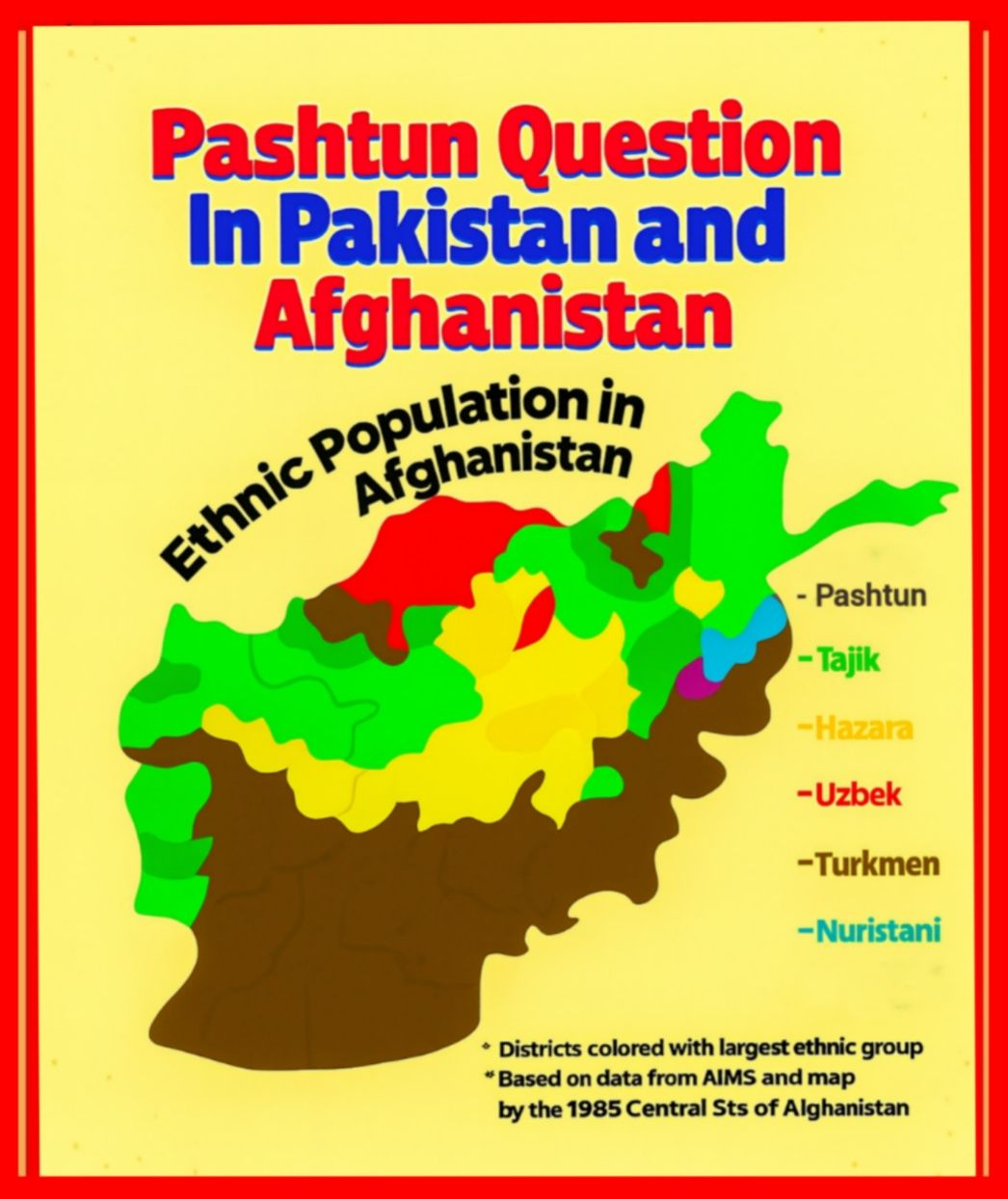
Afghanistan’s topography—its mountain arcs, narrow corridors, and high plateaus—maps directly onto its ethno-linguistic mosaic. Tajiks dominate much of the northeast and key urban-bureaucratic nodes; Uzbeks and Turkmens anchor the northern plains; Hazaras populate the central highlands; and Pashtuns straddle the south and east, where the terrain opens toward Pakistan. Dari (Persian) networks the administrative and mercantile spheres, while Pashto governs the trans-border tribal belts. In Afghanistan, valleys bind communities more reliably than capitals do.
Pakistan is equally plural in composition. Punjabis, Samats, Baloch, Brahuis, Gujaratis, Rajasthanis, Swatis, Chitralis, Kohistanis, and the peoples of Gilgit-Baltistan occupy distinct ecological and historical zones. Pashtuns connect these worlds—demographically large in Khyber Pakhtunkhwa, northern Balochistan, and Karachi—yet politically stretched between two states. Since 1893, the Durand Line has bisected kinship and trade, turning mountains into checkpoints and commerce into contraband. Claimed rhetorically by both capitals but trusted fully by neither, the Pashtuns exist within a geography that structures their partial inclusion and perpetual uncertainty.
——————————————–
2. From Frontier to Fault Line: Colonial Origins of the Crisis
The Durand Line was conceived not as a frontier of identity but as an instrument of imperial geometry—drawn by the British to fragment tribal cohesion and to buffer their Indian dominion against the advancing Russian sphere. Cut across Afridi, Wazir, Mohmand, and Ghilzai domains, the Line severed kinship corridors that had long operated through customary passage rather than political sovereignty.
When Pakistan inherited this boundary in 1947, it also inherited the contradictions embedded within it. Kabul refused to recognise the Line’s permanence, elevating the idea of “Pashtunistan” from political rhetoric into national doctrine. What had once been a negotiated corridor of movement and trade thus hardened into a militarised frontier—patrolled, fenced, and bureaucratised.
Institutionally, the colonial “agency” system that recognised tribal intermediaries without extending civic rights survived under Pakistan’s later Federally Administered Tribal Areas (FATA). The result was structural liminality: inclusion without citizenship, taxation without representation, sovereignty without participation. Kabul’s claim provided leverage; Islamabad’s securitisation provided control. For ordinary Pashtuns, life continued to oscillate between autonomy and abandonment—courted in war, sidelined in peace, and perpetually defined as a question of security rather than society.
——————————————–
3. Social Fracture and Mutual Hostility
The political geography forged by empire and hardened through post-1947 rivalries produced not only administrative divisions but also enduring social cleavages. Nowhere are these fractures more visible than in the mutual suspicions shaping everyday life on both sides of the Durand Line. Each state’s internal politics has been organised around the anxiety of the other: Afghanistan fears domination by Pakistan-backed Pashtuns, while Pakistan fears irredentism inspired by Kabul’s claim to a greater “Pashtunistan.” Between these narratives, ordinary communities have been reduced to symbols of loyalty or defiance.
In Afghanistan, centuries of Pashtun ascendancy—from the Durrani and Barakzai monarchies to Taliban rule—have generated deep and often unspoken resentments. Tajiks contest cultural and administrative primacy, insisting that Persian (Dari) urbanism and bureaucratic experience anchor the state’s continuity. Uzbeks and Turkmens protest their exclusion from military command and trade monopolies, while Hazaras recall the brutal campaigns of Abdur Rahman Khan and the discriminatory practices that followed. The post-2001 and post-2021 eras recast these grievances in sharper ethnic relief: Taliban dominance has come to represent, for many non-Pashtuns, a system of ethnic majoritarianism disguised as religious legitimacy. The consequence is an Afghanistan divided into enclaves of mistrust—cities, valleys, and provinces connected by roads but separated by memory.
In Pakistan, the pattern is reversed but socially similar. Pashtuns are celebrated in national mythology as brave soldiers and defenders of Islam, yet simultaneously viewed through a lens of suspicion and surveillance. In Punjab, stereotypes portray them as mercenaries or labour migrants; in Sindh, as demographic intruders competing for jobs and housing; and in Balochistan, as collaborators of a centralised state apparatus. Karachi’s Pashtuns navigate policing and labour-market barriers, while the border districts of Khyber Pakhtunkhwa and the former FATA endure the periodic disruptions of counter-insurgency. Visibility without voice defines their condition: they are present in the state’s security imagination but absent from its civic protections.
The cumulative outcome on both sides of the Line is a social paradox—Pashtuns are indispensable to national defence yet distrusted in national belonging. Suspicion has replaced solidarity; proximity breeds anxiety rather than empathy. Each society mirrors the other’s fears, and in that mirror, the Pashtun sees neither home nor refuge but a reflection of perpetual marginality.
——————————————–
4. Propaganda and Perception
Borders are sustained not only by fences and patrols but by stories. The Durand Line endures less as a cartographic fact than as a field of competing narratives—each side composing a version of history that vindicates its claims and distrusts the other. For more than a century, propaganda has replaced dialogue, transforming social complexity into moral allegory.
In Afghanistan, nationalist and Islamist currents have long converged on the idea that Pakistan occupies a “Pashtun land usurped by Punjabis.” School textbooks and clerical sermons trace the frontier’s story as one of betrayal—first by the British who drew it, then by Pakistan which inherited it. This narrative sustains a mythic geography in which Khyber Pakhtunkhwa and the former FATA are described as “lost provinces,” awaiting restoration to an imagined greater Afghanistan. Cultural discourse elevates figures like Ahmad Shah Durrani and Mirwais Hotak as symbols of an eternal Pashtun sovereignty stretching to the Indus, conflating past empires with present entitlements. Within this frame, Pakistan is not a neighbour but an interrupter of Afghan continuity.
In Pakistan, the mirror image prevails. State discourse romanticises Pashtuns as the frontier warriors of Islam, heirs to a heroic martial tradition that safeguards national borders. Yet this admiration collapses quickly into fear whenever insurgency or militancy surfaces. The same community praised for bravery in textbooks and media tributes is vilified in security briefings and urban commentary. “Pashtun” becomes both a metaphor for loyalty and a synonym for danger—a duality that reveals the depth of Pakistan’s internal contradictions. Official narratives justify militarisation as protection, even as they perpetuate a psychology of suspicion that alienates the very population they seek to integrate.
The power of propaganda lies in what it erases. Neither narrative acknowledges the intertwined lives of Pashtuns with Punjabis, Samats, Baloch, Brahuis, Gujaratis, Rajasthanis, Swatis, Chitralis, Kohistanis, and Gilgit-Baltistanis in Pakistan, nor their centuries of coexistence with Tajiks, Uzbeks, Hazaras, and Turkmens in Afghanistan. It is easier to sustain myths of betrayal than to confront shared culpability. By reducing the Pashtun to a symbol—of either historical grandeur or perpetual rebellion—both states deny them the status of citizens. The consequence is a circular logic of mistrust: each government fears the disloyalty that its own propaganda has produced.
——————————————–
5. Demographic Scale, Military Share, and Dispersed Power
By 2025, the combined Pashtun population across Pakistan and Afghanistan approaches fifty million, yet this demographic magnitude translates unevenly into power. Geography disperses them, politics divides them, and institutional hierarchies constrain their influence despite their strategic centrality.
In Afghanistan, Pashtuns constitute roughly 13.5 million of a national population of about 32.5 million. However, sustained out-migration to Pakistan, Iran, and the Gulf has reduced their domestic presence to an estimated ten million. Historically, their dominance within the state apparatus derived not from sheer numbers but from structural inheritance: the Durrani and Barakzai monarchies institutionalised a Pashtun-centric military and administrative ethos, which continued under successive republics and Taliban regimes. Yet this dominance now breeds backlash. Tajiks, Uzbeks, Hazaras, and Turkmens—demographically smaller but increasingly urbanised and internationally networked—control many northern and central provinces, universities, and aid sectors. Kabul’s bureaucracy, once a Pashtun bastion, now operates through inter-ethnic coalitions shaped as much by donor politics as by domestic legitimacy. Thus, the Pashtuns’ numerical significance coexists with declining administrative leverage and rising social resentment.
In Pakistan, the demographic picture appears inverse yet equally complex. Approximately 37 million Pashtuns inhabit Khyber Pakhtunkhwa, northern Balochistan, and major cities such as Karachi, Quetta, and Islamabad. Their footprint extends deep into Punjab’s industrial and transport economy and Sindh’s urban labour markets. Within the Pakistan Army and paramilitary forces, Pashtuns arguably hold a share disproportionate to their population, a legacy of both colonial recruitment patterns and frontier militarisation. Yet this military visibility contrasts with their relative under-representation in civilian institutions—federal bureaucracy, diplomacy, higher education, and the media—where Punjabi and Urdu-speaking groups dominate. The outcome is paradoxical: a community visible in uniform but marginal in policy; essential to defence yet peripheral to governance.
Within Khyber Pakhtunkhwa, internal asymmetries further complicate identity. Pashto-speaking elites dominate politics, administration, and commerce, often at the expense of Hindko-Punjabi, Derawali-Punjabi, Swati, Chitrali, and Kohistani populations. This intra-provincial imbalance mirrors Afghanistan’s wider dynamic, where Pashtun predominance triggers countervailing ethnic solidarities. Across both states, therefore, demography functions less as a source of unity than as a multiplier of grievance.
The Pashtun predicament is thus one of dispersed strength—militarily potent, economically present, and numerically large, yet socially fragmented and institutionally constrained. Demographic weight without equitable inclusion breeds suspicion on all sides. For Kabul’s non-Pashtuns, Pashtun numbers evoke domination; for Islamabad’s other provinces, they evoke fear of separatism. In reality, the Pashtuns’ power is both overstated and undersecured—a paradox that sustains their visibility but denies them stability.
——————————————–
6. The Taliban Era, Pakistani Sponsorship, and the Pivot Risk
6.1 Sponsorship and Pashtun Predominance
From the anti-Soviet jihad of the 1980s through successive Taliban regimes, Islamabad’s security doctrine has consistently viewed a Pashtun-led Kabul as a strategic necessity. The concept of “strategic depth”—ensuring a friendly or at least non-hostile government across the western frontier—drove Pakistan’s periodic sponsorship of Pashtun political and militant formations. Support varied in degree and form: sanctuary, logistics, diplomatic mediation, intelligence coordination, and facilitation of cross-border trade. Over time, this network of dependence not only stabilised Pashtun leverage within Afghanistan but also entrenched the perception that Pakistan was the decisive external guarantor of Pashtun ascendancy.
This external support, however, came at a high social cost. It reduced Pashtun autonomy in policymaking and blurred the line between Afghan nationalism and Pakistani patronage. While Islamabad treated Pashtun-led governments as buffers against Indian influence, Afghan Pashtuns began to internalise the suspicion that their political legitimacy was contingent on Pakistan’s approval. Thus, what appeared as empowerment in the short term produced dependency in the long run—a dependency that would later turn into vulnerability once the alliance fractured.
6.2 Breakdown and Recrimination
Since the Taliban’s return to power in August 2021, relations between Islamabad and Kabul have sharply deteriorated. Three intertwined issues dominate the rupture: the Taliban’s refusal to curtail Tehrik-e-Taliban Pakistan (TTP) sanctuaries inside Afghanistan; armed skirmishes over Pakistan’s border fencing and customs control; and growing Taliban resentment of Pakistani pressure on trade and transit routes. These tensions have transformed erstwhile allies into adversaries.
For ordinary Pashtuns straddling the frontier, the consequences have been severe. Border closures and retaliatory strikes disrupted markets and mobility; visa restrictions and transport crackdowns curtailed livelihoods. Communities that once benefited from fluid cross-border movement now find themselves trapped between two militarised sovereignties—each claiming to protect them, neither fully trusting them. The old metaphor of the “frontier tribe” has re-emerged, this time not as a colonial category but as a modern symptom of statelessness.
6.3 The Pivot Risk: Pakistan’s Potential Realignment
The most destabilising possibility is a strategic pivot, in which Pakistan redefines its Afghan policy by openly aligning with non-Pashtun blocs—Tajik, Uzbek, Hazara, and Turkmen—as a counterweight to the Taliban’s Pashtun government. Such a shift, whether gradual or abrupt, would fundamentally alter Afghanistan’s internal balance of power and reverberate throughout Pakistan’s own social fabric.
In Afghanistan, a Pakistani pivot would empower northern and central coalitions long marginalised by Pashtun dominance. Backed by regional patrons such as Iran, Russia, and Central Asian states, these groups could form a parallel administration or armed resistance, transforming Afghanistan into a de facto confederation. For Pashtuns, this would mean a loss of monopolised authority, heightened insecurity in mixed provinces, and the potential displacement of populations as retaliation for decades of perceived supremacy. The Taliban’s ideological rigidity and exclusionary governance would further deepen their isolation, making the Pashtun belt the epicentre of renewed conflict rather than national unity.
In Pakistan, the consequences would be equally severe. The symbolic abandonment of Pashtun causes abroad would trigger resentment among Pashtuns at home, who already perceive disproportionate policing, restricted economic mobility, and underrepresentation in civil institutions. Punjabi, Sindhi, and Baloch media narratives could portray Pashtuns as extensions of an unfriendly Kabul regime, heightening ethnic suspicion in workplaces, universities, and cities such as Karachi, Lahore, and Quetta. The resulting feedback loop—military distrust from the top, social profiling from below—would confine Pashtuns to the margins of both politics and economy.
A pivot-driven escalation would thus convert a regional policy into a domestic crisis. Pakistan’s attempt to weaken Pashtun dominance in Afghanistan could inadvertently weaken national cohesion within its own borders, transforming a foreign problem into an internal fracture. In strategic terms, the move might appease external powers temporarily, but in sociological terms, it would mark the unraveling of a century-old frontier society held together by trade, kinship, and cultural continuity.
The lesson is clear: Pashtun predominance in Afghanistan may have been sustained by Pakistan’s sponsorship, but its future stability depends on something far more delicate—the maintenance of trust between the Pashtuns and their non-Pashtun neighbours in both states. Once that trust collapses, no external alliance can restore it.
——————————————–
7. Regional Powers and External Manipulation
Pashtun territories occupy one of Asia’s most coveted geopolitical corridors—where South, Central, and West Asia converge. Yet their location, long treated as an advantage by empires, has condemned local populations to a century of external intervention without sustained development. The contest for influence that began in the Great Game of the nineteenth century has only deepened in the twenty-first: now waged through pipelines, proxy forces, and digital surveillance rather than cavalry or caravans.
China’s expanding footprint defines the new economic axis. The China–Pakistan Economic Corridor (CPEC) traverses Pashtun-inhabited districts of Khyber Pakhtunkhwa and Balochistan, linking Kashgar to Gwadar. Beijing views the corridor as a stabilising route for commerce; locals experience it as a securitised infrastructure belt patrolled by troops rather than governed by municipalities. Employment and ownership remain limited, breeding quiet resentment that development passes through but not into their towns.
The United States and NATO, though formally withdrawn, maintain intelligence and counter-terror networks that span the same terrain. Drone bases, surveillance outposts, and security contractors shape daily life along the frontier, normalising exceptional violence. Their stated goal—counter-terrorism—has yielded few civic dividends: schools rebuilt after one strike are destroyed in the next cycle of retaliation.
Iran exerts influence through Hazara communities and Shia seminaries in the west, projecting a counterweight to Sunni Pashtun dominance. Russia and the Central Asian republics view the frontier through a security lens, fearing Islamist spill-over from Afghanistan into their southern borders. Turkey pursues cultural and religious diplomacy via educational foundations and language centres, emphasising Sunni fraternity while quietly competing with Gulf charities for ideological reach. The Gulf monarchies, meanwhile, oscillate between patronage and neglect—funding madrassas and militias in one decade, redirecting investment elsewhere in the next.
Despite this dense web of foreign presence, human development indicators in Pashtun regions remain among the lowest in South and Central Asia. Roads built for convoys seldom lead to hospitals; mineral concessions enrich urban investors but not mining towns; and security budgets eclipse spending on education or clean water. The frontier is managed as a strategic buffer, not nurtured as a social community.
External powers thus sustain a paradox: their competition keeps the region perpetually relevant but never prosperous. Each actor claims to secure stability while treating the Pashtuns as terrain rather than people. Until regional policy shifts from strategic access to social investment—from extraction to inclusion—the Pashtun belt will continue to absorb the costs of every alliance and the benefits of none.
——————————————–
8. Structural and Social Contradictions
The Pashtun predicament endures not only because of borders and wars, but because of deeper structural contradictions embedded in the political and social orders of both Pakistan and Afghanistan. Each state has alternately depended on Pashtun strength for its security and feared Pashtun assertion for its politics. The result is a paradox of mobilisation without empowerment: a people central to the state’s defence yet peripheral to its development.
8.1. Partition without Integration
The Durand Line divided a living ethnic continuum into two sovereignties that used the Pashtuns as buffers rather than citizens. Both Pakistan and Afghanistan incorporated the Pashtun belt into their national frameworks without building corresponding civic institutions. In Pakistan, the continuation of the “tribal agency” model—later formalised as FATA—kept millions outside regular law and taxation. In Afghanistan, the state’s authority never penetrated beyond garrisons and governors. Thus, while both countries claimed Pashtuns as their own, neither offered them stable governance or equal citizenship.
8.2. Ideological Instrumentalisation
Religion became a substitute for rights. From the anti-Soviet jihad to the post-9/11 “war on terror,” Pashtuns were mobilised under the banner of faith rather than development. Their loyalty was sought through clerics and commanders, not through schools or courts. The vocabulary of jihad displaced that of justice; martyrdom replaced education as the route to social respect. This process militarised identity and left generations of Pashtuns fluent in sacrifice but impoverished in civic opportunity.
8.3. Ethnic Competition and Internal Hegemonies
Ethnic politics magnify insecurity on both sides of the border. In Afghanistan, non-Pashtun groups—Tajiks, Uzbeks, Hazaras, and Turkmens—frame decentralisation as reparation for Pashtun over-rule, seeing every centralising impulse as a return to dominance. In Pakistan, by contrast, Pashtun political assertion alarms neighbouring groups—Punjabis, Samats, Baloch, Brahuis, Gujaratis, Rajasthanis, Swatis, Chitralis, Kohistanis, and the peoples of Gilgit-Baltistan—who fear demographic and commercial encroachment along transport and labour corridors. Consequently, Pashtuns feel besieged by claims of their power, while others fear their expansion—a cycle of mutual exaggeration that hardens stereotypes and prevents cooperation.
8.4. Urban Migration and Social Backlash
Migration from the frontier to Pakistan’s major cities has created new hierarchies and resentments. In Karachi, Quetta, and Lahore, Pashtuns dominate transport, construction, and logistics sectors, but their visibility provokes ethnic suspicion and media profiling. Informal economies that once offered dignity now attract police harassment; success is recast as intrusion. These pressures drive inward solidarity—Pashtun neighbourhoods turning defensive and insular—thereby deepening the very isolation that prejudice imagines. The frontier, once geographic, has become psychological: an invisible boundary separating citizen from neighbour.
8.5. Development without Inclusion
Infrastructure projects in Pashtun regions are often conceived for transit rather than transformation. Highways, pipelines, and military roads traverse the landscape but seldom link local communities to new markets or services. The absence of participatory planning—combined with low educational investment—ensures that development remains extractive rather than emancipatory. This material exclusion reinforces the social one, sustaining a perception that Pashtuns are valued for terrain, not talent.
Together, these contradictions trap the Pashtuns in a loop of dependence and distrust. Each state claims to protect them, each movement claims to represent them, yet the institutions that could empower them—schools, municipalities, legislatures—remain weak. Until these structural paradoxes are confronted, no peace process or border adjustment will resolve the Pashtun question. The issue is not only where they live, but how they are governed and how they live among others.
——————————————–
9. Cultural Transformation and Identity Crisis
The Pashtun story in the twenty-first century is not solely one of geopolitics and borders; it is also a narrative of social transition. The traditional code of Pashtunwali—centred on hospitality (melmastia), honour (nang), courage (tura), and reciprocity (badal)—once provided moral structure and collective balance. Yet decades of war, migration, and economic disruption have weakened this moral economy, displacing the authority of elders and jirgas with that of militias, clerics, and markets. In this shift from custom to coercion, the Pashtun world has entered a period of profound identity crisis.
9.1. Erosion of Traditional Authority
Continuous conflict has corroded the institutions that mediated social life. The maliks and khans who once settled disputes through consensus have lost legitimacy to armed actors and religious ideologues. The spread of small arms and the collapse of local arbitration systems have turned kinship networks into security blocs. Honour, once maintained through collective restraint, is now pursued through individual retribution. The transition from tribal solidarity to personal survival marks a deeper moral dislocation: the weakening of community as an organising principle.
9.2. Migration and Cultural Hybridisation
Large-scale migration—both internal and transnational—has transformed Pashtun society from a rural-tribal structure into a dispersed, multi-lingual diaspora. Millions of Pashtuns have settled in Karachi, Quetta, Lahore, the Gulf states, and beyond. In these urban and transnational spaces, Pashto coexists with Urdu, Punjabi, Persian, English, and Arabic, producing hybrid dialects and mixed cultural forms. Music, dress, and even idiom now blend city cosmopolitanism with frontier conservatism. This hybridisation has enriched cultural expression but unsettled traditional boundaries of identity, creating generational tension between village custom and urban pragmatism.
9.3. The Gender Question
Among the most significant social transformations is the gradual, contested redefinition of women’s roles. War and migration have paradoxically opened spaces for women’s economic participation—through remittances, education, and activism—while religious orthodoxy continues to impose constraints. Female literacy in Pashtun regions remains among the lowest in South Asia, yet every decade has brought incremental progress. Women’s learning circles in KP, Quetta, and Kabul have become quiet laboratories of change, challenging patriarchal readings of Pashtunwali and linking gender dignity to national renewal.
9.4. Youth and the New Civic Imagination
A digital generation now re-imagines Pashtun identity beyond tribe or jihad. Through social media, student unions, and civic movements such as the Pashtun Tahafuz Movement (PTM), young Pashtuns articulate rights in the language of law and equality rather than lineage and revenge. Their grievances—disappearances, collective punishments, exclusion from development—have widened into a moral claim for recognition as full citizens of Pakistan and Afghanistan alike. This shift signals a new phase in Pashtun consciousness: a move from martial pride to moral agency. Yet it also invites backlash from states uneasy with autonomous civic mobilisation.
9.5. Education and the Uneven Path to Modernity
Education has become the chief fault line between continuity and change. Where schools and universities expand, traditional hierarchies loosen; where they remain absent, clerical and militant networks fill the vacuum. Both states have invested in security infrastructure while under-investing in human capital. The result is an uneven modernity: pockets of scientific ambition coexisting with regions trapped in illiteracy. For the Pashtuns, this imbalance is not merely economic—it is existential. A community taught for generations to fight for others must now learn to think for itself.
9.6. The Crisis of Representation
Despite visibility in warfare and politics, Pashtun intellectual representation remains thin in national narratives. In both Pakistan and Afghanistan, school curricula, media, and official histories understate their cultural and philosophical contributions. The absence of inclusive storytelling reduces them to a stereotype—either noble warrior or fanatic insurgent—leaving little room for artists, poets, scientists, and reformers who once defined the Pashtun Enlightenment under figures such as Khushal Khan Khattak and Bacha Khan. Restoring this intellectual lineage is vital to re-humanising the Pashtun image.
Together, these transformations form a complex tableau: tradition eroded but not extinct, modernity desired but unevenly achieved. The Pashtuns stand at a crossroads between old solidarities and new aspirations. If war and prejudice persist, the outcome will be further fragmentation and loss of moral compass. But if education, gender inclusion, and cultural hybridity are nurtured within frameworks of justice, the Pashtuns can convert survival into revival—redefining themselves not as relics of the frontier but as architects of a plural, post-tribal future.
——————————————–
10. Social Consequences of Ethnic Conflict
The Pashtun experience across Pakistan and Afghanistan reveals how prolonged ethnic confrontation corrodes not only political structures but the moral and emotional fabric of society. What began as competition for territory and representation has evolved into a multi-layered social crisis: mistrust between communities, internal disunity among Pashtuns themselves, and the steady erosion of inter-ethnic coexistence that once defined the region’s plural heritage. The consequences are visible in every domain—from education and employment to language, marriage, and migration.
10.1. The Weight of Suspicion
In Afghanistan, non-Pashtun nations—Tajiks, Uzbeks, Hazaras, and Turkmens—perceive Pashtun rule, particularly under the Taliban, as a continuation of historical domination. Each cycle of Pashtun ascendancy therefore deepens the fear of marginalisation among northern and central ethnic groups. The result is a political geography increasingly defined by invisible boundaries: ethnic enclaves where inter-community trust is replaced by surveillance and defensive militarisation. Pashtuns may still command the state, but they no longer command social legitimacy beyond their linguistic zones.
In Pakistan, the reverse is true. Here, the Pashtuns are socially visible yet politically vulnerable. They are celebrated as soldiers and traders but distrusted as potential militants. In Punjab, they are often reduced to stereotypes of toughness and aggression; in Sindh, portrayed as settlers altering urban demography; in Balochistan, seen as instruments of federal intrusion. In Karachi, their neighbourhoods have become shorthand for law-and-order anxieties, while in Khyber Pakhtunkhwa, military operations and internal displacement have normalised a culture of checkpoints and verification. The long-term consequence is the internalisation of suspicion—citizens learning to see one another through the lens of threat rather than fellowship.
10.2. Economic Exclusion and Structural Inequality
Conflict has fractured economic opportunity. In Afghanistan, Pashtun-dominated ministries and networks monopolise political power but fail to translate it into equitable development. Non-Pashtun regions, particularly the north and centre, remain under-invested, breeding resentment that fuels opposition to Pashtun governments. In Pakistan, the imbalance works differently: Pashtuns have achieved mobility in transport, construction, and the informal economy, yet face institutional barriers in formal employment, higher education, and finance. Their labour builds cities in Punjab and Sindh, but ownership and policy remain concentrated elsewhere. Economic visibility thus masks structural precarity—a people essential to the economy but marginal in its command.
10.3. Social Isolation and Cultural Stigma
Decades of war have turned ethnic difference into moral hierarchy. In both states, public discourse often equates Pashtun identity with militancy, reducing a vast cultural civilisation to a caricature of extremism. The effect is social isolation: landlords hesitate to rent, employers hesitate to hire, and bureaucracies impose additional scrutiny. This stigma corrodes dignity and narrows participation in civic life. It also provokes reactive pride—a defensive insistence on tribal honour that reinforces separation rather than integration. The vicious circle of prejudice and self-isolation thus perpetuates the very stereotypes that produced it.
10.4. Educational Disruption and the Lost Generation
Conflict zones along the Durand Line have produced an entire generation raised amid closure, displacement, and militarisation. Thousands of schools in KP, FATA, and eastern Afghanistan were destroyed or repurposed during the jihad and post-9/11 wars. Many children grew up knowing camps before classrooms and checkpoints before playgrounds. The resulting literacy gap sustains the dependency cycle: under-educated youth become recruits for militias or migrant labour, unable to compete in national economies. Education, once a tool of mobility, has become a casualty of the security state.
10.5. Migration and the Psychology of Displacement
Mass migration has reshaped the Pashtun social psyche. Refugee camps in Pakistan’s border provinces, migrant colonies in Karachi and the Gulf, and diasporic enclaves in Europe have fragmented kinship networks and redefined belonging. Mobility offers survival but not necessarily stability. For many Pashtuns, home is now a transient concept—an emotional geography rather than a physical one. Displacement has also eroded the inter-ethnic familiarity that once moderated prejudice. In the absence of everyday contact, stereotypes harden and empathy declines, reinforcing national mythologies of division.
10.6. Fragmentation Within
Internal disunity compounds external hostility.
Class, region, and ideology divide Pashtun society: tribal elites, urban professionals, religious factions, and militant commanders compete for legitimacy without articulating a shared social vision. The gulf between the urbanised Pashtun elite in Islamabad, Lahore or Karachi and the rural communities of Waziristan, Kabul or Kandahar mirrors the wider regional inequality between centre and periphery. Without mechanisms of inclusive representation—provincial federalism, devolved governance, equitable education—the Pashtuns risk reproducing within their own ranks the very hierarchies they resist externally.
10.7. Cultural Fatigue and Emotional Toll
The human cost of perpetual conflict manifests in mental health crises, addiction, and generational trauma. Families fractured by disappearances and displacement carry grief unacknowledged by state or society. Traditional coping mechanisms—collective mourning, poetry, and jirga reconciliation—have eroded, while modern psychological services remain scarce. A population that once prized resilience now grapples with exhaustion. Beneath the rhetoric of bravery lies a quiet despair that rarely finds language in political analysis.
10.8. The Collapse of Inter-Ethnic Social Capital
Perhaps the most profound consequence of decades of ethnic conflict is the erosion of social capital between nations. In both Afghanistan and Pakistan, inter-ethnic trust—once sustained by markets, festivals, and inter-marriage—has disintegrated. Fear has replaced familiarity. The bazaars that once united languages are now divided by checkpoints and armed guards. Without deliberate reconciliation policies—inter-provincial cultural exchanges, shared education projects, and public history reforms—the subcontinent’s north-western corridor risks losing its last vestiges of plural coexistence.
In sum, the social consequences of ethnic conflict extend far beyond battlefield losses. They manifest in classrooms without books, families without security, and hearts without trust. The Pashtuns’ predicament is not merely political exclusion but social estrangement—caught between dominance that breeds resentment and marginalisation that breeds despair. Healing this fracture demands more than ceasefires or power-sharing; it requires rebuilding the social grammar of coexistence. Without that, the frontier will remain not a bridge between nations, but a mirror reflecting their mutual fear.
——————————————–
11. The Durand Line, Erasure Scenarios, and Future Pathways
The Durand Line, drawn in 1893 to divide the British and Afghan spheres of influence, remains the single most enduring fault line in the social geography of South and Central Asia. Yet the line’s symbolism has grown larger than its cartography. It is not merely a boundary between states but a mirror reflecting the conflicting fears and aspirations of the peoples it divides — Pashtuns who see it as a wound to their unity and non-Pashtuns who see its erosion as a threat to their security. Any future arrangement around this border will therefore define not only the stability of Pakistan and Afghanistan but also the balance between majority and minority nations within each.
11.1. Status-Quo Tension
The most likely trajectory is the continuation of managed hostility and selective cooperation. In this model, Pakistan and Afghanistan maintain diplomatic contact and occasional security coordination while distrusting each other’s motives. The border remains heavily fenced and militarised, punctuated by checkpoints, informal crossings, and smuggling routes that sustain local economies in defiance of state control. Pashtun communities living along the frontier bear the cost: trade restrictions, curfews, visa delays, and collective suspicion. Religious leaders and tribal elders substitute for absent civil institutions, and informal taxation replaces legal revenue. This status-quo model avoids total war but also blocks total peace — a permanent halfway state in which Pashtuns remain militarised subjects of two capitals and citizens of neither. It sustains state sovereignty on paper but perpetuates social exclusion in practice.
11.2. Confederal Cooperation
The second, more progressive path imagines the Durand Line not as a barrier but as a corridor. A confederal arrangement could preserve existing sovereignties while linking Pashtun regions through regulated mobility and shared development. Cross-border economic zones and joint transport corridors could allow goods and labour to move freely under mutual customs agreements. Dual-community rights in contiguous districts would permit citizens to access markets, education, and health facilities on either side of the border without compromising citizenship. Coordinated policing could reduce smuggling and terrorism while re-civilising the frontier space long governed by soldiers rather than civilians.
Such a framework would serve the strategic needs of both states and the social needs of their border populations. For Pakistan, it would convert a security burden into a commercial bridge connecting South and Central Asia. For Afghanistan, it would anchor legitimacy in collaboration rather than ethnic hegemony. For Pashtuns, it would restore mobility without violence and cultural unity without territorial annexation. However, confederal cooperation requires a political imagination both states have yet to cultivate — a recognition that shared sovereignty can enhance, not diminish, national dignity.
11.3. Erasure of the Line (Annexation to Afghanistan)
A more radical scenario is the complete dissolution of the Durand Line and the absorption of Pakistan’s Pashtun belt into Afghanistan. On paper, this appears to resolve a century-old division of tribes. In practice, it would detonate the delicate ethnic balance within Afghanistan. Pashtuns already command disproportionate influence in Kabul’s state structure — a position long reinforced by Pakistan’s strategic support. Annexing the Pashtun regions of Pakistan would greatly expand their demographic and territorial weight, reducing Tajiks, Uzbeks, Hazaras, and Turkmens to an even smaller minority bloc. For these non-Pashtun communities, such a move would appear not as reunification but as domination — a final proof that Afghanistan had become an ethnic monopoly rather than a multi-national republic. Fears of cultural erasure and political subordination would likely drive them toward armed resistance or external alignment with Iran, Russia, and Central Asia. Instead of unifying Pashtuns, the erasure of the Line could ignite a wider civil war across northern and central Afghanistan.
The domestic repercussions inside Pakistan would be no less severe. Absorbing its Pashtun belt into Afghanistan would leave millions of Pashtuns living outside that zone — in Punjab, Sindh, Balochistan, and the non-Pashtun districts of Khyber Pakhtunkhwa — suddenly suspect. In public discourse and policy, they could be viewed as foreign affiliates rather than equal citizens. Employment discrimination, housing restrictions, and securitised policing would likely intensify. Inter-ethnic relations in cities like Karachi, Lahore, and Quetta — already fraught — would deteriorate further, with Pashtun migrants bearing the brunt of social backlash. Far from solving a historical division, annexation would export the conflict into Pakistan’s multi-ethnic heartlands and destroy the bridges of economic and social integration built over decades.
Put plainly, from the perspective of Tajiks, Uzbeks, Hazaras, and Turkmens, the persistence of the Durand Line — or its re-interpretation as a confederal corridor — is safer than erasure. For Pashtuns, too, their grievances will not be healed by cartographic change but by socio-political reconciliation with their neighbours on both sides. Borders may shift, but enmities persist when relationships are ignored.
11.4. Pivot-Driven Escalation
A final and deeply dangerous scenario is that of pivot-driven escalation. If Pakistan were to re-align its regional strategy by supporting Tajik, Uzbek, Hazara, and Turkmen coalitions against a Pashtun-dominated Kabul, it would reverse the historic logic of its foreign policy. Northern alliances — emboldened and supplied by external actors — would encircle Pashtun strongholds. Retaliation could follow inside Pakistan, where Pashtun citizens would face heightened scrutiny and periodic violence. The consequence would be dual marginalisation: diminished influence in Kabul and eroded trust in Islamabad. The Durand Line would cease to function as a buffer and become instead a front line of ethno-political polarisation stretching from Herat to Karachi.
11.5. Toward a Managed Reconciliation
The future of the Durand Line cannot be resolved through maps or military doctrine alone. It demands a broader architecture of mutual recognition. Pakistan and Afghanistan must institutionalise their ethnic and regional plurality through confederal arrangements, federal autonomy, and cross-border development. For Pashtuns, the path to stability lies not in expanding Afghanistan but in expanding cooperation — a shift from territorial fantasy to social federalism. Only then can the frontier cease to be a fault line and become the foundation of a shared future.
——————————————–
12. Conclusion: Between Neighbours and Nations
The future of the Pashtun nation will not be shaped by borders or by wars but by relationships. For more than a century, the Durand Line has been treated as the cause of their misfortune; in truth, it is only a symptom. The deeper question lies in how Pashtuns coexist with the nations around them—Punjabis, Samats, Baloch, Brahuis, Gujaratis, Rajasthanis, Swatis, Chitralis, Kohistanis, and Gilgit-Baltistanis in Pakistan; Tajiks, Uzbeks, Hazaras, and Turkmens in Afghanistan. Geography cannot be undone, but the grammar of coexistence can be rewritten. Where Pashtun politics has turned inward—cloistered in pride or armed assertion—neighbours have mobilised in fear. Where it has turned outward—toward cooperation, trade, and federal inclusion—respect and stability have followed.
The argument over the Durand Line thus conceals a moral geometry: expanding Afghanistan to absorb Pakistan’s Pashtun belt would deepen insecurity for the Tajiks, Uzbeks, Hazaras, and Turkmens inside Afghanistan while placing millions of Pashtuns in Punjab, Sindh, Balochistan, and non-Pashtun districts of Khyber Pakhtunkhwa in social jeopardy. The erasure of the Line would not heal the wound; it would tear open several others. Non-Pashtun communities in Afghanistan would read it as demographic conquest; non-Pashtun citizens in Pakistan would read their Pashtun neighbours as extensions of a foreign state. The outcome would be neither reunification nor justice but a widening circle of suspicion stretching from Kabul to Karachi.
What is needed instead is a confederal imagination—an architecture of shared sovereignties and distributed rights. Within Pakistan, that means a social contract based on inclusion: proportional access to universities, civil services, and development funds; bilingual administration across KP; and district-level participation that integrates Hindko-Punjabi, Derawali, Swati, Chitrali, and Kohistani communities rather than subordinating them. Within Afghanistan, it means constitutional guarantees that secure Tajik, Uzbek, Hazara, and Turkmen representation without treating Pashtuns as overlords. Such plural federalism is not a luxury—it is the only defence against perpetual rebellion.
The temptation of pivot-driven escalation remains high. If Pakistan were to ally with non-Pashtun blocs against a Pashtun-led Kabul, it would extinguish the last external pillar that once balanced Pashtun predominance and plunge its own western provinces into mistrust. Pashtuns would lose leverage in Afghanistan and legitimacy in Pakistan, transformed from bridge to buffer. A corridor of cooperation could become a corridor of conflict. Conversely, if Islamabad and Kabul re-imagine the frontier as a civic and economic bridge—opening markets before militaries, student exchanges before summits—the same geography could bind rather than divide.
The Pashtuns have served as soldiers in every empire yet remain citizens in few. Their valleys carry pipelines and proxy wars but lack hospitals and universities. Their tragedy is not that they were divided by others, but that they were seldom united with those who lived beside them. The answer therefore lies neither in annexation nor in isolation but in integration—social, linguistic, and developmental.
If the peoples of the frontier—Pashtuns with Punjabis, Samats, Baloch, Brahuis, Gujaratis, Rajasthanis, Swatis, Chitralis, Kohistanis, and Gilgit-Baltistanis in Pakistan, and Pashtuns with Tajiks, Uzbeks, Hazaras, and Turkmens in Afghanistan—choose reciprocity over rivalry, the Durand Line can evolve from a wound into a seam that holds two republics together. If they do not, it will remain the scar of a failed century, and the Pashtuns—stretched between sovereignties—will remain stranded between neighbours and nations.


Leave a Reply