
The United Punjab Before Partition: A Forgotten Model of Punjabi Pluralism and Its Systematic Dismantling in Post-1947 Pakistan
Dr. Masood Tariq
Independent Political Theorist
Karachi, Pakistan drmasoodtariq@gmail.com
Date: June 11, 2025
——————————————–
Abstract
Before the Partition of British India in 1947, the province of Punjab functioned as a unified and pluralistic political entity under a democratically elected government composed of Punjabi Muslims, Hindus, and Sikhs.
This article reconstructs the political leadership of United Punjab, analyzing its multi-religious composition and functionality, and traces the consequences of its dissolution during and after Partition.
Special attention is given to the replacement of Punjabi leadership in post-Partition Pakistan with non-Punjabi elites, particularly from the Urdu-speaking and Pashtun communities, and the long-term effects this had on Punjab’s political autonomy within the new state.
——————————————–
1. Introduction
Before its division in 1947, Punjab epitomized a shared cultural and political identity that transcended religious lines.
United Punjab had a robust parliamentary system under the Government of India Act 1935, which was pluralistic but firmly rooted in Punjabi ethnicity and culture (Talbot 1988).
The inclusive structure of governance and cross-religious cooperation stands in stark contrast to the communal narratives that later dominated post-Partition South Asia.
——————————————–
2. The First Elected Government of United Punjab
The first provincial elections under the 1935 Act resulted in the formation of a Cabinet led by Sir Sikandar Hayat Khan, a Punjabi Muslim and leader of the Unionist Party, which represented agricultural interests across religious communities (Jalal 1985).
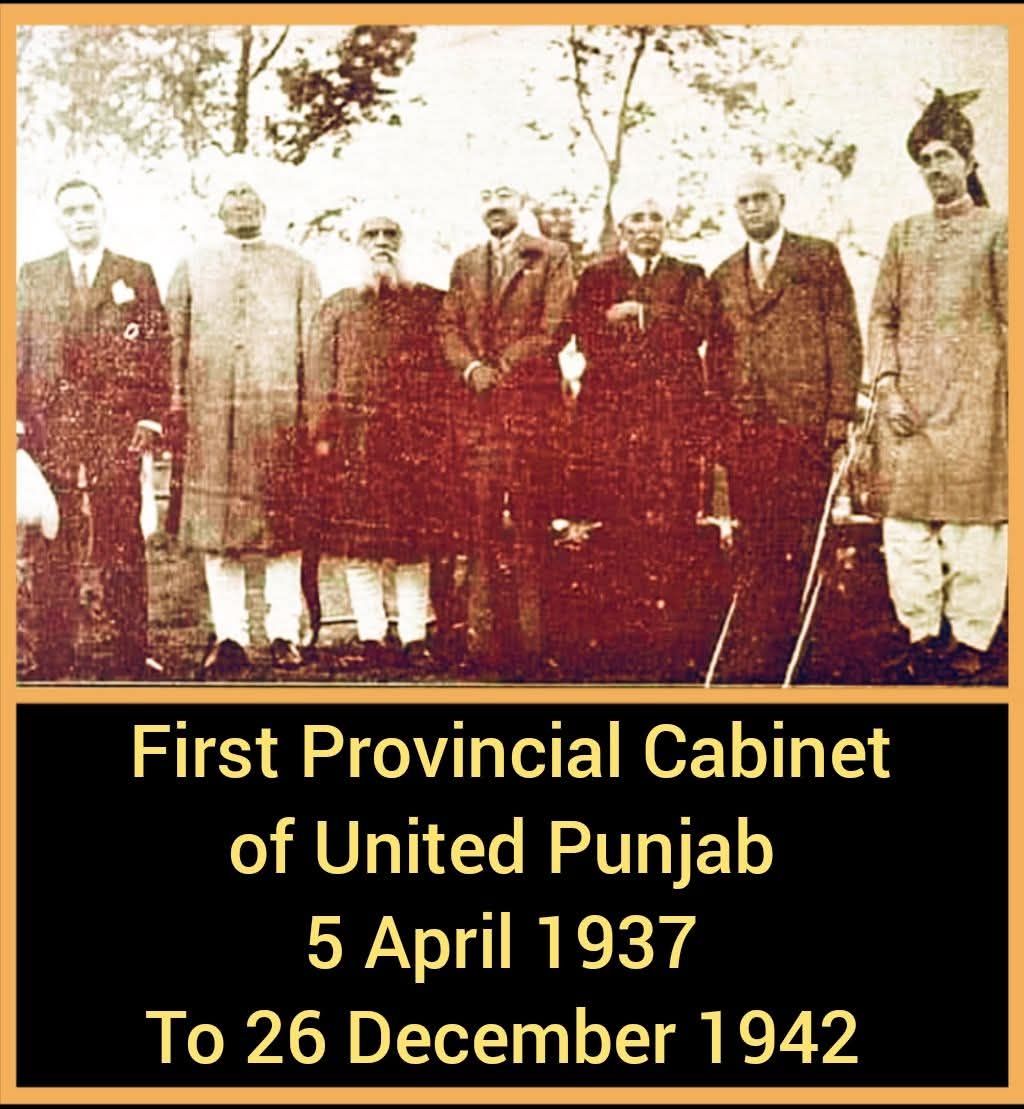
From 5 April 1937 to 26 December 1942, Prime Minister of United Punjab, Sikandar Hayat’s government included notable Punjabi Muslims, Hindus and Sikhs. The Prime Minister, Speaker, Deputy Speaker, Leader of Opposition and all Cabinet Members of United Punjab were Punjabi;
i). Speaker of the Punjab Assembly was Sir Chaudhry Shahab-ud-Din Virk.
ii). Deputy Speaker was Sardar Dasaundha Singh.
iii). Leader of the Opposition was Dr. Gopi Chand Bhargava.
The first Cabinet of United Punjab was;
i). Sir Sikandar Hayat Khan
Prime Minister with the portfolio of General Administration & Maintenance of Law and Order, Communications, Electricity, Local Government and Police Minister.
ii). Sir Chhotu Ram
Irrigation Minister
iii). Sir Sundar Singh Majithia
Revenue Minister
iv). Sir Manohar Lal
Finance and Industries Minister
v). Sir Malik Khizar Hayat Tiwana
Public Works Minister
vi). Sardar Baldev Singh
Development Minister
vii). Mian Abdul Hayee
Education, Medical Relief and Public Health Minister
This multi-religious Cabinet functioned effectively under a shared Punjabi identity, eschewing communal partisanship in favour of regional interests (Talbot 2007, 88–90).
——————————————–
3. Dissolution of Punjabi Unity During Partition
Sir Malik Khizar Hayat Tiwana succeeded Sikandar Hayat Khan in January 1943, continuing the Unionist tradition of communal cooperation (Tanwar 1999).
However, growing communal polarization, coupled with external pressures from the Muslim League and Congress, undermined this model.
Khizar Hayat resigned on 2 March 1947, after mass agitation supported by the Muslim League against his government (Jalal 1994, 73–75).
The British Governor, Sir Evan Jenkins, assumed direct control of Punjab until 17 August 1947. The collapse of Punjabi unity led to the catastrophic Partition violence:
i). Over 2 million Punjabis were killed in communal riots (Butalia 1998, 3).
ii). Around 14–20 million people were displaced, the majority being Punjabi Muslims, Hindus, and Sikhs (Talbot and Singh 2009, 12).
This was not merely a humanitarian disaster but a geopolitical realignment that destroyed the political agency of the Punjabi people on both sides of the new border.
——————————————–
4. Post-Partition Punjab and the Rise of Non-Punjabi Domination
After Partition, Punjab in Pakistan saw a dramatic shift. Despite the majority of the population and Assembly being ethnically Punjabi, the new leadership was quickly captured by non-Punjabi elites. Iftikhar Hussain Khan Mamdot, with Pathan lineage, was appointed Chief Minister of West Punjab. His administration was defined more by loyalty to central leadership than to provincial representation (Afzal 1976).
The Punjabi Assembly was dismissed on 25 January 1949 by Prime Minister Liaquat Ali Khan, an Urdu-speaking migrant from India, who imposed Governor’s Rule (Rizvi 1971, 140). He appointed Sardar Abdul Rab Nishtar, a Pashtun from Peshawar, as Governor of Punjab. This move institutionalized non-Punjabi control over the province and set a precedent for the centralization of authority in Pakistan.
This systemic marginalization of Punjabis within their own province, despite being the demographic majority, reveals the post-colonial state’s preference for loyalty over legitimacy, particularly when it came to provincial power centres (Jalal 1995).
——————————————–
5. Conclusion
United Punjab, before Partition, stood as a rare example of successful inter-religious and intra-ethnic governance. Its dissolution was not just a by-product of Partition but the result of deliberate political restructuring that prioritized communalism and central authority over regional autonomy.
In post-Partition Pakistan, Punjabi leadership was systematically sidelined in favour of Urdu-speaking Indian migrants and Pathan elites, undermining the province’s democratic foundation. Understanding this historical rupture is essential to reevaluating ethnic and political relations in contemporary Pakistan.
——————————————–
References
Afzal, M. Rafique. 1976. Political Parties in Pakistan: 1947–1958. Islamabad: National Commission on Historical and Cultural Research.
Butalia, Urvashi. 1998. The Other Side of Silence: Voices from the Partition of India. New Delhi: Penguin Books.
Jalal, Ayesha. 1985. The Sole Spokesman: Jinnah, the Muslim League and the Demand for Pakistan. Cambridge: Cambridge University Press.
Jalal, Ayesha. 1994. Democracy and Authoritarianism in South Asia: A Comparative and Historical Perspective. Cambridge: Cambridge University Press.
Jalal, Ayesha. 1995. The State of Martial Rule: The Origins of Pakistan’s Political Economy of Defence. Cambridge: Cambridge University Press.
Rizvi, Hasan Askari. 1971. The Military and Politics in Pakistan: 1947–1969. Lahore: Progressive Publishers.
Talbot, Ian. 1988. Punjab and the Raj, 1849–1947. New Delhi: Manohar.
Talbot, Ian. 2007. Pakistan: A Modern History. London: Hurst & Company.
Talbot, Ian, and Gurharpal Singh. 2009. The Partition of India. Cambridge: Cambridge University Press.
Tanwar, Raghuvendra. 1999. Politics of Sharing Power: The Punjab Unionist Party 1923–1947. Delhi: Manohar.
——————————————–
Author Biography
Dr. Masood Tariq is a Karachi-based politician and political theorist. He formerly served as Senior Vice President of the Pakistan Muslim Students Federation (PMSF) Sindh, Councillor of the Municipal Corporation Hyderabad, Advisor to the Chief Minister of Sindh, and Member of the Sindh Cabinet.
His research explores South Asian geopolitics, postcolonial state formation, regional nationalism, and inter-ethnic politics, with a focus on the Punjabi question and Cold War strategic alignments.
He also writes on Pakistan’s socio-political and economic structures, analysing their structural causes and proposing policy-oriented solutions aligned with historical research and contemporary strategy.
His work aims to bridge historical scholarship and strategic analysis to inform policymaking across South Asia, Central Asia, and the Middle East.


Leave a Reply