
Why Did Punjabis Support the British During the 1857 Rebellion?
Dr. Masood Tariq
Independent Political Theorist
Karachi, Pakistan
drmasoodtariq@gmail.com
Date: May 24, 2025
——————————————–
Abstract
The Indian Rebellion of 1857—often hailed as the First War of Independence—was marked by widespread unrest in North India, particularly among Bengal Army sepoys (Purbias). Yet, Punjab annexed less than a decade earlier, remained not only peaceful but a vital source of British military manpower.
This paper explores the historical, religious, political, and strategic factors behind Punjabi support for the British during the uprising. It argues that this alignment was rooted less in loyalty to the Raj and more in deep historical grievances, sectarian memory, and regional antagonisms toward the rebels, particularly the Purbia soldiers and the Mughal leadership.
——————————————–
Table of Contents
1. Introduction
2. Historical Grievances and the Anglo-Sikh Wars
3. Religious Memory and Mughal Antipathy
4. The Rebellion as a Feudal Restorationist Project
5. British Strategy and Punjabi Recruitment
6. The Role of the Cis-Sutlej States
7. Aftermath: Reward and Integration
8. Conclusion
——————————————–
1. Introduction
The Rebellion of 1857 was a defining moment in the colonial history of the Indian subcontinent. While large portions of North India erupted in revolt, Punjab—home of the recently subjugated Sikh Empire—emerged as a key ally of the British. This alignment demands analysis beyond simple accusations of collaboration. By contextualizing Punjab’s political landscape, inter-community tensions, and historical memory, we find that Punjabi support was rooted in a complex matrix of pragmatic and moral considerations rather than imperial allegiance.
——————————————–
2. Historical Grievances and the Anglo-Sikh Wars
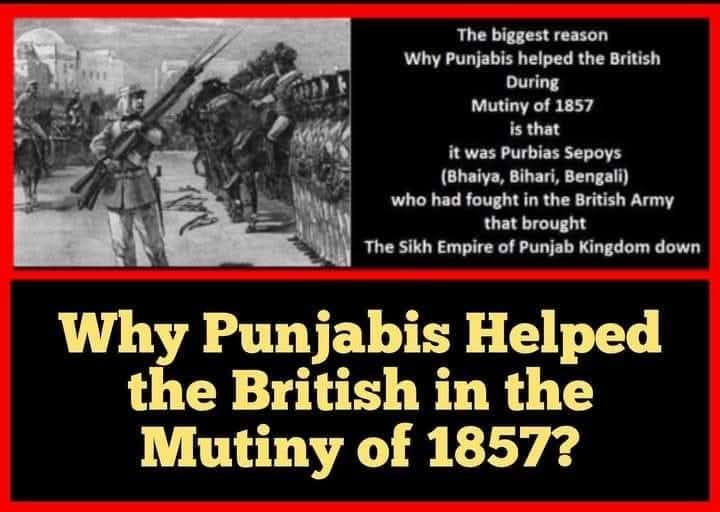
The Anglo-Sikh Wars (1845–49) profoundly shaped Punjabi political memory. The annexation of the Sikh Empire, especially after bloody battles like Chillianwala and Ferozpur, was facilitated by the British reliance on Purbia troops—mainly Bihari and Awadhi soldiers in the Bengal Army. These same troops later spearheaded the 1857 rebellion.
To many Punjabis, the Purbias were traitors who had once helped dismantle their independent kingdom and now sought to pose as liberators. The memory of betrayal was intensified when these soldiers were stationed in Punjab after annexation and rewarded with civil posts. Their presence in garrisons was perceived as humiliating and provocative (Dalrymple, 2006; Roy, 2011).
——————————————–
3. Religious Memory and Mughal Antipathy
The symbolic leadership of the 1857 revolt, Bahadur Shah Zafar II—the last Mughal emperor—evoked little sympathy in Punjab. Among Sikhs, memories of Mughal tyranny were vivid and traumatic. Mughal emperors were responsible for the martyrdom of Sikh Gurus, including Guru Arjan Dev under Jahangir and Guru Tegh Bahadur under Aurangzeb (Grewal, 1998). Sikh resistance was inspired by these events, with figures like Dulla Bhatti immortalized in folk memory as defenders against Mughal oppression.
The Sikh tradition, from Guru Nanak onward, condemned imperial tyranny, particularly that of the Mughals. Consequently, the idea of restoring Mughal authority alienated many Punjabis, who viewed the rebellion as an attempt to revive an order they had long resisted (Kaur Singh, 2003).
——————————————–
4. The Rebellion as a Feudal Restorationist Project
Rather than a grassroots nationalist struggle, the 1857 uprising was perceived in Punjab as a feudal restoration movement led by dethroned princes, Mughal remnants, and Maratha nobles seeking to regain lost privileges. For most Punjabis—Sikhs, Muslims, and Hindus alike—these elites represented the same ruling classes who had once betrayed or undermined Punjabi sovereignty by colluding with the British.
This perception discredited the rebellion’s legitimacy in Punjabi eyes. Without a cohesive national vision or popular program, the uprising lacked resonance in Punjab. Instead, it appeared as the desperate final gasp of an old imperial order that most Punjabis neither respected nor wished to see revived (Chakravarty, 2005).
——————————————–
5. British Strategy and Punjabi Recruitment
The British administration, well aware of the antagonism between Punjabis and Purbias, exploited this divide. As described in Jangnama Dilli (1858) by Kavi Khazan Singh, many Punjabis joined the British campaign out of vengeance. A British officer noted: “The animosity between the Punjabis and the Purbias is notorious… It was, therefore, determined to take advantage of this ill feeling by offering rewards for every Hindustani sepoy captured” (Dalrymple, 2006).
Sikh, Muslim, and Hindu Punjabis were recruited in large numbers to crush the rebellion in Delhi, Kanpur, and Lucknow. Their martial performance earned them lasting recognition within the colonial system, laying the groundwork for the British “martial races” doctrine and reorienting the British Indian Army’s demographic base.
——————————————–
6. The Role of the Cis-Sutlej States
The princely states of Cis-Sutlej Punjab—Patiala, Nabha, Jind, Faridkot, Malerkotla, and Kalsia—had a longstanding rivalry with Ranjit Singh’s centralizing Lahore court. After surviving through British patronage, these rulers had vested interests in maintaining the colonial order.
During the rebellion, they provided logistical support, troops, and safe passage to British columns. Their motives were pragmatic: gratitude to the British, preservation of their political autonomy, and historical opposition to Sikh unification under Lahore (Kaul, 2017).
——————————————–
7. Aftermath: Reward and Integration
Post-rebellion, the British rewarded Punjabi loyalty by restructuring the army to favour communities they deemed dependable—Sikhs, Punjabi Muslims, Rajputs, and Gurkhas. For many in Punjab, especially those recovering from the collapse of the Sikh Empire, military service became a pathway to restored prestige and social mobility.
This alignment also had long-term consequences: Punjab became the sword arm of the British Empire in India, contributing disproportionately to imperial campaigns in Asia and Africa (Omissi, 1994).
——————————————–
8. Conclusion
Punjabi support for the British during the 1857 Rebellion was not accidental, nor was it simply a case of elite collaboration. It was the product of recent betrayal, historical animosities, sectarian memory, and political calculation. The Purbia-led uprising—seen as a self-serving attempt by dethroned elites to regain power—failed to resonate with Punjabi society.
For the British, Punjab became more than just a stable province—it became a loyal ally, providing troops and legitimacy to the Raj for nearly a century. For Punjabis, the mutiny was not the first war of independence, but a reminder of the shifting alliances and bitter legacies that shaped colonial South Asia.
——————————————–
References
Chakravarty, G. (2005). The Indian Mutiny and the British Imagination. Cambridge University Press.
Dalrymple, W. (2006). The Last Mughal: The Fall of a Dynasty, Delhi 1857. Bloomsbury Publishing.
Grewal, J. S. (1998). The Sikhs of the Punjab. Cambridge University Press.
Kaul, C. (2017). Princely India and the British: Political Development and the Operation of Empire. Routledge.
Kaur Singh, N. (2003). The Guru Tradition in Sikhism. Oxford University Press.
Omissi, D. (1994). The Sepoy and the Raj: The Indian Army, 1860–1940. Palgrave Macmillan.
Roy, K. (2011). The Army in British India: From Colonial Warfare to Total War 1857–1947. Bloomsbury Publishing.
Singh, K. K. (1858/1995). Jangnama Dilli [War Chronicles of Delhi]. Trans. Harbhajan Singh. Punjabi University Patiala.
——————————————–
Author Biography
Dr. Masood Tariq is a Karachi-based politician and political theorist. He formerly served as Senior Vice President of the Pakistan Muslim Students Federation (PMSF) Sindh, Councillor of the Municipal Corporation Hyderabad, Advisor to the Chief Minister of Sindh, and Member of the Sindh Cabinet.
His research explores South Asian geopolitics, postcolonial state formation, regional nationalism, and inter-ethnic politics, with a focus on the Punjabi question and Cold War strategic alignments.
He also writes on Pakistan’s socio-political and economic structures, analysing their structural causes and proposing policy-oriented solutions aligned with historical research and contemporary strategy.
His work aims to bridge historical scholarship and strategic analysis to inform policymaking across South Asia, Central Asia, and the Middle East.



Leave a Reply