
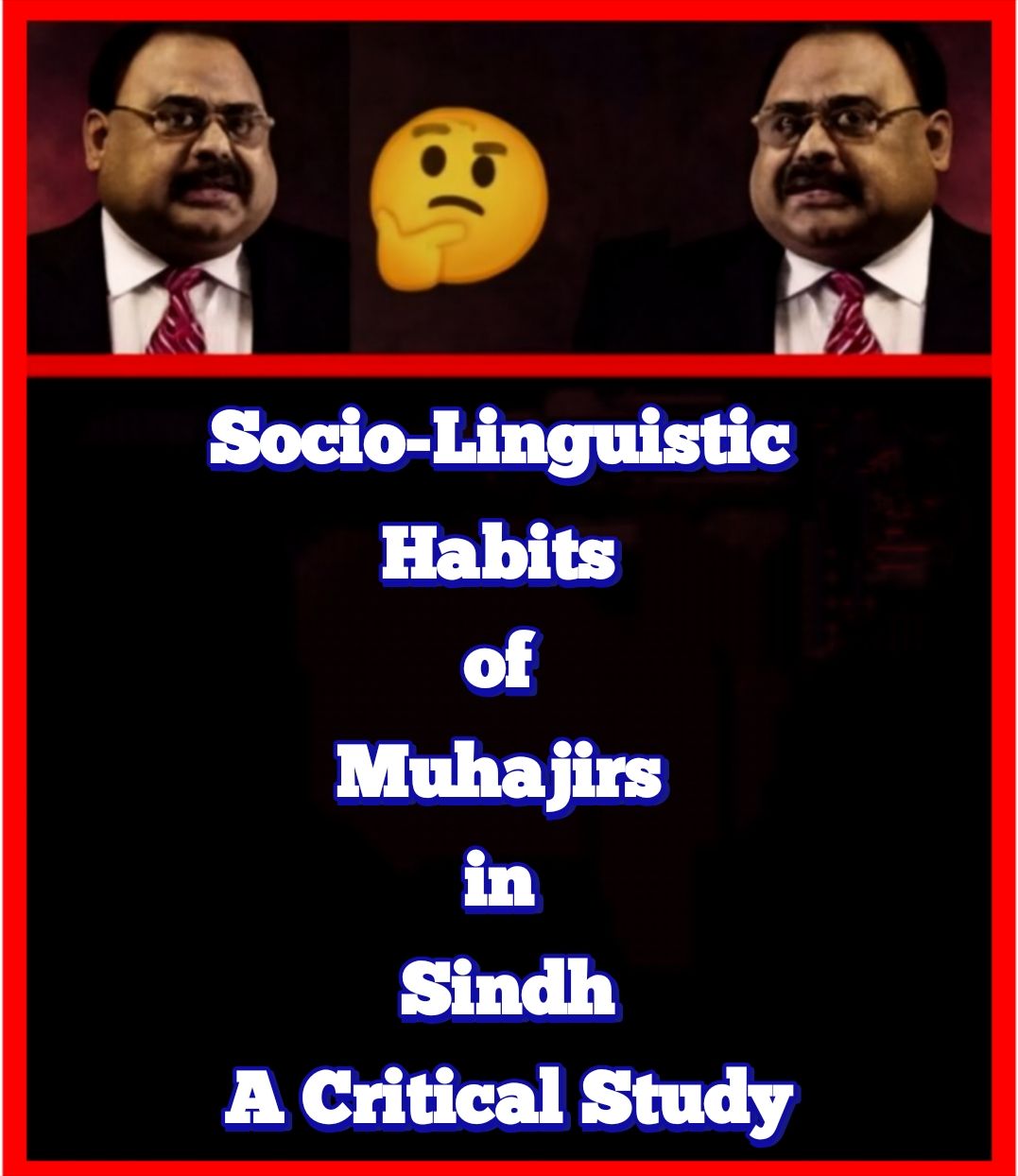
The Socio-Linguistic Habits of Muhajirs in Sindh: A Critical Study
Dr. Masood Tariq
Independent Political Theorist
Karachi, Pakistan drmasoodtariq@gmail.com
Date: June 24, 2025
—–‐———-‐———-‐———-‐—–
Abstract:
This research paper critically examines the linguistic, social, and political habits of the Indian migrants (Muhajirs) who settled in Sindh after the Partition of 1947. The central theme of this paper revolves around those behaviours of the Muhajir community that have become obstacles to fostering harmony within Sindh’s multicultural society. The paper emphasises the urgent need to promote intercultural dialogue, linguistic tolerance, and mutual respect for identities as preconditions for the region’s prosperity.
—–‐———-‐———-‐———-‐—–
Table of Contents
1. Introduction
2. Linguistic Exclusivism
3. The Imposed Centrality of Urdu
4. Avoidance of Local Languages
5. Contradictions in Accusations of Ethnic Prejudice
6. Perpetual Migrant Identity
7. Political Ethnic Nationalism and Contradictions
8. Double Standards in Linguistic Politics
9. Policy Recommendations
10. Conclusion
—–‐———-‐———-‐———-‐—–
1. Introduction
Following the creation of Pakistan in 1947, millions of Muslims migrated from Uttar Pradesh, Madhya Pradesh, Rajasthan, Gujarat, and Maharashtra and settled primarily in urban centres of Sindh, such as Karachi, Hyderabad, Mirpurkhas, Nawabshah, and Sukkur. These migrants are commonly referred to as Muhajirs (immigrants). Their arrival significantly altered the linguistic and cultural balance of Sindh’s urban landscape. In today’s context, the questions surrounding Muhajir identity, Sindhi nationalism, and inter-ethnic relations warrant serious academic inquiry.
—–‐———-‐———-‐———-‐—–
2. Linguistic Exclusivism
Muhajirs predominantly speak Urdu or their respective mother tongues (such as Dakhni, Khariboli, Marwari, Gujarati, or Marathi). The Sindhi population never compelled them to learn the Sindhi language, which is why the majority of Muhajirs still do not understand or speak Sindhi. (Baloch, 2002)
—–‐———-‐———-‐———-‐—–
3. The Imposed Centrality of Urdu
A significant number of Muhajirs maintain that Urdu should be the sole national language of Pakistan, even though other ethno-linguistic communities take pride in their regional languages and have launched movements to preserve them. (Rahman, 1996)
—–‐———-‐———-‐———-‐—–
4. Avoidance of Local Languages
Despite the fourth generation of Muhajirs having grown up in Sindh, awareness and understanding of Sindhi, Punjabi, Pashto, or Balochi languages remain limited within their community. In contrast, members of other ethnic groups have been compelled to learn Urdu to interact with Muhajirs. (Ayub, 2020)
—–‐———-‐———-‐———-‐—–
5. Contradictions in Accusations of Ethnic Prejudice
Muhajirs often label other ethnic groups as “nationalist” or “prejudiced,” while themselves refusing to acknowledge or respect any local language or identity. They only consider Urdu speakers as acceptable counterparts. (Shaikh, 2014)
—–‐———-‐———-‐———-‐—–
6. Perpetual Migrant Identity
Muhajirs are the only ethnic group in Pakistan that, even after seven decades, still identify themselves as “migrants.” Despite being in their fourth generation, they shy away from associating themselves with a Sindhi or any localised identity. (Ansari, 2013)
—–‐———-‐———-‐———-‐—–
7. Political Ethnic Nationalism and Contradictions
The Muttahida Qaumi Movement (MQM), which originated to represent the Muhajir identity, was the only major political party founded explicitly on ethnic and linguistic identity. Yet, ironically, this same group often advises others to become “just Pakistani.” (Waseem, 1994)
—–‐———-‐———-‐———-‐—–
8. Double Standards in Linguistic Politics
Muhajirs have historically elected MQM candidates based on ethnic affiliation, while accusing Sindhi nationalists of linguistic politics—even though Sindhi voters have never made a linguistic party a majority in parliament. (Shaikh, 2014)
—–‐———-‐———-‐———-‐—–
9. Policy Recommendations
1. Promotion of Intercultural Harmony
Efforts must be made to encourage intercultural and interethnic dialogue so that diverse ethnic communities in Sindh can coexist peacefully and constructively.
2. Mandatory Sindhi Language Education in Urban Schools
The teaching of Sindhi should be made compulsory in urban educational institutions to help the new generation of Muhajirs become familiar with the local language and culture.
3. De-Ethnicization of Politics
Political parties should avoid mobilising based on linguistic identity and instead promote narratives of national unity and regional cooperation.
—–‐———-‐———-‐———-‐—–
10. Conclusion
The development and prosperity of Sindh depend on mutual respect among all ethnic groups residing in the province. It is imperative for Muhajirs to critically reassess their cultural and linguistic behaviours and recognise themselves not merely as migrants but as active, integrated members of Sindhi society. Only through inclusion, dialogue, and acceptance of local identities can lasting harmony be achieved.
—–‐———-‐———-‐———-‐—–
References:
Baloch, Nabi Bakhsh Khan. (2002). The Linguistic History of Sindh. University of Sindh, Jamshoro.
Rahman, Tariq. (1996). Language and Politics in Pakistan. Oxford University Press.
Shaikh, Muhammad Ali. (2014). Sindhi-Muhajir Relations: Post-Partition Dynamics. University of Karachi Press.
Ansari, Sahar. (2013). The Identity of Migrants and Urdu Culture. National Language Authority, Islamabad.
Ayub, Kamran. (2020). Linguistic Politics and Urban Identity: A Critical Study of Karachi. Institute of Policy Studies, Islamabad.
Waseem, Muhammad. (1994). Politics and Ethnicity in Pakistan. HEC Research Publication.
—–‐———-‐———-‐———-‐—–
Author Biography
Dr. Masood Tariq is a Karachi-based politician and political theorist. He previously served as Senior Vice President of the Pakistan Muslim Students Federation (PMSF) Sindh, Councillor of the Municipal Corporation Hyderabad, Advisor to the Chief Minister of Sindh, and Member of the Sindh Cabinet.
His research explores South Asian geopolitics, postcolonial state formation, regional nationalism, and inter-ethnic politics with a focus on the Punjabi question and Cold War strategic alignments.
In addition, he writes on Pakistan’s social, administrative, financial, and economic challenges, analysing their structural causes and proposing policy-oriented solutions. His work attempts to align contemporary strategy and governance models with the analysis of historical research.


Leave a Reply