
The Evolution of Governance: From Body Politics to Brain Politics in Pakistan
Dr. Masood Tariq
Independent Political Theorist
Karachi, Pakistan
drmasoodtariq@gmail.com
Date: July 8, 2025
——————————————–
Abstract
This paper explores the historical transformation of governance models in Pakistan by correlating political power structures with shifts in the Human Development Index (HDI).
It classifies three core paradigms of governance—Body Politics, Ballot Politics, and Brain Politics—each reflecting distinct tools of authority, ethnic predominance, and geographic application.
Drawing from comparative political theory and sociological observation, the study demonstrates how governance modes evolve in tandem with educational attainment, urbanization, and institutional development.
The paper further assesses ethnic and regional variations in governance practice and forecasts the growing dominance of cognitive influence in Pakistan’s political future.
——————————————–
Introduction
Governance models reflect the interplay between socio-economic development, political awareness, and institutional maturity. In ethnically diverse and unevenly developed states such as Pakistan, governance practices vary significantly across regions. Historically rooted in physical force, Pakistan’s political trajectory has evolved—first toward electoral legitimacy, and increasingly toward intellectual hegemony in urban high-HDI areas.
> This paper introduces a tripartite framework for analyzing this governance evolution:
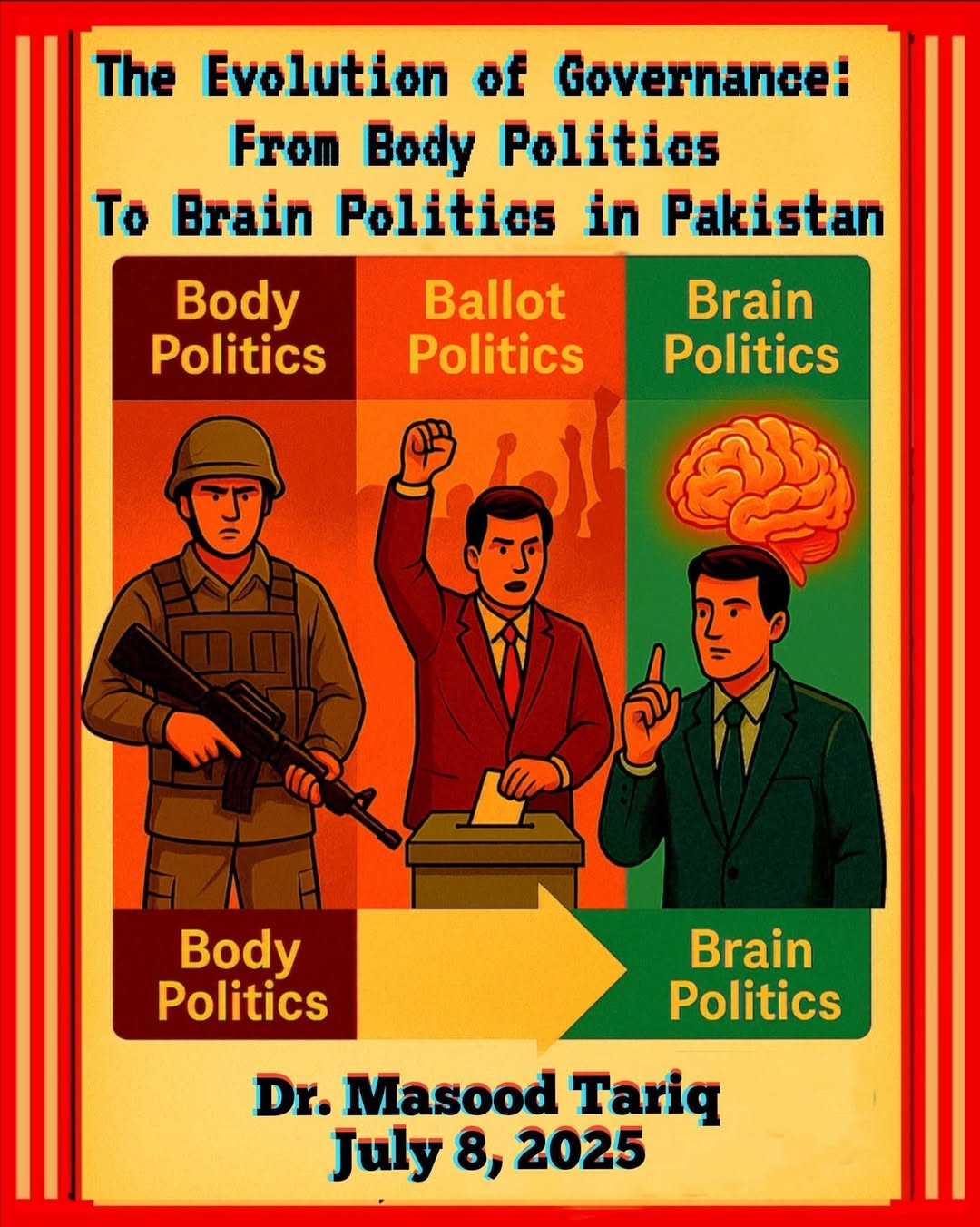
1. Body Politics – Rule through physical coercion and militancy
2. Ballot Politics – Rule through electoral legitimacy and mass mobilization
3. Brain Politics – Rule through intellectual influence, strategic discourse, and institutional power
> Each model corresponds to specific HDI levels and dominant ethnic dynamics, offering a comprehensive lens into Pakistan’s fragmented political landscape.
——————————————–
Table of Contents
1. Body Politics: Governance by Physical Force
2. Ballot Politics: Governance through Electoral Power
3. Brain Politics: Governance through Intellectual Influence
4. Comparative Analysis: Governance Models and Ethnic-Regional Patterns
5. Governance Models in HDI Perspective
6. Conclusion
——————————————–
1. Body Politics: Governance by Physical Force
In early or low-development phases, Body Politics dominates. It is the most archaic form of governance, relying on physical coercion, militias, and rule through fear.
(i) Characteristics:
(a) Territorial Dominance via Violence:
Power is secured by destroying or weakening the physical capability of opponents.
(b) Militarization:
The creation of militias and training of armed groups are central strategies.
(c) Fear-Based Control:
Public dissent is neutralized through intimidation and violence.
(d) Use of Local Strongmen:
Physically powerful individuals (local enforcers) are co-opted into governance roles.
(ii) Geographic Presence:
Body Politics is prevalent in low-HDI tribal and rural regions, especially where state institutions are weak or absent.
(iii) Ethnic Relevance:
Among Pakistan’s ethnic groups, Pashtuns and Baloch have historically engaged in this model, particularly in regions where formal governance structures remain underdeveloped.
——————————————–
2. Ballot Politics: Governance through Electoral Power
As literacy, media access, and political institutions expanded, Ballot Politics replaced physical dominance with mass-based electoral legitimacy.
(i) Characteristics:
(a) Electoral Dominance:
Governance is pursued by weakening the opponent’s vote bank.
Political Party Formation: Structured organizations mobilize the electorate and coordinate political activities.
(b) Mass Protests and Campaigns:
Demonstrations serve as pressure tactics for electoral and legislative gains.
(c) Capital Integration:
Wealthy individuals with voting influence are absorbed into party systems.
(ii) Geographic Presence:
Ballot Politics remains influential in semi-urban and rural areas with moderate HDI, though it is increasingly ineffective in educated urban zones.
(iii) Ethnic Relevance:
This model is predominantly practiced by Punjabis and Sindhis, who maintain traditional networks of political patronage and rural vote blocs.
——————————————–
3. Brain Politics: Governance through Intellectual Influence
In high-HDI societies, Brain Politics emerges as the most advanced governance model, rooted in ideas, policy, and strategic communication.
(i) Characteristics:
(a) Cognitive Supremacy:
Political actors use argumentation, analysis, and information control to outmaneuver rivals.
(b) Think Tanks and Research Institutes:
Institutions shape public discourse and policy formulation.
(c) Workshops, Seminars, and Media Engagements:
Public support is cultivated through education and awareness campaigns.
(d) Recruitment of Professionals:
Educated individuals, scholars, and technocrats are brought into the fold.
(ii) Geographic Presence:
Brain Politics is prevalent in urban centers like Karachi, Lahore, and Islamabad, where educational institutions, media, and civil society are active.
(iii) Ethnic Relevance:
Muhajirs (Urdu-speaking Indian migrants) have historically practiced Brain Politics, using their urban literacy, institutional presence, and media dominance to shape political narratives.
——————————————–
4. Comparative Analysis: Governance Models and Ethnic-Regional Patterns
(a) Body Politics is defined by the use of force, militias, and fear. It is primarily practiced by Pashtuns and Baloch in low-HDI tribal and rural regions.
(b) Ballot Politics employs electoral mechanisms, political parties, and mobilization strategies. It is practiced mostly by Punjabis and Sindhis in moderate-HDI rural and semi-urban regions.
(c) Brain Politics revolves around ideas, research, workshops, and institutional influence. It is dominated by Muhajirs in urban areas with high HDI, such as Karachi and parts of Hyderabad and Lahore.
——————————————–
5. Governance Models in HDI Perspective
(a) Body Politics →
Governance through physical force and militias.
Dominant Ethnic Groups:
Pashtuns, Baloch
Geographic Spread:
Tribal and rural zones
HDI Dependency:
Very Low
(b) Ballot Politics → Governance through elections, protests, and party mobilization.
Dominant Ethnic Groups:
Punjabis, Sindhis
Geographic Spread:
Rural and semi-urban areas
HDI Dependency:
Moderate
Brain Politics → Governance through ideas, media influence, think tanks, and intellectual discourse.
Dominant Ethnic Groups:
Muhajirs
Geographic Spread:
Urban and metropolitan centers
HDI Dependency:
High
——————————————–
6. Conclusion
Pakistan’s political history reflects an ongoing transformation in governance. These transformations correspond not only to changes in technology, education, and urbanization, but also to ethnic patterns and institutional access. The evolution from Body to Ballot to Brain Politics maps directly onto the country’s HDI trajectory:
(a) Pashtun and Baloch regions remain entrapped in force-based politics due to underdevelopment and state neglect.
(b) Punjabi and Sindhi regions thrive in ballot-based systems but now face stagnation as urban centers demand intellectual governance.
(c) Muhajir communities, long embedded in urban institutional networks, have pioneered a politics of strategy, research, and communication.
Looking ahead, Brain Politics is likely to become the dominant form of governance in Pakistan, especially as the national HDI improves. This transition demands policy focus on:
(a) Educational reforms
(b) Institutional modernization
(c) Civic engagement through knowledge
For governance to truly modernize, these shifts must be accompanied by inclusive political discourse, decentralization, and strategic investment in intellectual infrastructure.
Ultimately, the dominance of Brain Politics depends not only on improved HDI, but also on the deliberate cultivation of intellectual infrastructure, decentralization, and inclusive policymaking.
The tripartite framework proposed herein offers both a diagnostic and a strategic roadmap for Pakistan’s evolving governance landscape.
——————————————–
Author Biography
Dr. Masood Tariq is a Karachi-based politician and political theorist. He formerly served as Senior Vice President of the Pakistan Muslim Students Federation (PMSF) Sindh, Councillor of the Municipal Corporation Hyderabad, Advisor to the Chief Minister of Sindh, and Member of the Sindh Cabinet.
His research explores South Asian geopolitics, postcolonial state formation, regional nationalism, and inter-ethnic politics, with a focus on the Punjabi question and Cold War strategic alignments.
He also writes on Pakistan’s socio-political and economic structures, analysing their structural causes and proposing policy-oriented solutions aligned with historical research and contemporary strategy.
His work aims to bridge historical scholarship and strategic analysis to inform policymaking across South Asia, Central Asia, and the Middle East.


Leave a Reply