
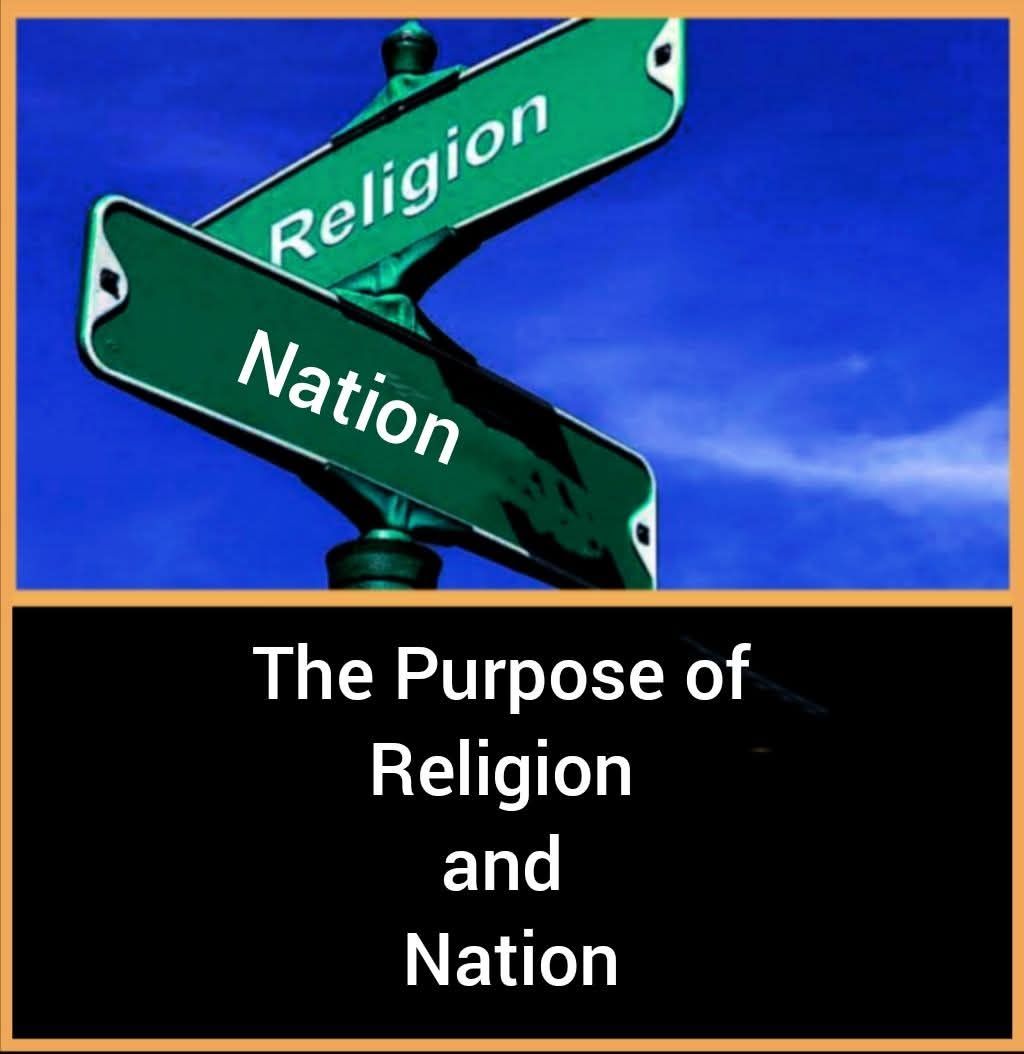
The Purpose of Religion and Nation
Dr. Masood Tariq
Independent Political Theorist
Karachi, Pakistan
drmasoodtariq@gmail.com
Date: May 25, 2025
——————————————–
Introduction: Religion and Nation as Civilizational Foundations
From ancient tribes to modern nation-states, societies have been shaped by two interwoven quests: the moral refinement of individuals and the collective empowerment of peoples. These pursuits—anchored in religion and nationhood—are not mere abstract ideals but enduring civilizational principles.
The purpose of Religion is to improve worldly life and the hereafter by following religious teachings to reform one’s physical actions, soul desires, and mind thoughts.
The purpose of Nation is to make worldly life better by achieving political stability to ensure one’s social dignity, administrative authority, financial prosperity, and economic development.
Understanding the complementary yet distinct purposes of religion and nation is critical to achieving cultural continuity, political stability, and human development in the modern world.
Recent scholarship in political theology (Bell, 2012) and civilizational studies (Eisenstadt, 2003) affirms that the historical progress of humanity has often depended on the successful integration—rather than isolation—of moral and institutional structures. These structures are primarily exemplified in religious ethics and national governance.
——————————————–
Table of Contents
1. Religion: The Moral and Metaphysical Core of Civilization
2. Nation: The Political and Cultural Organism of Collective Life
3. The Dynamic Between Religion and Nation
4. Conclusion: Integrating the Sacred and the Civic
5. References
——————————————–
1. Religion: The Moral and Metaphysical Core of Civilization
Religion has always been more than ritual. It offers humanity a framework for understanding the self, the universe, and the divine. It teaches the individual how to live rightly, suffer nobly, and die meaningfully. As such, religion is the spiritual conscience of civilization.
All major faiths have offered holistic paths to human development. The Qur’anic concept of al-falāḥ (success) encompasses both worldly welfare and eternal salvation (Nasr, 2002).
Christianity elevates ethical life through the teachings of Jesus as a model of love and sacrifice, emphasizing moral action in a fallen world (Niebuhr, 1932).
Hinduism’s Dharma and Confucianism’s Ren stress inner self-cultivation as a precondition for social harmony (Halbfass, 1988; Tu Weiming, 1985).
Islam’s concept of Tazkiyah al-Nafs (purification of the soul) aligns with the spiritual and moral dimensions of the human condition (Murata & Chittick, 1994).
Al-Ghazali (1058–1111), in his Iḥyāʾ ʿUlūm al-Dīn, insisted that the health of society is intrinsically linked to the ethical health of its individuals—and that only religion can offer a durable system for cultivating morally responsible citizens.
Moreover, religion guides not only belief but behaviour—shaping the body, soul, and mind into a coherent moral agent.
It instils virtues such as empathy, discipline, and humility, all crucial for civic life and societal cooperation (Taylor, 2007).
As Asad (2003) notes, the secular liberal notion of the self is incomplete without recognizing the religious practices that constitute moral subjectivity.
——————————————–
2. Nation: The Political and Cultural Organism of Collective Life
Where religion shapes the individual, the nation organizes the collective. A nation is not merely a geographical territory—it is a historical and cultural community united by shared values, language, memory, and collective aspiration.
The purpose of a nation is to ensure that its members live with dignity, freedom, and opportunity within a stable and just framework. Nationhood provides institutional mechanisms for representation, law, and resource distribution—essential for human flourishing (Gellner, 1983).
Unlike abstract theories of statehood, nations bind people not only by law but by memory and meaning. As Benedict Anderson (1983) famously argued, nations are “imagined communities” in which individuals find identity, belonging, and historical continuity.
Aristotle’s declaration that “man is by nature a political animal” (Politics, 1992) finds its most realized modern form in the nation-state—a political body capable of self-determination and structured justice.
In Islamic political thought, the concept of ummah offers a spiritual nation defined by shared moral purpose, while classical theorists like Al-Mawardi emphasized the necessity of imāmah (leadership) for securing justice and preventing chaos (Al-Aḥkām al-Sulṭāniyya, 11th century).
Furthermore, nationhood has become the principal framework for securing civil rights, cultural preservation, and economic growth. Amartya Sen (1999) argues that political and economic freedoms are mutually reinforcing; both are essential for national human development.
——————————————–
3. The Dynamic Between Religion and Nation
Religion and nation operate in distinct but interrelated spheres. Religion provides the ethical vision and moral compass for individual and collective life. The nation, in turn, offers the administrative, legal, and structural space where those values can be realized at scale. Their interaction is thus not adversarial but synergistic—when appropriately balanced.
Historically, societies that achieved this balance have experienced civilizational flourishing. For example, the Ottoman millet system allowed religious pluralism under a unified administrative order (Barkey, 2008). Similarly, the convivencia in Andalusian Spain permitted Muslims, Christians, and Jews to co-exist and contribute to shared cultural and scientific advancement (Menocal, 2002).
On the other hand, both religious absolutism and extreme secular nationalism have resulted in authoritarianism and moral decay. When religion is hijacked by nationalist ideologies, it risks becoming a tool of exclusion. Conversely, when nationalism suppresses religious expression, it risks becoming spiritually hollow and morally rudderless.
The equilibrium lies in mutual reinforcement: religion must illuminate the nation’s ethical direction, and the nation must safeguard religious freedom and dignity. Only then can both domains contribute to a humane, just, and dynamic civilization.
——————————————–
4. Conclusion: Integrating the Sacred and the Civic
The purpose of Religion is the inner reform of human beings—body, soul, and mind—so they may live morally and meaningfully.
The purpose of a Nation is to construct a collective system that ensures justice, dignity, development, and self-determination for its members.
One without the other leads to imbalance: religion without national structure may remain isolated; a nation without religious values may become ethically hollow. True civilization emerges when both the sacred and the civic work in harmony—forming morally guided, administratively efficient, and spiritually enriched societies.
Rather than fusing religion and nation into a single system—which risks the dangers of theocracy or ultra-nationalism—the task is to let each fulfil its respective role while respecting and reinforcing the other. This balance is the formula for enduring civilizational vitality and holistic human development.
——————————————–
5. References
Al-Ghazali. Ihya Ulum al-Din. Trans. by Nabih Amin Faris, 1952.
Anderson, Benedict. Imagined Communities: Reflections on the Origin and Spread of Nationalism. Verso, 1983.
Aristotle. Politics. Trans. C.D.C. Reeve, Hackett Publishing, 1992.
Asad, Talal. Formations of the Secular: Christianity, Islam, Modernity. Stanford University Press, 2003.
Barkey, Karen. Empire of Difference: The Ottomans in Comparative Perspective. Cambridge University Press, 2008.
Bell, Daniel M. The Political Theology of the Body: The Politics of Christ in the Empire. Baker Academic, 2012.
Eisenstadt, S.N. Comparative Civilizations and Multiple Modernities. Brill, 2003.
Gellner, Ernest. Nations and Nationalism. Cornell University Press, 1983.
Halbfass, Wilhelm. India and Europe: An Essay in Understanding. State University of New York Press, 1988.
Mawardi, al-. Al-Ahkam al-Sultaniyyah (The Ordinances of Government), 11th century.
Menocal, María Rosa. The Ornament of the World: How Muslims, Jews and Christians Created a Culture of Tolerance in Medieval Spain. Back Bay Books, 2002.
Murata, Sachiko, and William C. Chittick. The Vision of Islam. Paragon House, 1994.
Nasr, Seyyed Hossein. The Heart of Islam: Enduring Values for Humanity. HarperOne, 2002.
Niebuhr, Reinhold. Moral Man and Immoral Society. Charles Scribner’s Sons, 1932.
Sen, Amartya. Development as Freedom. Oxford University Press, 1999.
Taylor, Charles. A Secular Age. Harvard University Press, 2007.
Tu Weiming. Confucian Thought: Selfhood as Creative Transformation. State University of New York Press, 1985.
——————————————–
Author Biography
Dr. Masood Tariq is a Karachi-based politician and political theorist. He formerly served as Senior Vice President of the Pakistan Muslim Students Federation (PMSF) Sindh, Councillor of the Municipal Corporation Hyderabad, Advisor to the Chief Minister of Sindh, and Member of the Sindh Cabinet.
His research explores South Asian geopolitics, postcolonial state formation, regional nationalism, and inter-ethnic politics, with a focus on the Punjabi question and Cold War strategic alignments.
He also writes on Pakistan’s socio-political and economic structures, analysing their structural causes and proposing policy-oriented solutions aligned with historical research and contemporary strategy.
His work aims to bridge historical scholarship and strategic analysis to inform policymaking across South Asia, Central Asia, and the Middle East.


Leave a Reply