
Composition of the National Assembly of Pakistan and the Role of Punjab in Electing the Prime Minister
Date: October 10, 2025
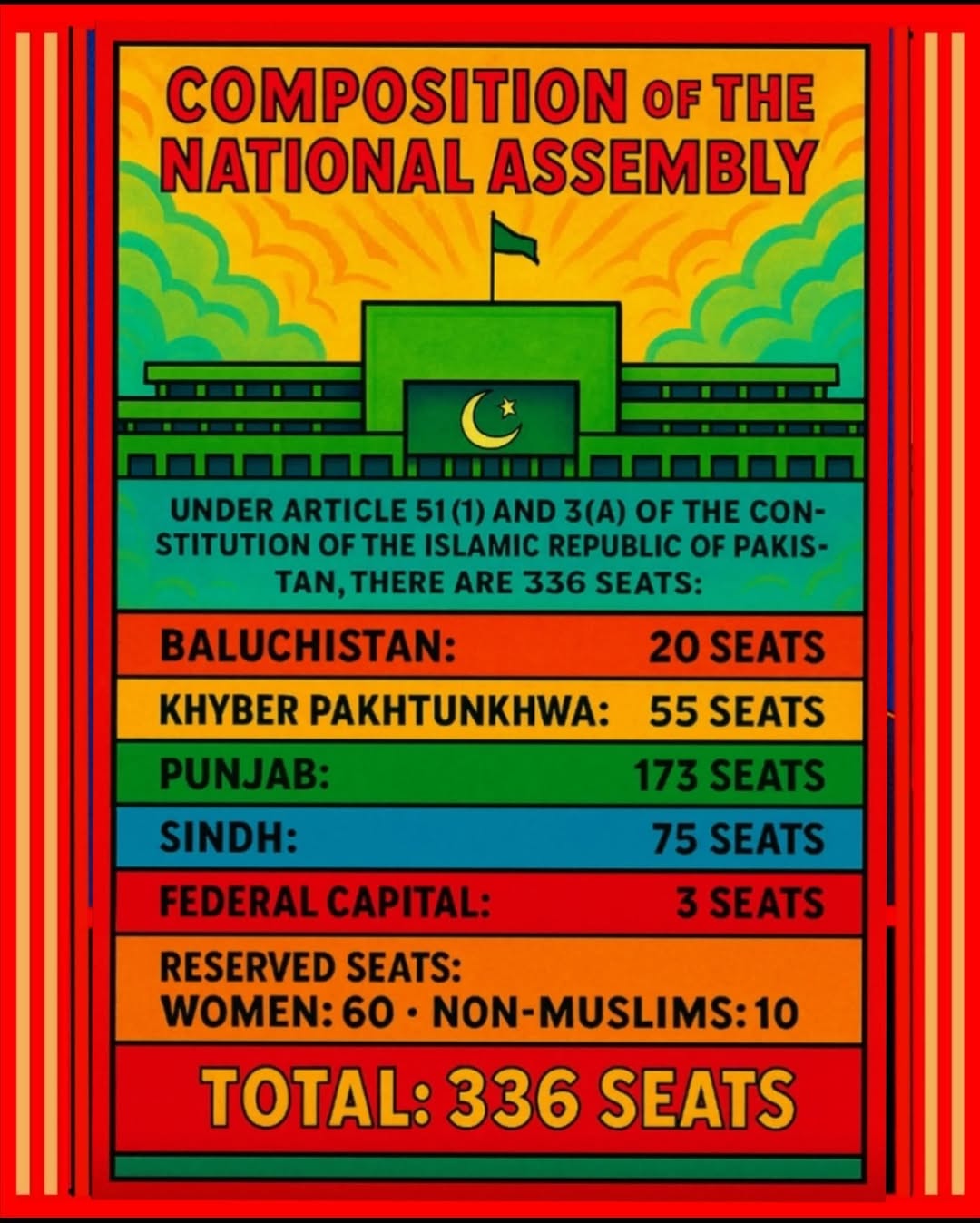
According to Article 51(1) and Article 51(3)(a) of the Constitution of the Islamic Republic of Pakistan, the National Assembly comprises a total of 336 seats, including general seats, reserved seats for women, and reserved seats for non-Muslims.
Out of these 336 seats, 266 are general seats, 60 are reserved for women, and 10 are reserved for non-Muslims. The allocation of these seats among the provinces and territories is as follows:
Punjab holds 141 general seats and 32 reserved seats for women, making a total of 173 seats.
Sindh has 61 general seats and 14 reserved seats for women, totaling 75 seats.
Khyber Pakhtunkhwa has 45 general seats and 10 reserved seats for women, totaling 55 seats.
Balochistan has 16 general seats and 4 reserved seats for women, totaling 20 seats.
The Federal Capital (Islamabad) has 3 general seats, bringing its total to 3 seats.
In addition, there are 10 seats reserved for non-Muslims, elected through the proportional representation system of political parties based on their overall performance in the National Assembly.
This brings the total strength of the National Assembly to 336 members — 266 general, 60 women, and 10 non-Muslim seats.
—
Prime Ministerial Majority and Punjab’s Central Role
Under Article 91(4) of the Constitution, the Prime Minister of Pakistan is elected by a majority of the total membership of the National Assembly. Since the Assembly comprises 336 members, a candidate requires the support of at least 169 members to secure a simple majority and form the government.
Given that Punjab alone accounts for 173 seats — more than half of the total House — it is the decisive province in determining who can become the Prime Minister of Pakistan.
No individual or party can form the federal government or elect a Prime Minister without winning a significant number of seats from Punjab, because even a clean sweep in Sindh (75 seats), Khyber Pakhtunkhwa (55 seats), Balochistan (20 seats), and Islamabad (3 seats) would still total only 153 seats, falling short of the required 169-vote majority.
Therefore, Punjab serves as the electoral pivot of Pakistan’s parliamentary system. The path to the Prime Minister’s Office constitutionally and mathematically runs through Punjab — making it the single most influential province in shaping the country’s federal leadership.



Leave a Reply