
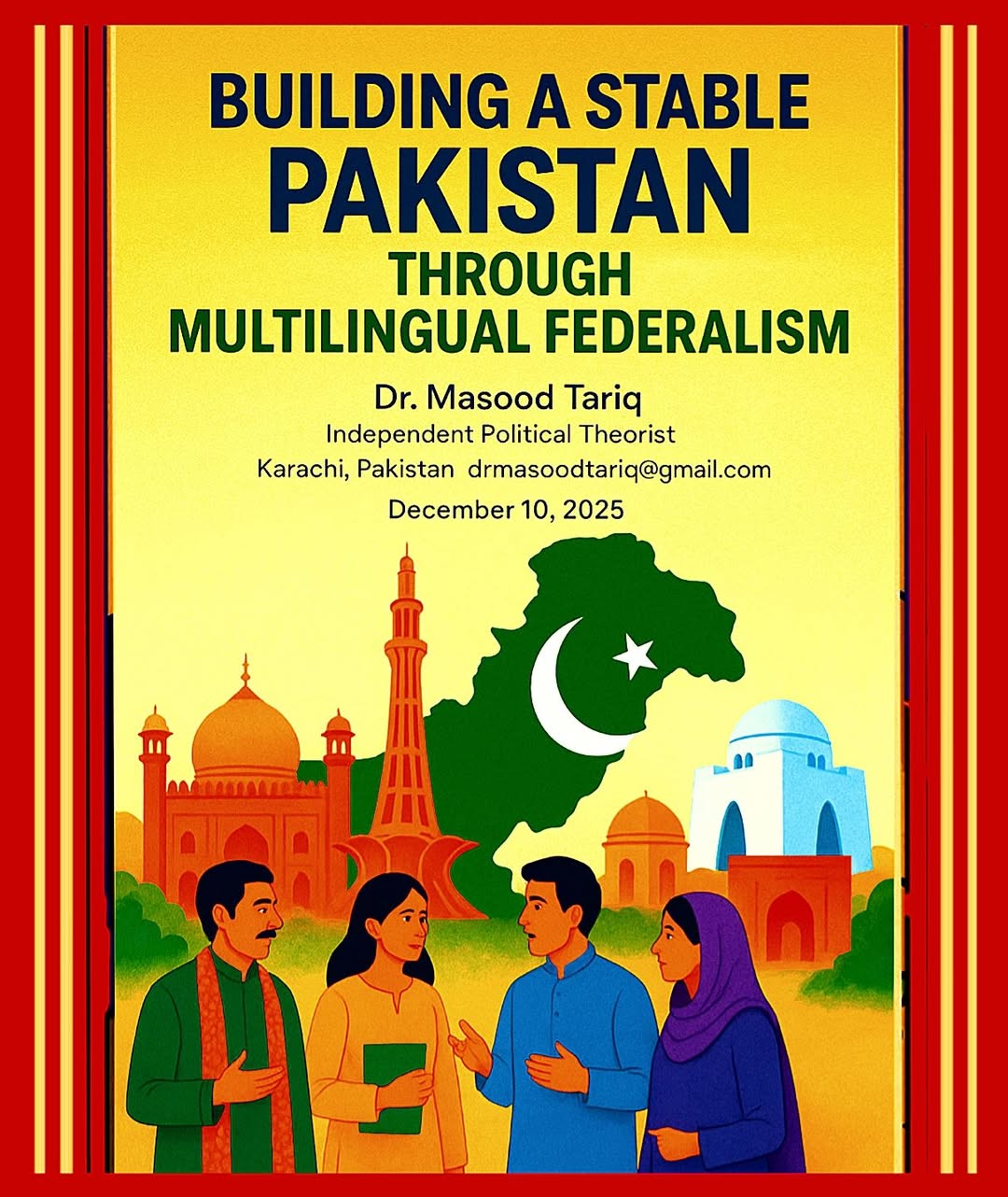
Dr. Masood Tariq
Independent Political Theorist
Karachi, Pakistan
drmasoodtariq@gmail.com
Date: December 10, 2025
——————————————–
Abstract
This article responds to key questions concerning the relationship between language policy, cultural rights, and state formation in Pakistan. Drawing on comparative linguistic policy, political theory, and research on postcolonial states, it argues that Pakistan’s adoption of Urdu as the sole national language was not a neutral administrative decision but a deliberate project of the post-Partition UP/CP Ashrafia to centralize political power and reshape national identity.
The analysis addresses five issues: the state’s need for an official language, the inadequacy of optional language inclusion, alternative models of recognition, the developmental benefits of indigenous languages, and the linguistic requirements of international diplomacy. It concludes that Pakistan’s long-term stability requires multilingual federalism rather than linguistic engineering, and that the empowerment of indigenous languages is essential for democratic consolidation and cultural justice.
——————————————–
Table of Contents
1. Introduction
2. The Need for an Official Language: Administrative Necessity or Cultural Supremacy?
3. Optional Inclusion: Symbolic Recognition or Structural Inequality?
4. Alternative Models for Linguistic Recognition
5. Benefits of Flourishing Indigenous Languages
6. Language and International Affairs
7. Urdu: Expedience or Political Engineering?
8. Would Any Regional Language Have Created Similar Confusion?
9. Conclusion
10. References
——————————————–
1. Introduction
Language is more than a communication tool; it is a repository of memory, identity, and historical continuity. In postcolonial societies—particularly those emerging from traumatic partitions—language policy becomes an instrument through which elites shape national identity and consolidate power (Fishman, 1972; Anderson, 1983; Rahman, 1996).
Pakistan’s decision to adopt Urdu as the sole national language in 1948 remains one of the most consequential choices in its early political history. This article argues that the decision was neither neutral nor administratively inevitable. Rather, it constituted a political project that redefined power relations among Pakistan’s linguistic-national groups.
The discussion proceeds through the five major questions, offering evidence from comparative politics, historical archives, and sociolinguistics.
——————————————–
2. The Need for an Official Language: Administrative Necessity or Cultural Supremacy?
Modern states require functional lingua francas to operate efficiently. Yet the selection of such a language—especially in multilingual societies—is closely tied to political power and elite identity (Laitin, 1992; Ricento, 2006).
2.1 Comparative Models
Switzerland employs German, French, Italian, and Romansh without privileging one identity (Grin, 1999).
Indonesia adopted Bahasa Indonesia—a non-majority mother tongue—to avoid ethnic supremacy (Errington, 1998).
Tanzania elevated Kiswahili but maintained institutional protection for over 120 local languages (Batibo, 2005).
These examples show that administrative cohesion does not require linguistic homogenization.
2.2 Pakistan’s Case
The issue in Pakistan was not the use of Urdu as a functional language but its symbolic elevation and the exclusion of other languages from state institutions. Urdu’s elevation coincided with:
Political dominance of the post-Partition UP/CP Ashrafia (Jalal, 1995; Alavi, 1972)
Marginalization of majority indigenous languages such as Bengali, Punjabi, Sindhi, and Pashto
Construction of a state ideology disconnected from demographic realities
Thus, Urdu’s adoption served as a tool for centralization and identity engineering, not merely administrative expedience.
——————————————–
3. Optional Inclusion: Symbolic Recognition or Structural Inequality?
The teaching of indigenous languages as optional subjects constitutes “symbolic multiculturalism” (Skutnabb-Kangas, 2000), not meaningful policy.
3.1 Domains Where Languages Survive
Languages survive when present in:
1. School instruction
2. Administration
3. Courts
4. Media
5. Prestige knowledge domains
Punjabi, Sindhi, Pashto, Balochi, Brahui, Shina, and others were denied these domains (Rahman, 1996; Mansoor, 2004).
3.2 CSS and Higher Examinations
Exclusion from CSS and judicial exams institutionalized a linguistic hierarchy:
Urdu/English proficiency became a gateway to state power (Bourdieu, 1991)
Indigenous speakers were structurally disadvantaged
Bureaucratic dominance reproduced itself through language
Thus, optional subjects offered token inclusion, not linguistic rights.
——————————————–
4. Alternative Models for Linguistic Recognition
A multilingual federation is administratively viable and politically stabilizing.
4.1 Constitutional Recognition
Belgium, Ethiopia, South Africa, Canada, and India recognize multiple official languages, reducing grievances and strengthening federal cohesion.
4.2 Administrative Federalism
Provincial languages could function in:
Local government
Police and courts
Revenue administration
Provincial legislatures
4.3 Education Policy
UNESCO and World Bank research recommend:
Mother tongue for primary education
Regional language for secondary
National/global languages taught as subjects
This model enhances literacy, conceptual learning, and bilingual competency.
4.4 Cultural Recognition
The state could promote indigenous languages through:
National awards
Cultural academies
Film, media, and publishing grants
Preservation of native scripts
Such measures strengthen cultural identity without diminishing the role of Urdu.
——————————————–
5. Benefits of Flourishing Indigenous Languages
5.1 Education and Cognitive Gains
Mother-tongue education correlates with:
Higher retention
Stronger comprehension
Better bilingualism (Cummins, 2000; UNESCO, 2016; Heugh, 2009)
5.2 Governance and Justice
Local-language administration improves:
Access to justice
Citizen–state interaction
Transparency (UNDP, 2018)
5.3 Social Cohesion
Suppression—not diversity—generates separatist sentiment (Lijphart, 1977; Gurr, 1993).
5.4 Economic and Cultural Growth
Thriving language ecosystems generate:
Literary production
Film and theatre
Publishing industries
Local research traditions
Sindhi and Pashto demonstrate this resilience despite structural suppression.
——————————————–
6. Language and International Affairs
International diplomacy relies on English, Arabic, French, Spanish, and Chinese. Pakistan already uses English for:
Treaties
Diplomacy
Military cooperation
Higher judiciary
Bureaucracy
Recognizing indigenous languages would not hinder Pakistan’s diplomatic operations.
The optimal structure is:
English for diplomacy
Urdu/English for federal communication
Indigenous languages for provincial governance
This mirrors multilingual federations globally.
——————————————–
7. Urdu: Expedience or Political Engineering?
Archival evidence (Government Proceedings, 1948–52) shows that:
The strongest advocates of Urdu belonged to the UP/CP Ashrafia (Jalal, 1995).
Their linguistic preference aligned with their political dominance in the new state (Alavi, 1972).
Bengali—spoken by the majority—was denied equal national status, contributing to the 1971 disintegration.
Thus, the elevation of Urdu was a political project tied to elite consolidation—not a neutral administrative choice.
——————————————–
8. Would Any Regional Language Have Created Similar Confusion?
No. Confusion arose because Pakistan’s state identity was disconnected from its demographic base.
A multilingual federal model would have:
Protected all major linguistic communities
Reduced center–province conflict
Prevented Bengali alienation
Strengthened federal stability
The crisis emerged from cultural imposition, not linguistic diversity.
——————————————–
9. Conclusion
Pakistan’s linguistic hierarchy is historically constructed, not administratively necessary. The exclusion of indigenous languages has weakened literacy, governance, cultural confidence, and national integration.
A multilingual federal framework—grounded in equality, decentralization, and cultural recognition—is essential for long-term stability.
Pakistan’s future depends on acknowledging that internal cultural marginalization is as damaging as external geopolitical domination. Only a linguistically just federation can create unity rooted in dignity and democratic inclusion.
——————————————–
10. References
Alavi, H. (1972). The State in Post-Colonial Societies. New Left Review.
Anderson, B. (1983). Imagined Communities. Verso.
Batibo, H. (2005). Language Decline and Death in Africa. Multilingual Matters.
Bourdieu, P. (1991). Language and Symbolic Power. Harvard University Press.
Cummins, J. (2000). Language, Power, and Pedagogy. Multilingual Matters.
Errington, J. (1998). Shifting Languages: Interaction and Identity in Javanese Indonesia. Cambridge University Press.
Fishman, J. A. (1972). Advances in the Sociology of Language. Mouton.
Grin, F. (1999). Managing Multilingualism in Switzerland. Journal of Multilingual and Multicultural Development.
Gurr, T. (1993). Minorities at Risk. US Institute of Peace.
Heugh, K. (2009). The Case Against Bilingual and Multilingual Education? International Journal of Linguistics.
Jalal, A. (1995). Democracy and Authoritarianism in South Asia. Cambridge University Press.
Laitin, D. (1992). Language Repertoires and State Construction in Africa. Cambridge University Press.
Lijphart, A. (1977). Democracy in Plural Societies. Yale University Press.
Mansoor, S. (2004). The Status and Role of Regional Languages in Higher Education in Pakistan. British Council.
Rahman, T. (1996). Language and Politics in Pakistan. Oxford University Press.
Ricento, T. (2006). An Introduction to Language Policy. Blackwell.
Skutnabb-Kangas, T. (2000). Linguistic Genocide in Education. Routledge.
UNESCO. (2003). Education in a Multilingual World.
UNESCO. (2016). If You Don’t Understand, How Can You Learn?
UNDP Governance Indicators. (2018).
World Bank. (2021). Multilingual Education and Learning Outcomes.
——————————————–
Author Biography
Dr. Masood Tariq is a Karachi-based politician and political theorist. He formerly served as Senior Vice President of the Pakistan Muslim Students Federation (PMSF) Sindh, Councillor of the Municipal Corporation Hyderabad, Advisor to the Chief Minister of Sindh, and Member of the Sindh Cabinet.
His research explores South Asian geopolitics, postcolonial state formation, regional nationalism, and inter-ethnic politics, with a focus on the Punjabi question and Cold War strategic alignments.
He also writes on Pakistan’s socio-political and economic structures, analysing their structural causes and proposing policy-oriented solutions aligned with historical research and contemporary strategy.
His work aims to bridge historical scholarship and strategic analysis to inform policymaking across South Asia, Central Asia, and the Middle East.


Leave a Reply