
Dr. Masood Tariq
Independent Political Theorist
Karachi, Pakistan
drmasoodtariq@gmail.com
Date: June 14, 2025
——————————————–
Abstract
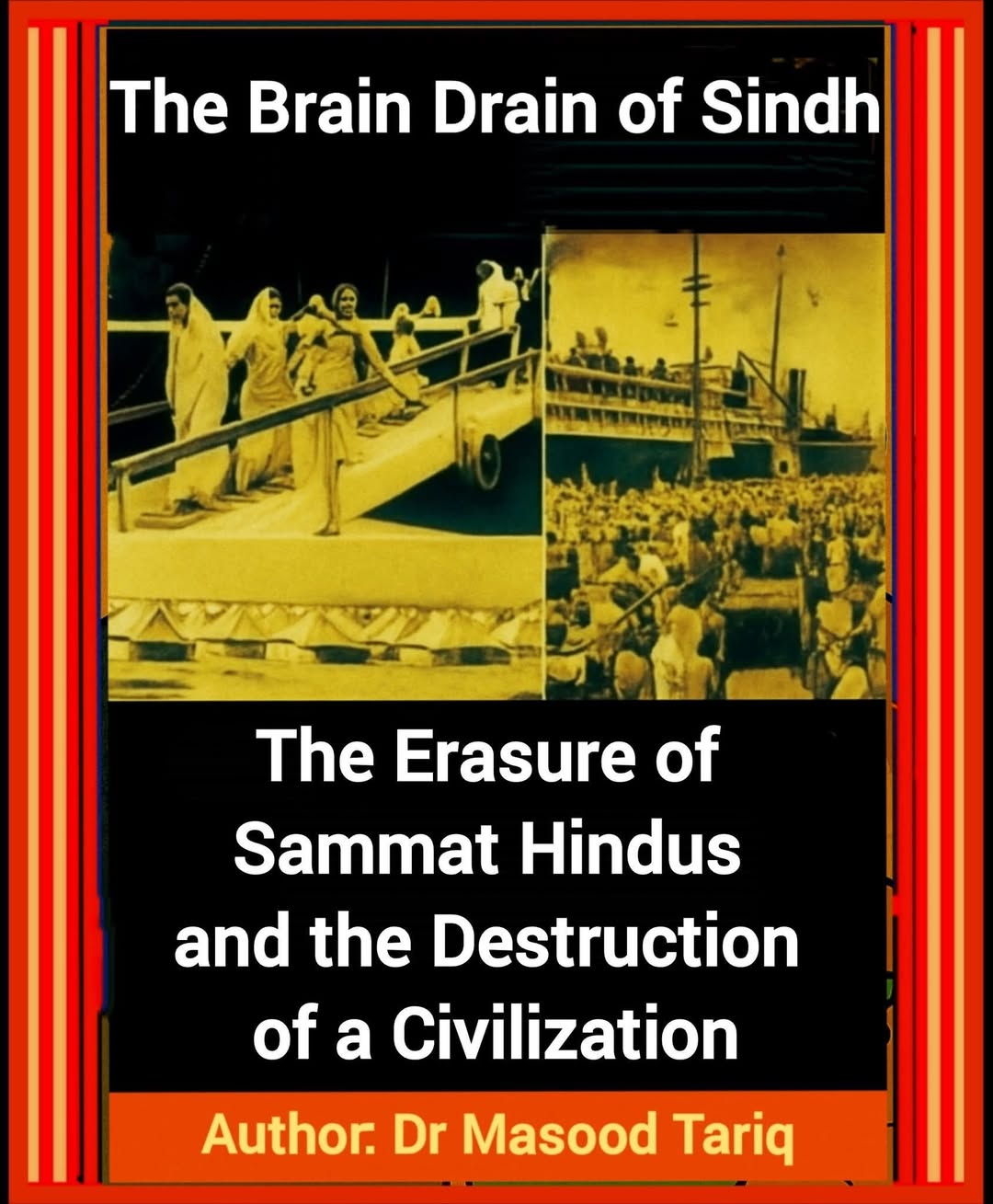
The migration of Sindhi Hindus—particularly the indigenous and educated Sammat Hindu community—during and after the 1947 Partition represents one of the most significant yet overlooked instances of brain drain in South Asian history.
This paper contends that their exodus was not merely the result of communal unrest but a politically facilitated and institutionally tolerated purge of a vital segment of Sindh’s intellectual, cultural, and administrative class.
Drawing on demographic data, archival records, and political testimonies, the study maps how targeted violence and official complicity—especially in Karachi—led to the near-total removal of the native Sammat Hindu population.
The research challenges dominant nationalist narratives that conflate religion with foreignness and reasserts the Sammat Hindus’ status as indigenous inhabitants of the Indus Valley Civilization.
By reevaluating Pakistan’s foundational identity through the lens of Sindh’s demographic transformation, this paper calls for the restoration of suppressed historical truths to build a more inclusive and accurate understanding of the Pakistani nation-state.
——————————————–
Table of Contents
(1). Introduction
(2). Demographic Composition of Sindh and Karachi in 1947
(3). Demographic Shift After Partition
(4). Violence Against Hindu Sindhis and State Complicity
(5). Efforts to Restore Order and the Political Crisis
(6). Targeted Violence Against Indigenous Sammat Hindu Sindhis
(7). Rethinking the National Composition of Pakistan
( . Identity of Sammat Hindus and Their Place in Pakistan
(9). Conclusion
(10). References
——————————————–
(1). Introduction
The Partition of British India in 1947 was one of the most violent and disruptive events of the 20th century, leading to widespread demographic upheaval, forced migration, and deep socio-political ruptures across the subcontinent.
While much of the historical discourse has focused on the Punjab and Bengal regions, Sindh, too, underwent profound transformations that continue to reverberate in the political and cultural landscape of Pakistan.
Among the most tragic consequences was the mass exodus of Sindhi Hindus—many of them educated, economically active members of society—leading to what can aptly be described as the “brain drain” of Sindh.
This paper presents a historical and political account of the migration of Sammat Hindu Sindhis from Karachi and other parts of Sindh, the state-backed communal violence that accompanied it, and the long-term impact on Sindh’s social and administrative fabric.
It situates this migration not merely as a demographic shift but as a strategic loss of cultural continuity, administrative capacity, and indigenous intellectual capital.
——————————————–
(2). Demographic Composition of Sindh and Karachi in 1947
Sindh, one of the most vibrant, tolerant, and economically productive provinces of pre-Partition India, suffered immensely in the aftermath.
With a total population of 3.88 million in 1947—of which over 1 million were Hindus—Sindh had one of the most balanced and cosmopolitan social fabrics, like Punjab.
In August 1947, when Pakistan was created, the total population of Sindh was 3,887,070, out of which 2,832,000 were Muslims and 1,015,000 were Hindus.
Karachi’s population on the eve of the creation of Pakistan was 450,000, and its demography was:
Sindhi – 61.2%
Balochi – 8.6%
Urdu/Hindi – 6.3%
Punjabi – 4.3%
Gujarati – 3.5%
——————————————–
(3). Demographic Shift After Partition
Karachi’s population rapidly grew with a large influx of Muslim refugees from India after the creation of Pakistan in 1947. By 1951, Karachi’s population became 1,137,000 and its demography was:
Urdu – 50%
Sindhi – 8.6%
After the creation of Pakistan, most of the Urdu-speaking Muslims from North India settled in Karachi.
Likewise, a large number of Hindus left the city in 1947 due to Hindu-Muslim riots and settled in India.
This was not just demographic change—it was the cultural and administrative decapitation of Sindh.
The migration of Hindu Sindhis—particularly from the educated Sammat caste—was one of the greatest brain drains from Sindh, a process that ironically continues to date.
——————————————–
(4). Violence Against Hindu Sindhis and State Complicity
In the aftermath of Partition, newly arrived Muslim refugees from India played a central role in the organized violence against Sammat Hindu Sindhis, particularly in Karachi (1947–48). These communities were subjected to targeted assaults, intimidation, and displacement, while the state largely remained passive—if not complicit.
Historical accounts suggest that Prime Minister Liaquat Ali Khan tacitly supported this campaign, enabling unchecked actions by incoming refugees. The failure to prevent or condemn such violence contributed to a sense of impunity.
In January 1948, during a cabinet meeting, Liaquat Ali Khan reportedly told Sindh Chief Minister Ayub Khuhro: “Go make your capital in Hyderabad or somewhere else.” Muhammad Ali Jinnah, present at the meeting, did not object—reflecting a federal inclination to displace indigenous Sindhi leadership.
——————————————–
(5). Efforts to Restore Order and the Political Crisis
The Sindh government set up a Peace Board comprising Hindu and Muslim members to maintain order in Sindh province. P.V. Tahilramani was secretary of the Peace Board.
P.V. Tahilramani rushed to the Chief Minister of Sindh Ayub Khuhro’s office on January 6, 1948, at around 11 a.m. to inform the Chief Minister that the Sikhs in the Guru Mandir areas of Karachi were being killed.
According to Ayub Khuhro’s personal testimony, senior bureaucrats and police were absent when he arrived at Guru Mandir on January 6, 1948. He witnessed mobs of Indian Muslim refugees “armed with knives and sticks storming the Gurdwara.”
When Khuhro later met Prime Minister Liaquat Ali Khan, the latter reportedly rebuked him: “What sort of Muslim are you that you protect Sikhs and Hindus here when Muslims are being killed in India? Aren’t you ashamed of yourself!”
——————————————–
(6). Targeted Violence Against Indigenous Sammat Hindu Sindhis
The violence that accompanied the demographic upheaval in Sindh was not spontaneous. Archival records and testimonies reveal that Prime Minister Liaquat Ali Khan gave tacit support to attacks against Hindu and Sikh residents in Karachi, particularly the Sammat Hindu Sindhis—the original inhabitants of the Indus Valley region.
——————————————–
(7). Rethinking the National Composition of Pakistan
Pakistan is composed of the land of the Indus Valley Civilization, and Punjabi, Sammat, Brahui, Gilgiti-Baltistani, Kohistani, Chitrali, and Swati nations (Kashmiri, Hindko, Derawali are counted in the Punjabi nation) are the actual and original inhabitants of Indus Valley Civilization land.
The dominant narrative that Pakistan consists solely of four major nations—Punjabi, Sindhi, Baloch, and Pashtun—oversimplifies the country’s complex ethno-cultural makeup.
Pakistan is home to a diverse array of indigenous groups Punjabi, Sammat (Sindhi), Baloch, Brahui, Gilgiti-Baltistani, Kohistani, Chitrali, Swati, Pathan peoples, in addition to communities such as the Muhajirs (Indian Muslim refugees) who arrived after Partition.
This layered composition reflects the civilizational continuity of the Indus Valley region, whose demographic foundation cannot be reduced to a binary Hindu-Muslim division or a limited ethnonational framework.
——————————————–
(. Identity of Sammat Hindus and Their Place in Pakistan
The Sammat Hindus of Sindh share neither linguistic, cultural, nor traditional ties with present-day India. As original inhabitants of the Indus Valley Civilization, their historical identity is rooted in the same soil as many Muslim communities in Pakistan today.
Their religious affiliation does not negate their indigeneity. Across various regions—Punjabi, Brahui, Gilgiti-Baltistani, Kohistani, Chitrali, Swati, and others—Sammat Hindus have historically been regarded as part of the broader regional fabric, not as outsiders.
Recognizing this historical continuity is essential for reframing the place of Hindu Sindhis within Pakistan’s national identity—not as remnants of a foreign past, but as contributors to its foundational civilization.
——————————————–
(9). Conclusion
The migration of Sammat Hindu Sindhis in the wake of Partition was not an incidental outcome of communal riots but a deliberate and systematic erasure of a vibrant, indigenous population from the heart of the Indus Valley.
The socio-political patronage extended by state leadership to incoming Muslim refugees from North India, at the expense of native Sindhi populations—both Hindu and Muslim—altered the demographic and administrative structures of Sindh permanently.
This historical exodus, driven by violence and facilitated by official inaction or hostility, must be recognized not only as a humanitarian loss but also as a civilizational rupture that drained Sindh of some of its most capable communities.
The Sammat Hindu Sindhis were not outsiders—they were intrinsic to the land and culture of Sindh and the broader Indus Valley Civilization.
The continued marginalization of this historical truth distorts the national narrative and suppresses indigenous identities that are essential to understanding the real composition of Pakistan.
Reclaiming this history is not just about justice for the past—it is a necessary step toward forging a more inclusive and historically grounded national identity.
——————————————–
(10). References
Khuhro, Hamida. The Making of Modern Sindh: British Policy and Social Change in the Nineteenth Century. Karachi: Oxford University Press, 1999.
Butalia, Urvashi. The Other Side of Silence: Voices from the Partition of India. Durham: Duke University Press, 2000.
Talbot, Ian. Pakistan: A Modern History. London: Hurst & Company, 2009.
Ansari, Sarah F. D. Life after Partition: Migration, Community and Strife in Sindh, 1947–1962. Oxford: Oxford University Press, 2005.
Vazirani, Aruna. “Sindhi Hindus and Partition: A Forgotten Exodus.” Economic and Political Weekly, vol. 53, no. 45, 2018, pp. 45–52.
Official Population Census of Pakistan, 1951. Government of Pakistan, Bureau of Statistics.
Archives of the Sindh Assembly and Cabinet Proceedings, 1947–1948. Sindh Secretariat Historical Records, Karachi.
Qasmi, Ali Usman. The Ahmadis and the Politics of Religious Exclusion in Pakistan. London: Anthem Press, 2014.
——————————————–
Author Biography
Dr. Masood Tariq is a Karachi-based politician and political theorist. He formerly served as Senior Vice President of the Pakistan Muslim Students Federation (PMSF) Sindh, Councillor of the Municipal Corporation Hyderabad, Advisor to the Chief Minister of Sindh, and Member of the Sindh Cabinet.
His research explores South Asian geopolitics, postcolonial state formation, regional nationalism, and inter-ethnic politics, with a focus on the Punjabi question and Cold War strategic alignments.
He also writes on Pakistan’s socio-political and economic structures, analysing their structural causes and proposing policy-oriented solutions aligned with historical research and contemporary strategy.
His work aims to bridge historical scholarship and strategic analysis to inform policymaking across South Asia, Central Asia, and the Middle East.


Leave a Reply