
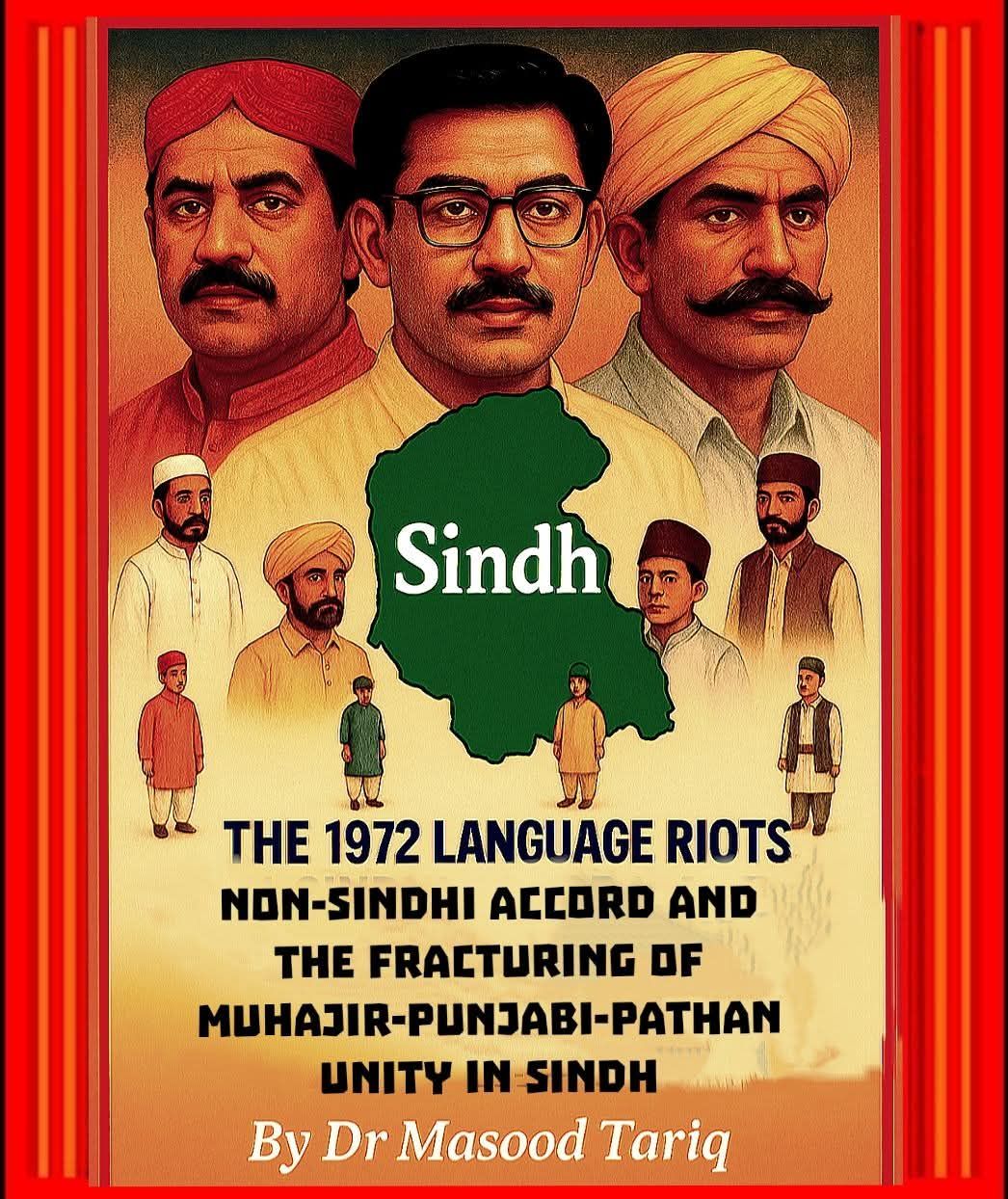
The 1972 Language Riots, Non-Sindhi Accord, and the Fracturing of Muhajir-Punjabi-Pathan Unity in Sindh
Author:
Dr. Masood Tariq
Independent political theorist
Karachi, Pakistan
drmasoodtariq@gmail.com
Date: May 26, 2025
——————————————–
Abstract
This paper analyzes the sociopolitical dynamics of Sindh following the 1972 Language Bill and the subsequent communal tensions between Sindhis and Urdu-speaking Muhajirs.
It contextualizes the historic “non-Sindhi” accord brokered by Prime Minister Zulfikar Ali Bhutto, examines the breakdown of Muhajir-Punjabi-Pathan political unity in the late 1980s, and proposes a reevaluation of political representation in Sindh, particularly the role of the Governor.
Drawing upon primary sources, newspaper archives, and scholarly research, this study illustrates the long-term impact of ethnic power-sharing frameworks and their erosion under the rise of ethnic-centric movements like the MQM.
——————————————–
Table of Contents
1. Introduction
2. The 1972 Language Bill and Ethnic Unrest
3. The “Non-Sindhi” Accord and Power-Sharing Framework
4. Breakdown of Unity: The Rise of MQM and Formation of PPI
5. The Political Marginalization of Punjabis and Pashtuns
6. Reassessing the Accord in the Present Context
7. Conclusion
8. References
——————————————–
1. Introduction
The political history of Sindh has long been shaped by ethnic stratification and the legacy of migration after the 1947 Partition.
The arrival of Urdu-speaking Muhajirs in Karachi and the urban centres of Sindh disrupted existing demographic balances and sparked debates over language, identity, and political power.
A key turning point in this history was the passage of the 1972 Language Bill under Chief Minister Mumtaz Bhutto, which made Sindhi the sole official language of the province—igniting widespread riots and violent confrontations.
——————————————–
2. The 1972 Language Bill and Ethnic Unrest
In July 1972, the Sindh Assembly passed the Sindhi Language Bill, declaring Sindhi as the only official and educational language of the province, replacing Urdu.
This triggered widespread protests by Urdu-speaking Muhajirs, who perceived the bill as an existential threat to their cultural and administrative status.
The Urdu-speaking Muhajirs wanted Urdu to remain the official and educational language of Sindh. The Punjabis and Pashtuns of Sindh, being the social and political allies of the Urdu-speaking Muhajirs—and due to certain other reasons—were supporting the Urdu-speaking Muhajirs’ demand.
Violent riots broke out in Karachi and Hyderabad, leading to dozens of deaths and property damage. The events came to be known as the 1972 Language Riots.
[Citation: Hussain, A. (1989). Ethnic Conflict in Pakistan: The Case of Sindh. Asian Survey]
The federal government, under Prime Minister Zulfikar Ali Bhutto, intervened swiftly. Bhutto publicly apologized to Muhajirs, Punjabis, and Pashtuns of Sindh on national television, and invited their leaders to Islamabad for negotiation.
——————————————–
3. The “Non-Sindhi” Accord and Power-Sharing Framework
A 10-member delegation representing Muhajirs, Punjabis, and Pashtuns of Sindh negotiated with Bhutto in Islamabad. The details of the delegation are as follows:
(a). From the Mohajir Punjabi Pathan Muttahida Mahaz (MPPM), the Urdu-speaking Muhajir Nawab Muzaffar Khan, Punjabi Chaudhry Muhammad Ashraf, and Pashtun Ali Muhammad Kakar were included.
(b). From the Karachi Province Movement, Punjabi Azad Bin Haider was included.
(c). From the Sindh Assembly, the Leader of the Opposition from Jamiat Ulema-e-Pakistan (JUP), Urdu-speaking Muhajir Shah Farid-ul-Haq was included.
Among the members of the Sindh Assembly:
(a). From Jamiat Ulema-e-Pakistan (JUP): Urdu-speaking Muhajir Zahoor-ul-Hasan Bhopali
(b). From Pakistan Muslim League (PML): Urdu-speaking Muhajir G.A. Madani
(c).From Jamaat-e-Islami (JI): Urdu-speaking Muhajir Iftikhar Ahmed
(d).From National Awami Party (NAP): Urdu-speaking Muhajir Mehmood-ul-Haq Usmani
Urdu-speaking Muhajir intellectual Raees Amrohvi and Urdu-speaking Muhajir former Vice Chancellor of Karachi University, Dr. Ishtiaq Hussain Qureshi, were also part of the delegation.
[Source: Government of Pakistan Archives, 1972; Dawn archives, July–August 1972; Kennedy, 1991]
Zulfikar Ali Bhutto used the term “non-Sindhi” for Punjabis, Pashtuns, and Muhajirs of Sindh. Under the agreement reached with these non-Sindhi leaders:
(a). Sindh was declared a province of both Sindhis and non-Sindhis.
(b). It was decided to withdraw the bill that declared Sindhi as the sole official and educational language of Sindh, and instead, a new bill would be introduced declaring both Sindhi and Urdu as the official and educational languages of Sindh.
A balance of power was instituted across ethnic lines in the civil bureaucracy and political administration:
(a). If the Chief Minister of Sindh is Sindhi, then the Governor will be non-Sindhi.
(b). If the Chief Secretary is Sindhi, then the Inspector General of Police (IGP) will be non-Sindhi.
(c). If the Minister is Sindhi, then the Secretary of the Ministry will be non-Sindhi.
(d). If the Commissioner in a division is Sindhi, then the Deputy Inspector General (DIG) of Police will be non-Sindhi.
(e). If the Commissioner in a division is non-Sindhi, then the DIG will be Sindhi.
(f). If the Deputy Commissioner in a district is Sindhi, then the Senior Superintendent of Police (SSP) will be non-Sindhi.
(g). If the Deputy Commissioner in a district is non-Sindhi, then the SSP will be Sindhi.
(h). The existing quota system for government jobs and admissions to educational institutions in Sindh was renamed the “Urban-Rural Quota,” under which 60% of government job quotas would be reserved for rural Sindh and 40% for urban Sindh.
(i).The Governor was appointed as the Chancellor of all public universities in Sindh, and all educational boards in Sindh were placed under the Governor’s supervision.
After the agreement between Zulfikar Ali Bhutto and the non-Sindhi leaders, the Sindhi Governor of Sindh, Rasool Bakhsh Talpur, was removed and replaced with Urdu-speaking Muhajir Begum Ra’ana Liaquat Ali Khan as the new Governor of Sindh.
This accord aimed to stabilize Sindh’s multiethnic society by ensuring proportional representation.
——————————————–
4. Breakdown of Unity: The Rise of MQM and Formation of PPI
Initially, Muhajirs, Punjabis, and Pashtuns of Sindh had maintained a united political front through the platform Mohajir Punjabi Pathan Muttahida Mahaz (MPPM) under Nawab Muzaffar Ali Khan, Chaudhry Muhammad Ashraf, and Ali Muhammad Kakar. Therefore, the political and social atmosphere in Sindh was divided into Sindhi and non-Sindhi, where:
(a). Muhajirs, Punjabis, and Pashtuns of Sindh were considered non-Sindhis.
(b). Muhajirs, Punjabis, and Pashtuns of Sindh identified themselves as non-Sindhis.
(c). They were politically united based on being non-Sindhis.
This unity began to unravel in the 1980s because of the formation of the Mohajir Qaumi Movement (MQM) in 1984 by Altaf Hussain.
Despite this, Punjabis and Pashtuns of Sindh continued to identify as non-Sindhis and politically supported the Muhajirs until 1986.
However, in 1987, Punjabis and Pashtuns of Sindh politically separated from the Muhajirs and formed the Punjabi-Pashtun Ittehad (PPI)— under the leadership of Punjabi Malik Ghulam Sarwar Awan and Pashtun Mir Hazar Khan.
The MQM-PPI conflict escalated into violent turf wars in urban Sindh, particularly in Karachi and Hyderabad. Repeated curfews, clashes, and killings characterized this era, weakening the earlier cooperative foundations [Citation: Gayer, L. (2014). Karachi: Ordered Disorder and the Struggle for the City. Oxford University Press]
——————————————–
5. The Political Marginalization of Punjabis and Pashtuns
After the agreement between Zulfikar Ali Bhutto and the non-Sindhi elders, the Muhajirs transformed the non-Sindhi identity into a Sindhi-Muhajir agreement in practice.
As a result, the political and administrative benefits were mainly availed by Muhajirs whereas, Punjabis and Pashtuns of Sindh were sidelined in the implementation of political and administrative appointments:
(a). Under the agreement, the position of Governor of Sindh, designated for non-Sindhis, was always given to Muhajirs—not to Punjabis or Pashtuns of Sindh.
(b). Within the 40% urban quota for government jobs and university admissions, most of the positions went to Muhajirs, while Punjabis and Pashtuns of Sindh were largely deprived of these jobs and university admissions.
This led to growing resentment among Punjabi and Pashtun of Sindh, who began realigning socially and politically with Sindhis instead of Muhajirs, especially during anti-MQM state operations in the 1990s.
——————————————–
6. Reassessing the Accord in the Present Context
By the late 1980s, the demographic and political landscape of Sindh had changed significantly. Today, the Punjabis and Pashtuns of Sindh have more integrated social and political relations with Sindhis than with Muhajirs. This shift calls into question the continued relevance of the 1972 non-Sindhi accord.
Recommendations:
(a). The practice of appointing only Muhajirs as Governor under the “non-Sindhi” framework should be ended.
(b). Either a Punjabi or Pashtun of Sindh should be appointed Governor to reflect broader non-Sindhi representation.
(c). Alternatively, both the Chief Minister and Governor positions can be held by Sindhis, reflecting contemporary political alignments.
(d). The urban-rural quota system should be revisited to ensure equitable representation for all communities, including marginalized urban Punjabis and Pashtuns.
——————————————–
7. Conclusion
The 1972 Language Riots and the subsequent political compromise reshaped the governance framework in Sindh.
While initially fostering ethnic coexistence, the evolution of identity-based politics, especially post-MQM, fractured earlier coalitions.
To ensure political stability, representation in Sindh must reflect current demographic realities and interethnic relationships.
A new consensus, grounded in inclusivity rather than outdated binaries, is essential for sustainable governance in Sindh.
——————————————–
8. References
Hussain, A. (1989). Ethnic Conflict in Pakistan: The Case of Sindh. Asian Survey.
Gayer, L. (2014). Karachi: Ordered Disorder and the Struggle for the City. Oxford University Press.
Kennedy, C. H. (1991). The Politics of Ethnicity in Sindh. Asian Survey.
Government of Pakistan. (1972). Official Records of the Sindh Language Bill.
Dawn News Archives (1972–1987).
Talbot, I. (1998). Pakistan: A Modern History. Hurst & Company.
Ahmed, F. (1999). Ethnicity and Politics in Pakistan. Oxford University Press.
——————————————–
Author Biography
Dr. Masood Tariq is a Karachi-based politician and political theorist. He formerly served as Senior Vice President of the Pakistan Muslim Students Federation (PMSF) Sindh, Councillor of the Municipal Corporation Hyderabad, Advisor to the Chief Minister of Sindh, and Member of the Sindh Cabinet.
His research explores South Asian geopolitics, postcolonial state formation, regional nationalism, and inter-ethnic politics, with a focus on the Punjabi question and Cold War strategic alignments.
He also writes on Pakistan’s socio-political and economic structures, analysing their structural causes and proposing policy-oriented solutions aligned with historical research and contemporary strategy.
His work aims to bridge historical scholarship and strategic analysis to inform policymaking across South Asia, Central Asia, and the Middle East.
——————————————–
Note: This is an academic article. The purpose of this article is to critically reflect on the historical mistakes made by various ethnic groups and to foster a spirit of acknowledgement and reconciliation, with the ultimate goal of promoting harmony in Sindh.
If anyone believes that any part of this article is inaccurate, please identify the specific section and support the critique with credible evidence. Additionally, please refer to the following article to gain a broader understanding of Sindh’s political history:
The Deterioration of Punjabi-Muhajir Relations (1947–2024)


Leave a Reply