
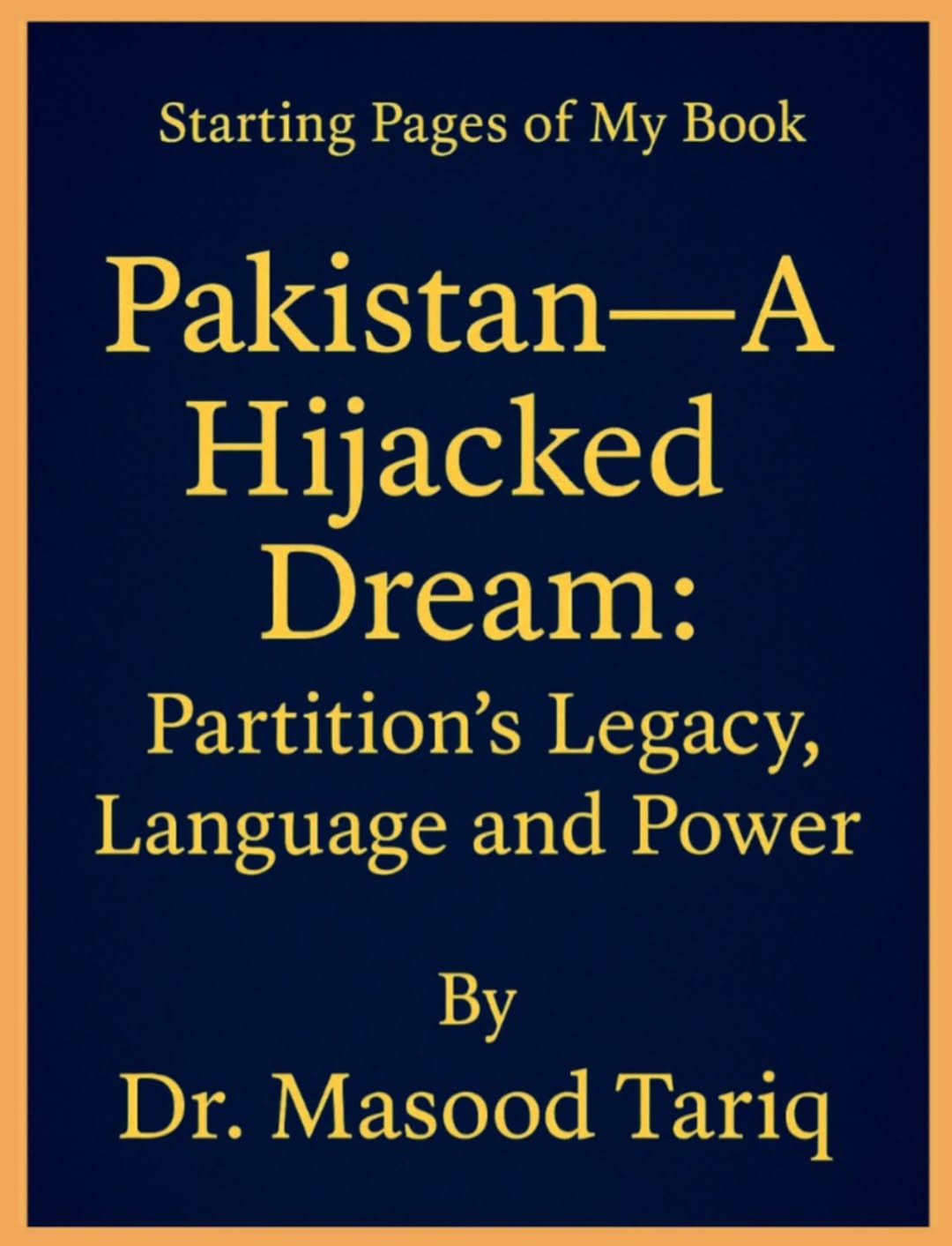
Pakistan – A Hijacked Dream: Partition’s Legacy, Language and Power (1947–2025)
——————————————–
Dedication
To all those who endured suppression yet refused silence —
the nations of Punjab, Sindh, Balochistan, Pashtun lands, and the memory of Bengal.
Your languages, your songs, and your courage are the real history of Pakistan.
——————————————–
Table of Contents
Dedication
Series Preface
Acknowledgements
Preface
Note on Sources and Method
Introduction: The Continuity of the Hijack
Overview of Volume II
Bridge Essay: Undoing the Lie — Restoring Pakistan’s Regional Histories and Identities
Part I · From Liaquat to One Unit (1947–1958)
1. Liaquat Ali Khan’s Assassination and the Politics of Succession
2. Objectives Resolution and the Centralising State
3. Provincial Grievances and the Seeds of One Unit
4. Governor-General’s Powers and the Dismissal of Assemblies
5. The 1956 Constitution: A Republic Without Nations
6. Iskander Mirza and the Slide Toward Martial Law
Part II · Ayub’s Cold War Pakistan (1958–1971)
7. Ayub Khan’s Coup and the Military–Bureaucratic State
8. SEATO, CENTO, and Washington’s Shadow
9. Punjab in Uniform, Command Elsewhere
10. Economic Growth and Regional Inequalities
11. The Bengali Language Movement and Mujib’s Six Points
12. From Language to Liberation: Autonomy, Repression, and Secession (1948–1971)
13. Bhutto, Yahya, and the Failure of Compromise
Part III · From Bhutto to Zia (1971–1988)
14. Bhutto and the Constitution of 1973: Federal Illusion
15. Bhutto’s Populism and Its Limits
16. The Baloch Rebellions and Military Suppression
17. Sindhi Students, Adabi Board, and the 1972 Language Act
18. Zia-ul-Haq and the Project of Islamisation
19. Pashtuns and the Afghan Jihad
20. Resistance, Poetry, and the Politics of Survival
Part IV · Cycles of Democracy and Dictatorship (1988–1999)
21. Benazir and Nawaz: Alternation Without Change
22. Ethnic Politics in Sindh: MQM and the Urdu-Speaking Question
23. Karachi in Violence: Militias, Mafias, and State Repression
24. Balochistan’s Smouldering Grievances
25. Baloch Exile Politics in the 1990s
26. Pashtun Margins in a Centralised State
27. Punjabi Silence and the Question of Identity
Part V · War on Terror and Its Aftermath (1999–2008)
28. Musharraf’s Coup and the Promise of Reform
29. Pakistan as U.S. Proxy in Afghanistan
30. War on Terror and the 2007–08 Crisis
31. Displacement, Militancy, and Pashtun Resistance
32. Baloch Nationalist Reprisals and Killings
33. Sindh’s Struggles in the Shadow of Karachi
Part VI · Nations Reasserted (2008–2018)
34. The Eighteenth Amendment and the Return of Provinces
35. Sindhi and Baloch Movements in a Globalised Era
36. Baloch and Pashtun Resistance in the 2008–2018 Decade
37. CPEC: Development Dreams and Federal Faultlines
Part VII · From Hijacked State to Federal Imagination (2018–2025)
38. Social Media and Ethnic Revival
39. Khalistan and the Punjabi Imagination
40. The Rise of Punjabi Nationalism and the Federal Future
Annexures
Annex II.1 — Governance of Punjab Before and After Partition Till Creation of Bangladesh: A Case Study of Punjab
Annex II.2 — Agreed vs. Non-Agreed Areas: Post-Partition Property Politics
Annex II.3 — Partition, Geopolitics, and the Destruction of the Punjabi Nation (1940–2025)
Annex II.4 — Khalistan as a Strategic Buffer: Rethinking Regional Stability in South Asia
Closing of Volume II
Bibliography
Index
——————————————–
Series Preface
This work is presented in two companion volumes — Hijacked Nations: Making of Pakistan and Unmaking of Its Nations (1748–1951) (Volume I) and Pakistan – A Hijacked Dream: Partition’s Legacy, Language and Power (1947–2025) (Volume II). Together they are meant to be read as one continuous narrative, but each volume is also complete in itself.
The argument is stark but simple: Pakistan was never allowed to be the federation of nations it was promised to be. Its creation in 1947 was less the fulfilment of a dream than the beginning of a hijack. The peoples who made Pakistan — Punjabis, Bengalis, Sindhis, Baloch, and Pashtuns — found their voices silenced, their lands partitioned, and their languages suppressed. A state that should have rested on the foundations of its historic nations was instead captured by an outsider class: the Urdu-speaking Ashrafia of United Provinces and Central Provinces (UP/CP). Through their command of language, education, bureaucracy, and political manoeuvring, they turned themselves from refugees into rulers.
To understand this, one must step back from state-centric histories. Constitutions, ministries, and generals are the surface. Beneath them lie nations — communities bound by land, language, and memory. A state is an instrument; a nation is a living organism. Pakistan’s tragedy is that its nations were forced to disappear inside a state that denied their existence.
——————————————–
Acknowledgements
This second volume rests on the same foundations as the first — archives, testimonies, and encounters with leaders of every nation of Pakistan — but extends into later decades.
I remain indebted to my early political teachers and interlocutors: Pir Pagaro, G.M. Syed, Rasool Bux Palijo, Dr. Hamida Khoro, Ibrahim Joyo, Nawab Muzaffar Khan, Nawab Yameen Khan, Azad Bin Hyder, Chaudhry Zahoor Elahi, Sardar Abdul Qayyum Khan, Air Marshal Asghar Khan, Khan Abdul Wali Khan, Hanif Ramay, and finally Benazir Bhutto — with whom I served directly as Advisor to the Chief Minister and Cabinet Member of Sindh.
But as this book moves into the twenty-first century, I must also acknowledge the younger voices who shaped its politics: Sindhi poets and students who defended their script online; Baloch activists who documented disappearances at great risk; Pashtun youth who built the Pashtun Tahafuz Movement; and Punjabi cultural workers who dared to reclaim their tongue.
They are unnamed here not because they are unimportant, but because their work belongs to the living commons, beyond the ownership of any one writer.
Finally, I thank colleagues, readers, and friends who encouraged me to pursue this two-volume project to completion. Without them, the attempt to tell this long and difficult story — from Abdali to social media, from Partition to CPEC — would have remained unfinished.
——————————————–
Preface
Pakistan – A Hijacked Dream continues the story from where Hijacked Nations ended — at the breaking point of 1947 and the refugee rule of Liaquat Ali Khan’s era — and carries it forward to the digital resistances and new federal imaginations of the 2020s.
If the first volume traced how the Ashrafia of UP and CP hijacked the new state in its founding years, this second volume shows the continuity of that hijack. It follows how refugee rulers consolidated power through language, bureaucracy, and alliances; how Cold War dependency militarised the state; how Islamisation masked injustice; and how cycles of democracy and dictatorship reproduced centralisation rather than federalism.
The book is organised in seven parts. It begins with Liaquat’s assassination, the Objectives Resolution, and the seeds of One Unit (1947–1951). It then moves through Ayub’s coup, Cold War alignments, and the secession of Bengal (1958–1971). It explores Bhutto’s populism, the 1973 Constitution, Baloch and Sindhi resistance, and Zia’s Islamisation (1971–1988). It follows the alternation of Benazir and Nawaz, Karachi’s violence, Baloch exile politics, and Punjabi silence (1988–1999). It examines Musharraf, the War on Terror, displacement and reprisals (1999–2008). It then turns to the Eighteenth Amendment, Baloch and Sindhi resurgence, and Pashtun resistance (2008–2018). Finally, it closes with the federal reimaginings of the 2018–2025 decade: social media, diaspora networks, Khalistan’s revival, and the rise of Punjabi nationalism.
The argument remains the same as Volume I: Pakistan was never allowed to be the federation of nations it was promised to be. Sindhis, Baloch, Pashtuns, Bengalis, and Punjabis were treated as problems to be managed, rather than nations to be recognised. Yet, just as in the first volume, this is also a story of endurance.
Where Volume I recorded promises broken, this second volume records resistance renewed. It ends with the possibility that Pakistan’s future may still be rebuilt — not through denial, but through recognition.
——————————————–
Note on Sources and Method
Sources.
The foundations remain the same as Volume I — archives, reports, party records, memoirs, and oral histories — but this volume extends further into Cold War archives, declassified diplomatic cables, Urdu and English press, and the digital traces of twenty-first century activism. Testimonies of students, activists, and community members from Sindh, Balochistan, Pashtun lands, Punjab, and Bengal again anchor the narrative. Blogs, diaspora forums, and social media campaigns are treated as archives of resistance in their own right.
Method.
The approach remains “nation history,” not state chronicle. States are instruments; nations are living agents, bound by land, language, and memory. By following language, land, and cultural identity as archives of power, this volume restores voices silenced by official narratives.
Perspective.
Language was the first weapon of the UP/CP Ashrafia. Bengali and Sindhi nations waged the most visible struggles to defend their tongues; Punjabi, Baloch, and Pashtun voices carried their own, often suppressed, battles. By tracing how language functioned as memory, archive, and instrument of domination, this book uncovers how repression and resistance unfolded in everyday life as much as in parliaments.
Continuity.
If Volume I traced the origins of the hijack, this volume traces its continuity — from Liaquat’s Objectives Resolution to Ayub’s coup, from Mujib’s Six Points to Sindh’s 1972 Language Act, from Bhutto’s failed federal illusion to Zia’s Islamisation, from Musharraf’s War on Terror to the digital movements of the 2020s. The same structural logic recurs: denial of nations, dressed as unity.
——————————————–
Introduction: The Continuity of the Hijack
Pakistan’s creation in 1947 was not the fulfilment of a dream but the beginning of a hijack. What had been promised as a federation of nations — Punjabi, Sindhi, Baloch, Pashtun, and Bengali — was instead captured by outsiders: the Urdu-speaking Ashrafia of United Provinces and Central Provinces (UP/CP). With colonial legacies behind them, they transformed themselves from refugees into rulers, using Urdu, bureaucracy, and political manoeuvres to dominate a state not their own.
The problem was clear from the outset. The nations who made Pakistan were silenced, while outsiders claimed the role of founders and saviours. Bengali and Sindhi language struggles were branded treason; Punjabi silence was manufactured by propaganda that painted Bengalis and Sindhis as “anti-Pakistan”; Baloch and Pashtun lands were treated as buffers, not homelands.
Argument. Pakistan’s post-1947 crises were not accidents of leadership but the product of a deliberate strategy: the denial of nations. Centralisation, Islamisation, and militarisation were instruments of that strategy, not neutral processes.
Method. This book applies the same “nation history” lens as Volume I, but with an expanded archive that includes Cold War diplomacy, press, memoirs, oral histories, and the traces of digital resistance in the twenty-first century.
The continuity of the hijack is unmistakable — from refugee rulers to military dictators, from constitutions that denied nations to wars that devastated them, from suppression in assemblies to suppression online. Yet equally unmistakable is the endurance of nations. Languages, songs, and memories carried forward what politics tried to erase.
This introduction sets the stage: the hijack continued after 1947, but so did resistance. The question for the future is whether Pakistan can finally shift from denial to recognition.
——————————————–
Overview of Volume II
This second volume follows the trajectory of Pakistan after 1947, tracing how refugee rulers consolidated their grip, how Cold War militarisation and Islamisation deepened centralisation, and how the nations of Pakistan endured through resistance.
The story unfolds in seven parts:
Part I (1947–1951): Refugee rule under Liaquat Ali Khan, the Objectives Resolution, and provincial grievances in the aftermath of Partition.
Part II (1958–1971): Ayub’s coup, Cold War alignments, economic inequalities, the Bengali language movement, Mujib’s Six Points, and the secession of Bengal.
Part III (1971–1988): Bhutto’s populism, the 1973 Constitution, Baloch and Sindhi struggles, Zia’s Islamisation, and Pashtun resistance during the Afghan Jihad.
Part IV (1988–1999): The alternation of Benazir and Nawaz, Karachi’s violence, Baloch exile politics, Pashtun margins, and Punjabi silence.
Part V (1999–2008): Musharraf, the War on Terror, displacement, reprisals, and Sindh’s struggles.
Part VI (2008–2018): The Eighteenth Amendment, Sindhi and Baloch resurgence, Pashtun and Baloch resistance, and the federal tensions of CPEC.
Part VII (2018–2025): Social media, diaspora networks, Khalistan’s revival, and the rise of Punjabi nationalism.
At its centre lies the same lesson as Volume I: repression can forge a state, but it cannot erase nations.
——————————————–
Bridge Essay: Undoing the Lie — Restoring Pakistan’s Regional Histories and Identities
Pakistan was not only hijacked politically; it was hijacked historically. Its textbooks erased the Indus Valley, belittled Punjab’s Unionists, ignored Sindh’s Sammat Hindus, reduced Balochistan to a “frontier,” and framed Pashtun lands only as buffers.
To recover a federal future, these erased histories must be restored: Punjabi poets, Sindhi intellectuals, Baloch confederacies, Pashtun jirgas, and Bengali martyrs. Pakistan is not a monolith but a mosaic.
If Volume I closed with the broken triangle of intellectuals, bureaucrats, and business classes, this second volume closes with the broken mirror of history. Only by restoring these histories can Pakistan escape denial.
——————————————–
Closing of Volume II
Nations Hijacked, Nations Endure
From Liaquat’s assassination in 1951 to the digital resistances of the 2020s, this volume has traced how the hijack deepened — and how Pakistan’s nations refused to vanish. Each decade repeated the same cycle: centralisation by the outsider Ashrafia of UP and CP, backed by military–bureaucratic power, and resistance by the historic nations of Punjab, Sindh, Balochistan, Pashtun lands, and Bengal.
The story is one of betrayals and suppressions: Liaquat’s Objectives Resolution, Ayub’s modernisation, the secession of Bengal, Bhutto’s failed federalism, Zia’s Islamisation, the crises of democracy in the 1990s, Musharraf’s War on Terror, and the partial promises of the Eighteenth Amendment.
Yet the nations endured. Sindhis defended their script; Baloch bore the costs of repression but carried their cause into exile and memory; Pashtuns turned displacement into political organisation; Punjabis began to reclaim their silenced tongue; and Bengal’s memory remained a warning. In the 2010s and 2020s, social media amplified these voices, diaspora networks reconnected to homelands, and Khalistan re-entered the global imagination.
The conclusion is stark: Pakistan has survived, but it has not healed. Its crises are structural, born of denial of its nations. If Volume I showed how the hijack began, this second shows its continuity. But it also points to a horizon: a federal imagination where Pakistan’s nations are recognised, their languages respected, and their histories restored.
Nations endure longer than states. If Pakistan has a future, it lies not in denial, but in recognition.
——————————————–
Leave a Reply