
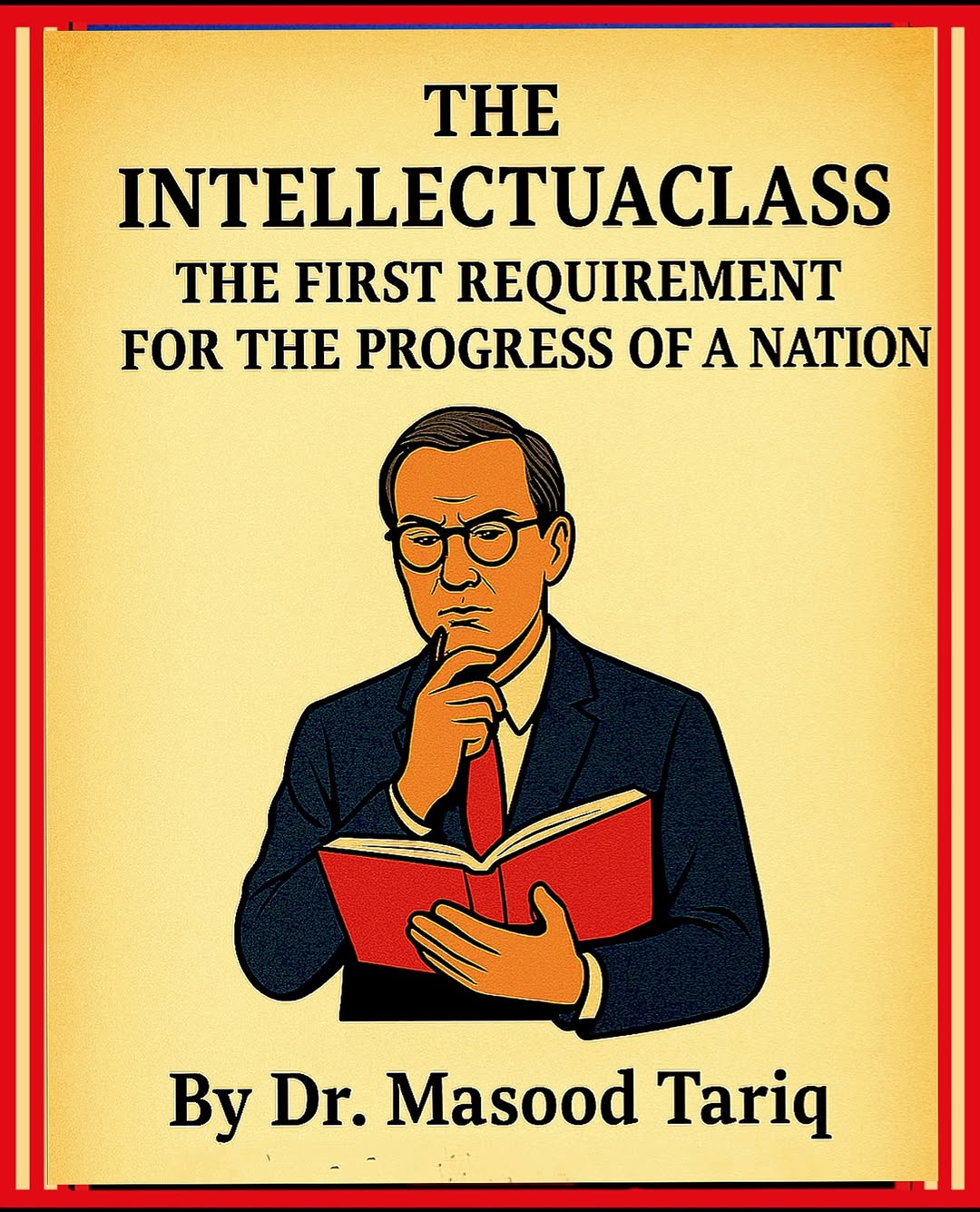
The Intellectual Class: The First Requirement for the Progress of a Nation
Date: September 8, 2025
No nation has ever advanced without the guidance of its intellectual class. The intelligentsia — scholars, writers, teachers, journalists, and critical thinkers — act as the compass of society. They generate new ideas, challenge injustices, and connect a people’s past to their possible future. In Pakistan, however, this class has historically been weak, co-opted, or silenced. The absence of a strong and independent intellectual leadership is one of the central reasons why the promise of 1947 has remained unfulfilled.
The intellectual class is the first requirement for the progress of a nation, followed by the bureaucratic class and the business class. Without this sequence of leadership — ideas, administration, and economic initiative — no society can achieve balanced development.
The Nature of the Intelligentsia
The intellectual class is marked by higher education, complex mental labor, and moral responsibility. Thinkers like Antonio Gramsci emphasized that intellectuals are not neutral observers but active shapers of social and political life. Jean-Paul Sartre went further, arguing that intellectuals must serve as the moral conscience of their age, speaking the truth even when it is unpopular.
In Pakistan, this responsibility was urgent from the beginning. After Partition, millions of people were displaced, societies were uprooted, and new structures of governance had to be built. It was precisely at this historical turning point that Pakistan needed a strong intelligentsia to articulate visions of federalism, cultural plurality, and national progress. Instead, intellectual space was captured by a migrant elite whose outlook was shaped by the memory of North India rather than the soil of Punjab, Sindh, Balochistan, Pashtun lands, or Bengal.
Pakistan’s Lost Intellectual Independence
Unlike Bengal, with its rich literary tradition and strong middle-class intellectual community, West Pakistan lacked an independent intelligentsia after 1947. Sindh’s Hindu Sammat intelligentsia — the teachers, merchants, publishers — was forced into exile. Punjab’s intellectuals were silent or subordinated to the state’s Urdu-centric narrative. Baloch and Pashtun intellectual voices were marginalized under suspicion of separatism.
Instead, the Urdu-speaking Ashrafia from UP and CP filled this vacuum. Their dominance over bureaucracy, education, and media ensured that the new state’s intellectual life was shaped by a single language and worldview. The result was devastating: Pakistan’s indigenous nations were denied their cultural expression, and the state’s policies were cut off from the lived realities of its people.
The Role of Criticism and Conscience
In healthy societies, intellectuals speak truth to power. In Pakistan, many were silenced by censorship, intimidation, or co-optation. Those who dared to speak — such as Faiz Ahmed Faiz, Habib Jalib, or Sindhi and Baloch nationalist writers — were jailed, exiled, or branded as traitors.
This suppression weakened Pakistan’s democratic foundations. When Bengali intellectuals raised their voices for cultural rights, they were met with bullets in 1952 and eventually with war in 1971. Sindhi intellectuals who defended their language in 1972 faced riots and repression. Baloch and Pashtun thinkers who demanded autonomy were accused of rebellion.
The tragedy is that instead of acting as a bridge among Pakistan’s nations, the intellectual class often served the state’s centralizing ideology, becoming a tool of domination rather than a conscience of society.
The Need for an Indigenous Intelligentsia
For Pakistan to progress, it must cultivate a truly indigenous intelligentsia — rooted in the languages, histories, and struggles of its nations. Punjabi, Sindhi, Baloch, and Pashtun intellectual traditions must be recognized as part of the national heritage. Universities should not merely reproduce official narratives but encourage critical inquiry, debate, and dissent.
A genuine intellectual class must:
1. Defend linguistic and cultural rights as the foundation of federal harmony.
2. Expose injustices and guide public opinion against authoritarianism.
3. Develop independent thought instead of parroting state propaganda or foreign agendas.
4. Connect knowledge to people’s struggles, ensuring that ideas are not detached abstractions but living responses to real challenges.
Conclusion
The future of Pakistan depends not only on armies or economies but on the vitality of its intellectual life. A nation without an active and independent intelligentsia is condemned to repeat mistakes and remain captive to elite manipulation.
For too long, Pakistan’s intellectual class has been hijacked by outsiders, silenced by rulers, or detached in ivory towers. To move forward, Pakistan must reclaim its intellectual independence — producing thinkers who are fearless in conscience, rooted in culture, and committed to truth.
But intellectuals alone are not enough. Once the intellectual class defines the vision, the bureaucratic class must provide honest administration, and the business class must create economic opportunity. Together, these three classes — intellectual, bureaucratic, and business — form the backbone of a modern nation.
Only when these forces act in harmony, with the intellectual class leading as the nation’s conscience, can Pakistan transform from a state of imposed narratives into a nation of living voices.
Leave a Reply