
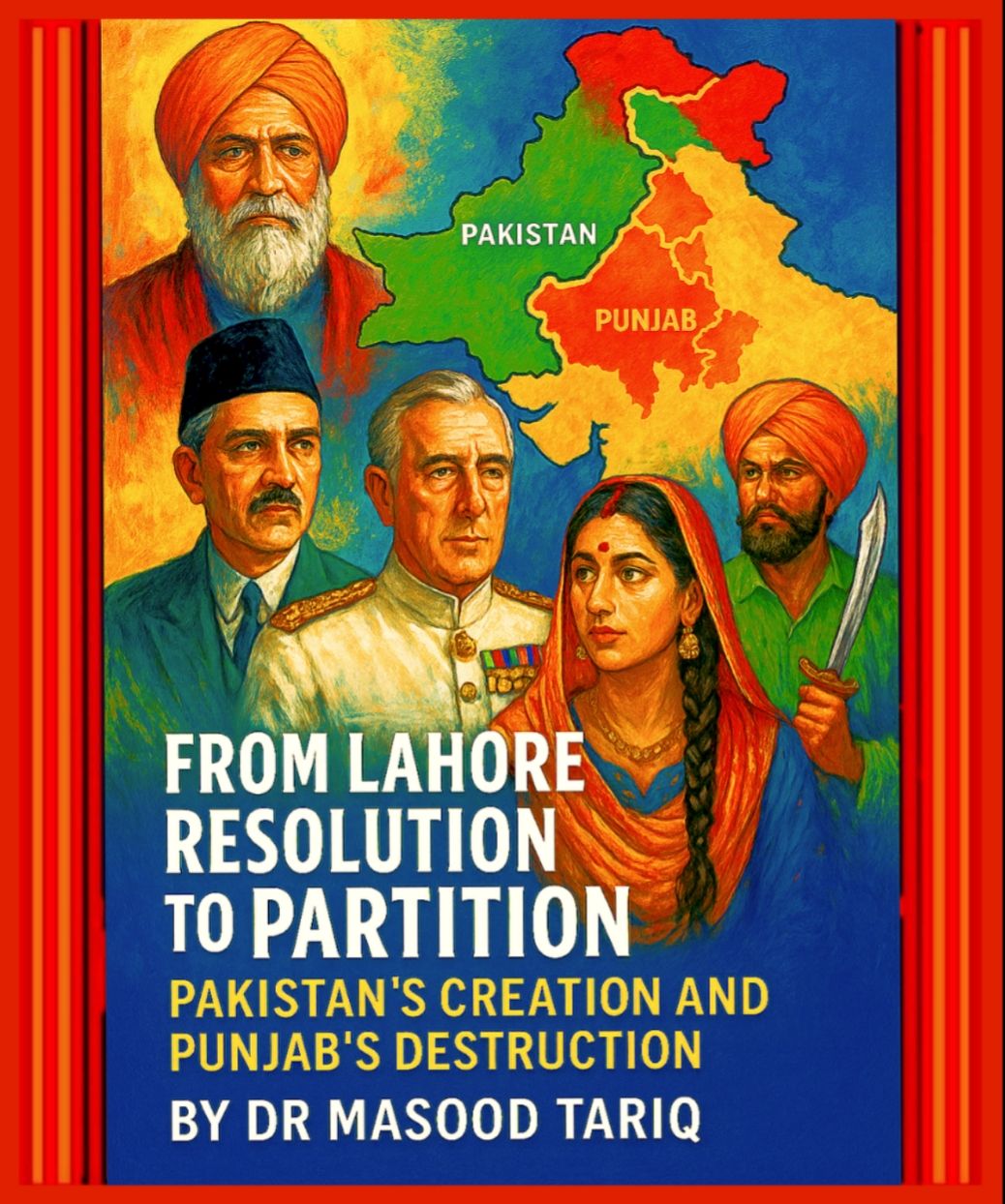
From Lahore Resolution to Partition: Pakistan’s Creation and Punjab’s Destruction
Date: August 22, 2025
The Myth of March 23
For decades, Pakistan’s official narrative has claimed that the country was born on March 23, 1940, with the Lahore Resolution. Yet the historical record tells a different story. The Resolution did not call for one Pakistan — it called for independent states in Muslim-majority regions of India. The word “Pakistan” itself did not enter Muslim League documents until April 1946, at the Delhi Convention.
Pakistan’s real birth came later — not in Lahore in 1940, but through the rejection of the Cabinet Mission Plan in 1946 and acceptance of the Mountbatten Plan in 1947. At the center of this process lay Punjab: divided, devastated, and drenched in blood.
What Lahore Resolution Really Said
The Lahore Resolution, passed at Minto Park, Lahore, on March 23, 1940, stated that Muslim-majority regions in the northwest and northeast of India should form “independent states.” The plural was critical. The Resolution neither outlined boundaries nor specified the word “Pakistan.”
This ambiguity allowed multiple interpretations. Sir Sikandar Hayat Khan, Punjab’s Unionist Premier, had initially drafted it as a loose confederal arrangement. Jinnah, however, reshaped it into a rallying cry for sovereignty. By the mid-1940s, the Resolution was rebranded in public memory as the birth certificate of Pakistan. But the real shift came six years later.
The Delhi Convention, 1946: From “States” to One Pakistan
In April 1946, Muslim League legislators gathered in Delhi. For the first time, they demanded a single state of Pakistan. Specific territories were listed: Punjab, Sindh, NWFP, Balochistan, Bengal, and Assam. Strikingly, Kashmir — a Muslim-majority region — was excluded.
Some leaders protested. Abu Hashim from Bengal argued that this violated the Lahore Resolution, which had clearly demanded “states.” But Jinnah insisted this was a tactical adjustment. The League now demanded one Pakistan, not many.
The Cabinet Mission Plan: A Missed Chance
Just weeks later, the British government sent a three-man Cabinet Mission to India (Lawrence, Cripps, Alexander). Their plan of May 1946 tried to balance Congress and the League:
An Indian Union would exist with limited central powers (defense, foreign affairs, communications).
Provinces would be grouped: Hindu-majority provinces in Group A, Muslim-majority provinces of Punjab-Sindh-NWFP in Group B, and Bengal-Assam in Group C.
Provinces could reconsider membership after ten years — potentially paving the way for secession.
Congress accepted the plan on June 25, 1946. The Muslim League rejected it.
Despite resembling Chaudhry Rahmat Ali’s earlier vision of multiple Muslim homelands, the League had fixed its sights on one Pakistan.
The rejection of compromise set the stage for confrontation. On July 29, 1946, the League declared Direct Action Day.
Direct Action: Violence Unleashed
On August 16, 1946, Bengal’s capital Calcutta erupted. Over 3,000 people were killed in Hindu-Muslim clashes. Violence spread across the subcontinent — Bombay, Bihar, Ahmedabad, and above all, Punjab. In Rawalpindi, Sikh villages were attacked and thousands massacred. In Amritsar, Muslims were killed in retaliation.
Communal killings spiraled out of control. The League had hoped to demonstrate political strength, but what followed was carnage that made partition seem inevitable.
The Mountbatten Plan: Partition Sealed
In March 1947, Lord Louis Mountbatten arrived as the last Viceroy. He quickly concluded that partition was the only way forward. On June 3, 1947, he announced his plan:
India and Pakistan would be created as dominions.
Punjab and Bengal would be divided by boundary commissions.
NWFP and Sylhet would hold referendums.
Princely States could choose their allegiance.
Congress and the Muslim League both accepted. The British Parliament passed the Indian Independence Act in July. On August 15, Pakistan was born — but without a defined Punjab.
Only on August 17, when the Radcliffe Award was announced, was Punjab divided: 17 Muslim-majority districts to Pakistan, 12 Hindu- and Sikh-majority districts to India.
Punjab: A Homeland Shattered
The consequences were catastrophic.
At least 2 million Punjabis were slaughtered.
More than 20 million were uprooted — the largest forced migration in recorded history.
On August 15, 1947, Lahore did not celebrate independence; it mourned amid corpses and chaos.
Pakistan was born, but Punjab was destroyed.
The Geopolitics Behind Partition
Partition was not only about Hindu-Muslim divisions. It was also about Anglo-American strategy at the dawn of the Cold War.
Winston Churchill had long envisioned a Muslim buffer state to block Soviet access to the Indian Ocean. Clement Attlee’s Labour government implemented partition but followed Churchill’s logic. American strategists also supported the plan, fearing that a united India under Nehru might lean toward Moscow.
Dividing Punjab was not just communal; it was strategic — a Cold War calculation to weaken a potential Soviet ally. A united Punjabi nation, militarily strong and strategically located, could have aligned with the Soviet Union. Partition destroyed this possibility.
After Partition: Punjab in the Cold War
Churchill’s vision was realized in 1979. When the Soviet Union invaded Afghanistan, Pakistan became the frontline state for U.S. strategy. Punjab’s infrastructure and manpower were critical in arming the Mujahideen.
But history did not stop there. Just as Punjab had once been weaponized against the Soviet Union, today it is the pivot of China’s rise. Through the China-Pakistan Economic Corridor (CPEC), Beijing has gained access to Gwadar on the Arabian Sea. Once again, Punjab — through which CPEC runs — has become the hinge of great power rivalry.
The Punjabi Question Today
If united, Punjabis across India and Pakistan would number 187 million people — the seventh-largest nation in the world. They share a language, land, and culture, divided only by religion and politics.
The Punjabi nation today is:
56% Muslim Punjabi
26% Hindu Punjabi
14% Sikh Punjabi
4% Christian Punjabi
Yet both India and Pakistan suppress Punjabi identity in favor of nationalist projects centered on Delhi and Karachi. The tragedy of 1947 endures.
Partition Was Betrayal
The story we are told — that Pakistan was created by the Lahore Resolution — is a myth. In truth, Pakistan emerged by rejecting compromise, by embracing an imperial blueprint, and by cutting Punjab into two bleeding halves.
Pakistan was born as a Cold War buffer; Punjab was sacrificed in the process. Today, as China rises and America wanes, Punjab once again sits at the crossroads of history. The urgent question is this: will Punjabis remain pawns in other people’s games, or reclaim their destiny as a united nation?
 Dr. Masood Tariq is a Karachi-based politician and political theorist. He formerly served as Senior Vice President of the Pakistan Muslim Students Federation (PMSF) Sindh, Councillor of the Municipal Corporation Hyderabad, Advisor to the Chief Minister of Sindh, and Member of the Sindh Cabinet.
His research explores South Asian geopolitics, postcolonial state formation, regional nationalism, and inter-ethnic politics, with a focus on the Punjabi question and Cold War strategic alignments.
He also writes on Pakistan’s socio-political and economic structures, analysing their structural causes and proposing policy-oriented solutions aligned with historical research and contemporary strategy.
His work aims to bridge historical scholarship and strategic analysis to inform policymaking across South Asia, Central Asia, and the Middle East.
Leave a Reply