
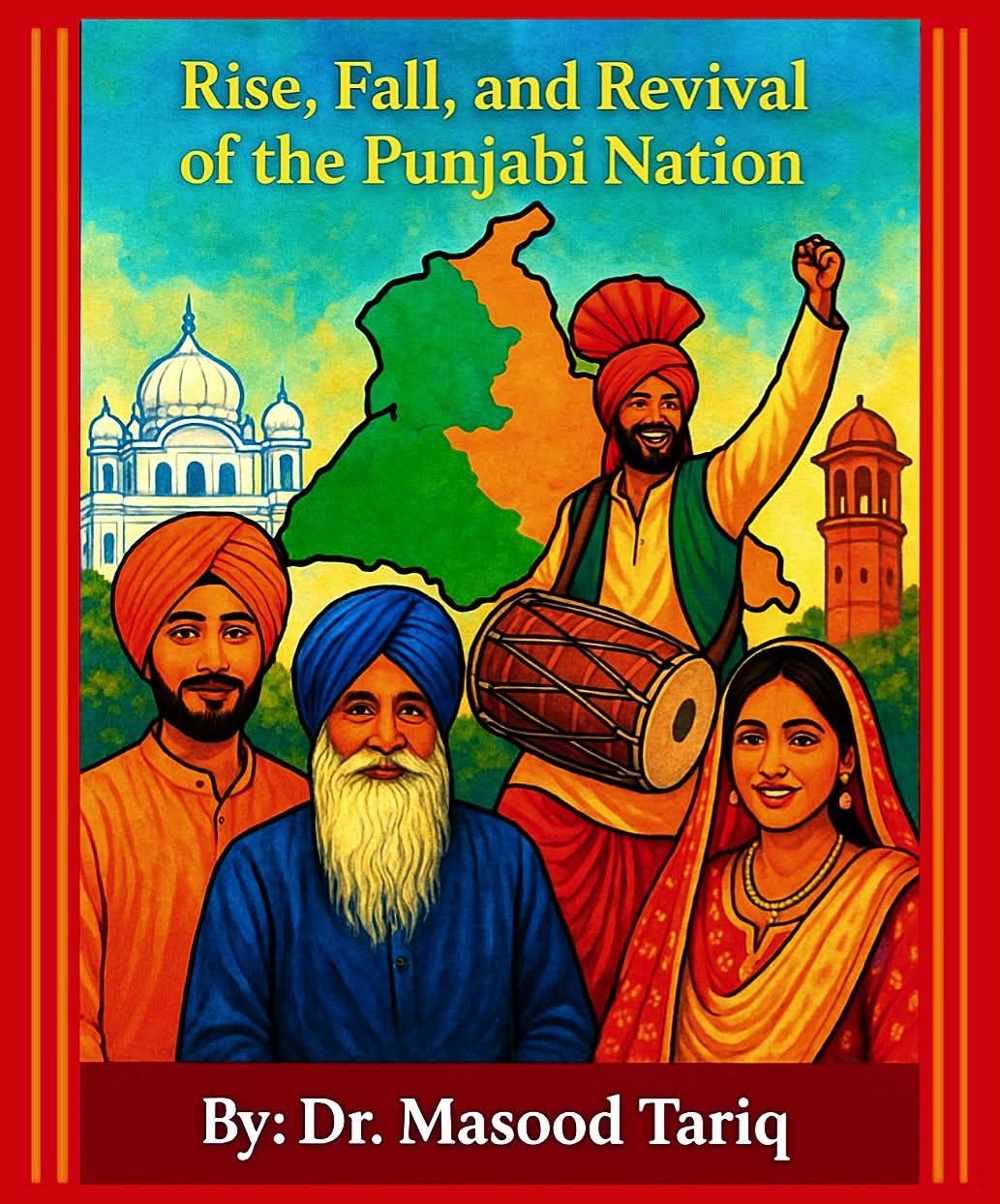
Rise, Fall, and Revival of the Punjabi Nation
Dr. Masood Tariq
Independent Political Theorist
Karachi, Pakistan
drmasoodtariq@gmail.com
Date: August 23, 2025
——————————————–
Abstract
This paper traces the historical trajectory of the Punjabi nation, examining its rise, decline, and contemporary prospects for revival. It argues that the foundation of any nation rests on its language, reinforced by shared land, culture, and history.
Punjab—stretching historically from Delhi to Peshawar and from Kashmir to Kashmore—has long been the homeland of one of the world’s largest linguistic communities. Yet Punjabis endured fragmentation through successive invasions, colonial manipulation, and the politicization of religion, which displaced linguistic and cultural unity.
Three stages are identified: the rise of Punjabi identity shaped by the spiritual and cultural influence of Sufi saints and consolidated under the secular empire of Maharaja Ranjit Singh; the fall of Punjabi nationalism under British colonial language policies, religious divisions, and the Partition of 1947; and the revivalist efforts of modern Punjabi nationalists.
The paper advances the framework of a “triple role,” whereby Punjabis embrace their identity simultaneously as Punjabis, as members of their religious communities, and as citizens of their states (Pakistan or India). The study concludes that revival requires restoring linguistic pride, reaffirming cultural respect, and reclaiming historical consciousness—transcending divisions imposed by religion and statehood.
——————————————–
Table of Contents
1. Introduction
2. Foundations of the Punjabi Nation: Language, Land, Culture, History
3. Early Invasions and the Sufi Awakening (11th–17th Century)
4. Emergence of Punjabi Nationalism under the Sikh Empire (18th–19th Century)
5. British Colonial Manipulations and the Fall of Punjabi Identity (1849–1947)
6. Partition, Division, and the Collapse of Punjabi Unity (1947)
7. Post-Partition Identity Crisis of the Punjabi Nation (1947–Present)
8. The Revival of Punjabi Nationalism: Framework and Challenges
9. Triple Role of Punjabi Identity: Nation, Religion, and State
10. Application of the Triple Role
11. Conclusion
12. References
——————————————–
1. Introduction
Nations are built on shared languages, cultures, histories, and territories. The Qur’an emphasizes: “We sent every messenger with a message in the language of his nation so that he might make clear to them the commandments of Allah” (Qur’an 14:4). For Punjabis, these elements—language, land, culture, and history—constitute the foundations of a distinct national identity that transcends religion, caste, or race.
This paper explores the rise, fall, and revival of the Punjabi nation. It asks: Why did the Punjabi nation—despite its demographic strength, cultural richness, and historical continuity—collapse into divisions, and what ideological framework can guide its revival?
The analysis unfolds chronologically: beginning with early invasions and the Sufi awakening, moving to the consolidation of Punjabi nationalism under Maharaja Ranjit Singh, its erosion under British colonial policies, the collapse of unity during Partition, and the subsequent postcolonial identity crisis. The paper concludes by proposing the framework of triple identity as a pathway for Punjabi revival.
——————————————–
2. Foundations of the Punjabi Nation: Language, Land, Culture, History
The Punjabi nation is rooted primarily in its language, with land, culture, and history serving as essential pillars of collective identity. Historically, Punjab’s geographical boundaries extended from Delhi to Peshawar and from Kashmir to Kashmore. Irrespective of caste, creed, or religion, Punjabis have long been bound by their shared language, cultural traditions, and historical experiences.
Today, Punjabi is the ninth most widely spoken language in the world. Punjabis constitute the third largest nation in South Asia, and Punjabi Muslims form the third largest ethnic community in the Muslim Ummah. Punjabis also remain the largest ethnic population in Pakistan, though their cultural expression has often been subordinated to external political and linguistic influences.
——————————————–
3. Early Invasions and the Sufi Awakening (11th–17th Century)
From Mahmud of Ghazni’s conquest in 1022 to Ahmad Shah Abdali’s repeated incursions in the 18th century, Punjab endured centuries of invasions. Resistance to these incursions was frequent but fragmented, typically confined to tribal or local struggles, and lacked the cohesion of a united national front.
Amid this turmoil, Sufi saints and poets such as Baba Farid, Guru Nanak, Shah Hussain, Sultan Bahu, Bulleh Shah, and Waris Shah emerged as transformative figures. They condemned tyranny, emphasized human dignity, and nurtured a cultural consciousness that transcended religious boundaries. Their spiritual and literary contributions created the cultural foundations for a collective Punjabi identity, which later evolved into the roots of Punjabi nationalism.
——————————————–
4. Emergence of Punjabi Nationalism under the Sikh Empire (18th–19th Century)
The devastation wrought by Abdali and the Durranis underscored the necessity of Punjabi cohesion. This sense of unity crystallized under Maharaja Ranjit Singh (1799–1839), who established a secular Punjabi empire.
Despite Punjab’s diverse demography—52% Muslims, 41% Hindus, 6% Sikhs, and 1% others—Ranjit Singh united communities under a shared Punjabi identity. Lahore became the capital of a state that extended from Multan to Kashmir and the Khyber Pass. For over four decades, his empire successfully checked British expansion east of the Sutlej.
Following his death in 1839, internecine conflicts, Dogra intrigues, and two Anglo-Sikh wars culminated in British annexation in 1849, marking the end of sovereign Punjabi rule.
——————————————–
5. British Colonial Manipulations and the Fall of Punjabi Identity (1849–1947)
The British categorized Punjabis as a “martial race” but feared their collective potential. To weaken Punjabi identity, they imposed Urdu as the official language of Punjab, marginalizing Punjabi in administration, education, and governance.
Urdu-speaking clerics, teachers, and bureaucrats from UP and CP were introduced into Punjab, embedding the Ganga-Jumna cultural hegemony within its governance structures.
Colonial policies deliberately fractured Punjabis into Muslim, Hindu, and Sikh categories, shifting allegiances from shared nationhood to religious identity.
Although Punjabis contributed significantly to the colonial military and economy, their cultural autonomy and political unity were systematically eroded.
——————————————–
6. Partition, Division, and the Collapse of Punjabi Unity (1947)
By the mid-20th century, Hindu Punjabis increasingly identified with Hindi as the “language of Hindus,” while Muslim Punjabis embraced Urdu as the “language of Muslims.” This linguistic polarization shattered Punjabi unity and paved the way for Partition.
The consequences were catastrophic:
(a). The massacre of nearly two million Punjabis.
(b). The largest forced migration in recorded history.
(c). The permanent division of the Punjabi nation across hostile states.
——————————————–
7. Post-Partition Identity Crisis of the Punjabi Nation (1947–Present)
In Pakistan, Muslim Punjabis form the demographic majority and dominate key institutions, yet face resentment in Sindh, Balochistan, and Khyber Pakhtunkhwa. Despite their central role, Punjabi remains absent from the state’s educational and administrative domains, reinforcing an identity framed primarily through Islam and Pakistani nationalism rather than Punjabi heritage.
In India, Sikh and Hindu Punjabis remain minorities within a vast Hindi-speaking polity, limiting their capacity to assert Punjabi nationhood. On both sides of the border, Punjabis remain culturally insecure and politically fragmented, caught between competing national frameworks.
——————————————–
8. The Revival of Punjabi Nationalism: Framework and Challenges
Contemporary efforts to revive Punjabi nationalism center on restoring Punjabi as a language of education, governance, and cultural pride. Punjabi nationalists argue for reasserting cultural traditions and recovering historical consciousness as essential steps toward revival.
The greatest obstacle lies in overcoming the internalized alienation from Punjabi language and identity—a legacy of colonial policies, reinforced by postcolonial elites who prioritized external cultural frameworks over indigenous heritage.
——————————————–
9. Triple Role of Punjabi Identity: Nation, Religion, and State
For meaningful revival, Punjabis must adopt a triple identity:
(a). Punjabi Identity — rooted in shared language, land, culture, and history.
(b). Religious Identity — as Muslims, Sikhs, Hindus, or Christians, contributing to their respective faith communities.
(c). State Identity — as citizens of Pakistan or India, fulfilling civic and political responsibilities.
This framework enables Punjabis to reconcile their cultural roots, spiritual commitments, and state obligations in a balanced manner.
——————————————–
10. Application of the Triple Role
(a). Muslim Punjabis (Pakistan): The largest community, tasked with balancing their Punjabi identity alongside Islamic and Pakistani statehood.
(b). Christian Punjabis (Pakistan): A vital minority whose inclusion in Punjabi revival strengthens pluralism and social cohesion.
(c). Hindu Punjabis (India): A smaller community preserving Punjabi traditions while engaging in Indian civic and political life.
(d). Sikh Punjabis (India): Custodians of Punjabi language and culture, playing a central role in the revival of Punjabi nationalism.
——————————————–
11. Conclusion
The Punjabi nation—once united by language, culture, and secular traditions—was fractured by colonial manipulation, religious polarization, and the Partition of 1947. Today, Punjabis continue to grapple with an unresolved identity crisis, suspended between nationhood, religion, and state loyalty.
Revival depends on reclaiming Punjabi language and culture, coupled with adopting the triple role framework. By balancing their Punjabi heritage, religious commitments, and civic responsibilities, Punjabis can restore unity, dignity, and respect, ensuring a renewed role for the Punjabi nation in South Asia and beyond.
——————————————–
12. References
Ahmed, Ishtiaq. Punjab: Bloodied, Partitioned and Cleansed. Oxford University Press, 2011.
Grewal, J.S. The Sikhs of the Punjab. Cambridge University Press, 1990.
Oberoi, Harjot. The Construction of Religious Boundaries: Culture, Identity, and Diversity in the Sikh Tradition. Oxford University Press, 1994.
Shackle, Christopher. Punjabi Language and Identity. School of Oriental and African Studies, University of London, 2001.
Singh, Khushwant. A History of the Sikhs. Princeton University Press, 1963.
Talbot, Ian. Punjab and the Raj, 1849–1947. Oxford University Press, 1988.
Butalia, Urvashi. The Other Side of Silence: Voices from the Partition of India. Penguin, 1998.
——————————————–
Author Biography
Dr. Masood Tariq is a Karachi-based politician and political theorist. He formerly served as Senior Vice President of the Pakistan Muslim Students Federation (PMSF) Sindh, Councillor of the Municipal Corporation Hyderabad, Advisor to the Chief Minister of Sindh, and Member of the Sindh Cabinet.
His research explores South Asian geopolitics, postcolonial state formation, regional nationalism, and inter-ethnic politics, with a focus on the Punjabi question and Cold War strategic alignments.
He also writes on Pakistan’s socio-political and economic structures, analysing their structural causes and proposing policy-oriented solutions aligned with historical research and contemporary strategy.
His work aims to bridge historical scholarship and strategic analysis to inform policymaking across South Asia, Central Asia, and the Middle East.
Leave a Reply