
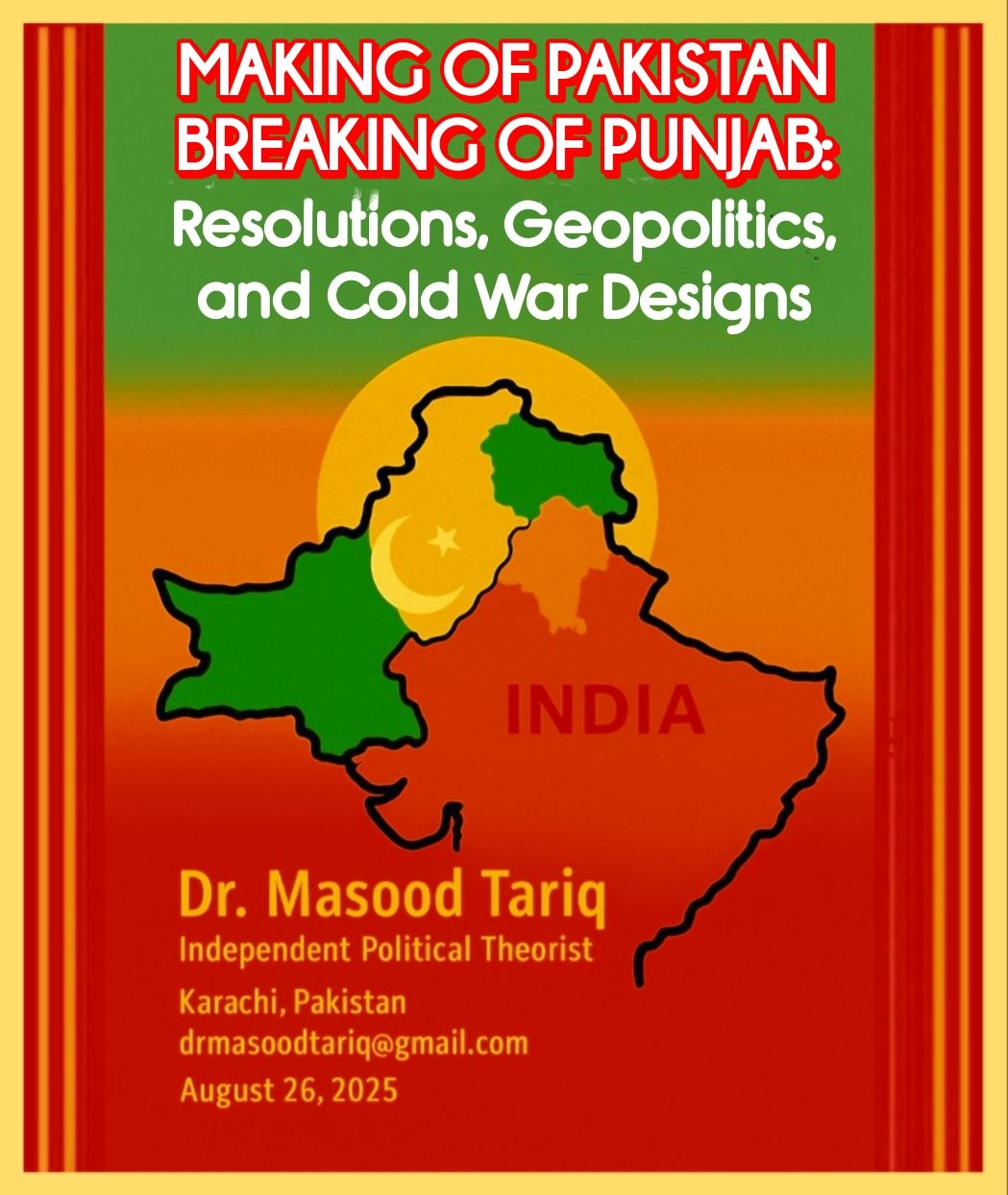
Making of Pakistan and Breaking of Punjab: Resolutions, Geopolitics, and Cold War Designs
Dr. Masood Tariq
Independent Political Theorist
Karachi, Pakistan
drmasoodtariq@gmail.com
Date: August 26, 2025
——————————————–
Abstract
This paper re-examines the political and strategic origins of Pakistan by situating the Lahore Resolution of March 23, 1940, the Delhi Convention of April 1946, the rejection of the Cabinet Mission Plan, and the acceptance of the Mountbatten Plan within the larger imperatives of Anglo-American strategy during the early Cold War. It argues that the Lahore Resolution did not demand a single Pakistan but envisaged multiple Muslim “states,” a vision later reframed by the Muslim League into a centralized statehood project.
By tracing how tactical adjustments, British geopolitical designs, and communal violence converged, the study contends that the partition of Punjab was not merely an accident of Hindu–Muslim rivalry but a deliberate maneuver to fracture South Asia’s most powerful nation. The dismemberment of Punjab served Western strategic purposes: it secured Pakistan as a pro-Western buffer while eliminating the possibility of a united Punjabi homeland that might have aligned with the Soviet Union.
Finally, the paper situates Punjab within a longer arc of geopolitics — from its Cold War role as the backbone of Pakistan’s alliance system to its twenty-first-century centrality in China’s Belt and Road Initiative. The enduring tragedy of 1947 lies not only in mass displacement and bloodshed but in the denial of Punjabi nationhood, a denial that continues to shape South Asian geopolitics today.
——————————————–
1. Introduction: Partition as Tragedy and Strategy
The partition of British India in 1947 remains one of the most traumatic events of the twentieth century. In Pakistan’s nationalist memory, the story begins with the Lahore Resolution of March 23, 1940, celebrated as the “birth certificate” of the nation. Yet the Resolution, when read closely, called not for a single state but for “independent states” in Muslim-majority areas, reflecting provincialist and federalist thinking rather than a unitary demand.
The Muslim League’s demand evolved dramatically between 1940 and 1946. By the Delhi Convention of April 1946, the plural “states” of Lahore had been replaced by the singular “Pakistan.” This transformation — from federalist ambiguity to centralized sovereignty — was the critical turning point in Muslim League politics.
The rejection of the Cabinet Mission Plan and the acceptance of Mountbatten’s hurried partition plan completed the process. But to reduce partition to Hindu–Muslim antagonism misses the larger picture. Anglo-American Cold War strategy, seeking to block Soviet access to the Indian Ocean, favored the creation of a smaller, dependent Pakistan and the division of Punjab. Partition was therefore not only a communal or colonial outcome but also a geopolitical maneuver whose consequences reverberate into the present.
——————————————–
2. The Lahore Resolution, March 23, 1940: “Independent States,” Not One Pakistan
The Lahore Resolution of March 23, 1940, passed at Minto Park during the annual session of the All India Muslim League, has long been mythologized in Pakistan as the nation’s “birth certificate.” Yet its actual language is more cautious and plural. It called for the establishment of “independent states” in Muslim-majority areas of northwestern and northeastern India. The use of the plural was deliberate, leaving open the possibility of multiple sovereign Muslim homelands rather than a single Pakistan.
The Resolution did not mention the word “Pakistan” at all. It reflected the influence of leaders such as Punjab’s Unionist Premier Sir Sikandar Hayat Khan, who favored a confederal arrangement where provinces retained autonomy. For Sikandar and others, the goal was to safeguard Muslim-majority provinces from Congress dominance while avoiding the perils of an over-centralized state.
The Resolution also carried tactical dimensions. The Muslim League had performed poorly in the 1937 provincial elections, winning few seats in Muslim-majority areas where regional parties were dominant. By advancing a radical but flexible demand, Jinnah sought to strengthen the League’s bargaining position. “Independent states” was language broad enough to rally support across provinces with divergent interests.
In retrospect, however, the Lahore Resolution was retrospectively reinterpreted as a demand for one Pakistan. This rebranding began in the mid-1940s and was enshrined in nationalist historiography after 1947. The gap between what the Resolution said in 1940 and how it was remembered later illustrates the political manipulation of history. What was originally a federalist and provincialist vision was recast into the foundation myth of a centralized state.
——————————————–
3. From “States” to One Pakistan: The Delhi Convention, April 1946
By April 1946, the ambiguities of the Lahore Resolution had been replaced with a clear call for a single Pakistan. The Delhi Convention of April 1946, attended by all Muslim League legislators following the League’s sweeping victory in the 1945–46 elections, marked this decisive shift.
At the Convention, Jinnah declared that Muslims spoke with “one voice” in demanding Pakistan. The resolution passed at Delhi specified six regions as its basis: Punjab, Sindh, the North-West Frontier Province (NWFP), Balochistan, Bengal, and Assam. Strikingly, Kashmir — a Muslim-majority region contiguous with Punjab — was omitted, revealing how fluid the League’s claims remained.
Not all agreed. Abu Hashim and other Bengal leaders criticized the abandonment of the Lahore Resolution’s federal spirit. They argued that the move from “states” to “one Pakistan” contradicted the League’s own 1940 commitment. Yet Jinnah dismissed such objections, insisting that political realities required unity under one centralized Pakistan.
The Delhi Convention thus marked the turning point in the League’s evolution. The flexibility of 1940 had been replaced by uncompromising centralism. In transforming the Lahore Resolution into the demand for a single Pakistan, the Muslim League silenced alternative visions of Muslim sovereignty that could have preserved regional identities and avoided the catastrophic bloodshed of 1947.
——————————————–
4. The Cabinet Mission Plan, 1946: Lost Federal Possibilities
Only weeks after the Delhi Convention, the British government attempted one final constitutional compromise through the Cabinet Mission Plan of May 1946. The Mission, composed of Sir Pethick-Lawrence, Sir Stafford Cripps, and A. V. Alexander, sought to reconcile Congress’s desire for Indian unity with the League’s demand for Muslim autonomy.
The Plan envisioned an Indian Union with a weak central government restricted to defense, foreign affairs, and communications. All other powers would remain with the provinces. To manage diversity, provinces were grouped into three clusters:
Group A: Hindu-majority provinces.
Group B: Punjab, Sindh, and the North-West Frontier Province.
Group C: Bengal and Assam.
Most crucially, the Plan included a “reconsideration clause” permitting provinces to opt out of the Union after ten years, creating the possibility of future secession. For many, this offered a middle path: it recognized Muslim-majority provinces as distinct political entities while avoiding an immediate partition.
Congress, after hesitation, accepted the Plan on June 25, 1946. The Muslim League, however, rejected it outright. By this stage, Jinnah and the League were committed not to multiple Muslim homelands, as in Lahore (1940), but to one centralized Pakistan, as declared at Delhi (1946). The Cabinet Mission Plan’s flexibility was therefore incompatible with the League’s new strategy.
The rejection of the Plan proved decisive. It foreclosed the last serious opportunity for a federal India, closed off constitutional compromise, and set the stage for confrontation. Within weeks, the Muslim League announced it would launch a campaign of “Direct Action” to achieve Pakistan, abandoning constitutional negotiation for mass mobilization.
——————————————–
5. Direct Action and Communal Violence: The Road to Partition
On July 29, 1946, the Muslim League formally withdrew cooperation with both the British government and Congress, declaring that only direct mobilization could now achieve Pakistan. Muhammad Ali Jinnah proclaimed:
“We will either have a divided India or a destroyed India.”
He set August 16, 1946 as Direct Action Day. The consequences were catastrophic.
In Calcutta, what began as a political demonstration descended into four days of communal rioting. More than 3,000 people were killed, thousands injured, and entire neighborhoods destroyed. The violence spread rapidly: Hindu mobs in Bihar retaliated against Muslims, massacring thousands; clashes engulfed Bombay, Ahmedabad, and other cities.
Nowhere was the devastation greater than in Punjab. In March 1947, Rawalpindi witnessed massacres in which entire Sikh villages were destroyed. Retaliatory killings followed in Amritsar and Lahore. Trains full of refugees were attacked and burned, earning the grim epithet of “trains of corpses.” By mid-1947, Punjab had become a battlefield of communal annihilation.
The Muslim League had intended Direct Action to demonstrate political unity and bargaining strength. Instead, it unleashed a spiral of communal violence that hardened divisions irreparably. What had once been a tactical demand for Pakistan became, through violence, the only conceivable solution. By the time Lord Mountbatten arrived in March 1947, partition appeared less a choice than an inevitability.
——————————————–
6. The Mountbatten Plan and the Dismemberment of Punjab
When Lord Louis Mountbatten assumed office as the last Viceroy in March 1947, he encountered a subcontinent on the brink of civil war. The failure of the Cabinet Mission Plan and the bloodshed unleashed by Direct Action convinced him that partition was the only viable option.
On June 3, 1947, Mountbatten announced his plan. Its key provisions included:
The creation of two dominions, India and Pakistan.
The division of Punjab and Bengal by boundary commissions.
Referendums in NWFP and Sylhet.
Autonomy for princely states to choose accession.
Both Congress and the Muslim League, wary but resigned, accepted the plan. The British Parliament passed the Indian Independence Act in July 1947, setting August 15 as the date of independence.
The fate of Punjab, however, was left to the Radcliffe Boundary Commission. Cyril Radcliffe, unfamiliar with India and given just five weeks, was tasked with dividing Punjab and Bengal. On August 17, 1947, his award ceded 17 Muslim-majority districts to Pakistan and 12 Hindu- and Sikh-majority districts to India.
The human cost was cataclysmic. Nearly 20 million Punjabis were displaced in the largest forced migration in recorded history, and at least two million were killed in massacres, reprisals, and expulsions. Trains of corpses crossing the border, villages in flames, and mass graves became the enduring symbols of partition.
For Punjab, partition was doubly tragic: it not only split the land but destroyed an ancient cultural and political unity. On the day Pakistan celebrated independence, Lahore burned. Pakistan had been created, but Punjab had been dismembered.
——————————————–
7. Geopolitical Designs: Churchill, Attlee, and Anglo-American Strategy
Partition was not simply the product of communal antagonism or constitutional deadlock. It was also profoundly shaped by British and American geopolitical calculations at the dawn of the Cold War. Winston Churchill, though no longer in office after 1945, had long envisaged the creation of a Muslim state in India’s northwest as a strategic buffer. He feared that a united India under Congress, especially under Jawaharlal Nehru’s leadership, might tilt toward the Soviet Union. A Muslim state, loyal to Britain, could instead provide a pro-Western bulwark that blocked Soviet access to the Indian Ocean and safeguarded imperial routes to the Persian Gulf.
Clement Attlee’s Labour government, formally committed to decolonization, adopted this logic in practice. Britain’s declining power demanded a rapid withdrawal from India, but not at the cost of abandoning Western influence in South Asia. Partition became the instrument through which Britain could exit quickly while ensuring that Pakistan would emerge dependent on Western support, militarily weak, and strategically aligned.
American policymakers shared these concerns. Washington regarded Nehru’s socialism and his sympathies with Moscow with suspicion, fearing India might become a Soviet partner. By contrast, Pakistan was seen as more pliant — a smaller state, militarily dependent, and geopolitically positioned on the frontiers of Central Asia and the Middle East.
Punjab’s division was central to this strategy. A united Punjab, with its fertile lands, martial traditions, and geostrategic location, could have emerged as a powerful independent state — and one that might have aligned with Moscow. By fracturing Punjab between India and Pakistan, Britain neutralized this threat.
Thus, partition was not only a hurried imperial withdrawal but also an Anglo-American maneuver to reshape South Asia in line with Cold War imperatives. Pakistan’s creation and Punjab’s division were intended to secure Western interests, not the self-determination of South Asia’s peoples.
——————————————–
8. Punjab in the Cold War: From Partition to the Afghan Jihad
If partition destroyed Punjab’s unity, it did not diminish its strategic importance. On the contrary, in the decades that followed, Punjab became the linchpin of global geopolitics.
During the early Cold War, Pakistan quickly aligned itself with the West, joining alliances such as SEATO and CENTO. Punjab’s military infrastructure, officers, and soldiers became the backbone of Pakistan’s contribution to these alliances. What had once been a divided province now served as the core of a Western-backed security state.
The Soviet invasion of Afghanistan in 1979 marked a turning point. Under General Zia-ul-Haq, Pakistan was transformed into the frontline state of U.S. strategy against Moscow. Punjab was the hub of this militarization: its cantonments received U.S. weapons, its roads and airfields were the arteries of Western supply, and its people bore the brunt of refugee flows, heroin smuggling, and Kalashnikov culture.
In this way, Churchill’s vision of Pakistan as an Islamic bulwark against communism was realized. Yet the costs were immense. Punjab was flooded with refugees and weapons; sectarian militancy spread, eroding social cohesion. What was presented as a global victory against the Soviet Union left Punjab more vulnerable, more militarized, and more deeply enmeshed in external designs.
The Cold War thus reproduced the same pattern as partition: Punjab’s resources and people were mobilized for the strategic needs of others, while Punjabis themselves remained divided and denied sovereignty.
——————————————–
9. Punjab in the 21st Century: China’s Rise and Strategic Futures
The end of the Cold War did not free Punjab from its role as a geopolitical hinge. In the 21st century, its position at the crossroads of South Asia, Central Asia, and the Middle East has once again made it the site of great power competition — this time between China and the United States.
Through the China–Pakistan Economic Corridor (CPEC), inaugurated in 2015, Beijing has integrated Punjab into its Belt and Road Initiative (BRI). New highways, energy projects, and industrial zones crisscross Punjab, transforming it into the infrastructural heart of Pakistan’s connectivity with western China and the Arabian Sea. Just as Punjab once served Anglo-American strategy during the Cold War, it now serves Chinese strategy in the 21st century.
At the same time, Washington views CPEC and China’s growing influence with alarm. Punjab’s integration into Beijing’s network is interpreted in Washington as a challenge to the U.S.-led Indo-Pacific order. Thus, Punjab is once again entangled in the designs of external powers, caught between Beijing’s BRI and Washington’s containment strategy.
Demographically, the Punjabi nation underscores the tragedy of 1947. Across India and Pakistan, Punjabis number nearly 187 million — a population that would rank as the seventh largest in the world if united. They share language, culture, and history, yet remain divided by religion and state boundaries. In Pakistan, Punjabi identity has been suppressed in favor of Urdu nationalism, while in India, Sikh and Punjabi Hindu aspirations have been subordinated to Hindi-Hindu nationalism.
The future of Punjab remains unresolved. Its geography ensures it will remain central to great power rivalries. The question is whether Punjabis will remain divided pawns in the strategies of others, or whether they can reclaim their destiny as a united nation, capable of shaping their own geopolitical future.
——————————————–
10. Conclusion: The Double Tragedy of Partition and Punjabi Nationhood
Partition was not the straightforward fulfillment of the Lahore Resolution of March 23, 1940. That resolution had called for “independent states” in Muslim-majority areas — a federalist vision that recognized South Asia’s diversity and allowed space for regional sovereignty. By the Delhi Convention of 1946, however, this plural imagination had been abandoned. The Muslim League now demanded one centralized Pakistan, subsuming Punjab, Bengal, and other provinces into a unitary state.
The rejection of the Cabinet Mission Plan and the violence unleashed during Direct Action ensured that constitutional compromise collapsed. Mountbatten’s plan accepted partition as inevitable, but it did so by fracturing Punjab and Bengal. In Punjab’s case, the result was catastrophic: nearly two million dead, twenty million displaced, and a nation broken into pieces.
Yet the division of Punjab cannot be understood solely through communal violence or League–Congress rivalry. It was also a deliberate act of Anglo-American strategy. British and American policymakers saw Pakistan as an Islamic buffer against Soviet expansion, but they also feared the potential of a united Punjab, with its military traditions and strategic location, to emerge as an independent power. The dismemberment of Punjab served Western interests: Pakistan was secured as a loyal ally, while Punjabi nationhood was destroyed.
In the Cold War decades, Punjab’s strategic role only deepened. It became the backbone of Pakistan’s Western alliances and later the staging ground of the Afghan jihad, where its land, soldiers, and infrastructure were instrumentalized in the service of U.S. strategy. The human costs — refugees, militarization, sectarianism — were borne by Punjabis themselves.
In the 21st century, Punjab has once again been drawn into global rivalry, this time between China’s Belt and Road Initiative and Washington’s Indo-Pacific order. Through the China–Pakistan Economic Corridor, Punjab’s territory has been reconfigured into a corridor of global trade and competition. Once again, its resources and geography serve the strategies of external powers, not the aspirations of its people.
The tragedy of partition is therefore twofold. It was a human catastrophe of displacement and death — but it was also the deliberate erasure of Punjabi nationhood. Today, 187 million Punjabis remain divided between India and Pakistan, their common language, land, and culture subordinated to national projects that deny their identity.
The central question, therefore, is not only how Pakistan came into being, but why Punjab was broken. The partition of Punjab was not an accident of history; it was a calculated geopolitical maneuver whose consequences continue to define South Asia. Whether Punjabis remain divided pawns in great power rivalries, or reclaim their place as a nation shaping their own destiny, will determine the balance of power in the subcontinent in the 21st century.
——————————————–
References
Primary Sources and Official Records
All India Muslim League. The Lahore Resolution, March 23, 1940. Reprinted in Syed Sharifuddin Pirzada, Foundations of Pakistan: All-India Muslim League Documents: 1906–1947. Karachi: National Publishing House, 1969.
All India Muslim League. Proceedings of the Delhi Convention, April 1946. In Foundations of Pakistan: All-India Muslim League Documents. Karachi: National Publishing House, 1969.
Government of India. The Cabinet Mission Plan, May 1946. London: His Majesty’s Stationery Office, 1946.
Government of India. The Indian Independence Act, 1947. London: His Majesty’s Stationery Office, 1947.
Radcliffe, Cyril. The Boundary Commission Award, August 17, 1947. London: The National Archives, CAB 134/7.
Mountbatten, Lord Louis. The Transfer of Power, 1942–47. London: Her Majesty’s Stationery Office, 1970–83.
——————————————–
Secondary Sources (Historiography and Analysis)
Ali, Chaudhry Mohammad. The Emergence of Pakistan. Lahore: Services Book Club, 1967.
Ali, Tariq. The Duel: Pakistan on the Flight Path of American Power. New York: Scribner, 2008.
Dar, Farooq. Chaudhry Rahmat Ali: Founder of the Pakistan National Movement. Lahore: Sang-e-Meel, 1998.
Jalal, Ayesha. The Sole Spokesman: Jinnah, the Muslim League, and the Demand for Pakistan. Cambridge: Cambridge University Press, 1985.
Khan, Yasmin. The Great Partition: The Making of India and Pakistan. New Haven: Yale University Press, 2007.
Khan, Shaukat Hayat. The Nation That Lost Its Soul. Lahore: Jang Publishers, 1976.
Malik, Iftikhar H. The History of Pakistan. Westport: Greenwood Press, 2002.
Singh, Anita Inder. The Origins of the Partition of India, 1936–1947. Oxford: Oxford University Press, 1987.
Talbot, Ian, and Gurharpal Singh. The Partition of India. Cambridge: Cambridge University Press, 2009.
——————————————–
Cold War and Geopolitical Context
Churchill, Winston. The Second World War, Vol. 6: Triumph and Tragedy. London: Cassell, 1953.
Louis, Wm. Roger. Imperialism at Bay: The United States and the Decolonization of the British Empire, 1941–1945. Oxford: Oxford University Press, 1977.
McMahon, Robert J. The Cold War on the Periphery: The United States, India, and Pakistan. New York: Columbia University Press, 1994.
Soz, Saifuddin. Kashmir: Glimpses of History and the Story of Struggle. New Delhi: Rupa, 2018.
Thatcher Foundation Archives. Margaret Thatcher and the Soviet-Afghan War, 1979–1989. London: The Margaret Thatcher Foundation.
——————————————–
Contemporary Data and Reports
Government of Pakistan. Population Census Reports. Islamabad: Pakistan Bureau of Statistics, 2023.
Government of India. Census of India Reports. New Delhi: Registrar General and Census Commissioner, 2021.
Pew Research Center. The Future of the Global Muslim Population. Washington, D.C., 2011.
——————————————–
Author Biography
Dr. Masood Tariq is a Karachi-based politician and political theorist. He formerly served as Senior Vice President of the Pakistan Muslim Students Federation (PMSF) Sindh, Councillor of the Municipal Corporation Hyderabad, Advisor to the Chief Minister of Sindh, and Member of the Sindh Cabinet.
His research explores South Asian geopolitics, postcolonial state formation, regional nationalism, and inter-ethnic politics, with a focus on the Punjabi question and Cold War strategic alignments.
He also writes on Pakistan’s socio-political and economic structures, analysing their structural causes and proposing policy-oriented solutions aligned with historical research and contemporary strategy.
His work aims to bridge historical scholarship and strategic analysis to inform policymaking across South Asia, Central Asia, and the Middle East.
Leave a Reply