
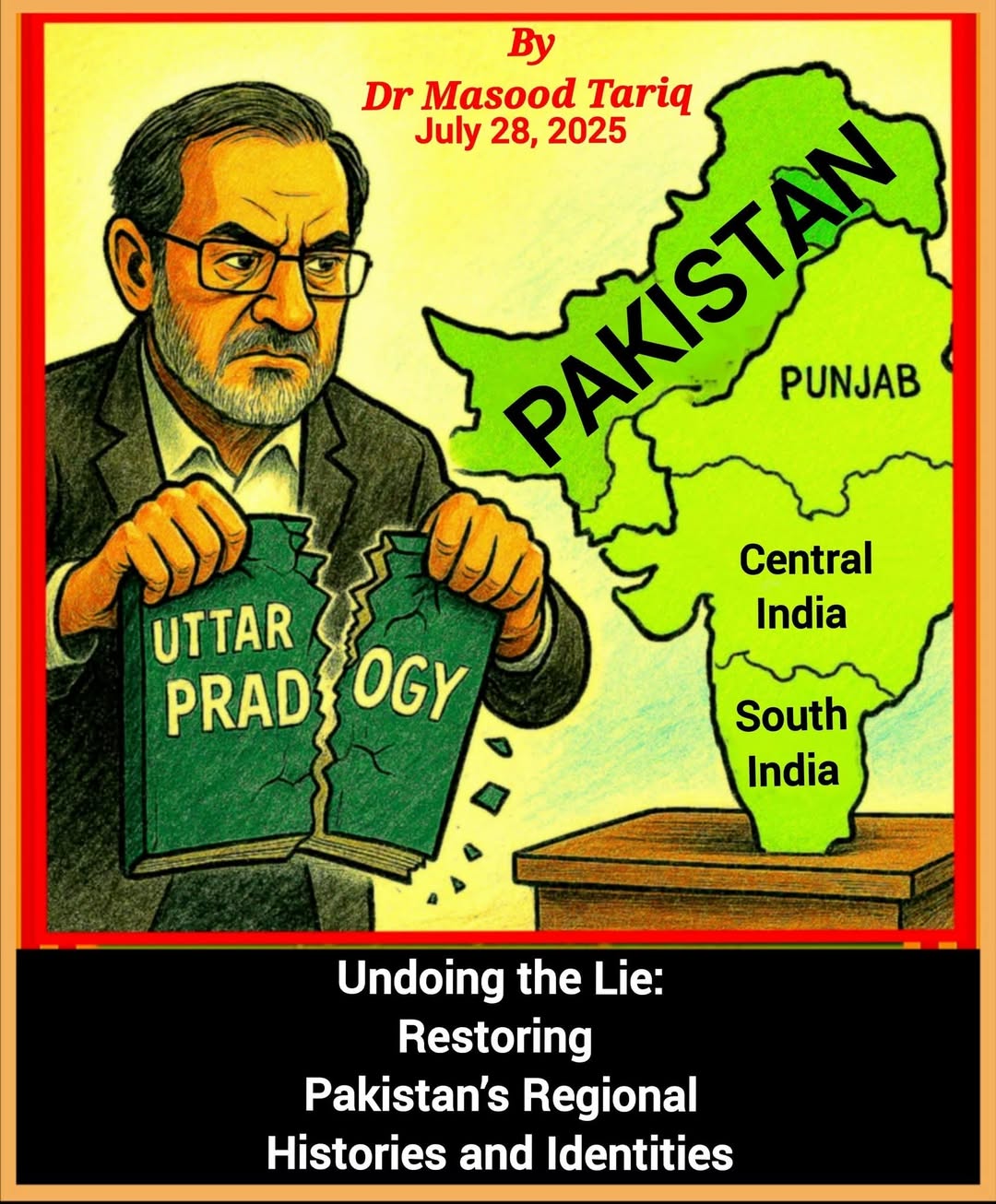
Undoing the Lie: Restoring Pakistan’s Regional Histories and Identities
Dr. Masood Tariq
Independent Political Theorist
Karachi, Pakistan
drmasoodtariq@gmail.com
Date: July 28, 2025
——————————————–
Abstract
This paper critiques the dominance of the ‘Uttar Pradesh ideology’—a centralized, Islamicized, and Urdu-centric doctrine—in Pakistan’s national identity and state-building processes. It demonstrates how this transplanted ideology led to the marginalization of regional identities and the suppression of plurinational consciousness.
Through analysis of curriculum content, state ideology, and historical suppression of subnational histories, the paper argues for a reorientation towards a plurinational framework rooted in local history, languages, and cultures. Policy recommendations include curriculum reform, language inclusion, and constitutional restructuring to support Pakistan’s plurinational reality.
——————————————–
Table of Contents
1. Introduction
2. Systematic Omissions and the Imported Ideology
3. Consequences of Ideological Fabrication
4. Theoretical Justification for a Plurinational Stat
5. Pathways to a Plurinational Curriculum and State
6. Conclusion
7. References
——————————————–
1. Introduction
After the creation of Pakistan in 1947, the elite segment of Urdu-speaking Indian Muslims—mainly from Uttar Pradesh and Bihar—successfully imposed their historical memory and religious understanding upon a demographically diverse state. The result was the adoption of an ideology shaped by their unique minority experience in Hindu-majority India, not reflective of the plurinational realities of Pakistan.
This framework advanced a centralized Islamic identity, elevated Urdu as a linguistic hegemon, and systematically erased Pakistan’s ethnic, linguistic, and cultural plurality. It denied indigenous peoples like Sindhis, Balochis, Brahuis, Pashtuns, Kohistanis, Chitralis, Swatis, Gilgiti-Baltistanis and even Muslim Punjabis their historical agency, cultural legitimacy, and political autonomy.
——————————————–
2. Systematic Omissions and the Imported Ideology
The post-1947 narrative architecture was rooted in an ideology forged in the Indo-Gangetic plain, not the Indus Valley or the mountains of Balochistan and Khyber. The ideology framed Pakistan as a product of Islamic civilization beginning with Muhammad bin Qasim in 712 CE, deliberately bypassing thousands of years of pre-Islamic regional civilization.
Key omissions in state ideology and curricula include:
a). The historical significance of the Indus Valley Civilization.
b). Contributions of regional mystics, poets, and political movements (e.g., Baba Farid, Baba Nanak, Shah Hussain, Sultan Bahu, Bulleh Shah, Mian Muhammad Bakhsh, Khwaja Ghulam Farid, Shah Abdul Latif Bhittai, Sachal Sarmast, Khushal Khan Khattak, and the Khilafat Movement in Sindh).
c). Exclusion of anti-colonial figures like Ahmad Khan Kharral, Bhagat Singh, Hemu Kalani and others.
Examples from the Pakistan Studies Curriculum:
Grade 9 Pakistan Studies textbook (Federal Board, 2022):
a). Focuses heavily on religious invasions; e.g., glorification of Mahmud of Ghazni’s temple raids.
b). No mention of indigenous Sufi saints or secular resistance movements.
c). Punjab’s history is often summarized only in terms of Islamic conquest.
Grade 10 Pakistan Studies textbook:
a). States, “The creation of Pakistan was the culmination of Muslim aspirations beginning in 712 CE.”
b). No mention of the 1940s secular nationalist movements in Punjab, Khyber Pakhtunkhwa, Balochistan or Sindh.
These omissions are not merely academic lapses—they are ideologically calculated to homogenize the population under an Islamic, Urdu-speaking identity that serves the interests of a narrow political class.
——————————————–
3. Consequences of Ideological Fabrication
The forced imposition of a single, homogenizing ideology has created widespread political, intellectual, and social dysfunction. Among its major consequences are:
a). Political Immaturity and Intellectual Paralysis
A narrow, Arabized version of Islam was promoted over inclusive South Asian Sufi traditions.
The curriculum discourages critical thinking; dissent is labeled heretical or anti-national.
b). Alienation of Ethnonational Groups
Sindhis, Balochis, Brahuis, Pashtuns, Kohistanis, Chitralis, Swatis, Gilgiti-Baltistanis feel historically excluded from the national narrative.
Movements for autonomy and even secession (e.g., Baloch insurgency) are direct outcomes.
c). Undermining Democracy and Federalism
Centralized nationalism weakened provincial rights enshrined in the 1973 Constitution.
Urdu was imposed as a national language despite being the mother tongue of less than 8%.
d). Evidence from Surveys
A Gallup Pakistan 2022 survey found that 68% of high school students could not name a regional historical figure from their own province.
ASER Pakistan 2023 reported that only 12% of Grade 10 students understood the concept of federalism or provincial autonomy.
This ideological conditioning stunts national cohesion rather than strengthening it. A nation cannot unify by erasing its plurality.
——————————————–
4. Theoretical Justification for a Plurinational State
The idea of a plurinational state rests on the recognition that multiple nationalities can exist within a single political structure without erasing their identities. Bolivia and Ecuador are modern examples of constitutionally plurinational states that acknowledge indigenous groups as equal stakeholders.
In Pakistan’s case, each province—Punjab, Sindh, Balochistan, and Khyber Pakhtunkhwa—has its own language, culture, and historical consciousness. The Islamic identity alone cannot mask these deeply rooted distinctions.
Relevant Theories:
a). Benedict Anderson’s concept of “imagined communities” helps explain how national identities are socially constructed.
b). Ernesto Laclau and Chantal Mouffe’s work on radical democracy emphasizes the inclusion of marginalized voices in national discourse.
c). Walter Mignolo’s decolonial theory urges states to delink from Eurocentric (or in this case, Indo-Gangetic) epistemologies.
——————————————–
5. Pathways to a Plurinational Curriculum and State
To replace the Uttar Pradesh ideology with a plurinational framework, the following steps must be taken:
a). Curriculum Reform
Rewrite Pakistan Studies to include regional histories, poets, heroes, and indigenous languages.
Decenter the narrative from religious conquest to civilizational plurality.
b). Constitutional Recognition of Nations
Each nation should be recognized as a distinct nation with autonomy over education, language, and culture.
Article 251 (language policy) must be amended to give official recognition to Punjabi, Sindhi, Pashto, Balochi, Brahui and other languages.
c). Decentralized Education
Provinces should design their own history and language curricula.
Local cultural institutions like Punjabi Lok Virsa and the Sindhi Adabi Board must be revived and funded.
d). Learn from Global Cases
In post-apartheid South Africa, a new curriculum emphasized inclusivity and historical truth-telling to heal ethnic divisions.
Rwanda’s post-genocide curriculum reform focused on shared civic values rather than ethnic propaganda.
e). Mobilize Civil Society
Engage NGOs, educators, and historians in curriculum review processes.
Highlight the work of scholars like Dr. Rubina Saigol and Dr. Tariq Rahman, who have long argued for a pluralist and decolonized national identity.
——————————————–
6. Conclusion
The current ideological framework of Pakistan is imported, exclusionary, and unsustainable. To build a democratic, peaceful, and equitable federation, Pakistan must embrace its plurinational reality. This involves reconstructing national identity not through religious uniformity but through respect for regional cultures, languages, and histories. The replacement of the Uttar Pradesh ideology with a plurinational framework is not merely a political necessity but a historical and moral imperative.
——————————————–
7. References
Gallup Pakistan. (2022). Youth Perception Survey. https://gallup.com.pk
ASER Pakistan. (2023). Annual Status of Education Report. http://aserpakistan.org
Anderson, B. (1983). Imagined Communities. Verso.
Laclau, E., & Mouffe, C. (1985). Hegemony and Socialist Strategy. Verso.
Mignolo, W. (2011). The Darker Side of Western Modernity. Duke University Press.
Saigol, R. (2003). The Pakistan Curriculum and National Identity. SDPI.
Rahman, T. (1996). Language and Politics in Pakistan. Oxford University Press.
Ministry of Federal Education (2022). Pakistan Studies Textbook – Grade 9 & 10. Federal Board of Intermediate and Secondary Education.
——————————————–
Author Biography
Dr. Masood Tariq is a Karachi-based politician and political theorist. He formerly served as Senior Vice President of the Pakistan Muslim Students Federation (PMSF) Sindh, Councillor of the Municipal Corporation Hyderabad, Advisor to the Chief Minister of Sindh, and Member of the Sindh Cabinet.
His research explores South Asian geopolitics, postcolonial state formation, regional nationalism, and inter-ethnic politics, with a focus on the Punjabi question and Cold War strategic alignments.
He also writes on Pakistan’s socio-political and economic structures, analysing their structural causes and proposing policy-oriented solutions aligned with historical research and contemporary strategy.
His work aims to bridge historical scholarship and strategic analysis to inform policymaking across South Asia, Central Asia, and the Middle East.
Leave a Reply