
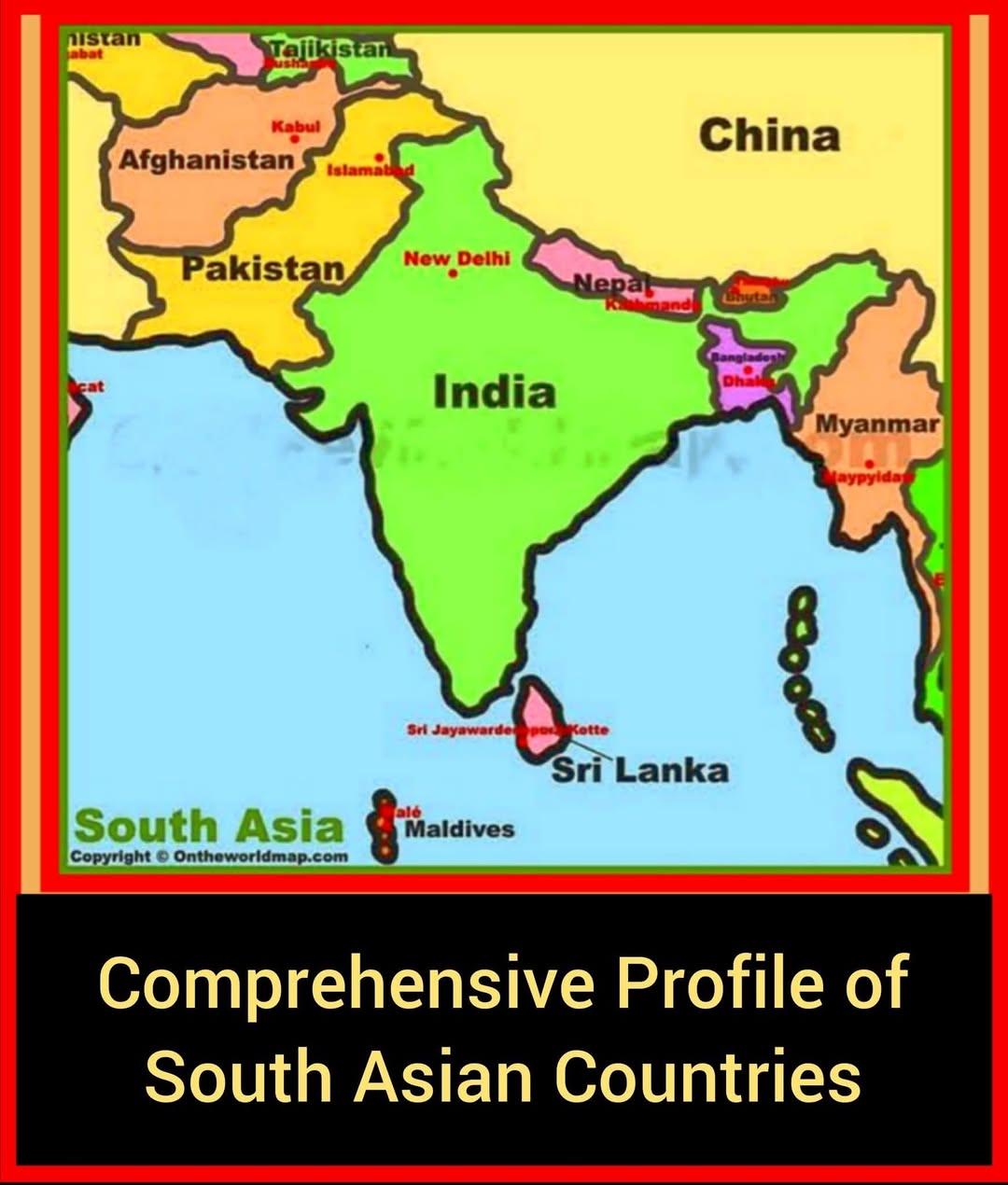
Comprehensive Profile of South Asian Countries
Dr. Masood Tariq
Independent Political Theorist
Karachi, Pakistan drmasoodtariq@gmail.com
Date: June 24, 2025
——————————————–
Abstract
This paper provides a comprehensive profile of the eight sovereign states and one de facto state that constitute South Asia, examining their demographic weight, economic structures, and military capabilities. Drawing on data from 2024–2025 estimates, it highlights both convergences and divergences within the region, from India’s position as the world’s most populous nation and fifth-largest economy to Afghanistan’s prolonged instability and dependence on aid. The analysis underscores how South Asia’s diversity in religion, language, culture, and development translates into varied political and security outlooks. India and Pakistan dominate the military and geopolitical landscape, while Bangladesh and Sri Lanka contribute dynamic economic sectors. Smaller states such as Bhutan and the Maldives showcase unique development models rooted in hydropower and tourism. By situating these profiles within the broader context of global geopolitics, the paper identifies regional cooperation, resource management, and collective security as critical for South Asia’s stability in an era of multipolar competition.
——————————————–
Table of Contents
(1). Introduction
(2). Summary Table (Rankings by Population in South Asian Countries) – Total Population (2024–2025 Estimates)
(3). Summary Table (Rankings by Economic Size in South Asian Countries) – Total GDP, Nominal USD
(4). Summary Table (Rankings by Per Capita GDP in South Asian Countries) Nominal GDP Per Capita (USD, 2024–2025)
(5). Summary Table (Rankings by Military Power in South Asia): According to the Global Firepower Index 2024
(6). Country Profiles
(7). Conclusion
——————————————–
(1). Introduction
South Asia is among the most densely populated and geopolitically contested regions of the world. Comprising India, Pakistan, Bangladesh, Afghanistan, Nepal, Sri Lanka, Bhutan, and the Maldives—alongside Kashmir as a disputed de facto entity—the region embodies extraordinary cultural, religious, and linguistic diversity. It is also home to nearly two billion people, accounting for almost a quarter of humanity.
The region’s historical trajectory has been shaped by ancient civilizations, colonial encounters, and post-independence state-building struggles. In the 21st century, South Asia stands at the crossroads of global change. India has emerged as the world’s most populous nation and an economic heavyweight, while Pakistan and Bangladesh remain central to Muslim-majority geopolitics and global labor flows. Sri Lanka and Nepal grapple with post-conflict and developmental challenges, while Bhutan and the Maldives exemplify small-state resilience through niche strategies such as hydropower and tourism.
The purpose of this paper is to profile South Asian countries comprehensively across population, economy, and military power. By comparing their demographic weight, economic indicators, and defense capabilities, the paper aims to provide policymakers, scholars, and strategists with a consolidated view of South Asia’s internal composition and regional balance of power. This comparative approach is particularly relevant at a time when climate change, resource competition, and shifting global alliances intensify the pressures and opportunities confronting the region.
——————————————–
(2). Summary Table (Rankings by Population in South Asian Countries) – Total Population (2024–2025 Estimates)
1. India – ~1.44 billion — World Rank: 1st
2. Pakistan – ~248 million — World Rank: 5th
3. Bangladesh – ~172 million — World Rank: 8th
4. Afghanistan – ~42 million — World Rank: 36th
5. Nepal – ~31 million — World Rank: 49th
6. Sri Lanka – ~22 million — World Rank: 59th
7. Bhutan – ~800,000 — World Rank: 162nd
8. Maldives – ~560,000 — World Rank: 171st
Note: These population figures reflect mid-2024 to early-2025 estimates. Rankings are based on total population size, not population growth. India remains the most populous country in the world, having overtaken China in 2023. Pakistan and Bangladesh are also among the top ten globally. Conversely, Bhutan and Maldives rank among the least populous sovereign states.
——————————————–
(3). Summary Table (Rankings by Economic Size in South Asian Countries) – Total GDP, Nominal USD
1. India – ~$3.9 trillion (Per Capita: ~$2,700) — World Rank: 5th
2. Bangladesh – ~$411 billion (Per Capita: ~$2,400) — World Rank: 35th
3. Pakistan – ~$385 billion (Per Capita: ~$1,550) — World Rank: 39th
4. Sri Lanka – ~$91 billion (Per Capita: ~$4,000) — World Rank: 67th
5. Nepal – ~$47 billion (Per Capita: ~$1,550) — World Rank: 92nd
6. Afghanistan – ~$14 billion (Per Capita: ~$330) — World Rank: 115th
7. Maldives – ~$6.5 billion (Per Capita: ~$14,000) — World Rank: 141st
8. Bhutan – ~$3.1 billion (Per Capita: ~$3,800) — World Rank: 159th
Note: Rankings are based on nominal GDP from IMF, World Bank, and UN sources (accessed June 2025). Per capita GDP provides additional insight into individual prosperity, with Qatar, UAE, and Israel ranking highest by per capita income despite relatively smaller populations.
——————————————–
(4). Summary Table (Rankings by Per Capita GDP in South Asian Countries) Nominal GDP Per Capita (USD, 2024–2025)
1. Maldives – ~$14,000 — World Rank: 63rd
2. Sri Lanka – ~$4,000 — World Rank: 94th
3. Bhutan – ~$3,800 — World Rank: 96th
4. India – ~$2,700 — World Rank: 104th
5. Bangladesh – ~$2,400 — World Rank: 107th
6. Pakistan – ~$1,550 — World Rank: 117th
7. Nepal – ~$1,550 — World Rank: 118th
8. Afghanistan – ~$330 — World Rank: 145th
Note: Per capita GDP figures are based on nominal estimates from IMF, World Bank, and UN sources (2024–2025). The Maldives leads South Asia in per capita income due to its small population and tourism-driven economy, while Afghanistan ranks among the lowest globally due to prolonged conflict and underdevelopment.
——————————————–
(5). Summary Table (Rankings by Military Power in South Asia): According to the Global Firepower Index 2024
1. India – World Rank: 4th
2. Pakistan – World Rank: 7th
3. Bangladesh – World Rank: 42nd
4. Sri Lanka – World Rank: 71st
5. Nepal – World Rank: 94th
6. Bhutan – World Rank: 141st
7. Maldives – World Rank: 151st
8. Afghanistan – Not officially ranked (Under Taliban rule; no internationally recognized national army)
Note: Rankings consider not just hardware or troop numbers but also military readiness, logistics, air/naval strength, and regional power projection. Figures are drawn from Global Firepower Index 2024, SIPRI, World Bank, and defense analysis reports accessed as of June 2025.
——————————————–
(6). Country Profiles
1. Afghanistan
Area: ~652,864 km²
Year of founding: 1919 (Independence from British control)
Population (2024 est.): ~42 million
Religious demography: ~99% Muslim (Sunni ~85%, Shia ~15%)
Language demography: Pashto, Dari (Persian), Turkic dialects
Economy: Agriculture, informal trade, opium, aid-dependent
Economic position: GDP ~US$ 15 billion; per capita ~US$ 400
Military power: Under the Taliban; no official ranking
2. Bangladesh
Area: ~147,570 km²
Year of founding: 1971 (from Pakistan)
Population (2024 est.): ~172 million
Religious demography: ~90% Muslim, ~8.5% Hindu, others ~1.5%
Language demography: Bengali (official), English (secondary)
Economy: Textiles, remittances, agriculture
Economic position: GDP ~US$ 460 billion; per capita ~US$ 2,700
Military power: 3rd in South Asia, ~42nd globally
3. Bhutan
Area: ~38,394 km²
Year of founding: Unified in the 17th century; modern state 2008
Population (2024 est.): ~800,000
Religious demography: Vajrayana Buddhism ~75%, Hindu ~23%
Language demography: Dzongkha (official), Tshangla, Nepali
Economy: Hydropower, agriculture, tourism
Economic position: GDP ~US$ 3 billion; per capita ~US$ 3,800
Military power: Minimal; dependent on India for defence
4. India
Area: ~3,287,263 km²
Year of founding: 1947 (from Britain)
Population (2025 est.): ~1.44 billion
Religious demography: Hindu ~79%, Muslim ~14%, Christian ~2.5%, Sikh ~2%, others
Language demography: Hindi & English (official), 21 other scheduled languages
Economy: Services, industry, agriculture, IT
Economic position: GDP ~US$ 3.9 trillion; per capita ~US$ 2,800
Military power: 1st in South Asia, 4th globally
5. Maldives
Area: ~298 km²
Year of founding: 1965 (from British protectorate)
Population (2024 est.): ~560,000
Religious demography: 100% Muslim (Sunni)
Language demography: Dhivehi (official), English
Economy: Tourism, fishing
Economic position: GDP ~US$ 6 billion; per capita ~US$ 11,000
Military power: Minimal; coastal security forces only
6. Nepal
Area: ~147,516 km²
Year of founding: 1768 (unified kingdom); Republic since 2008
Population (2024 est.): ~31 million
Religious demography: Hindu ~81%, Buddhist ~9%, Muslim ~4.5%, Christian ~1.5%
Language demography: Nepali (official), Maithili, Bhojpuri, Tharu, and others
Economy: Agriculture, tourism, remittances
Economic position: GDP ~US$ 45 billion; per capita ~US$ 1,400
Military power: 6th in South Asia
7. Pakistan
Area: ~881,913 km²
Year of founding: 1947 (from Britain, with India)
Population (2025 est.): ~248 million
Religious demography: ~96% Muslim (Sunni ~85%, Shia ~15%), Christian ~1.5%, Hindu ~1.8%
Language demography: Urdu (national), Punjabi (~60%), Sindhi, Pashto, Balochi, English
Economy: Agriculture, textiles, remittances, industry
Economic position: GDP ~US$ 400 billion; per capita ~US$ 1,600
Military power: 2nd in South Asia, 7th globally
8. Sri Lanka
Area: ~65,610 km²
Year of founding: 1948 (from Britain)
Population (2024 est.): ~22 million
Religious demography: Buddhist ~70%, Hindu ~12%, Muslim ~10%, Christian ~7%
Language demography: Sinhala (official), Tamil, English
Economy: Tea, textiles, tourism, agriculture
Economic position: GDP ~US$ 90 billion; per capita ~US$ 4,100
Military power: 4th in South Asia
——————————————–
(7). Conclusion
South Asia represents both promise and peril. Its vast populations, rich resources, and civilizational depth equip the region with immense potential, yet persistent political divisions, underdevelopment, and inter-state rivalries undermine its collective strength. India and Pakistan dominate the strategic theater, both as nuclear powers and as regional heavyweights whose rivalry continues to shape the security landscape. Bangladesh’s economic dynamism and Sri Lanka’s service-led recovery highlight opportunities for growth, while Afghanistan’s instability underscores the dangers of unresolved conflict. Nepal, Bhutan, and the Maldives demonstrate how smaller states navigate survival through specialized development paths and reliance on larger neighbors.
This profile reveals that South Asia cannot be understood in isolation—its countries are bound together by shared histories, transnational challenges, and interdependent futures. Common threats such as poverty, climate vulnerability, and resource scarcity require cooperative solutions, while regional frameworks for trade, energy, and security remain underdeveloped.
As South Asia enters the mid-21st century, the path to sustainable peace and prosperity will depend less on unilateral national ambitions and more on regional integration, mutual security, and respect for cultural pluralism. By mapping the demographic, economic, and military strengths of South Asia’s states, this study seeks to inform constructive policy and scholarly debates on how the region can transform its contradictions into collective opportunities.
——————————————–
Author Biography
Dr. Masood Tariq is a Karachi-based politician and political theorist. He formerly served as Senior Vice President of the Pakistan Muslim Students Federation (PMSF) Sindh, Councillor of the Municipal Corporation Hyderabad, Advisor to the Chief Minister of Sindh, and Member of the Sindh Cabinet.
His research explores South Asian geopolitics, postcolonial state formation, regional nationalism, and inter-ethnic politics, with a focus on the Punjabi question and Cold War strategic alignments.
He also writes on Pakistan’s socio-political and economic structures, analysing their structural causes and proposing policy-oriented solutions aligned with historical research and contemporary strategy.
His work aims to bridge historical scholarship and strategic analysis to inform policymaking across South Asia, Central Asia, and the Middle East.
Leave a Reply