
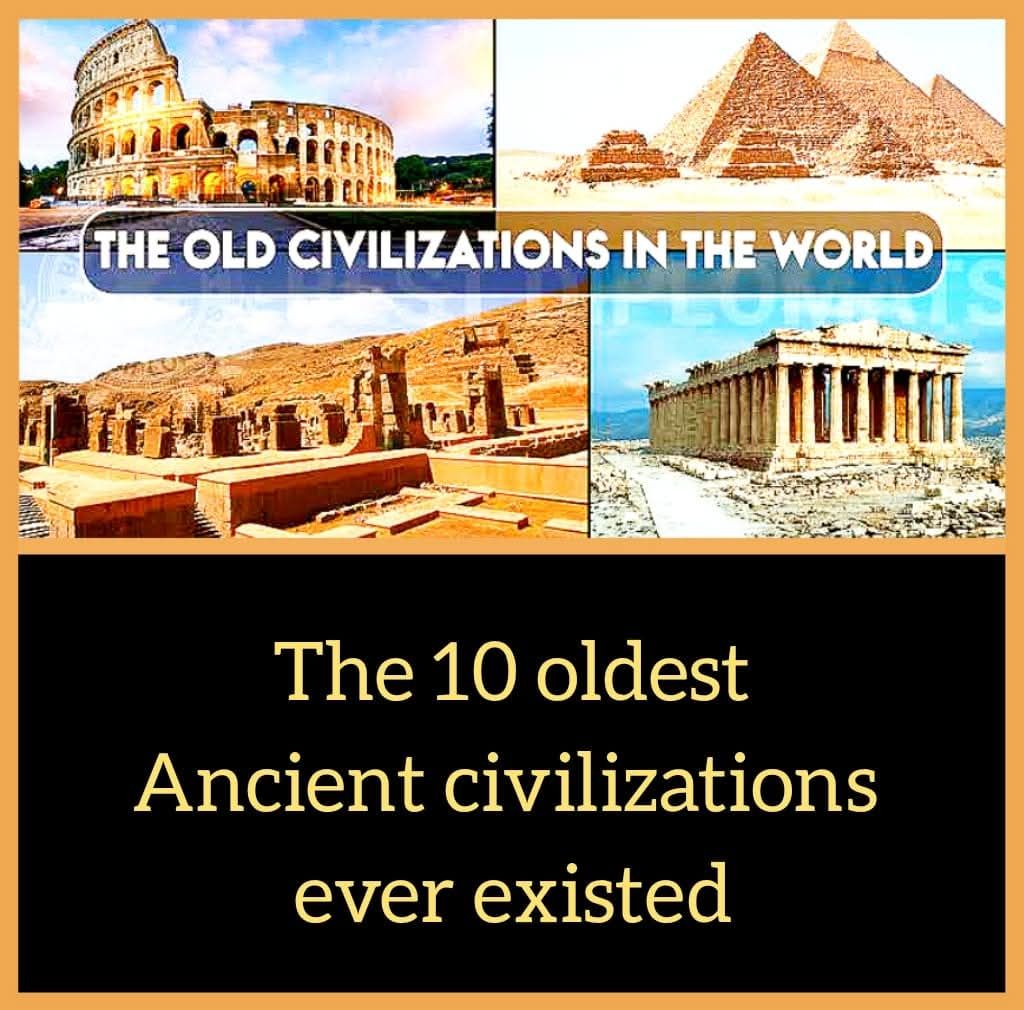
The 10 Oldest Civilizations ever existed.
Date: September 23, 2025
Introduction
Long ago, people lived in small groups, hunting, farming, and moving with the seasons. But slowly, something changed. People began to gather along rivers, sharing food, building homes, and learning to live together in bigger communities. From these gatherings, the first civilizations were born.
Civilizations are not just about farming or living together. They are about building cities, creating writing, trading goods, ruling with laws, and leaving behind stories and monuments that last for thousands of years.
Here, we will travel back in time to meet ten of the greatest and oldest civilizations that shaped the world we know today.
1. Mesopotamia – The First Civilization
Our journey begins in the land between two great rivers, the Tigris and Euphrates. Today we call it Iraq, but back then, it was known as Mesopotamia.
Around 3500 BC, the Sumerians built the first cities like Uruk and Ur. They made one of the world’s first writing systems—cuneiform—pressing symbols into clay. They also gave us laws, schools, temples, and epic stories like Gilgamesh.
Mesopotamia was truly the cradle of civilization—the first place where human life became organized on a grand scale.
2. Indus Valley – The Silent Cities
Next, we move east to the valleys of the Indus River. Around 2600 BC, a mysterious and advanced civilization rose here. Their great cities—Harappa and Mohenjo-Daro—had wide streets, brick houses, and the world’s first indoor plumbing and drainage systems.
People of the Indus Valley were skilled traders, connecting with Mesopotamia and beyond. They used beautiful seals carved with strange symbols. Yet, their script is still undeciphered, and so much about their lives remains a mystery.
Their cities were abandoned around 1900 BC, and no one knows exactly why.
3. Ancient Egypt – The Land of the Pharaohs
Along the banks of the Nile River, Egypt became one of the most famous civilizations in history. Around 3100 BC, Egypt united under its first pharaoh, and for thousands of years, kings ruled this desert kingdom.
Egypt gave the world pyramids, mummies, and hieroglyphs. They built giant temples for gods like Ra and Isis, and pharaohs like Ramses the Great expanded their empire far and wide.
The Nile’s yearly floods brought life to the desert, making Egypt the “gift of the Nile.”
4. The Maya – Keepers of Time
In the rainforests of Central America, the Maya built cities and pyramids from around 2000 BC, reaching their golden age around 250–900 AD.
The Maya were great astronomers. They watched the stars, created complex calendars, and carved their history on stone monuments. Their cities, like Tikal and Palenque, rose tall above the jungle.
Though their great cities declined, the Maya people never vanished. Millions still live in Mexico, Guatemala, and beyond, keeping their traditions alive.
5. Ancient China – The Yellow River Cradle
In the valleys of the Yellow River, one of the longest continuous civilizations took shape. By 1600 BC, the Shang dynasty ruled with bronze tools, oracle bones, and early Chinese writing.
Over centuries, dynasties rose and fell—Zhou, Qin, Han—each leaving inventions we still use today: paper, the compass, gunpowder, and printing.
China’s civilization became a tree with deep roots and many branches, surviving for thousands of years.
6. Ancient Greece – Birthplace of Ideas
On the rocky coasts and islands of the Aegean Sea, the Greeks built a civilization that still shapes our world. From around 800 BC, Greek city-states like Athens and Sparta flourished.
The Greeks gave us democracy, philosophy, theatre, and the Olympic Games. Thinkers like Plato and Aristotle, heroes like Alexander the Great—all changed history forever.
Even though ancient Greece fell to Rome, its ideas live on in our schools, governments, and sciences.
7. Persia – Empire of Kings
In the lands of Iran, the Persians built one of the largest empires in history. Around 550 BC, Cyrus the Great united the Persian tribes, creating a kingdom stretching from Egypt to India.
The Persians built grand cities like Persepolis and ruled with tolerance, letting conquered peoples keep their customs and religions. Their roads and coins tied the empire together.
But by 330 BC, Alexander the Great swept in, ending the Persian Empire. Still, its memory of wise kings and vast power lives on.
8. Ancient Rome – Builders of an Empire
Legend says Rome was founded in 753 BC by brothers Romulus and Remus. Whatever its true beginning, Rome grew from a small city into a mighty empire.
The Romans built roads, aqueducts, and grand arenas. They gave us Roman law, the Latin language, and stories of emperors like Julius Caesar and Augustus.
At its height, Rome ruled all around the Mediterranean Sea. But by 476 AD, the western empire had fallen to invading tribes. The eastern half, known as Byzantium, lived on for another thousand years.
9. The Aztecs – Masters of Mexico
High in the valleys of Mexico, the Aztecs—or Mexica—built their capital, Tenochtitlan, in 1325 AD on a lake. It became one of the greatest cities of its time, with canals, temples, and markets.
The Aztecs were fierce warriors and skilled farmers. They raised floating gardens on lakes and built giant pyramids for their gods.
But in 1521, Spanish conquistadors led by Hernán Cortés conquered their empire, ending their rule but not their legacy.
10. The Inca – Children of the Sun
In the Andes mountains of South America, the Inca Empire rose in the 1400s. Their capital, Cusco, and the famous city of Machu Picchu still amaze visitors today.
The Inca built stone roads across mountains, stretching thousands of miles. They recorded information with quipu—knotted strings—since they had no writing system.
The Incas worshipped the Sun God, Inti, and their emperor was called the Sapa Inca, the “Child of the Sun.” But like the Aztecs, they fell to the Spanish in the 1530s.
Conclusion
From the rivers of Mesopotamia to the mountains of the Andes, civilizations rose, flourished, and fell. They built cities, created writing, and left behind monuments that still inspire us.
Though some vanished, their stories continue to shape our world. Civilizations may rise and fall, but their ideas, inventions, and legacies live forever in the way we live today.
Leave a Reply