
Agreed vs. Non-Agreed Areas: Post-Partition Property Politics
Dr. Masood Tariq
Independent Political Theorist
Karachi, Pakistan
drmasoodtariq@gmail.com
Date: August 7, 2025
—–‐———‐———‐———‐——–
Abstract:
This paper re-examines the post-Partition territorial and property policies of Pakistan through the overlooked distinction between “Agreed” and “Non-Agreed” Areas. Focusing on the political maneuvering of Prime Minister Liaquat Ali Khan and the rise of Urdu-speaking migrants from India, it argues that the resettlement of Non-Agreed Area migrants—primarily from the United and Central Provinces—was not rooted in humanitarian necessity, but in deliberate demographic and bureaucratic engineering.
Drawing upon historical treaties such as the Liaquat–Nehru Pact, demographic data, and legal records, the paper reveals how state institutions like the Evacuee Property Trust Board were used to consolidate UP, CP elite control over urban centers. The study concludes that this process fostered systemic inequality, linguistic homogenization, and long-term ethnic marginalization of indigenous populations, with lasting effects on Pakistan’s urban political economy and federal cohesion.
—–‐———‐———‐———‐——–
Keywords:
Partition of India, Agreed vs. Non-Agreed Areas, Urdu-speaking migrants, Liaquat–Nehru Pact, Evacuee Property, postcolonial bureaucracy, refugee politics, urban hegemony, ethnolinguistic conflict, Pakistan history
—–‐———‐———‐———‐——–
Table of Contents
1. Introduction
2. Historical Context: Partition and the Punjabi Exchange
3. Conceptual Framework: Agreed vs. Non-Agreed Areas
4. Rise of the Urdu-Speaking Migrant Bureaucracy
5. Language, Identity, and Cultural Overwrite
6. The Liaquat–Nehru Pact (Official Summary)
7. Political Engineering by Liaquat Ali Khan
8. Urban Dominance and the Rewriting of Demographics
9. Demographic Transformation of Lahore: A Case Study
10. The Structural Dominance of Urdu-Speaking Migrants
11. Political Realignments and Ethnic Fractures
12. Legal Framework and the Role of the Evacuee Property Legislation
13. Property Claims, Fraud, and the Culture of Corruption
14. Conclusion
—–‐———‐———‐———‐——–
1. Introduction
The creation of Pakistan in 1947 was a monumental and traumatic moment in South Asian history, leading to the displacement of millions across religious and regional lines. While the migration of Muslim Punjabis from East Punjab to West Punjab and Hindus/Sikhs Punjabis from West Punjab to East Punjab is widely studied, less attention has been paid to the migration of Urdu-speaking elites from India’s United Provinces (UP) and Central Provinces (CP), especially those who arrived in Pakistan after 1950.
This paper examines the controversial settlement of these migrants—commonly referred to as Muhajirs—and the systemic allocation of valuable urban properties to them under disputed claims from Non-Agreed Areas. It argues that this process was neither organic nor purely humanitarian but rather a deliberate political strategy orchestrated by Prime Minister Liaquat Ali Khan to reshape Pakistan’s political and bureaucratic order in favor of a loyal Urdu-speaking elite class.
In particular, the paper investigates the legal, political, and administrative manipulation surrounding “Non-Agreed Area” claims, and how these practices laid the groundwork for ethnolinguistic tensions, socio-economic inequality, and urban unrest in Pakistan’s largest cities. The paper also revisits the Liaquat–Nehru Pact to critically assess its exploitation for demographic engineering rather than refugee resettlement.
—–‐———‐———‐———‐——–
2. Historical Context: Partition and the Punjabi Exchange
Partition of Punjab was accompanied by an unprecedented population exchange across the Punjab regions. Entire communities of Hindu and Sikh Punjabi families in West Punjab migrated to India, while Muslim Punjabi families from East Punjab relocated to Pakistan. The displacement was total and collective, forming the demographic and emotional bedrock of the new Pakistani state.
However, unlike this symmetrical migration in Punjab, the movement of Urdu-speaking Muslims from UP and CP was neither forced nor immediate. Many of these elites remained in India long after 1947, only migrating after the 1950 Liaquat–Nehru Pact, a treaty meant for reciprocal protection of minorities rather than mass resettlement.
These late migrants later claimed valuable properties in Pakistan through sworn affidavits, without verification from India or bilateral oversight—an abuse made possible due to the ambiguous classification of Non-Agreed Areas.
—–‐———‐———‐———‐——–
3. Conceptual Framework: Agreed vs. Non-Agreed Areas
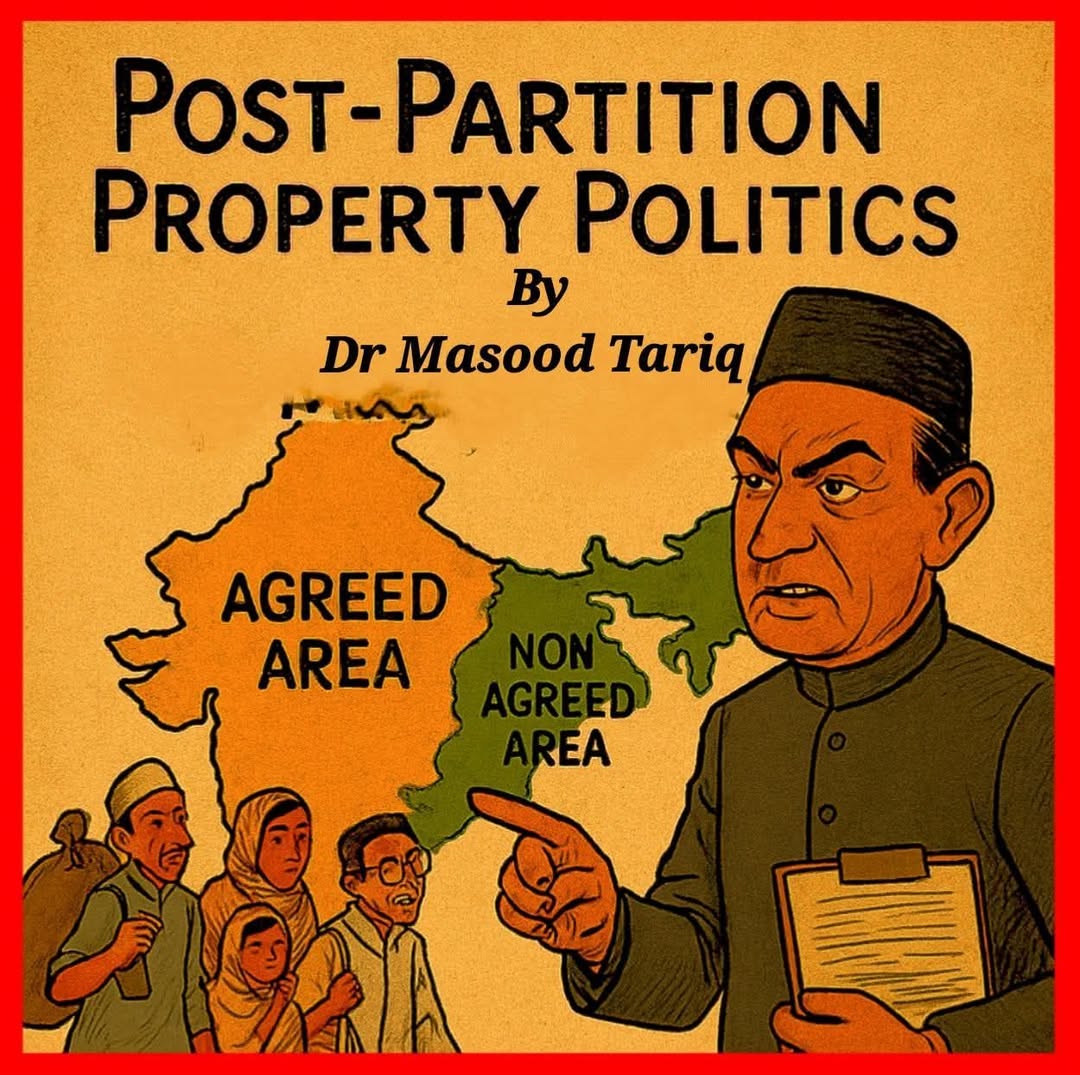
The distinction between Agreed and Non-Agreed Areas forms a critical component of post-Partition property politics:
a). Agreed Areas refer to regions directly affected by the Partition (such as Punjab and Bengal) whose population exchange and property claims were mutually recognized and verified by both Indian and Pakistani governments under the terms of the Indian Independence Act (1947) and post-Partition protocols.
b). Non-Agreed Areas, such as the United Provinces (UP) and Central Provinces (CP), were not included in the bilateral framework. Consequently, migrants from these areas were not legally entitled to claim properties in Pakistan. However, under Liaquat Ali Khan’s administration, alternative verification methods (primarily sworn statements and witness endorsements) were introduced, allowing these claimants to obtain large swathes of urban property without governmental authentication from India.
This loophole enabled the large-scale settlement and empowerment of Non-Agreed Area migrants, with far-reaching consequences for Pakistan’s urban demography and inter-ethnic relations.
—–‐———‐———‐———‐——–
4. Rise of the Urdu-Speaking Migrant Bureaucracy
After 1947, Pakistan saw a rapid bureaucratic consolidation under the leadership of Urdu-speaking elites who migrated from Uttar Pradesh, Bihar, and other parts of northern India. Karachi, declared the federal capital, was transformed into a stronghold of these migrants. Many of them quickly occupied key positions in the civil service, media, academia, and commerce.
This demographic and administrative shift had significant consequences. The promises made to Agreed Areas—such as recognition of traditional leadership, regional languages, and resource rights—were neglected in favor of a centralized, Urdu-speaking, and Indian-origin elite. The new administrative structure prioritized the homogenization of Pakistan’s identity, often at the expense of historical pluralism.
—–‐———‐———‐———‐——–
5. Language, Identity, and Cultural Overwrite
The imposition of Urdu as the sole national language served as a cultural tool for consolidating migrant dominance. Native languages such as Punjabi, Sindhi, Pashto, Balochi, and Brahui were marginalized. The cultural and educational policies promoted by the federal administration favored a north-Indian Islamic idiom that was alien to the native populations of the Agreed Areas.
—–‐———‐———‐———‐——–
6. The Liaquat–Nehru Pact (Official Summary)
The Liaquat–Nehru Pact, signed on April 8, 1950, in New Delhi, was an agreement between Prime Minister Jawaharlal Nehru of India and Prime Minister Liaquat Ali Khan of Pakistan. It was officially called the “Delhi Pact” and aimed to address the deteriorating condition of minorities in both countries following Partition.
Key Provisions:
a). Protection of minorities in both countries.
b). Establishment of Minority Commissions in both India and Pakistan.
c). Restoration of abducted women.
d). Granting minorities the right to freely practice religion, develop their culture, and secure representation.
e). Assurances regarding the security of life, property, and honor of minorities.
Note: The pact did not authorize mass migration or property claims for Non-Agreed Area migrants; it was primarily a human rights agreement, not an immigration or resettlement treaty.
—–‐———‐———‐———‐——–
7. Political Engineering by Liaquat Ali Khan
Liaquat Ali Khan, as Pakistan’s first Prime Minister and a native of UP, orchestrated a deliberate policy to bring in Urdu-speaking Muslims from India to consolidate his political base.
By allocating properties, government jobs, and bureaucratic positions to his co-ethnics, he restructured the fledgling state’s power dynamics.
The use of state institutions like the Evacuee Property Board to process dubious claims from Non-Agreed Areas opened the floodgates for fraud and patronage.
These migrants, though late arrivals, were disproportionately settled in urban centers and provided access to civil service, press, and commerce.
—–‐———‐———‐———‐——–
8. Urban Dominance and the Rewriting of Demographics
Before Partition, cities like Lahore, Rawalpindi, and Sargodha were demographically Punjabi and socioeconomically dominated by local populations. Following 1950, prime neighborhoods in these cities were redistributed to migrants from UP and CP:
In Lahore: Anarkali, Shah Alami, Gawalmandi, and Model Town reallocated to non-Punjabi migrants.
In Rawalpindi: Raja Bazaar, Mohanpura, Arya Mohalla reallocated to non-Punjabi migrants.
In Sargodha: A city built by Punjabi Sikhs, almost entirely reallocated to non-Punjabi migrants.
A similar redistribution occurred in Faisalabad, Gujranwala, Sheikhupura, Sialkot, Multan, Bahawalpur and other cities of Punjab.
In Sindh: Cities like Karachi, Hyderabad, Sukkur, Nawabshah, and Mirpur Khas came under Indian Muslim dominance.
According to Pakistan’s 1951 census, 83% of the population was rural, while only 17% was urban. Of that 7% were Indian Muhajirs.
These urban takeovers established Urdu-speaking Indian dominance in Pakistan’s most critical cities, leading to a class of bureaucratic and commercial elite detached from indigenous ethnic populations.
—–‐———‐———‐———‐——–
9. Demographic Transformation of Lahore: A Case Study
The city of Lahore, the cultural capital of Punjab, serves as a prime example of this transformation:
a). In 1951, the population of Lahore was 849,000, of which 271,000 were Urdu-speaking Indians. They constituted 36% of the city’s population.
b). By 1961, Lahore’s population had grown to 1,320,000, with 474,000 Urdu-speaking Indians, making up 32% of the population.
These Urdu-speaking migrants quickly entrenched themselves in the city’s educational institutions, newspaper offices, media houses, government departments, banks, and hospitals. Their dominance extended beyond economic and administrative institutions to religious and ideological spheres as well.
After the creation of Pakistan, Lahore became the epicenter of the religious and sectarian influx from UP and CP. Several influential religious and ideological movements set up their headquarters in Lahore:
a). Dr. Israr Ahmed’s Tanzeem-e-Islami
b). Abul Ala Maududi’s Mansoora (Jamaat-e-Islami)
c). The Deobandi religious center in Raiwind
d). The Barelvi school of thought
e). Ahl-e-Hadith networks
f). The Lucknow-style Shia theological tradition
Simultaneously, progressive and leftist movements of Urdu-speaking migrants that opposed religious extremism also established their base in Lahore. Ironically, even these progressive circles contributed to the cultural hegemony of Urdu by promoting it as the language of enlightenment and resistance.
—–‐———‐———‐———‐——–
10. The Structural Dominance of Urdu-Speaking Migrants
The role of Urdu-speaking migrants was not limited to Lahore alone. In Karachi, Hyderabad (Sindh), and other major cities, a similar pattern was observed. The Muhajirs, by virtue of their perceived higher educational qualifications and linguistic alignment with the state’s ideological vision, secured dominant positions in the civil bureaucracy, foreign service, military high command (especially in non-combat roles), media, and financial institutions.
The urban Sindhi, Baloch, and native Punjabi populations were gradually sidelined from key policy-making and administrative roles. The state’s alignment with Urdu as the national language further reinforced this marginalization, creating structural advantages for the migrants.
—–‐———‐———‐———‐——–
11. Political Realignments and Ethnic Fractures
The dominance of Urdu-speaking elites played a key role in exacerbating ethnic tensions in Pakistan. Their efforts to centralize identity around Islam and Urdu alienated non-Urdu speaking ethnic groups.
The Bengali language movement in East Pakistan was the first major rupture in this imposed national narrative, culminating in the secession of East Pakistan and the creation of Bangladesh in 1971.
In Sindh, the influx of Urdu-speaking migrants led to political polarization between Sindhis and Muhajirs. The 1972 Language Riots in Sindh were a direct outcome of this linguistic and ethnic competition.
The state’s continued preference for Urdu-speaking bureaucrats and policymakers, coupled with economic centralization in migrant-dominated urban centers, deepened these divides.
—–‐———‐———‐———‐——–
12. Legal Framework and the Role of the Evacuee Property Legislation
The establishment of the Evacuee Property Trust Board allowed the state to confiscate and redistribute properties abandoned by Hindus and Sikhs.
However, its misuse became a hallmark of the early Pakistani state’s patronage system. The discretionary powers of verification and allocation created an unregulated property economy that lacked transparency or justice.
—–‐———‐———‐———‐——–
13. Property Claims, Fraud, and the Culture of Corruption
The claim process was fundamentally flawed. Properties were allotted based on affidavits, with no reciprocal verification from Indian authorities. This incentivized perjury, false witness statements, and legal manipulation.
This culture of claim-based fraud seeded a broader culture of corruption in Pakistan’s public institutions, where property was no longer a right tied to displacement, but a reward linked to political loyalty and linguistic identity.
—–‐———‐———‐———‐——–
14. Conclusion
This paper argues that the post-1950 settlement of Non-Agreed Area migrants was not merely a continuation of Partition’s humanitarian agenda but a calculated political and demographic reengineering project. Liaquat Ali Khan’s policy not only enabled the Urdu-speaking elite to dominate Pakistan’s political, bureaucratic, and urban spheres, but also undermined the integrity of the refugee resettlement process.
The long-term effects of these policies are visible in the continued ethnic fragmentation of Pakistan’s urban centers, the erosion of federal cohesion, and the enduring alienation of indigenous communities. A critical re-evaluation of the legal, political, and historical frameworks that enabled such large-scale demographic manipulation is necessary for Pakistan’s future stability and ethnic harmony.
—–‐———‐———‐———‐——–
References
Census Reports of Pakistan, 1951 & 1961
Talbot, Ian. Pakistan: A Modern History. Hurst & Company, 2009.
Ansari, Sarah F.D. Life after Partition: Migration, Community and Strife in Sindh 1947–1962. Oxford University Press, 2005.
Alavi, Hamza. “The State in Post-Colonial Societies: Pakistan and Bangladesh.” New Left Review, 1972.
Shaikh, Farzana. Making Sense of Pakistan. Columbia University Press, 2009.
Ahmed, Ishtiaq. The Punjab: Bloodied, Partitioned and Cleansed. Oxford University Press, 2012.
—–‐———‐———‐———‐——–
Author Biography
Dr. Masood Tariq is a Karachi-based politician and political theorist. He formerly served as Senior Vice President of the Pakistan Muslim Students Federation (PMSF) Sindh, Councillor of the Municipal Corporation Hyderabad, Advisor to the Chief Minister of Sindh, and Member of the Sindh Cabinet.
His research explores South Asian geopolitics, postcolonial state formation, regional nationalism, and inter-ethnic politics, with a focus on the Punjabi question and Cold War strategic alignments.
He also writes on Pakistan’s socio-political and economic structures, analysing their structural causes and proposing policy-oriented solutions aligned with historical research and contemporary strategy.
His work aims to bridge historical scholarship and strategic analysis to inform policymaking across South Asia, Central Asia, and the Middle East.
Leave a Reply