
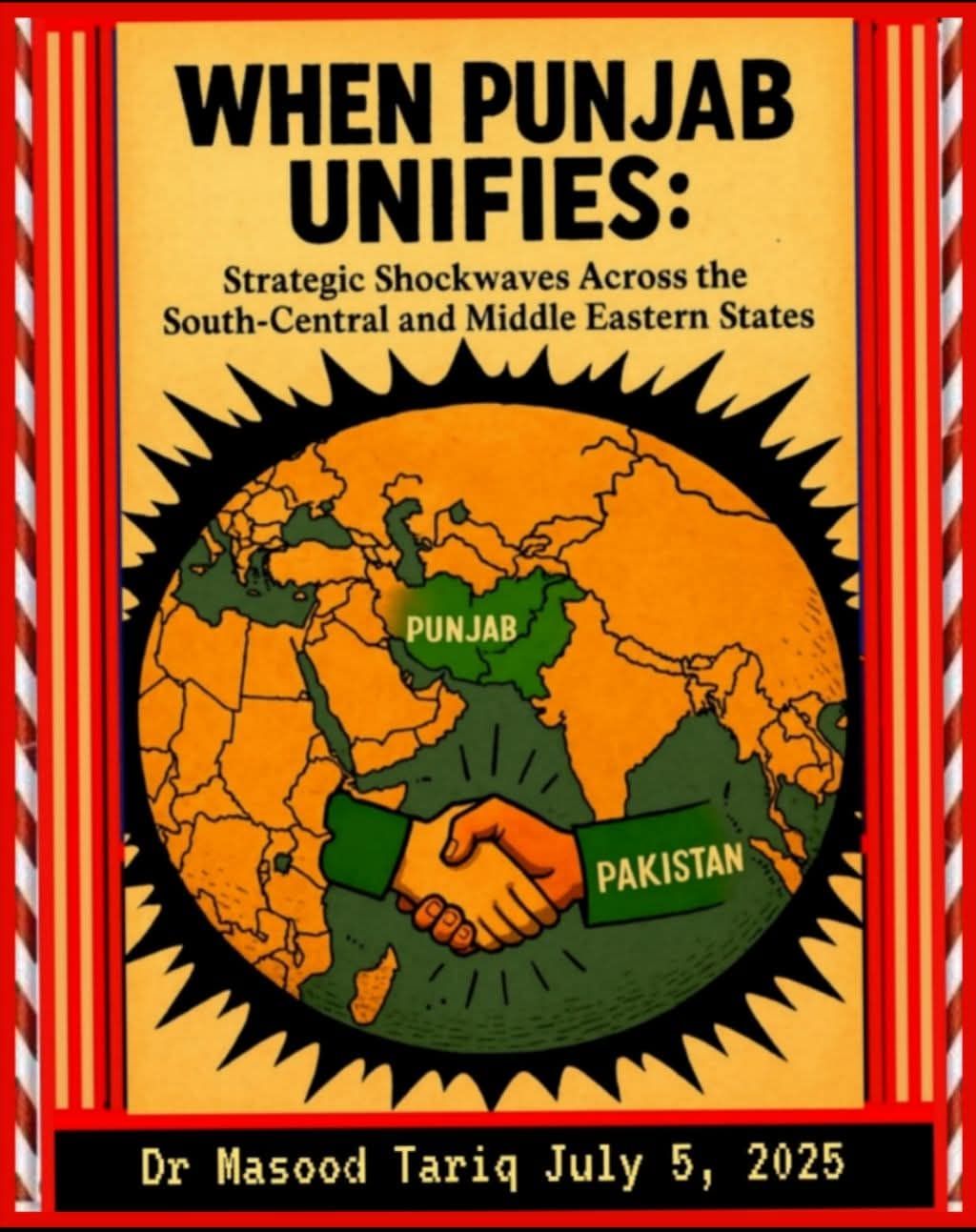
When Punjab Unifies: Strategic Shockwaves Across the South-Central and Middle Eastern States
Dr. Masood Tariq
Independent Political Theorist
Karachi, Pakistan
drmasoodtariq@gmail.com
Date: July 5, 2025
——————————————–
Abstract
This paper investigates the true centers of power in South Asia, Central Asia, and the Middle East by shifting focus from formal state structures to the dominant ethnic nations within them. It argues that in many cases, structurally weak or externally dependent states operate as vessels for powerful ethnic groups that control strategic institutions, including the military, bureaucracy, agriculture, industry, and ideological apparatuses.
The study introduces a transformative scenario: the unification of Indian Punjab with Pakistani Punjab, forming a consolidated Punjabi ethno-national state. This union would enhance Punjabi control over nuclear assets, industrial centers, agricultural sector, and ideological frameworks while destabilizing the existing regional balance of power.
Using comparative geopolitical analysis, the paper ranks 31 South-Central and Middle Eastern States based on their anticipated strategic resilience or vulnerability to this unification. It concludes that dominant ethnic nations—not just administrative states—should be the central unit of geopolitical analysis for understanding regional dynamics and long-term strategic shifts.
——————————————–
Introduction
While international relations traditionally emphasize state-centric models, many strategically significant regions—particularly in South Asia, Central Asia, and the Middle East—are effectively governed not by unified states but by dominant ethnic nations embedded within fragile political structures. These ethnic cores—such as Turks in Turkey, Jews in Israel, and Persians in Iran—command disproportionate control over the military, bureaucracy, economy, and ideological apparatuses, often marginalizing other groups within their borders.
This paper offers an alternative geopolitical model: one that prioritizes ethnic-national dominance as the central factor in understanding regional power dynamics. Applying this framework to a hypothetical yet increasingly plausible event—the unification of Indian Punjab with Pakistani Punjab—it posits the formation of a consolidated Punjabi Nation-state wielding control over Pakistan’s nuclear arsenal, the fertile Indus Basin, industrial centers like Lahore, Faisalabad, Sialkot and Amritsar, and the ideological institutions of the Pakistani state. Such a shift would not only dissolve the entrenched India–Pakistan strategic binary but also recalibrate the balance of power across South-Central Asia and the Middle East.
The study begins by identifying 31 South-Central and Middle Eastern States across the region and classifying them by military capacity. It then maps patterns of ethnic-national dominance before ranking states by their projected resilience or vulnerability to the geopolitical shock of Punjabi unification. The paper argues that ethnic nations—not formal states—must be understood as the true agents of strategic continuity in this volatile geopolitical theater.
——————————————–
(1). Geopolitical Classification of 31 South-Central and Middle Eastern States
To measure the impact of Punjabi unification, the paper identifies 31 South-Central and Middle Eastern States stretching from the Levant to the Hindu Kush. These countries are categorized into four tiers based on military capacity and strategic posture:
Tier I – High Strategic Capacity (Nuclear or Regional Military Hegemons):
1. India
2. Pakistan
3. Israel
4. Turkey
5. Iran
Tier II – Medium Strategic Capacity (Large Conventional Forces and Regional Influence):
1. Egypt
2. Saudi Arabia
3. Kazakhstan
4. Iraq
5. UAE
Tier III – Limited Strategic Capacity (Moderate Defense Forces and Strategic Dependency):
1. Syria
2. Jordan
3. Bangladesh
4. Uzbekistan
5. Turkmenistan
6. Qatar
Tier IV – Low Strategic Capacity (Minimal Military Reach or Fragmented State Power):
1. Afghanistan
2. Lebanon
3. Bahrain
4. Oman
5. Yemen
6. Sudan
7. Kuwait
8. Kyrgyzstan
9. Tajikistan
10. Palestine
11. Cyprus
12. Sri Lanka
13. Nepal
14. Bhutan
15. Maldives
——————————————–
(2). Military Classification in South-Central and Middle East Region
The classification reflects not only formal military assets but also access to strategic depth, defense alliances, technological infrastructure, and energy security in South-Central and Middle East Region.
South Asia (8):
Afghanistan, Bangladesh, Bhutan, India, Maldives, Nepal, Pakistan, Sri Lanka
Central Asia (5):
Kazakhstan, Kyrgyzstan, Tajikistan, Turkmenistan, Uzbekistan
Middle East (~18):
Bahrain, Cyprus (disputed), Egypt (partial), Iran, Iraq, Israel, Jordan, Kuwait, Lebanon, Oman, Palestine, Qatar, Saudi Arabia, Syria, Turkey, UAE, Yemen, Sudan
i) States Capable of Confronting Global Powers
South Asia:
Unified Punjabi Pakistan (hypothetical scenario), India
Central Asia:
Not Anyone
Middle East:
Turkey, Iran, Israel
ii) States Capable of Challenging Regional Rivals, but Not Global Powers
South Asia:
Bangladesh, Afghanistan
Central Asia:
Kazakhstan, Turkmenistan, Uzbekistan
Middle East:
Egypt, Saudi Arabia, UAE, Iraq, Syria
iii) States Lacking Capacity even to Confront Regional Powers
South Asia:
Maldives, Bhutan, Nepal, Sri Lanka
Central Asia:
Kyrgyzstan, Tajikistan
Middle East:
Bahrain, Cyprus, Jordan, Kuwait, Lebanon, Oman, Palestine, Qatar, Yemen
——————————————–
(3). Nations vs. States: The Ethnic Foundations of Power in South-Central and Middle East Region
3-1 South Asia
i) Unified Punjabi Pakistan (Hypothetical):
The unification of Indian Punjab into Pakistan would create a consolidated Punjabi Nation of approximately 200 million people. This would intensify Punjabi dominance in strategic sectors—military leadership, agricultural production, bureaucratic control, industrial output, and ideological direction. Pashtuns would continue to serve as secondary stakeholders in national security and commerce. This transformation would replace the fragmented postcolonial state with a cohesive, ethnically unified and strategically assertive Punjabi power center in the heart of South Asia.
ii) India (Post-Punjab Loss):
The secession of Indian Punjab would result in India losing significant military manpower, agricultural heartlands, and industrial zones. The ideological fabric of the Indian state would be weakened, with power fragmenting among Hindi-speaking elites in the north, Dravidian nationalities in the south (Tamil, Telugu, Kannada, and Malayalam), Marathis, Gujaratis and Rajasthanis in the west, and diverse ethno-linguistic minorities in the northeast. The central government’s ability to project a coherent nationalist ideology or strategic policy would be significantly diminished.
iii) Afghanistan:
Ethnic Pashtuns dominate both the political and military establishments, retaining the highest authority in national leadership and decision-making. Tajiks and Hazaras serve as secondary players, often influential in provincial administration, business, and civil society, but excluded from core state power and security institutions.
iv) Bangladesh:
A largely homogenous Bengali population governs a unitary nation-state, with minimal ethnic fragmentation. Political, military, and economic institutions are dominated by ethnic Bengalis, enabling internal stability and a clear national identity, albeit challenged by elite factionalism rather than ethnic division.
v) Sri Lanka:
The Sinhalese majority controls the state’s political, military, and cultural institutions. Ethnic Tamils, primarily located in the northern and eastern provinces, remain politically marginalized despite limited local autonomy and past peace accords. Sinhala-Buddhist nationalism continues to shape the ideological orientation of the state.
vi) Nepal:
State power is concentrated among the Hill Brahmin and Chhetri castes, who dominate politics, the military, and civil administration. Indigenous Janajati communities and Madhesi populations in the southern plains remain underrepresented and face systematic exclusion from decision-making processes.
vii) Bhutan:
The Ngalop (Drukpa) ethnic group maintains dominance over Bhutanese political and religious institutions. The Lhotshampa population—ethnic Nepalis—has historically faced expulsion, statelessness, and political exclusion, with strict cultural assimilation policies enforced by the state.
viii) Maldives:
The Maldives is an ethnically and religiously homogenous society. Sunni Maldivians of Dhivehi ethnicity control all sectors of power, including governance, judiciary, security, and media. There is no significant ethnic minority group with structural political presence.
—
3-2 Central Asia
i) Kazakhstan:
Ethnic Kazakhs dominate the political and administrative apparatus of the state. While ethnic Russians continue to hold influence in economic sectors—particularly in urban centers and resource industries—political power remains firmly in Kazakh hands. Kazakhstan has maintained strategic autonomy through a multi-vector foreign policy balancing Russia, China, the West, and regional Muslim powers.
ii) Uzbekistan:
Ethnic Uzbeks monopolize state institutions and the security apparatus. Minority groups—including Tajiks, Karakalpaks, and Russians—are systematically excluded from significant positions of political or military authority. The state’s political culture remains centralized and ethno-nationalist, with limited space for ethnic pluralism.
iii) Turkmenistan:
The Turkmen ethnic majority maintains exclusive control over the state’s political, military, and economic systems. Ethnic minorities such as Russians, Uzbeks, and Kazakhs have no structural role in governance. The regime enforces a highly centralized, ethnically homogeneous national identity.
iv) Kyrgyzstan:
Kyrgyz elites dominate state power, particularly in rural and mountainous regions. Ethnic Uzbeks, despite their significant population in the southern part of the country, remain marginalized from political influence and often face systemic discrimination. The state’s ethnic hierarchy has fueled periodic interethnic conflict.
v) Tajikistan:
The Tajik majority exercises control over the government, military, and economic sectors. Ethnic minorities—including Uzbeks, Kyrgyz, and Russians—are largely excluded from meaningful participation in state affairs. Political power is further concentrated in the hands of regional elites from the Kulyab faction, reinforcing intra-Tajik hierarchies alongside ethnic exclusion.
—
3-3 Middle East
i) Turkey:
Ethnic Turks maintain dominance over the political, military, and bureaucratic apparatus of the Turkish Republic. The Kurdish population, despite being the largest ethnic minority, is politically excluded and subjected to restrictive state policies including surveillance, militarization, and bans on cultural expression. The state maintains a unitary Turkish nationalist ideology that suppresses non-Turkish ethnic identities.
ii) Iran:
The Persian ethnic majority dominates all levels of the Iranian state, particularly the political elite, judiciary, military leadership, and cultural institutions. The Azeri minority is partially integrated and holds influential positions, particularly in business and clerical circles. In contrast, ethnic minorities such as the Kurds, Baloch, and Arabs face systemic marginalization, military repression, and underrepresentation in national politics and development planning.
iii) Israel:
The Jewish Israeli population holds exclusive control over all state institutions, including the military, intelligence services, judiciary, and high-tech economy. Arab citizens of Israel, while possessing formal citizenship, face institutional discrimination, underrepresentation in policymaking, and limited access to security-related employment.
iv) Egypt:
Sunni Arab elites dominate the political, military, and security institutions. Coptic Christians, despite being the largest religious minority, face systemic marginalization and limited access to power. Nubians and other ethnic minorities are politically invisible and face long-standing discrimination in land rights and cultural recognition.
v) Iraq:
Shia Arabs dominate the post-2003 Iraqi state, particularly in the federal government and military institutions. The Kurdish population exercises autonomous governance through the Kurdistan Regional Government (KRG), maintaining its own security forces (Peshmerga) and political infrastructure. Sunni Arabs, formerly dominant under Ba’athist rule, have been largely relegated to a diminished political role, with influence restricted to certain tribal and provincial enclaves.
vi) Syria:
The ruling Alawite minority, centered around the Assad regime, maintains control of the military, intelligence services, and executive authority despite representing a small fraction of the population. The Sunni Arab majority is politically disenfranchised and heavily surveilled. Other ethnic and religious groups—including Kurds, Druze, and Christians—exist within negotiated spaces of local autonomy or political accommodation, often shaped by war-era alliances.
vii) Lebanon:
Lebanon operates under a formal confessional power-sharing system, with major sectarian groups allocated positions in the government. However, Hezbollah—a Shi’a political and paramilitary organization—has increasingly asserted dominance over Lebanese politics, foreign policy, and national security. Sunni and Christian factions remain institutionally present but are politically weakened and militarily outmatched.
viii) Saudi Arabia:
The ruling Najdi elite, specifically the House of Saud, maintains complete control over state institutions, security forces, and religious authority. Minority populations—including Shia Muslims in the Eastern Province and the culturally distinct Hejazi population—are systematically excluded from governance and face repression in political and religious expression.
ix) United Arab Emirates (UAE):
Political and military authority rests with the ruling Arab tribal elites of each emirate, particularly Abu Dhabi. Despite the presence of a large expatriate workforce and ethnic minorities, including South Asians, Iranians, and East Asians, these groups are entirely excluded from political participation and national policymaking. Emirati citizens form a minority of the total population but monopolize all strategic institutions.
x) Qatar:
The Al Thani ruling family and Qatari Arab elite dominate state institutions, wealth distribution, and media. Expatriate communities—who constitute over 85% of the population—lack citizenship rights and have no role in governance, lawmaking, or national defense.
xi) Kuwait:
The Kuwaiti Arab population holds full political rights, while the ruling Al Sabah family retains ultimate executive authority. The stateless Bidun community and a large expatriate labor force remain politically invisible and structurally disenfranchised. Sunni-Shia tensions exist but are managed within a relatively stable parliamentary monarchy.
xii) Oman:
Governance is controlled by the ruling Arab elite, led by the Sultan and royal family. Baluchi and Swahili-origin minorities exist in significant numbers but are largely excluded from high office and strategic policymaking. The political system is hierarchical and centralized, with minimal ethnic representation beyond the dominant group.
xiii) Bahrain:
Despite a Shia majority population, political and military power remains concentrated in the hands of the Sunni royal family and its allied elite. Shia communities face political repression, exclusion from national security institutions, and systematic discrimination in employment, housing, and religious freedom.
xiv) Yemen:
The country is divided between competing ethno-sectarian factions. The Zaidi Shi’a Houthi movement controls much of northern Yemen, while Sunni tribal and Islamist factions dominate central and southern regions. The south also hosts a growing secessionist movement seeking independence. The central state is fractured and has lost effective sovereignty over most of the territory.
xv) Palestine:
Political authority is divided between Fatah in the West Bank and Hamas in Gaza. Neither faction has consolidated national unity or institutional legitimacy. Internal factionalism, Israeli military control, and dependency on foreign aid have weakened Palestinian sovereignty and fragmented political representation.
xvi) Cyprus:
Greek Cypriots control the internationally recognized Republic of Cyprus in the south, which holds UN and EU membership. Turkish Cypriots govern the northern part of the island under the self-declared Turkish Republic of Northern Cyprus (TRNC), recognized only by Turkey. Ethnic and political division has persisted since the Turkish military intervention of 1974.
xvii) Jordan:
The Hashemite monarchy, rooted in tribal Sunni Arab lineage, dominates Jordan’s political and military establishment. Power is centralized around the royal family, supported by East Bank Jordanian tribes who form the backbone of the military and intelligence services. In contrast, the Palestinian-origin population—comprising over half the country’s total—is largely excluded from national security roles and high-level decision-making, with limited representation in state institutions. The monarchy maintains internal cohesion through patronage, external aid, and strategic security cooperation with Israel and the United States.
xviii) Sudan:
Sudan’s political structure has historically been dominated by Arabized northern elites, particularly from the Nile Valley region, who have controlled the military, bureaucracy, and state media. Ethnic and regional minorities—such as the Fur, Beja, Nuba, and people of Darfur—have faced systematic political marginalization and military repression. Ongoing ethnic tensions and civil conflict in regions like Darfur and the Blue Nile reflect the deep fragmentation within the Sudanese state. The military remains the primary political actor, often in competition with civilian movements and regional armed groups.
——————————————–
(4). Projected Geopolitical and Strategic Ranking of South-Central and Middle East States Following Punjabi Unification
The Punjabi unification scenario represents a fundamental regional transformation. It elevates the Punjabi Nation to the top tier of South-Central and Middle East geopolitics, diminishes India’s centralized dominance, and forces other ethnic nations and states to recalibrate their positions across ideological, strategic, and military dimensions.
This analysis ranks countries from South Asia, Central Asia, and the Middle East based on their projected military and strategic strength following the hypothetical unification of Indian Punjab with Pakistani Punjab, forming a unified Punjabi ethno-national superstate. Rankings consider strategic depth, internal cohesion, military capabilities, ideological resilience, and vulnerability to the Punjabi unification shockwave.
1. Unified Punjabi Pakistan (Hypothetical)
The most powerful ethno-national military force in South Asia.
Controls Pakistan’s nuclear arsenal, Indus Basin agriculture, and major industrial cities (Lahore, Faisalabad, Sialkot Amritsar).
Deep strategic geography: From Delhi to Balochistan.
Military, bureaucracy, and ideological apparatus dominated by Punjabis.
2. Israel (Jewish Nation)
Maintains nuclear capability, global intelligence supremacy, and cyber warfare dominance.
Strategic alliance with the U.S. remains intact.
Internal cohesion is ethnically unified and militarily fortified.
3. Turkey
Retains second-largest standing army in NATO.
Turkish majority holds full control; Kurds remain suppressed.
Strategic position in NATO and regional energy transit routes.
4. Iran
Persian-Azeri dominance sustains military-industrial and ideological strength.
Maintains regional alliances and missile deterrent.
Likely to recalibrate strategy in response to unified Punjab.
5. Kazakhstan
Resource-rich and militarily autonomous.
Kazakh ethnic core controls strategic policy.
May balance between Russia-China-Punjab in response to new power axis.
6. India (Post-Punjab Loss)
Severely weakened militarily and ideologically.
Loss of agricultural-industrial Punjab shatters national morale.
Ethnic fragmentation among Hindi, Dravidian, and Northeastern groups intensifies.
7. Egypt
Arab-Sunni elite retains military control.
Relatively cohesive despite internal ethnic tensions.
Strategic Suez position unaffected by Punjab, but may lose regional leverage.
8. Saudi Arabia
Najdi elite controls state power; Shia repression continues.
Oil wealth secures external alliances but ideological power wanes amid Punjabi-Islamist consolidation.
9. Uzbekistan
Strong internal cohesion under Uzbek control.
May align more tightly with China or Pakistan-led Islamic bloc.
10. Iraq
Shia Arab dominance remains with Kurdish autonomy.
Strategically fragile due to sectarian fragmentation.
May reposition amid new Sunni-Shia-Punjabi axis.
11. Syria
Alawite control continues with Russian-Iranian support.
Strategic flexibility constrained by internal displacement and reconstruction needs.
12. UAE
Tribal Arab elite governs a demographically foreign labor population.
Economic power remains, but security role diminishes in a realigned Islamic bloc.
13. Bangladesh
Ethnically homogeneous and internally stable.
Limited hard power but may become ideological competitor or ally.
14. Qatar
Economic and media influence (Al Jazeera) outweighs military footprint.
Politically agile; may mediate or shift toward Punjabi-Islamic pole.
15. Lebanon
Hezbollah-led Shi’a strength growing.
State capacity remains fractured.
May become ideological outpost of Iran-Punjab alliance.
16. Jordan
Strong military institutions and stable Hashemite monarchy.
Vulnerable to Palestinian-Israeli re-escalation and Persian Gulf polarization.
17. Sudan
Currently undergoing internal transition.
Islamist history and Red Sea access provide strategic potential.
Could be drawn into Islamic realignment or Arab-Punjabi cooperation.
18. Yemen
Zaidi-Shia Houthis dominate the north.
Country remains strategically fractured but ideologically mobilized.
19. Afghanistan
Pashtun elite maintains dominance.
Taliban regime isolated; likely threatened by Punjabi dominance over Islamic narrative.
20. Oman
Politically stable, ideologically neutral.
Likely to avoid alignment but retain mediation role.
21. Kuwait
Oil-rich but militarily dependent on U.S. and Gulf alliance.
Stateless minorities and sectarian division may grow.
22. Palestine
Divided authority between Fatah and Hamas.
Strategic insignificance in military terms but symbolically important.
23. Kyrgyzstan
Ethnic Kyrgyz control weak state.
Prone to regional unrest and ethnic tension.
24. Tajikistan
Authoritarian stability under Tajik ethnic dominance.
Limited regional influence.
25. Sri Lanka
Sinhalese-majority state with centralized control.
Strategically peripheral but maritime location holds latent value.
26. Nepal
Caste-ethnic divisions persist.
Strategically marginal despite proximity to India-China.
27. Maldives
Homogeneous, strategically insignificant.
May align symbolically with Punjab on religious unity.
28. Bahrain
Shia majority under Sunni monarchy.
Remains reliant on Saudi support.
29. Cyprus
Ethnically divided and diplomatically stagnant.
Geopolitically peripheral.
30. Turkmenistan
Isolationist under Turkmen rule.
Strategic irrelevance due to neutrality.
31. Bhutan
Small, neutral, and disengaged from regional militarism.
No military relevance in post-Punjabi unification landscape.
——————————————–
Conclusion
The hypothetical unification of Indian Punjab with Pakistani Punjab—forming a consolidated Punjabi Nation—would mark a civilizational and strategic inflection point in South-Central Asia. This transformation would dissolve the India–Pakistan strategic binary and replace it with a unified ethno-national Punjabi state capable of projecting significant power across the region. It would severely weaken India’s ideological coherence and territorial cohesion, while dramatically enhancing the geopolitical weight of Punjabi-led institutions in Pakistan.
The consequences would extend beyond South Asia. In Central Asia and the Middle East, ethnic cores—such as Persians, Turks, Arabs, and Kazakhs—would be compelled to reassess alliances, security doctrines, and ideological positions. Alongside the Jewish Nation in Israel and the Kazakh Nation in Central Asia, the Punjabi Nation would stand as one of the region’s most consolidated and potent ethnic actors.
This paper concludes that legal state boundaries frequently mask the deeper ethnic dynamics that shape military power, ideological influence, and strategic continuity. In multi-ethnic and conflict-prone regions, ethnic nations—not sovereign states—are the primary geopolitical agents.
A new model of geopolitical analysis must therefore prioritize ethnic-national dominance to accurately understand, anticipate, and influence regional transformations. Recognizing this shift is essential for policymakers, scholars, and diplomats committed to crafting stable and realistic approaches to peace, conflict resolution, and foreign policy.
——————————————–
Author Biography
Dr. Masood Tariq is a Karachi-based politician and political theorist. He formerly served as Senior Vice President of the Pakistan Muslim Students Federation (PMSF) Sindh, Councillor of the Municipal Corporation Hyderabad, Advisor to the Chief Minister of Sindh, and Member of the Sindh Cabinet.
His research explores South Asian geopolitics, postcolonial state formation, regional nationalism, and inter-ethnic politics, with a focus on the Punjabi question and Cold War strategic alignments.
He also writes on Pakistan’s socio-political and economic structures, analysing their structural causes and proposing policy-oriented solutions aligned with historical research and contemporary strategy.
His work aims to bridge historical scholarship and strategic analysis to inform policymaking across South Asia, Central Asia, and the Middle East.
Leave a Reply