
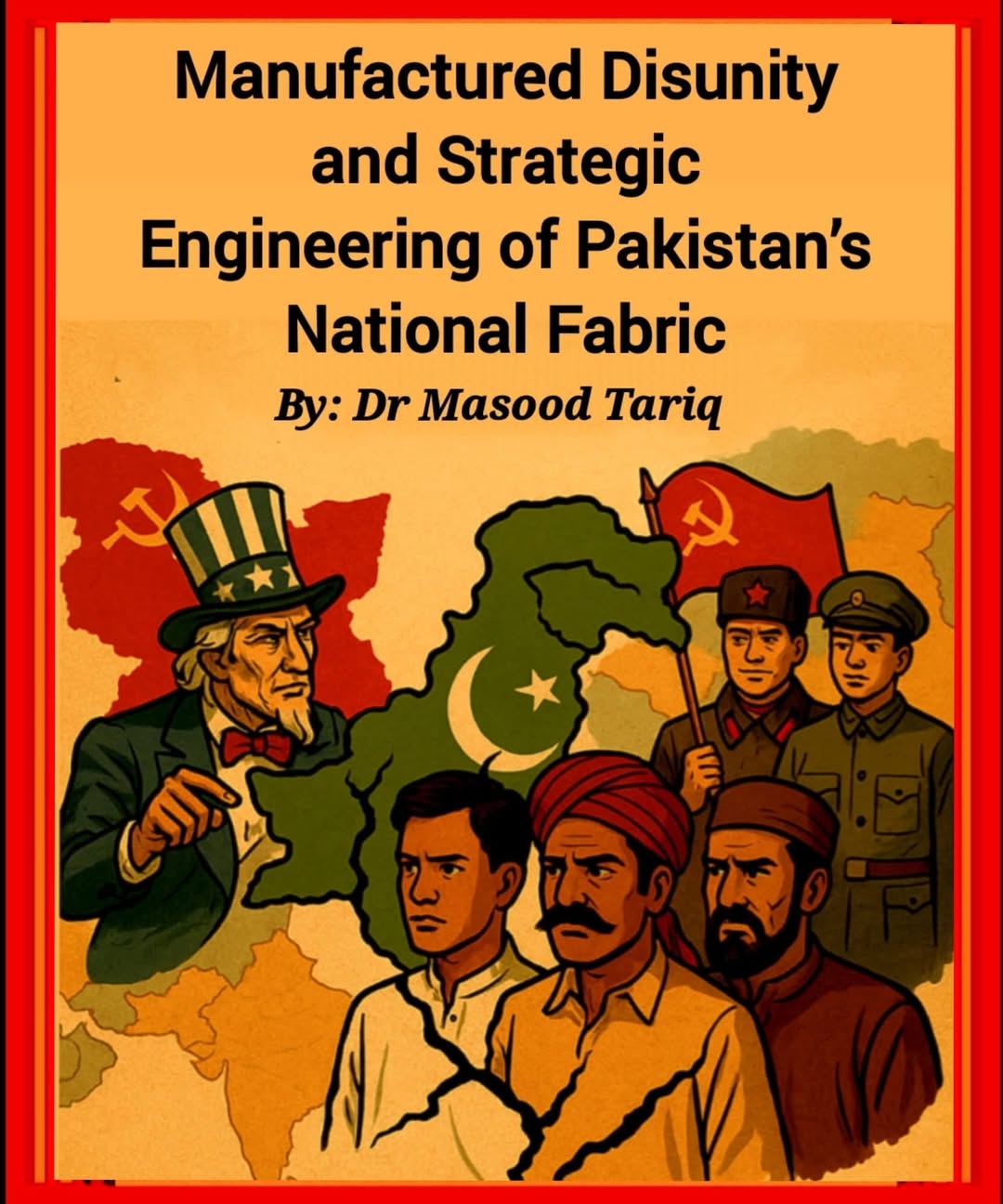
Partition and the Cold War: Manufactured Disunity and Strategic Engineering of Pakistan’s National Fabric
Dr. Masood Tariq
Independent Political Theorist
Karachi, Pakistan
drmasoodtariq@gmail.com
Date: August 9, 2025
——————————————–
Abstract
This paper critically reinterprets the creation of Pakistan as a Cold War geopolitical project, challenging conventional narratives that frame it primarily as an outcome of religious nationalism. Drawing on declassified intelligence archives, strategic policy documents, and recent scholarly analyses, the study argues that Pakistan’s establishment served the strategic interests of Western powers—particularly the United Kingdom and the United States—seeking to construct a pro-Western Islamic buffer zone against the expanding influence of the Soviet Union in South and West Asia.
The analysis situates Pakistan within a broader “Islamic geopolitical arc” alongside Egypt and Saudi Arabia, where Islamism was mobilized as a tool of anti-Communist containment. The paper further traces the long-term implications of this strategy, highlighting how the resulting structural disunity and elite manipulation within Pakistan impeded national integration. Finally, it links this historical trajectory to contemporary multipolar geopolitics, including the China–Pakistan nexus, the US–India strategic partnership, and Khalistan discourse as a potential buffer that could reshape strategic balances in South Asia, the Indian Ocean, and Central Asia.”
——————————————–
Keywords
Pakistan Partition; Cold War; US Foreign Policy; Islamic Geopolitics; Anti-Communist Arc; Khalistan; Indian Ocean Strategy; China-Pakistan Relations; USSR Containment; Postcolonial Statecraft; Multipolar World Order; Strategic Buffer States
——————————————–
Table of Contents
1. Introduction: Partition as a Strategic Geopolitical Project
2. Cold War Architecture: The Global Contest for Space and Influence
3. Strategic Objectives Behind the Creation of Pakistan
4. Pakistan’s “Islamist Design: The Role of the West
5. The Islamic Arc: Egypt to Pakistan as an Anti-Communist Corridor
6. Political Engineering: Islamism as a Geopolitical Weapon
7. The One Unit Scheme: Centralization, Urdu Elites, and Ethnic Discontent
8. Systematic Marginalization of Indigenous Nations in Pakistan
9. Geostrategic Realignment: From the USSR to China
10. The New Great Game: China, the Indian Ocean, and Pakistan’s Strategic Centrality
11. The Khalistan Factor in Indo-Pakistani Geopolitics
12. Strategic Realignments: The U.S., China, and the Future of South Asia
13. Confederal Solutions and Ethnic Harmony in Pakistan
14. Conclusion
15. References
——————————————–
1. Introduction: Partition as a Strategic Geopolitical Project
The 1947 partition of British India, culminating in the creation of Pakistan, is often interpreted through the ideological lens of communal politics and the Two-Nation Theory. While religious nationalism undoubtedly played a role in mobilizing support for partition, this explanation overlooks the wider geopolitical calculus that shaped the subcontinent’s division. Emerging historical evidence and critical scholarship now point to a strategic dimension behind Pakistan’s creation—namely, its utility to Western powers as a buffer against Soviet influence in South Asia (Ali, 2005; Jalal, 1995).
This study contends that Pakistan’s birth was not merely an outcome of internal sectarian tensions but rather a calculated move embedded within the emerging Cold War framework. As global politics polarized into capitalist and communist blocs—led respectively by the United States and the Soviet Union—Pakistan became a vital node in the Western security architecture. Its geostrategic location, adjacent to the Persian Gulf, Central Asia, and the broader Indian Ocean region, rendered it indispensable to the West’s policy of Soviet containment. This introductory section therefore reorients the understanding of partition from a solely ideological-religious phenomenon to one driven by the imperatives of post-World War II global power realignments.
The partition of British India in 1947 and the consequent creation of Pakistan have traditionally been explained through the prism of communalism and the Two-Nation Theory. However, recent scholarship suggests a deeper geopolitical motive: the formation of Pakistan served Western interests during the nascent Cold War by offering a strategic Islamic bulwark against Communist expansion in Asia (Ali, 2005; Jalal, 1995). Thus, the creation of Pakistan must be situated within the broader context of a bipolar world where global alignments were dictated by the ideological battle between capitalism and communism.
——————————————–
2. Cold War Architecture: The Global Contest for Space and Influence
In the aftermath of World War II, the international system rapidly bifurcated into two competing ideological and strategic blocs: the capitalist camp, spearheaded by the United States, and the communist bloc, led by the Soviet Union (Westad, 2007). This emerging Cold War order was not solely a clash of economic systems or political ideologies—it was fundamentally spatial and geopolitical in nature.
Both superpowers sought to expand their spheres of influence by securing footholds in strategically vital regions. In this context, South Asia—and particularly the Indian subcontinent—gained immense geopolitical significance. Its geographic proximity to the Soviet Union, adjacency to the Persian Gulf and Central Asia, and control over the northern arc of the Indian Ocean rendered it a critical theatre in the global Cold War competition. The United States viewed this region as essential for encircling the USSR and securing maritime dominance, while the Soviet Union sought to prevent encroachment by Western-aligned states.
Thus, the geopolitical value of South Asia extended far beyond regional conflicts or postcolonial transitions; it was central to the spatial logic of Cold War containment and expansion. Within this larger framework, the creation and subsequent militarization of Pakistan acquired strategic significance, particularly as Western powers looked to cultivate reliable allies on the Soviet Union’s southern flank.
——————————————–
3. Strategic Objectives Behind the Creation of Pakistan
The creation of Pakistan in 1947 must be understood not only through the lens of religious nationalism but also as a calculated move within the broader strategic framework of Cold War geopolitics. Both the United States and the United Kingdom saw in Pakistan the opportunity to establish a strategically located Islamic state that could serve as a bulwark against the southward expansion of Soviet influence into the Indian subcontinent and the broader Indian Ocean region (Hussain, 2008; McMahon, 1994).
By aligning itself ideologically and militarily with the Western bloc, Pakistan became a key component of the anti-Communist architecture in Asia. Its swift accession to Western-led security alliances such as the Southeast Asia Treaty Organization (SEATO) and the Central Treaty Organization (CENTO) underscored its role as a frontline state in the ideological and geopolitical contest of the Cold War.
Policymakers in Washington and London perceived Pakistan’s Islamic identity as a potential ideological counterweight to the atheistic communism of the Soviet Union, enabling the mobilization of religious sentiment in the service of strategic containment.
Moreover, the partition of British India—and the deliberate territorial configuration that emerged—served concrete geopolitical ends. The newly formed Pakistan was located at the crossroads of Central Asia, the Middle East, and South Asia, adjacent to the USSR, Afghanistan, and Iran. This geographical positioning allowed Western powers to secure influence over vital trade routes, energy corridors, and military passageways linking the Arabian Sea with the Eurasian heartland (Ali, 1983; Talbot, 1998). In effect, Pakistan functioned as both a territorial buffer and a strategic springboard for Western interests across Asia.
——————————————–
4. Pakistan’s Islamist Design: The Role of the West
From its inception, Pakistan’s leadership pursued a close alignment with Western—particularly American—strategic interests, a relationship that was both ideological and instrumental. Prime Minister Liaquat Ali Khan’s visit to the United States in 1950 marked a foundational moment in cementing Pakistan’s pro-Western orientation during the formative years of the Cold War. This alignment was not merely diplomatic but ideological, laying the groundwork for the use of Islam as a tool of internal cohesion and external projection (Burke & Ziring, 1990).
The most profound expression of this ideological strategy emerged under General Muhammad Zia-ul-Haq (1977–1988), whose regime undertook a sweeping Islamization of the state apparatus. This project was not only domestically motivated but strategically aligned with Western objectives in the region, especially during the Soviet invasion of Afghanistan in 1979. The United States and its allies actively supported Zia’s Islamization program, which was seen as a bulwark against Soviet influence and a mechanism to mobilize Islamic sentiment for the Afghan jihad (Haqqani, 2005; Yousaf & Adkin, 1992).
The West’s endorsement of political Islam in Pakistan was thus rooted in a broader geopolitical calculus: Islamism was perceived as a force capable of transcending ethnic divides and suppressing sub-nationalist aspirations that could destabilize a Cold War ally. By promoting a centralized Islamic identity, the Pakistani state—backed by Western funding and intelligence—sought to dilute regional ethnic identities (such as Bengali, Punjabi, Sindhi, Baloch, and Pashtun nationalism) and redirect societal energies toward the anti-Communist cause.
——————————————–
5. The Islamic Arc: Egypt to Pakistan as an Anti-Communist Corridor
During the Cold War, Western powers—particularly the United States—advanced the concept of an “Islamic arc” stretching from North Africa through the Middle East to South Asia. This arc was not merely a religious alignment but a geopolitical construct designed to contain Soviet influence across the Muslim world. Islamic identity was strategically instrumentalized to build an ideological and territorial bulwark against Communist expansion (Kepel, 2004).
Pakistan’s geographical location at the crossroads of Central Asia, the Middle East, and South Asia made it a crucial southern anchor in this arc. Alongside Egypt under Anwar Sadat, Iran under the Shah, Saudi Arabia, and Turkey, Pakistan was incorporated into a broader Western strategy to encircle the USSR’s southern periphery. These countries were systematically supported through military alliances, economic aid, and diplomatic engagement to foster a unified, Islamically motivated resistance to Communism (Curtis, 2010; Kepel, 2002).
The construction of this corridor reflected a deliberate policy to harness political Islam as a counter-ideological force to Marxist-Leninist doctrine. In this context, Pakistan’s Islamization process under Zia-ul-Haq and its involvement in the Afghan jihad became central components of a wider regional policy. Western powers actively funded and armed militant networks across the arc, prioritizing ideological cohesion over internal democratic development or ethnic pluralism.
——————————————–
6. Political Engineering: Islamism as a Geopolitical Weapon
Despite being a multiethnic federation, Pakistan was structured by its early ruling elites into a centralized state dominated by Urdu-speaking migrants (Muhajirs) and later the Punjabi military-bureaucratic establishment. Native ethnic groups—Punjabis (non-military elite), Sindhis, Pashtuns, Baloch, and Bengalis—were systematically marginalized through the imposition of a singular Islamic-Urdu national identity. This ideological framework erased linguistic and cultural diversity in favor of a homogenized vision of the state (Jalal, 1995).
Islamism became both a domestic tool of political control and an international instrument of Cold War geopolitics. The military-mullah alliance, solidified under General Zia-ul-Haq, was nurtured through significant American backing. The regime’s Islamization campaign—funded by the U.S. and Gulf states—suppressed leftist ideologies, dismantled secular opposition, and laid the groundwork for Pakistan’s central role in the Afghan jihad (Rashid, 2001).
Islam was no longer merely a religious identity; it was transformed into a geopolitical weapon aligned with Western interests in the broader anti-Communist struggle. Thus, the internal engineering of Pakistan’s Islamization cannot be divorced from the broader Western Cold War project that aimed to neutralize ethnic assertion through ideological conformity.
——————————————–
7. The One Unit Scheme: Centralization, Urdu Elites, and Ethnic Discontent
The One Unit Scheme (1955–1970) was a state-driven centralization policy aimed at merging the provinces of West Pakistan into a single administrative entity, ostensibly to create parity with the more populous East Pakistan. However, in practice, it served to concentrate political power in the hands of the Urdu-speaking bureaucratic elite and the Punjabi-dominated military establishment (Sisson & Rose, 1990).
This policy marginalized indigenous ethnic identities—Punjabi, Sindhi, Baloch, Brahui, Pashtun, Kohistani, Chitrali, Swati, and Gilgit-Baltistani—by erasing provincial distinctions and enforcing a homogenized Islamic-Urdu nationalist identity. Rather than promoting unity, the One Unit Scheme deepened ethnic grievances, weakened federalism, and alienated East Pakistan, which viewed the arrangement as a means of West Pakistani dominance. The resulting regional imbalances and denial of democratic representation were key factors that led to the secession of East Pakistan and the creation of Bangladesh in 1971.
——————————————–
8. Systematic Marginalization of Indigenous Nations in Pakistan
The post-1947 Pakistani state systematically marginalized its indigenous nations—Punjabi, Sindhi, Baloch, Brahui, Pashtun, Kohistani, Chitrali, Swati, Gilgit-Baltistanis, and Bengali—by denying them equitable cultural, linguistic, and political recognition. The imposition of Urdu as the sole national language, despite its being the mother tongue of only a small migrant minority, symbolized a broader project of cultural homogenization and state control (Waseem, 2010).
The refusal to accommodate demands for linguistic pluralism and provincial autonomy led to repeated episodes of state violence, including brutal repression in East Pakistan, culminating in the breakup of the country in 1971. This pattern reflects the enduring legacy of a unitary national model imposed on a multiethnic federation.
——————————————–
9. Geostrategic Realignment: From the USSR to China
The disintegration of the Soviet Union in 1991 did not end great power competition in South Asia and the Indian Ocean—it reconfigured it. In the post-Cold War era, China has emerged as the principal geostrategic rival to U.S. influence, replacing the USSR in the regional balance of power.
Through expansive projects such as the Belt and Road Initiative (BRI) and its flagship arm in South Asia, the China-Pakistan Economic Corridor (CPEC), China is securing strategic overland and maritime trade routes (Small, 2015). CPEC provides China direct access to the Arabian Sea via Gwadar Port, thereby bypassing chokepoints such as the Strait of Malacca, which remain vulnerable to U.S. naval dominance.
This shift reflects a new phase of geopolitical competition centered on connectivity, infrastructure, and energy corridors—where Pakistan remains a pivotal geographic node in China’s global ambitions.
——————————————–
10. The New Great Game: China, the Indian Ocean, and Pakistan’s Strategic Centrality
In the emerging multipolar world order, the Indian Ocean has become a key theater of geopolitical rivalry, often referred to as the “New Great Game.” Pakistan’s geographic position at the crossroads of South Asia, Central Asia, and the Middle East—coupled with its deep-water port at Gwadar—renders it strategically indispensable.
Gwadar provides China with direct maritime access to the Arabian Sea, allowing it to bypass traditional chokepoints like the Strait of Malacca, which are under the surveillance of U.S.-aligned naval powers. As India deepens its strategic partnership with the United States—particularly through the Quadrilateral Security Dialogue (QUAD) and the Indo-Pacific Strategy—China increasingly relies on Pakistan as a buffer and logistical hub in its regional containment calculus (Kapur, 2009).
Thus, Pakistan’s role has shifted from a Cold War frontline state to a linchpin in China’s Indian Ocean strategy, further entrenching its position in great power politics.
——————————————–
11. The Khalistan Factor in Indo-Pakistani Geopolitics
The resurgence of Sikh separatism and the renewed discourse around the Khalistan movement have introduced significant complexities into the strategic landscape of South Asia. The creation of a sovereign Sikh state in Indian Punjab could serve as a buffer zone between India and Pakistan, potentially reducing the intensity of direct Indo-Pakistani confrontation while simultaneously reshaping the regional balance of power.
Some geopolitical analysts suggest that external actors, including the United States and China, may find strategic utility in covertly supporting the Khalistan movement to undermine India’s centralized authority and fragment its internal cohesion. In this context, the Khalistan issue is not merely a domestic separatist demand but a geopolitical lever in the broader struggle for influence in South Asia (Tariq, 2025).
——————————————–
12. Strategic Realignments: The U.S., China, and the Future of South Asia
In the evolving multipolar global order, Pakistan retains strategic significance as a pivot state between competing powers. The United States is attempting to re-establish influence through financial mechanisms such as the International Monetary Fund (IMF) and World Bank, while maintaining security dialogues. Conversely, China continues to deepen its engagement with Pakistan through infrastructure projects, defense cooperation, and strategic connectivity initiatives like CPEC.
Amid rising tensions between the U.S. and China, India’s alignment with Washington, fueled by Hindu nationalist policies and participation in the QUAD and Indo-Pacific Strategy, is prompting Pakistan to further solidify its strategic partnership with Beijing. These realignments indicate a fluid and competitive regional landscape, where alliances are increasingly defined by geoeconomic dependencies and ideological divergence (Cloughley, 2006).
——————————————–
13. Confederal Solutions and Ethnic Harmony in Pakistan
To achieve long-term internal stability and reduce vulnerability to external manipulation, Pakistan must transition from a centralized federation to a confederal framework. Such a model would empower its ethno-linguistic nations—Punjabi, Sindhi, Baloch, Brahui, Pashtun, Kohistani, Chitrali, Swati, Gilgit-Baltistanis, and others—by ensuring autonomy over language, cultural expression, governance, and resource management.
A confederal arrangement, rooted in equal power-sharing among federating units, could help resolve long-standing grievances and diminish the appeal of separatist movements. By accommodating ethnic diversity within a flexible political structure, Pakistan could foster inclusive national unity while undermining foreign powers’ ability to exploit internal divisions (Waseem, 2010).
——————————————–
14. Conclusion
Pakistan’s formation was not solely a product of religious nationalism but was deeply entangled in Cold War strategic calculations, where Islamism, ethnic centralization, and authoritarian governance served the purpose of creating a reliable bulwark against Soviet influence. While these mechanisms aligned Pakistan with Western geopolitical interests, they simultaneously generated internal fragmentation, ethnic resentment, and democratic deficits.
As global power shifts from a unipolar U.S.-led order to a multipolar world dominated by U.S.-China competition, Pakistan’s strategic value remains significant. However, its future stability and geopolitical relevance hinge on its ability to implement domestic reforms. A confederal, inclusive, and democratic structure—one that respects the autonomy of its diverse nations—could offer the internal cohesion and external flexibility needed to thrive in the emerging global order.
——————————————–
15. References
Ali, Chaudhri Muhammad. 1983. The Emergence of Pakistan. New York: Columbia University Press.
Cloughley, Brian. 2006. A History of the Pakistan Army: Wars and Insurrections. Karachi: Oxford University Press.
Cohen, Stephen P. 2004. The Idea of Pakistan. Washington, DC: Brookings Institution Press.
Curtis, Lisa. 2010. Pakistan: Between Mosque and Military. London: Hurst & Company.
Haqqani, Husain. 2005. Pakistan: Between Mosque and Military. Washington, DC: Carnegie Endowment for International Peace.
Jalal, Ayesha. 1995. Democracy and Authoritarianism in South Asia: A Comparative and Historical Perspective. Cambridge: Cambridge University Press.
Kapur, Ashok. 2009. India and the South Asian Strategic Triangle. London: Routledge.
Kepel, Gilles. 2004. The War for Muslim Minds: Islam and the West. Cambridge, MA: Harvard University Press.
Kux, Dennis. 2001. The United States and Pakistan, 1947–2000: Disenchanted Allies. Baltimore: Johns Hopkins University Press.
Rashid, Ahmed. 2000. Taliban: Militant Islam, Oil and Fundamentalism in Central Asia. New Haven: Yale University Press.
Sisson, Richard, and Leo E. Rose. 1990. War and Secession: Pakistan, India, and the Creation of Bangladesh. Berkeley: University of California Press.
Small, Andrew. 2015. The China-Pakistan Axis: Asia’s New Geopolitics. London: Oxford University Press.
Tariq, Masood. 2025. “Partition, Geopolitics, and the Punjabi Nation: A Historical and Strategic Analysis.” Unpublished Manuscript.
Talbot, Ian. 1998. Pakistan: A Modern History. New York: St. Martin’s Press.
Waseem, Mohammad. 2010. Federalism in Pakistan. Lahore: LUMS Academic Press.
Westad, Odd Arne. 2005. The Global Cold War: Third World Interventions and the Making of Our Times. Cambridge: Cambridge University Press.
——————————————–
Author Biography
Dr. Masood Tariq is a Karachi-based politician and political theorist. He formerly served as Senior Vice President of the Pakistan Muslim Students Federation (PMSF) Sindh, Councillor of the Municipal Corporation Hyderabad, Advisor to the Chief Minister of Sindh, and Member of the Sindh Cabinet.
His research explores South Asian geopolitics, postcolonial state formation, regional nationalism, and inter-ethnic politics, with a focus on the Punjabi question and Cold War strategic alignments.
He also writes on Pakistan’s socio-political and economic structures, analysing their structural causes and proposing policy-oriented solutions aligned with historical research and contemporary strategy.
His work aims to bridge historical scholarship and strategic analysis to inform policymaking across South Asia, Central Asia, and the Middle East.
Leave a Reply