
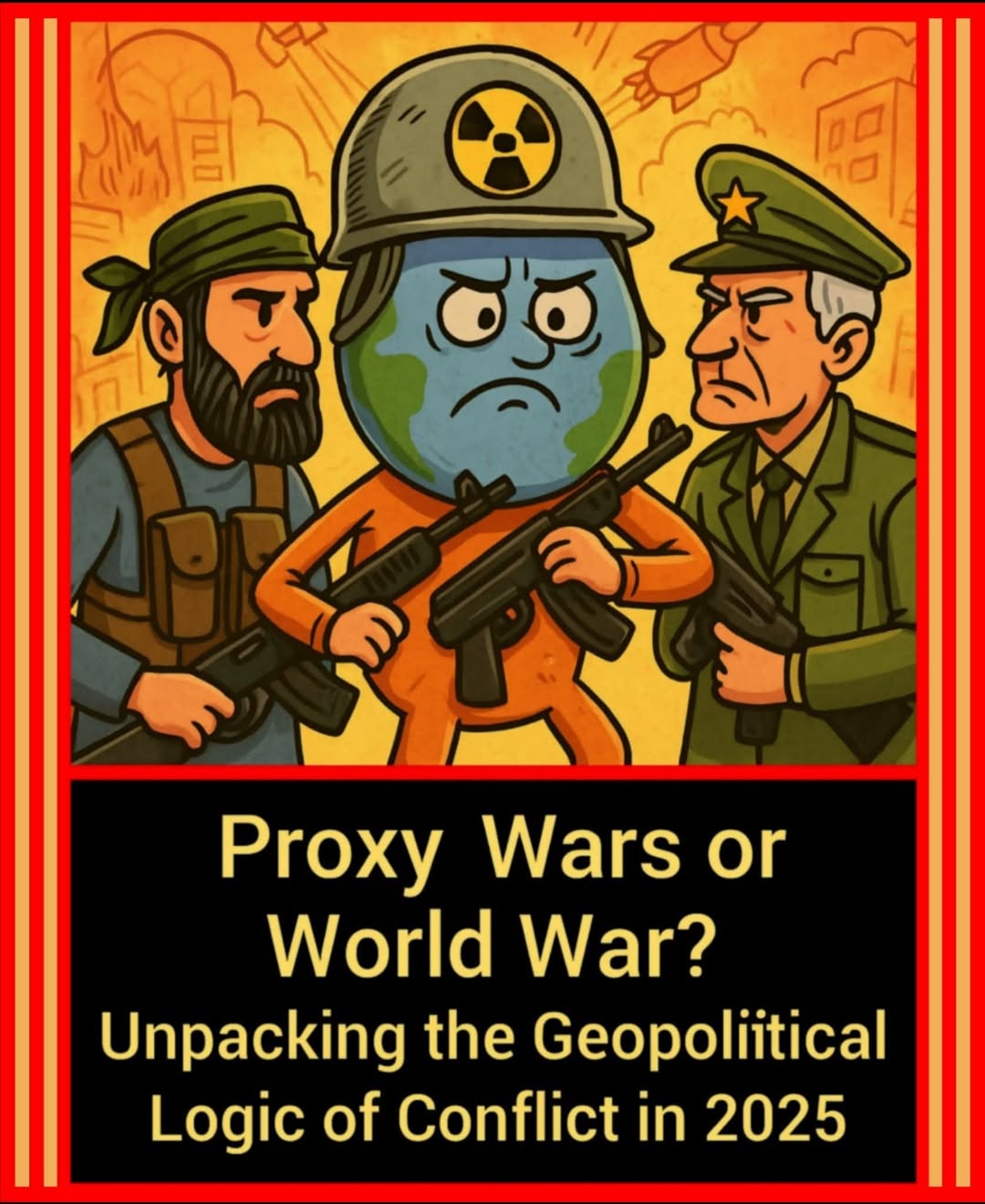
Proxy Wars or World War? Unpacking the Geopolitical Logic of Conflict in 2025
Dr. Masood Tariq
Independent Political Theorist
Karachi, Pakistan
drmasoodtariq@gmail.com
Date: July 1, 2025
——————————————–
Abstract
This paper re-evaluates the trajectory of global conflict in 2025, analysing whether humanity is heading towards a full-scale Third World War or becoming increasingly entrenched in a series of escalating proxy wars. Focusing on the 2024–2025 Indo-Pak border escalations and the recent Israel–Iran military confrontation, it argues that the current era is defined by multifaceted proxy warfare.
These indirect conflicts are fought through regional militias, cyberattacks, economic coercion, and media narratives. Nuclear deterrence, economic interdependence, and asymmetric military doctrines render direct world war improbable; however, proxy wars have become the primary battlegrounds of geopolitical competition.
States with political instability and weak militaries face systemic collapse, while those with strong armed forces and stable governance are more likely to endure or prevail.
——————————————–
Table of Contents
1. Introduction
2. Historical Background: From World Wars to Proxy Competition
3. Case Studies: Indo-Pak and Israel–Iran Conflicts (2024–2025)
4. Why World War Is Unlikely but Proxy Wars Are Inevitable
5. The Strategic Divide: Winners and Losers of Proxy Wars
6. Future Outlook: What Comes Next?
7. Conclusion: Proxy Wars Are the Present and the Future
——————————————–
1. Introduction
The geopolitical landscape of 2025 is marked by unprecedented instability—not through direct wars between great powers, but through intensifying proxy conflicts. Two recent flashpoints—the Indo-Pak border confrontations in Kashmir and the Israel–Iran conflict in West Asia—underscore this trend.
These are not isolated incidents; they are symptomatic of a broader strategic shift towards indirect, prolonged, and ideologically charged confrontations. As the global order becomes increasingly multipolar, the incentives for direct war are reduced, while the utility of proxy warfare rises. This paper analyses these patterns to argue that we are witnessing a sustained era of proxy wars rather than the threshold of World War III.
——————————————–
2. Historical Background: From World Wars to Proxy Competition
In the 20th century, the world experienced two catastrophic world wars, followed by a Cold War defined by nuclear deterrence and regional proxy battles. The doctrine of Mutually Assured Destruction (MAD) restricted direct superpower conflicts, leading instead to the Korean War, Vietnam War, and the Afghan-Soviet conflict.
Post-Cold War unipolarity under the United States has now given way to a more unstable multipolarity. The re-emergence of Russia, the rise of China, and regional assertiveness by India, Iran, and Turkey have recreated conditions ripe for new proxy confrontations.
——————————————–
3. Case Studies: Indo-Pak and Israel–Iran Conflicts (2024–2025)
3.1 Indo-Pakistani Escalation
In early 2025, renewed clashes along the Line of Control (LoC) between India and Pakistan intensified. Both sides utilised hybrid tactics: cross-border artillery, drone strikes, cyberattacks, and propaganda warfare.
India leveraged its alliance with the U.S. and Israel for ISR (Intelligence, Surveillance, Reconnaissance) support, while Pakistan relied on Chinese technology and regional diplomatic lobbying. Though full-scale war was avoided, the region became a stage for the broader Indo-China and U.S.–China rivalry.
3.2 Israel–Iran Confrontation
In late 2024, Israel launched targeted strikes against Iranian nuclear and military assets, triggering direct missile retaliation from Tehran. Hezbollah and militias in Iraq and Syria responded, intensifying the proxy dimensions of this regional war.
Cyberattacks on Israeli infrastructure and retaliatory strikes on Iranian oil facilities demonstrated the convergence of conventional and cyber warfare. This confrontation showcased the modern proxy war paradigm—fought simultaneously on kinetic and digital fronts—with global consequences for energy markets and diplomatic alignments.
——————————————–
4. Why World War Is Unlikely but Proxy Wars Are Inevitable
4.1 Nuclear Deterrence
No major power can risk direct confrontation due to second-strike capabilities. India, Pakistan, Israel, Russia, China, and the U.S. all possess nuclear arsenals, making conventional escalation strategically prohibitive.
4.2 Economic Interdependence
Global trade networks, financial markets, and technological supply chains constrain the calculus for war. The economic fallout from a world war would be globally catastrophic.
4.3 Rise of Asymmetric and Hybrid Warfare
Non-state actors, cyberattacks, drone strikes, and information warfare now dominate modern conflict. These tactics are cost-effective, deniable, and strategically potent.
4.4 Multipolar Strategic Rivalries
The competition among the U.S., China, Russia, Iran, India, and Turkey is dispersed across multiple regions. Rather than direct confrontations, powers prefer leveraging proxy actors to exert influence.
——————————————–
5. The Strategic Divide: Winners and Losers of Proxy Wars
Countries with strong militaries and stable governance structures are better positioned to conduct, resist, or survive proxy wars. China, Russia, India, Iran, and Turkey possess resilient institutions and offensive capabilities.
In contrast, states with fragmented politics, economic instability, and weak command structures are at risk of collapse. Syria, Yemen, Libya, and Afghanistan exemplify how proxy warfare can lead to humanitarian crises and state failure.
Pakistan stands at a strategic crossroads. Despite its formidable military strength, the absence of political cohesion and economic stability risks transforming it into a battleground rather than a strategic broker. The same vulnerabilities threaten other fragile states such as Lebanon, Iraq, and Sudan.
——————————————–
6. Future Outlook: What Comes Next?
The global trend toward proxy warfare is likely to intensify across several theatres:
6.1 South Asia
Renewed Indo-Pak tensions, particularly in Kashmir and Balochistan, involving both state and non-state actors.
6.2 West Asia
Iran–Israel hostility is extending into Syria, Lebanon, and the Gulf, with multiple proxy groups engaged.
6.3 East Asia
The U.S.–China rivalry is being played out through Taiwan-related tensions, cyberattacks, and naval standoffs.
6.4 Africa
Proxy militias supported by Turkey, Russia (Wagner), and Gulf states remain active in Libya, the Sahel, and Sudan.
6.5 Eurasia
Ukraine remains the central stage for NATO–Russia strategic competition.
Countries that prioritise institutional stability, military modernisation, and strategic autonomy will fare better in this environment. Others may face prolonged insecurity and loss of sovereignty.
——————————————–
7. Conclusion: Proxy Wars Are the Present and the Future
In 2025, total war has given way to total proxy conflict. While nuclear deterrence and global economic integration make a full-scale world war unlikely, proxy wars have become the dominant mode of international confrontation.
The Indo-Pak and Israel–Iran episodes reveal a broader shift: war has become indirect, multidimensional, and ideologically complex. These conflicts are difficult to win and harder to resolve.
Only nations with cohesive political structures, credible military deterrence, and autonomous strategic decision-making can shape outcomes. Others risk being consumed by foreign agendas and becoming theatres of destruction.
To avoid this fate, regional powers—especially in South Asia and the Middle East—must invest in political stability, conflict de-escalation, and independent foreign policy doctrines.
——————————————–
Author Biography
Dr. Masood Tariq is a Karachi-based politician and political theorist. He formerly served as Senior Vice President of the Pakistan Muslim Students Federation (PMSF) Sindh, Councillor of the Municipal Corporation Hyderabad, Advisor to the Chief Minister of Sindh, and Member of the Sindh Cabinet.
His research explores South Asian geopolitics, postcolonial state formation, regional nationalism, and inter-ethnic politics, with a focus on the Punjabi question and Cold War strategic alignments.
He also writes on Pakistan’s socio-political and economic structures, analysing their structural causes and proposing policy-oriented solutions aligned with historical research and contemporary strategy.
His work aims to bridge historical scholarship and strategic analysis to inform policymaking across South Asia, Central Asia, and the Middle East.
Leave a Reply