
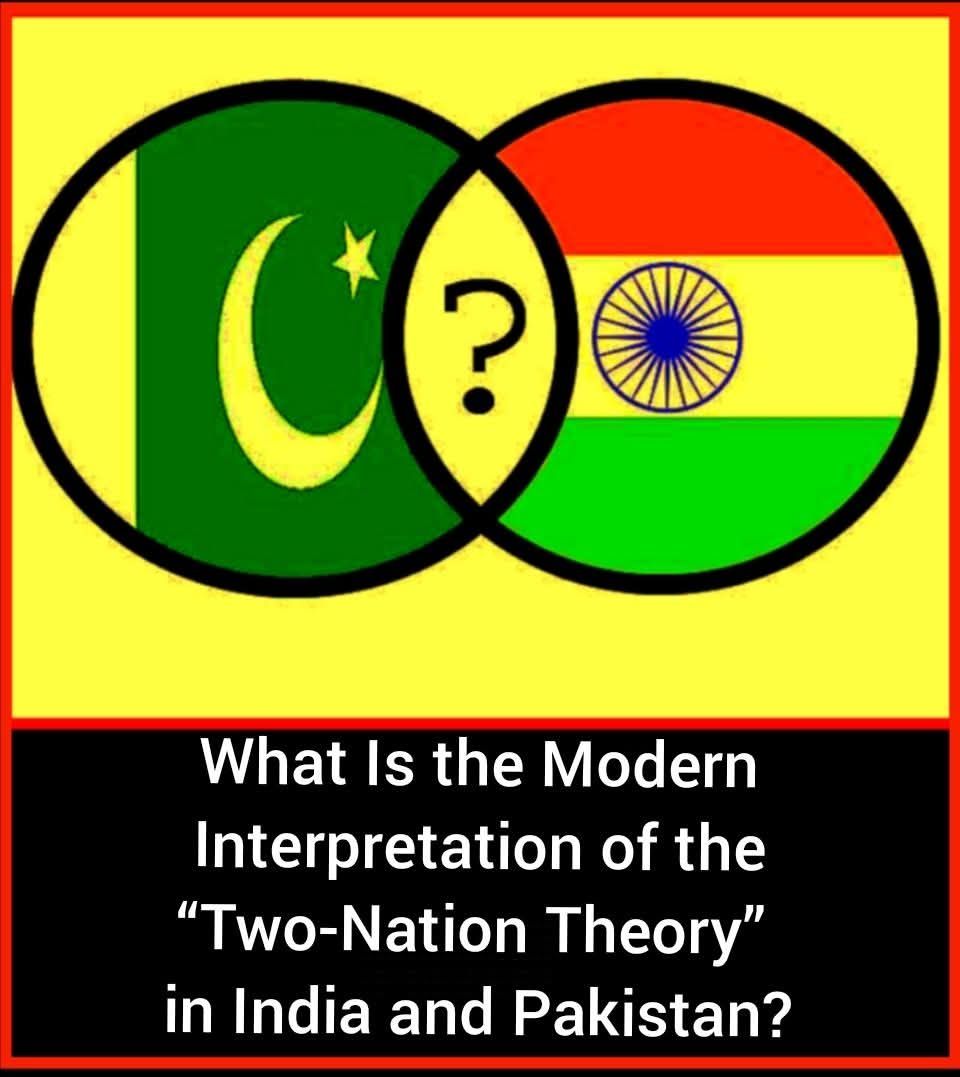
What Is the Modern Interpretation of the “Two-Nation Theory” in India and Pakistan?
May 21, 2025
The nation that dominates foreign affairs, military services, civil services, industry, trade and business, skilled professions, national media, and major cities is the one considered “powerful.” Politics is essentially the contest to gain this “power.”
It is for the sake of becoming powerful that individuals, families, communities, and nations engage in the game of politics. Those who play this political game are known as “power players.” Power players have always existed and played their game throughout history.
That is why politics takes place everywhere and has existed in every era. The only variation is whether politics operates through democratic methods and principles or through authoritarian tactics and political conspiracies.
Even before the creation of Pakistan, the game of “power” was being played. In that game, the Punjabis (inhabitants of the Indus Valley civilization) lost, and the Hindis (inhabitants of the Ganga-Jamuna civilization) emerged victorious.
In British India, the largest ethnic group was the Hindi-speaking people, followed by Bengalis as the second-largest, and Punjabis as the third-largest. The Telugu were fourth, Marathi fifth, Tamil sixth, Gujarati seventh, Kannada eighth, Malayalam ninth, and Odia tenth.
By introducing the “Two-Nation Theory” based on religion in British India, the British divided the second-largest nation (Bengalis) and the third-largest (Punjabis) on religious grounds and included Muslim Bengalis and Muslim Punjabis into Pakistan. In doing so;
1. They divided the second and third largest nations in British India—which shared a common language, land, culture, and history—based solely on religion.
2. They placed the fourth to tenth largest nations—Telugu, Marathi, Tamil, Gujarati, Kannada, Malayalam, and Odia—under the political dominance of the Hindi-speaking nation.
3. They brought Muslims from the Hindi nation into Pakistan and;
(a) Made a member of the Hindi nation the Prime Minister of Pakistan.
(b) Declared the national language of Pakistan to be that of the Ganga-Jamuna civilization.
(c) Adopted the traditional dress of the Ganga-Jamuna civilization—sherwani and pajama—as the national attire.
(d) Established the dominance of Ganga-Jamuna civilization Hindustanis over Pakistan’s government, constitutional assembly, civil services, politics, media, urban centers, and educational institutions.
After 77 years of Pakistan’s creation, a new power struggle has begun due to the Pakistan-India war that started on May 7, 2025. This new power struggle will also be based on the “Two-Nation Theory.”
However, in the modern interpretation of the “Two-Nation Theory,” the two nations of the subcontinent are:
1. The Punjabis (inhabitants of the Indus Valley civilization).
2. The Hindis (inhabitants of the Ganga-Jamuna civilization).
Religion is a personal matter. The purpose of religion is to attain religious knowledge to reform one’s physical actions, soul desires, and mind thoughts, so that worldly life and the hereafter can be improved.
Nationhood is a matter of political stability. The purpose of politics is to ensure social dignity, administrative authority, financial prosperity, and economic development through political stability, so that worldly life can be made better.
Therefore, in this newly emerging power game between India and Pakistan, based on language, land, culture, and history:
1. The second-largest nation, Bengalis, and the third-largest, Punjabis, will be united to counter the dominance of the Hindi nation.
2. The Telugu (4th largest), Marathi (5th), Tamil (6th), Gujarati (7th), Kannada (8th), Malayalam (9th), and Odia (10th) nations will be liberated from the dominance of the Hindi nation.
Leave a Reply