
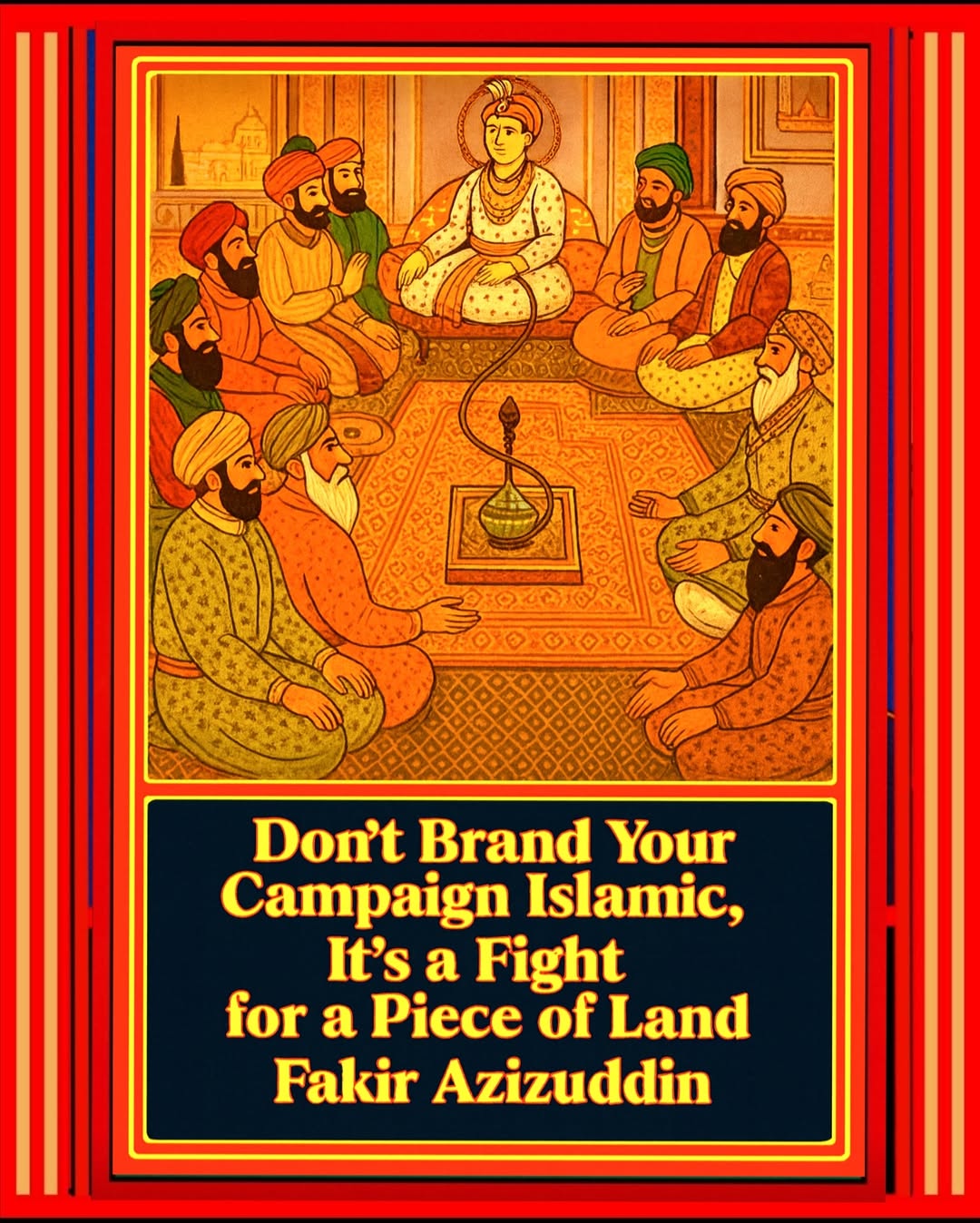
Don’t Brand Your Campaign Islamic, It’s a Fight for a Piece of Land. – Fakir Azizuddin
Date: October 12, 2025
Maharaja Ranjit Singh, popularly known as Sher-e-Punjab (“Lion of Punjab”), was the founder and ruler of the Sikh Empire. In his teenage years, he fought several wars to expel Afghan forces from Punjab and was proclaimed “Maharaja of Punjab” at the age of 21. Under his leadership, Punjab grew into a powerful, consolidated, and prosperous state until his death in 1839.
For almost 777 years of foreign domination—beginning with the Turkish invader Mahmud of Ghazni in 1022, who ousted the Hindu Shahi ruler Raja Tarnochalpal—Punjabis had not ruled their own land. That changed when Ranjit Singh entered the gates of Lahore on July 7, 1799, establishing indigenous rule over Punjab for the first time in centuries.
Before his rise, the region was divided among numerous warring misls (confederacies)—twelve Sikh and one Muslim. Ranjit Singh gradually united these misls, subdued rival principalities, and forged the Sikh Empire of Punjab, extending from the Sutlej to the Khyber.
He repeatedly repelled Afghan invasions and maintained friendly relations with the British. His army included Punjabi Muslims who had long fought under his banner against Afghan commanders such as Nadir Shah and later Azim Khan.
Ranjit Singh’s reign was marked by administrative reform, modernization, investment in infrastructure, and general prosperity. His court and army reflected religious inclusivity and regional diversity:
His Prime Minister, Dhian Singh, was a Dogra Hindu;
His Foreign Minister, Fakir Azizuddin, was a Muslim;
His Finance Minister, Dina Nath, was a Kashmiri Brahmin; and
His leading artillery officers, Mian Ghausa and Sarfaraz Khan, were Muslims.
The Khalsa Army represented Punjab’s demographic mosaic: Jat Sikhs from the Doabs, Rajputs from Jammu and the northern hills, and Muslims from Jhelum to the Afghan frontier.
In 1834, when Dost Mohammad Khan attacked Peshawar to reclaim it, Ranjit Singh dispatched his trusted Foreign Minister, Fakir Azizuddin, to negotiate. Upon reaching the Afghan camp, Azizuddin faced ridicule from courtiers who mocked him for serving a non-Muslim ruler. Calmly, he replied that as a faithful Muslim, it was his moral duty to serve loyally the sovereign to whom he owed allegiance.
When the Afghan courtiers warned of massive bloodshed among Muslims if war broke out, Fakir Azizuddin posed a direct question to Dost Mohammad Khan:
“If I were to convince Maharaja Ranjit Singh to return Peshawar, would you withdraw peacefully?”
Dost Mohammad answered, “Yes.”
Azizuddin paused, then delivered his immortal words:
“Then do not brand your campaign Islamic. It is a fight for a piece of land.”
Leave a Reply