
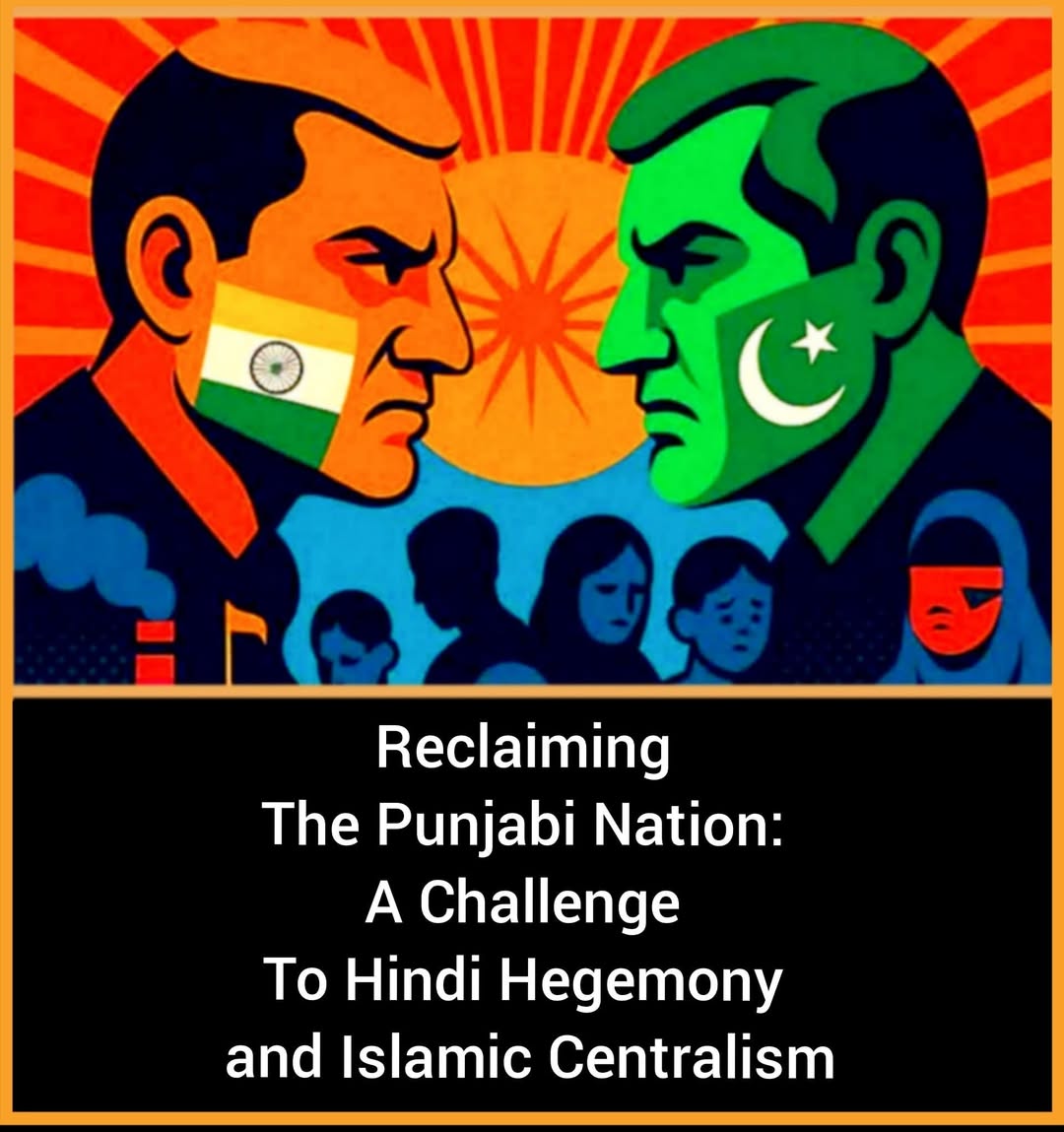
𝐑𝐞𝐜𝐥𝐚𝐢𝐦𝐢𝐧𝐠 𝐭𝐡𝐞 𝐏𝐮𝐧𝐣𝐚𝐛𝐢 𝐍𝐚𝐭𝐢𝐨𝐧: 𝐀 𝐂𝐡𝐚𝐥𝐥𝐞𝐧𝐠𝐞 𝐭𝐨 𝐇𝐢𝐧𝐝𝐢 𝐇𝐞𝐠𝐞𝐦𝐨𝐧𝐲 𝐚𝐧𝐝 𝐈𝐬𝐥𝐚𝐦𝐢𝐜 𝐂𝐞𝐧𝐭𝐫𝐚𝐥𝐢𝐬𝐦
Author:
𝐃𝐫. 𝐌𝐚𝐬𝐨𝐨𝐝 𝐓𝐚𝐫𝐢𝐪
Independent Political Theorist
Karachi, Pakistan
Date: May 21, 2025.
——————————————–
𝐀𝐛𝐬𝐭𝐫𝐚𝐜𝐭
The Indo-Pak subcontinent remains culturally and demographically dominated by two major ideological forces: the Hindi-speaking Hindu nationalist elite in India and the Islamic centralist elite in Pakistan. The 1947 Partition of British India, though framed as a religious necessity, had the deeper geopolitical effect of fragmenting the Punjabi nation.
This article argues that the division of Punjabi identity along religious lines has served the strategic interests of both power blocs—reinforcing Hindi hegemony in India and Islamic ideological supremacy in Pakistan.
Through a historical and political analysis of post-colonial state formation, language suppression, and ethnonationalist movements, the paper demonstrates that the reassertion of a unified Punjabi identity—rooted in shared language, land, and culture—poses a serious challenge to these dominant narratives.
The revival of cross-border Punjabi consciousness, decoupled from imposed religious nationalism, could reshape the regional political order and lay the groundwork for a more pluralistic and democratic South Asia.
——————————————–
Table of Contents
1.𝐈𝐧𝐭𝐫𝐨𝐝𝐮𝐜𝐭𝐢𝐨𝐧
𝟐. 𝐓𝐡𝐞 𝐏𝐚𝐫𝐭𝐢𝐭𝐢𝐨𝐧 𝐚𝐧𝐝 𝐭𝐡𝐞 𝐑𝐞𝐥𝐢𝐠𝐢𝐨𝐮𝐬 𝐅𝐫𝐚𝐠𝐦𝐞𝐧𝐭𝐚𝐭𝐢𝐨𝐧 𝐨𝐟 𝐏𝐮𝐧𝐣𝐚𝐛
𝟑. 𝐇𝐢𝐧𝐝𝐢 𝐇𝐞𝐠𝐞𝐦𝐨𝐧𝐲 𝐚𝐧𝐝 𝐋𝐢𝐧𝐠𝐮𝐢𝐬𝐭𝐢𝐜 𝐏𝐨𝐥𝐢𝐭𝐢𝐜𝐬 𝐢𝐧 𝐈𝐧𝐝𝐢𝐚
𝟒. 𝐋𝐢𝐧𝐠𝐮𝐢𝐬𝐭𝐢𝐜 𝐒𝐮𝐩𝐩𝐫𝐞𝐬𝐬𝐢𝐨𝐧 𝐚𝐧𝐝 𝐈𝐬𝐥𝐚𝐦𝐢𝐜 𝐍𝐚𝐭𝐢𝐨𝐧𝐚𝐥𝐢𝐬𝐦 𝐢𝐧 𝐏𝐚𝐤𝐢𝐬𝐭𝐚𝐧
𝟓. 𝐓𝐡𝐞 𝐒𝐭𝐫𝐚𝐭𝐞𝐠𝐢𝐜 𝐓𝐡𝐫𝐞𝐚𝐭 𝐨𝐟 𝐏𝐮𝐧𝐣𝐚𝐛𝐢 𝐔𝐧𝐢𝐟𝐢𝐜𝐚𝐭𝐢𝐨𝐧
𝟔. 𝐂𝐨𝐧𝐜𝐥𝐮𝐬𝐢𝐨𝐧
7. 𝐑𝐞𝐟𝐞𝐫𝐞𝐧𝐜𝐞𝐬
——————————————–
1.𝐈𝐧𝐭𝐫𝐨𝐝𝐮𝐜𝐭𝐢𝐨𝐧
The historical region of Punjab, straddling the modern-day states of India and Pakistan, has long been a cradle of linguistic, cultural, and religious diversity. The Punjabi language—spoken by over 125 million people across both countries—represents one of the most significant cultural bonds in South Asia (Rahman, 1996).
Despite this, Punjabi identity has remained politically fragmented, largely as a result of the Partition of 1947, which aligned national boundaries with religious identities. This fragmentation was not simply an accident of history but a strategic recalibration of regional power.
It is essential to distinguish the conceptual boundaries between religion and nationhood in this context. While religion is a personal domain concerned with the ethical transformation of the self—through the correction of physical actions, psychic desires, and inner intentions—nationhood is a political construct. A nation exists to secure social respect, administrative authority, financial stability, and economic development through collective political engagement.
Punjabis, despite their religious differences—whether Muslim, Sikh, Hindu, or Christian—form a single nation grounded in a common land, shared language, interwoven traditions, and a collective historical experience. These similarities give rise to mutual political and material interests that transcend sectarian boundaries. Recognizing this foundational reality challenges prevailing nationalist ideologies that equate nationhood with religious homogeneity.
This paper examines the strategic consequences of dividing this historically unified Punjabi nation, particularly in light of Hindi linguistic nationalism in India and Islamic ideological centralism in Pakistan.
——————————————–
𝟐. 𝐓𝐡𝐞 𝐏𝐚𝐫𝐭𝐢𝐭𝐢𝐨𝐧 𝐚𝐧𝐝 𝐭𝐡𝐞 𝐑𝐞𝐥𝐢𝐠𝐢𝐨𝐮𝐬 𝐅𝐫𝐚𝐠𝐦𝐞𝐧𝐭𝐚𝐭𝐢𝐨𝐧 𝐨𝐟 𝐏𝐮𝐧𝐣𝐚𝐛
The Partition of British India in 1947 created a sharp division between Indian and Pakistani Punjab, accompanied by mass violence and forced migrations. Over two million people died, and approximately 20 million were displaced, largely along religious lines—Muslims moved to Pakistan, while Sikhs and Hindus migrated to India (Talbot & Singh, 2009).
While Partition is often framed as a religious necessity, it also served a deeper geopolitical function: the deliberate fragmentation of the Punjabi nation. Historically, Punjab had developed a regional identity that transcended religious differences, particularly during the Sikh Empire under Maharaja Ranjit Singh (Singh, 2008).
This regional identity threatened the emerging religiously defined nationalisms of both India and Pakistan. The post-Partition order ensured that Punjab would be split and weakened, with neither side capable of forming a unified political force grounded in linguistic or regional solidarity.
——————————————–
𝟑. 𝐇𝐢𝐧𝐝𝐢 𝐇𝐞𝐠𝐞𝐦𝐨𝐧𝐲 𝐚𝐧𝐝 𝐋𝐢𝐧𝐠𝐮𝐢𝐬𝐭𝐢𝐜 𝐏𝐨𝐥𝐢𝐭𝐢𝐜𝐬 𝐢𝐧 𝐈𝐧𝐝𝐢𝐚
Following independence, the Indian state aggressively promoted Hindi as the national language. Although India is constitutionally multilingual, the central government’s emphasis on Hindi has marginalized other linguistic groups, including Punjabis.
In Indian Punjab, Punjabi was only granted official status after prolonged protests, including the 1966 Punjabi Suba movement, which sought to carve a Punjabi-speaking state out of multilingual East Punjab (King, 1994).
Hindi hegemony in India has not only been linguistic but also cultural and political. The ideology of “Hindi-Hindu-Hindustan” has been promoted by majoritarian nationalist movements to construct a homogenized Indian identity. In this framework, regional identities like those of Punjabis and Tamils are seen as potential threats to national unity (Brass, 1991).
A politically unified Punjabi identity—especially one that includes Indian Sikhs and Pakistani Muslims—could challenge the centrality of Hindi-speaking elites in India’s political system.
——————————————–
𝟒. 𝐋𝐢𝐧𝐠𝐮𝐢𝐬𝐭𝐢𝐜 𝐒𝐮𝐩𝐩𝐫𝐞𝐬𝐬𝐢𝐨𝐧 𝐚𝐧𝐝 𝐈𝐬𝐥𝐚𝐦𝐢𝐜 𝐍𝐚𝐭𝐢𝐨𝐧𝐚𝐥𝐢𝐬𝐦 𝐢𝐧 𝐏𝐚𝐤𝐢𝐬𝐭𝐚𝐧
In Pakistan, the situation is equally complex. Although Punjabi is spoken by a majority of Pakistanis, it is not an official language at the national level. Urdu, spoken natively by only around 8% of the population, has been imposed as a unifying Islamic medium (Rahman, 1996).
This imposition is part of a broader ideological effort to suppress ethnic nationalism and promote an Islamic national identity. Punjabi, despite being the majority language, is largely absent from education, media, and official discourse in Pakistan.
This marginalization is not accidental—it reflects a deliberate attempt to prevent the rise of Punjabi nationalism, which could challenge the centralized Islamic identity promoted by the state. The ruling elites, many of whom are ethnically Punjabi, paradoxically support this suppression to maintain national unity and their own power (Ayres, 2009).
——————————————–
𝟓. 𝐓𝐡𝐞 𝐒𝐭𝐫𝐚𝐭𝐞𝐠𝐢𝐜 𝐓𝐡𝐫𝐞𝐚𝐭 𝐨𝐟 𝐏𝐮𝐧𝐣𝐚𝐛𝐢 𝐔𝐧𝐢𝐟𝐢𝐜𝐚𝐭𝐢𝐨𝐧
A united Punjabi nation, built on the foundation of linguistic and cultural commonality rather than religious difference, poses a strategic threat to both India and Pakistan.
In India, it would undermine the narrative of Hindu majoritarian unity by empowering a minority that already possesses a distinct identity and a history of resistance.
In Pakistan, it would weaken the Islamic identity of the state and invite calls for ethnic federalism, which could destabilize the centralized military-bureaucratic elite structure.
Moreover, cross-border Punjabi solidarity—particularly between Indian Sikhs and Pakistani Muslims—could foster a political and cultural movement that transcends the artificial borders drawn in 1947.
Such a development could reshape the regional balance of power, fostering new alliances and undermining the religiously defined nationalism that currently dominates South Asia.
——————————————–
𝟔. 𝐂𝐨𝐧𝐜𝐥𝐮𝐬𝐢𝐨𝐧
The division of the Punjabi nation along religious lines has served the geopolitical interests of the Hindi-speaking heartland in India and the Islamic state narrative in Pakistan. However, the shared linguistic and cultural heritage of Punjabis across borders continues to resist these imposed divisions.
The dissimilarity of religion has not altered the fundamental political, social, and economic interests shared by Punjabi Hindus, Muslims, Christians, and Sikhs. They remain part of a single nation—anchored in a common linguistic, cultural, and historical consciousness.
Recognizing the difference between religion as a path to personal and moral betterment, and nationhood as a collective means of achieving political stability, is vital to understanding Punjabi identity.
A re-emergent Punjabi national consciousness—rooted in cultural commonality rather than religious exclusivity—could play a transformative role in challenging both Hindi-speaking dominance in India and Islamic centralism in Pakistan.
The future of regional peace and democratic pluralism may well depend on whether such historically grounded and politically viable identities are allowed to flourish.
——————————————–
7. 𝐑𝐞𝐟𝐞𝐫𝐞𝐧𝐜𝐞𝐬
Ayres, A. (2009). Speaking Like a State: Language and Nationalism in Pakistan. Cambridge University Press.
Brass, P. R. (1991). Ethnicity and Nationalism: Theory and Comparison. Sage Publications.
Gilmartin, D. (1998). Partition, Pakistan, and South Asian History: In Search of a Narrative. The Journal of Asian Studies, 57(4), 1068–1095.
King, C. R. (1994). One Language, Two Scripts: The Hindi Movement in Nineteenth Century North India. Oxford University Press.
Rahman, T. (1996). Language and Politics in Pakistan. Oxford University Press.
Singh, K. (2008). Ranjit Singh: Maharaja of the Punjab. Penguin Books.
Talbot, I., & Singh, G. (2009). The Partition of India. Cambridge University Press.
——————————————–
Author Biography
Dr. Masood Tariq is a Karachi-based politician and political theorist. He formerly served as Senior Vice President of the Pakistan Muslim Students Federation (PMSF) Sindh, Councillor of the Municipal Corporation Hyderabad, Advisor to the Chief Minister of Sindh, and Member of the Sindh Cabinet.
His research explores South Asian geopolitics, postcolonial state formation, regional nationalism, and inter-ethnic politics, with a focus on the Punjabi question and Cold War strategic alignments.
He also writes on Pakistan’s socio-political and economic structures, analysing their structural causes and proposing policy-oriented solutions aligned with historical research and contemporary strategy.
His work aims to bridge historical scholarship and strategic analysis to inform policymaking across South Asia, Central Asia, and the Middle East.
Leave a Reply