
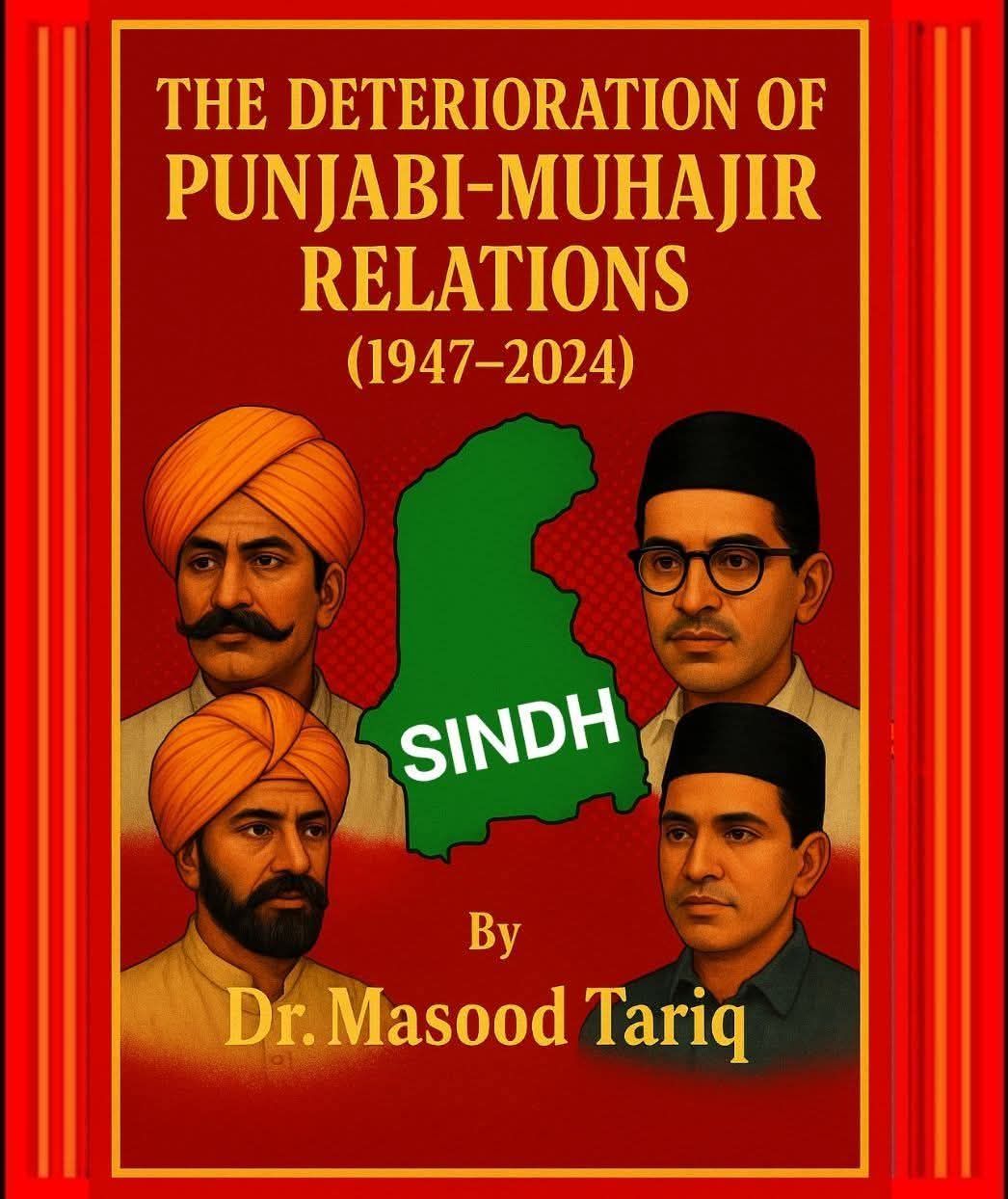
The Deterioration of Punjabi-Muhajir Relations (1947–2024)
Dr. Masood Tariq
Independent political theorist
Karachi, Pakistan
drmasoodtariq@gmail.com
Date: May 26, 2025
——————————————–
Abstract:
This paper examines the historical, political, and sociocultural factors contributing to the deterioration of relations between Punjabis and Urdu-speaking migrants (Muhajirs) in Pakistan, particularly in Karachi and Punjab.
Drawing on firsthand narratives, policy shifts, and historical developments since 1947, the study explores how initial camaraderie devolved into distrust and aversion, especially after the rise of Muhajir-centric politics post-1987.
It also discusses the broader implications for ethnic relations and urban governance in Pakistan.
——————————————–
Table of Contents
1. Introduction
2. Historical Context: Early Coexistence and Social Hierarchies
3. The Emergence of Ethnic Tensions (1970s–1980s)
4. The 1988 Turning Point: Punjabi Displacement and Aversion
5. Linguistic and Cultural Arrogance: The Politics of Superiority
6. Military Dictatorship and State Policies: 1999–2008
7. Demographic Realities and the Punjab Factor
8. Unanswered Questions and Calls for Accountability
9. Conclusion and Recommendations
10. References
——————————————–
1. Introduction
Ethnic relations in post-colonial nation-states often undergo profound transformations due to migration, political competition, and institutional biases.
Pakistan, since its inception in 1947, has been home to a complex tapestry of ethnic groups, including Punjabis, Sindhis, Pashtuns, Baloch, and Muhajirs—Urdu-speaking Muslims who migrated from India.
While Muhajirs initially enjoyed a privileged position in the state apparatus, their relations with other ethnic communities, particularly Punjabis, have significantly deteriorated over time.
This paper explores the evolution of Punjabi-Muhajir relations from camaraderie in the early decades to the emergence of resentment and hostility, particularly after 1987.
The analysis is situated within the context of ethnic politics, urban migration, and narratives of displacement and discrimination.
——————————————–
2. Historical Context: Early Coexistence and Social Hierarchies
At the time of Pakistan’s creation, a significant number of Urdu-speaking Muslims migrated from Uttar Pradesh, Bihar, and other parts of India to Sindh, particularly Karachi.
As the new nation’s capital and commercial hub, Karachi became the centre of bureaucracy, commerce, and elite social life—roles dominated by Muhajirs during the early years (Gayer, 2014).
Muhajirs often saw themselves as more “cultured” and “civilized,” drawing from their pre-Partition urban middle-class status and linguistic dominance.
This led to the marginalization of local ethnic groups, including Sindhis and Punjabis, who were often seen as “rustic” or “uncouth” (Yasmeen, 2001).
——————————————–
3. The Emergence of Ethnic Tensions (1970s–1980s)
Although Punjabis formed the bulk of Pakistan’s military and administrative apparatus, they were underrepresented in Karachi’s civil, commercial, and academic institutions.
The 1970s witnessed increasing ethnic competition due to quotas, urban migration, and political changes under Zulfiqar Ali Bhutto and later Zia-ul-Haq.
The rise of the Muhajir Qaumi Movement (MQM) in 1984 marked a watershed moment. Led by Altaf Hussain, MQM mobilized Urdu-speaking youth against perceived threats from Pashtuns and Punjabis, portraying themselves as victims of state policies.
Violence and targeted killings of Punjabis, especially businessmen and settlers in Karachi, escalated from 1987 onwards (ICG, 2007).
——————————————–
4. The 1988 Turning Point: Punjabi Displacement and Aversion
Punjabis who began relocating from Karachi to Punjab in the late 1980s brought with them stories of discrimination, extortion, violence, and harassment.
These narratives, particularly about the dominance of MQM-backed militias and land mafias, circulated widely across central Punjab, intensifying community-wide resentment.
Testimonies from displaced Punjabis described how entire families were driven out of Karachi, their businesses seized, and their lives threatened.
This led to the creation of a collective memory of victimhood in Punjabi households and a gradual shift from tolerance to aversion (Shah, 2007).
——————————————–
5. Linguistic and Cultural Arrogance: The Politics of Superiority
One of the key grievances articulated by Punjabis was the condescending attitude of Urdu-speaking elites toward their language and culture.
Muhajirs routinely corrected Punjabi pronunciation, mocked rural expressions, and projected themselves as the torchbearers of “civilized Urdu culture” (Rahman, 1996).
This disdain was not limited to private interactions but often surfaced in popular slogans and chants that circulated in colleges, youth gatherings, and political rallies. Among the most infamous were verses such as:
Kheench ke rakho
Taan ke rakho
Dhoti walon ko
Baandh ke rakho
Kheench ke rakho
Taan ke rakho
Pendooon bistar
Baandh ke rakho
Kheench ke rakho
Taan ke rakho
Dhaggo bistar
Baandh ke rakho
These lines, saturated with class and ethnic contempt, exemplified the kind of urban superiority that many Muhajir youth internalized and projected—viewing Punjabis (and often other non-Urdu speakers) as backward, unsophisticated, and unworthy of equal status in metropolitan life.
The reinforcement of such attitudes through media, education, and bureaucratic channels further alienated Punjabis. This culture of ridicule contributed to deep psychological wounds that widened the gap between the two communities over the decades.
——————————————–
6. Military Dictatorship and State Policies: 1999–2008
The Musharraf era (1999–2008) further aggravated Punjabi resentment. Though a Muhajir himself, Pervez Musharraf promoted MQM’s political ambitions, integrating them into federal coalitions and strengthening their influence over Karachi’s law enforcement and administrative machinery (Waseem, 2010).
This led many Punjabis to perceive the central state as complicit in their marginalization. Moreover, the absence of justice for victims of ethnic violence—many of whom were Punjabis—widened the psychological and political chasm between the two communities.
——————————————–
7. Demographic Realities and the Punjab Factor
While Karachi remains the stronghold of Muhajirs, census data reveals that approximately 5.3 million Urdu speakers reside in Punjab itself (Pakistan Bureau of Statistics, 2017).
As these communities advocate for the political narratives of their Karachi counterparts, tensions are now surfacing in Punjab as well—especially in cities like Rawalpindi, Lahore, and Faisalabad, where displaced Punjabis have settled.
The fear is that ethnic polarization, previously confined to Sindh, is now permeating the social fabric of Punjab.
——————————————–
8. Unanswered Questions and Calls for Accountability
Who is responsible for the thousands of Punjabis killed by MQM-backed militias since 1987?
Who will compensate for the lost businesses and homes?
Who will acknowledge the years of humiliation and insecurity suffered by Punjabi settlers in Karachi?
Without addressing these questions, meaningful reconciliation between the two communities remains elusive.
——————————————–
9. Conclusion and Recommendations
Ethnic tensions between Punjabis and Muhajirs stem from a complex mix of postcolonial migration, institutional favouritism, urban politics, and cultural superiority narratives. The state must address the historical grievances of Punjabis displaced from Karachi, investigate targeted violence, and foster inclusive policies in urban governance.
Rebuilding Punjabi-Muhajir relations requires mutual recognition of trauma, dismantling of superiority myths, and equitable resource sharing. Future studies should focus on interethnic dialogue models, federal conflict-resolution mechanisms, and comparative urban ethnographies.
——————————————–
10. References
Gayer, L. (2014). Karachi: Ordered Disorder and the Struggle for the City. Oxford University Press.
International Crisis Group. (2007). Pakistan: Karachi’s Madrasas and Violent Extremism. Asia Report No. 130.
Pakistan Bureau of Statistics. (2017). Population Census 2017: Language and Ethnicity Data. Government of Pakistan.
Rahman, T. (1996). Language and Politics in Pakistan. Oxford University Press.
Shah, S. (2007). “The Ethnic Divide in Karachi: The Rise and Fall of MQM.” Dawn, April 12.
Waseem, M. (2010). Political Sources of Ethnic Conflict in Pakistan. National Institute of Pakistan Studies.
Yasmeen, S. (2001). “Ethnic Politics in Pakistan: The Role of Muhajirs.” Asian Survey, Vol. 41, No. 6.
——————————————–
Author Biography
Dr. Masood Tariq is a Karachi-based politician and political theorist. He formerly served as Senior Vice President of the Pakistan Muslim Students Federation (PMSF) Sindh, Councillor of the Municipal Corporation Hyderabad, Advisor to the Chief Minister of Sindh, and Member of the Sindh Cabinet.
His research explores South Asian geopolitics, postcolonial state formation, regional nationalism, and inter-ethnic politics, with a focus on the Punjabi question and Cold War strategic alignments.
He also writes on Pakistan’s socio-political and economic structures, analysing their structural causes and proposing policy-oriented solutions aligned with historical research and contemporary strategy.
His work aims to bridge historical scholarship and strategic analysis to inform policymaking across South Asia, Central Asia, and the Middle East.
——————————————–
Note: This is an academic article. The purpose of this article is to critically reflect on the historical mistakes made by various ethnic groups and to foster a spirit of acknowledgement and reconciliation, with the ultimate goal of promoting harmony in Sindh.
If anyone believes that any part of this article is inaccurate, please identify the specific section and support the critique with credible evidence. Additionally, please refer to the following article to gain a broader understanding of Sindh’s political history:
From Linguistic Tensions to Political Realignment:
The 1972 Language Riots, Non-Sindhi Accord, and the Fracturing of Muhajir-Punjabi-Pathan Unity in Sindh
Leave a Reply