
Demographic Dominance and Political Marginalization: The Punjabi Nation in Post-1971 Pakistan
Date: June 18, 2025
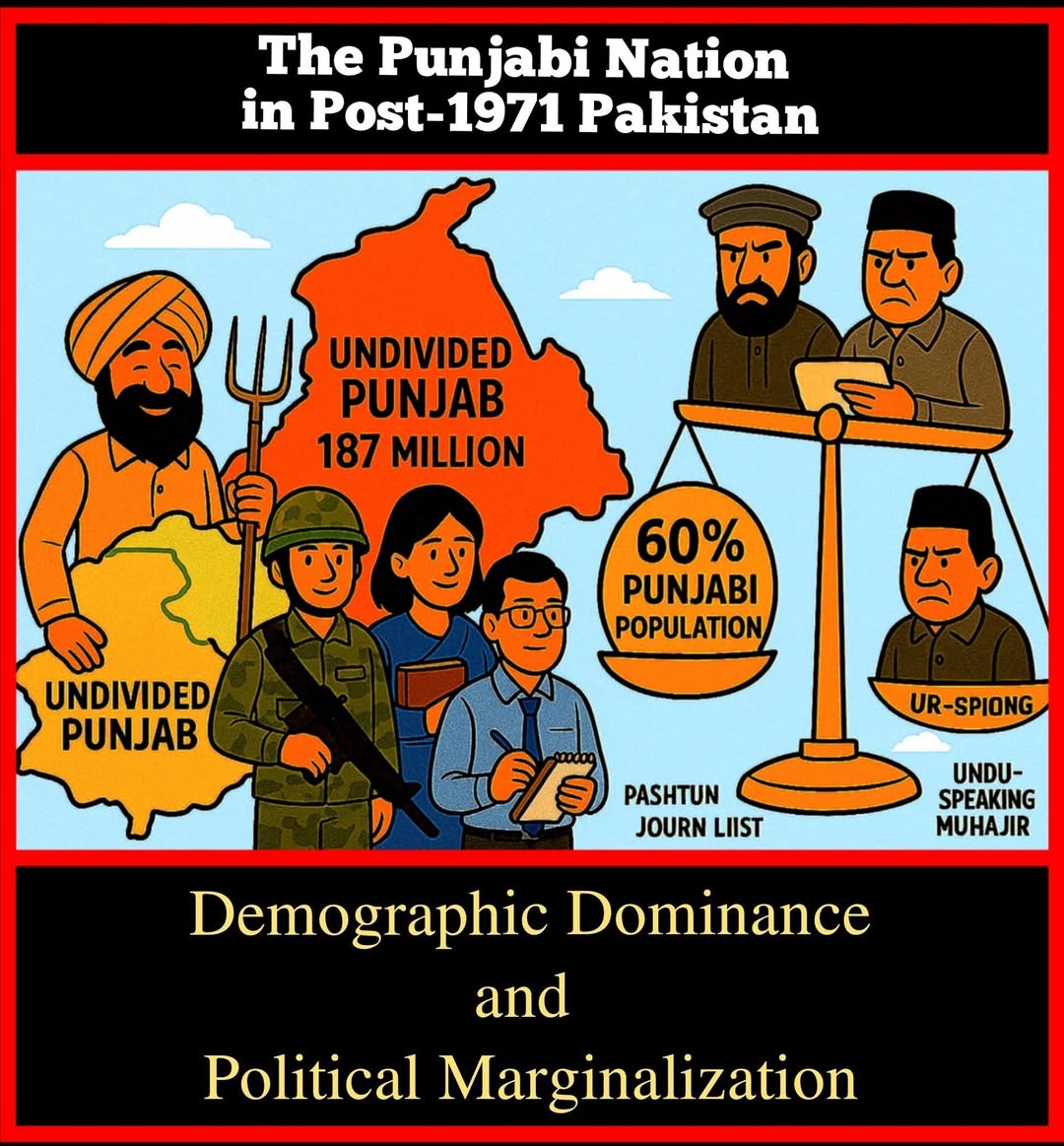
After East Pakistan separated on 20 December 1971 and became Bangladesh, West Pakistan was renamed Pakistan, and Punjabis came to make up 60% of Pakistan’s population (Kashmiri, Hindko, and Derawali are considered part of the Punjabi nation). The remaining 40% consisted of Sindhi, Brahui, Gilgit-Baltistani, Kohistani, Chitrali, Swati, Gujarati, Rajasthani, Pashtun, Baloch, and Urdu-speaking Indian Muhajirs.
All ethnic groups in Pakistan live together across the country. Therefore, no region of Pakistan can be exclusively declared the domain of any single ethnic group. However, for administrative purposes, Pakistan is divided into provinces, divisions, districts, tehsils, and union councils.
If Punjab (within Pakistan) were considered a separate country, it would be the 11th most populous country in the world.
The following are the ten countries with populations larger than Pakistani Punjab:
China – 1,448,471,400
India – 1,406,631,776
United States – 334,805,269
Indonesia – 279,134,505
Nigeria – 216,746,934
Brazil – 215,353,593
Bangladesh – 167,885,689
Russia – 145,805,947
Mexico – 131,562,772
Japan – 125,584,838
Apart from Russia (145 million), no European country has a larger population than Pakistani Punjab.
The ten most populous countries in Europe are:
Germany – 83,783,942
United Kingdom – 67,886,011
France – 65,273,511
Italy – 60,461,826
Spain – 46,754,778
Ukraine – 43,733,762
Poland – 37,846,611
Romania – 19,237,691
Netherlands – 17,134,872
Belgium – 11,589,623
Pakistani Punjab’s population is 120 million.
Indian Punjab – 30 million
Haryana – 30 million
Himachal Pradesh – 7 million
Combined (Undivided) Punjab’s total population – 187 million.
If Undivided Punjab were considered a separate country, it would be the 7th most populous country in the world, and no European country would have a larger population than it.
Had Punjab not been divided in 1947—or if the Radcliffe Line were erased and the parts of Punjab given to India were merged back into Pakistan—Pakistan’s total population would be 287 million, making it the 4th most populous country in the world, after:
China – 1,448 million
India – 1,406 million
USA – 334 million
Punjabis are not only the largest ethnic group in Punjab province but also the second-largest group in Khyber Pakhtunkhwa, the Pashtun regions of Balochistan, the Baloch regions of Balochistan, rural Sindh, and Karachi.
62 cities out of Pakistan’s 98 cities with populations over 100,000 have a Punjabi majority.
Therefore, in agriculture, industry, trade, politics, journalism, skilled labour, the armed forces (army, navy, air force), civil services, and educational institutions, Punjabis are dominant—and will continue to be.
Yet, from the creation of Pakistan until the formation of Bangladesh, the rule remained with Pathans and Urdu-speaking Indian-origin Muhajirs.
Even after West Pakistan became Pakistan:
1. Is it not the social right of 60% of Pakistan’s population that the Punjabi language should be declared the national language of Pakistan?
2. Is it not the human dignity of 60% of Pakistan’s population that Punjabi culture should be the dominant culture in Pakistan?
3. Is denying 60% of Pakistan’s population (Punjabis) the right to rule Pakistan not a violation of democratic principles?
Because of the growing realization within the Punjabi nation that it lacks social respect and administrative rights, can Pashtuns and Urdu-speaking Indian Muhajirs, by ruling Pakistan:
1. Bring social stability and financial prosperity to the people of Pakistan?
2. Ensure administrative improvement and economic development in Pakistan?
Leave a Reply