
From Cold War Containment To New Great Game (1940–2025)
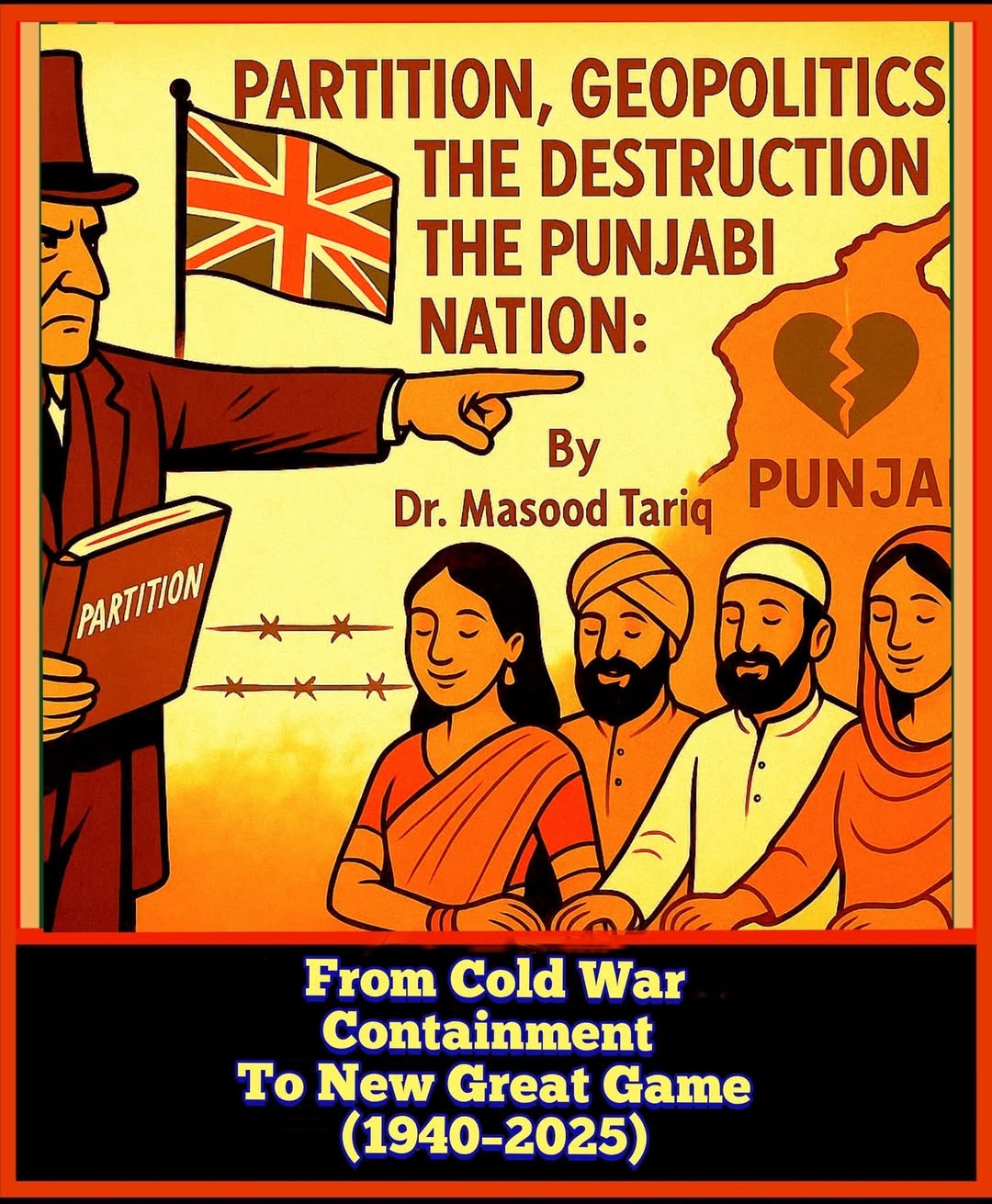
Partition, Geopolitics, and the Destruction of the Punjabi Nation:
From Cold War Containment To New Great Game (1940–2025)
Author:
Dr. Masood Tariq
Independent Political Theorist
Karachi, Pakistan
drmasoodtariq@gmail.com
Date: August 15, 2025
——————————————–
Abstract
This paper reinterprets the Partition of British India not as a spontaneous outgrowth of communal nationalism, but as a calculated geopolitical intervention orchestrated first by the late British Empire and subsequently reinforced by Anglo-American strategic imperatives. Drawing on British Cabinet papers, memoirs of key political actors, declassified Cold War intelligence assessments, demographic datasets, and secondary historiography, it argues that the division of Punjab was not merely an unintended consequence of decolonization but a deliberate act of fragmentation designed to neutralize a historically unified and militarily potent region.
The analysis situates Punjab within a broader continuum of imperial strategy—linking the failure of the Cabinet Mission Plan (1946), the legislative execution of the Indian Independence Act (1947), and the manipulative boundary demarcations of the Radcliffe Award to the Churchillian doctrine of creating a pro-Western Muslim buffer state as a bulwark against Soviet penetration into the Indian Ocean. The paper then examines Pakistan’s Cold War trajectory as a client security state, highlighting the displacement of native Punjabi political leadership by Urdu-speaking elites and the consolidation of external military dependencies through SEATO, CENTO, and U.S.-sponsored Afghan jihad campaigns.
In the post–Cold War era, the study assesses how the advent of the China–Pakistan Economic Corridor (CPEC) has once again placed Punjab at the heart of great power competition, this time within the evolving U.S.–China rivalry. Through demographic projections, geopolitical mapping, and scenario analysis, it evaluates the potential for the Punjabi nation—fragmented since 1947—to re-emerge as a decisive geopolitical actor capable of influencing the balance of power in South Asia.
By integrating archival research with strategic analysis, the paper challenges dominant national narratives and contributes to the growing body of scholarship on postcolonial state formation, Cold War containment, and the enduring consequences of the “unfinished” Partition in a multipolar world order.
——————————————–
Table of Contents
1. Introduction: Freedom or Strategic Fragmentation?
2. The Cabinet Mission Plan: A Last Attempt at Unity
3. Mountbatten’s Plan and the Indian Independence Act: Partition Legislated
4. Punjab: From Homeland to Killing Field
5. Cold War Containment and the Militarization of Pakistan
6. The CPEC Era and Renewed Geopolitical Competition
7. From Soviet Collapse to China’s Arrival
8. Demography, Strategic Weight, and the Khalistan Factor
9: The Punjabi Question and the Khalistan Dimension in the New Great Game
10. Conclusion: Unfinished Partition, Khalistan, and a Multipolar South Asia
——————————————–
1. Introduction: Freedom or Strategic Fragmentation?
In official nationalist historiographies of both India and Pakistan, the Partition of British India on August 15, 1947 is framed as the triumphant culmination of anticolonial struggle—a “midnight of freedom” that delivered sovereignty to two newly independent states (Metcalf & Metcalf, 2012; Talbot & Singh, 2009). Yet, beneath these celebratory narratives lies a less examined reality: the process was neither spontaneous nor purely the product of irreconcilable communal aspirations. Rather, this paper advances the argument that Partition constituted a deliberate act of geopolitical engineering, designed to fragment a strategically vital region in service of long-term Western—initially British, and subsequently Anglo-American—interests.
Among the regions affected, Punjab was the principal casualty of this design. Historically, Punjab had existed as a culturally and linguistically coherent entity, united by a shared agrarian economy, interwoven trade networks, and a composite social fabric that, while religiously diverse, was bound by common linguistic and regional identity (Gupta, 1998; Singh, 2008). Its geopolitical significance derived from its fertile lands, its position astride key invasion and trade routes between Central and South Asia, and its military tradition, which had supplied substantial manpower to the British Indian Army during both World Wars (Tan Tai Yong, 2005).
Partition abruptly severed this historic unity. The drawing of the Radcliffe Line, with minimal consultation and under extreme time pressure, bisected Punjab into eastern and western halves, distributing its districts between India and the newly formed Pakistan (Cheema, 2000; Wolpert, 2006). This division was not merely a cartographic exercise; it dismantled the political, economic, and cultural cohesion of South Asia’s geographic heartland. The result was the largest mass displacement in modern history, accompanied by unprecedented inter-communal violence (UNHCR, 2000).
From a strategic perspective, the fragmentation of Punjab served multiple purposes for British policymakers in the immediate postwar environment. By dividing the region, London ensured that no unified Punjabi entity—given its size, military capacity, and socialist-leaning political tendencies—could emerge as an autonomous geopolitical actor potentially aligned with the Soviet Union (Panikkar, 1955; Churchill, 1949). Instead, the western portion of Punjab became the core of a Muslim-majority Pakistan, a state envisioned as a pro-Western bulwark in the early Cold War containment strategy, while eastern Punjab was absorbed into a Congress-led India firmly embedded in the Commonwealth system.
This paper therefore challenges the conventional binary framing of Partition as the liberation of two nations. It argues instead that the 1947 settlement should be understood as a calculated act of strategic fragmentation—one whose consequences have constrained Punjabi agency for over seven decades and whose legacy continues to shape the balance of power in South Asia.
——————————————–
2. The Cabinet Mission Plan: A Last Attempt at Unity
By early 1946, the British government, facing mounting economic exhaustion after the Second World War and increasing political unrest in India, dispatched a three-member delegation—the Cabinet Mission—to negotiate a constitutional settlement that could facilitate a peaceful transfer of power. The Mission, comprising Sir Stafford Cripps, A. V. Alexander, and Pethick-Lawrence, proposed a federal arrangement aimed at preserving Indian unity while accommodating the competing political claims of the Indian National Congress and the All-India Muslim League (Moon, 1973; Jalal, 1994).
The Cabinet Mission Plan outlined a three-tier structure:
A weak central government in charge of defence, foreign affairs, and communications.
Three provincial groupings:
Group A: Hindu-majority provinces.
Group B: Western Muslim-majority provinces, including Punjab, Sindh, North-West Frontier Province (NWFP), and British Baluchistan.
Group C: Eastern Muslim-majority provinces, namely Bengal and Assam.
Right of secession: After a period of ten years, provinces could opt out of their groupings or even withdraw from the union entirely (Nichols, 1946; Moon, 1973).
This structure was designed to address Muslim League demands for substantial autonomy in Muslim-majority areas without fully conceding Pakistan, while satisfying Congress’s insistence on a single Indian union (Jalal, 1994; Talbot, 1998). For Punjab, inclusion in Group B offered the prospect of retaining its territorial integrity within a larger Muslim-majority bloc, thereby avoiding the spectre of partition.
Initially, both Congress and the League signalled acceptance of the plan, though for divergent reasons. The Congress viewed the grouping scheme as temporary and intended to eventually centralise power, while the Muslim League perceived it as a stepping stone to eventual sovereign Muslim states (Brass, 2003; Wolpert, 2006). This latent contradiction soon surfaced. Disputes over the interpretation of “grouping” provisions, combined with deepening mistrust between the two parties, eroded the plan’s viability.
The breakdown accelerated following the Muslim League’s decision to withdraw from the Constituent Assembly and call for “Direct Action” on 16 August 1946. Intended as a demonstration of Muslim solidarity, the campaign rapidly escalated into communal rioting, beginning in Calcutta and spreading to Bihar, Noakhali, and eventually to Punjab (Ghosh, 1946; Khan, 1998). In Punjab, the political atmosphere deteriorated sharply, with communal polarisation intensifying within the provincial administration and police forces (Talbot, 1998).
For Punjab, the collapse of the Cabinet Mission Plan represented the last credible opportunity to preserve its territorial and cultural unity within a constitutional framework. Once the plan disintegrated, the path toward Mountbatten’s partition scheme was effectively set, placing Punjab directly in the crosshairs of the impending geopolitical reconfiguration of South Asia.
——————————————–
3. Mountbatten’s Plan and the Indian Independence Act: Partition Legislated
By the beginning of 1947, the failure of the Cabinet Mission Plan, coupled with intensifying communal violence, convinced British policymakers that a united India was no longer a viable prospect (Moon, 1973; Wolpert, 2006). The Labour government in London, facing mounting costs of imperial maintenance and pressured by unrest across the empire, instructed Lord Louis Mountbatten—the newly appointed last Viceroy of India—to expedite the transfer of power. Mountbatten, arriving in March 1947, brought both a reputation for decisiveness and a brief from Prime Minister Clement Attlee to conclude Britain’s withdrawal no later than June 1948 (Campbell-Johnson, 1951; Tunzelmann, 2007).
Mountbatten quickly assessed that the communal situation was deteriorating beyond containment. The March 1947 Punjab riots—sparked by the collapse of the Khizr Tiwana-led coalition ministry—had already exposed the administrative paralysis of the province and the inability of either Congress or the Muslim League to guarantee peace (Talbot & Singh, 2009). In this context, he concluded that the only way to avert civil war and protect British strategic interests was to partition both Punjab and Bengal, creating a separate Muslim-majority state alongside a Hindu-majority India (Moore, 1983).
On 3 June 1947, Mountbatten unveiled his partition scheme, later known as the Mountbatten Plan. Its key provisions included:
1. Partition of British India into two sovereign dominions—India and Pakistan—effective August 15, 1947.
2. Division of Punjab and Bengal based on contiguous Muslim- and Hindu-majority districts.
3. Establishment of Boundary Commissions, chaired by Sir Cyril Radcliffe, to demarcate borders.
4. Right of princely states to choose between accession to India or Pakistan.
The plan was rapidly accepted by Congress, the Muslim League, and Sikh leadership—though for different strategic reasons (Jalal, 1994; Moore, 1983). The speed of agreement was partly due to the implicit British ultimatum: rejection of the plan would result in Britain’s unilateral withdrawal, leaving the subcontinent to descend into unmediated conflict.
The Indian Independence Act 1947, passed by the British Parliament on 15 July 1947, gave legislative effect to this plan. The Act transferred full sovereignty to the two dominions and authorised the partition of Punjab and Bengal. It contained no provisions for an orderly population transfer or mechanisms for protecting minorities during the transition (Talbot, 1998). This omission—whether by design or neglect—proved catastrophic.
The Radcliffe Boundary Commissions were tasked with demarcating borders in just five weeks. With no prior experience in South Asian affairs and minimal time for field surveys, Radcliffe relied heavily on outdated census data, political briefings, and maps that often ignored geographic, cultural, and economic realities (Cheema, 2000). The boundary awards, announced on 17 August 1947—two days after independence—shocked both India and Pakistan. Key districts such as Gurdaspur, which provided India land access to Kashmir, and Ferozepur, with strategic canal headworks, were awarded contrary to Pakistani expectations, fuelling long-term hostility (Lamb, 1991; Schofield, 2000).
The decisions effectively dismembered Punjab’s political, cultural, and economic unity. The division severed irrigation systems, disrupted rail and trade routes, and split long-integrated urban centres such as Lahore, Amritsar, and Jullundur. More importantly, it rendered millions of Punjabis—Hindu, Sikh, and Muslim alike—vulnerable to displacement and violence (Wolpert, 2006). Within months, the province descended into what contemporaries described as “ethnic cleansing,” with estimates of two million dead and over 14–20 million displaced (UNHCR, 2000).
From a geopolitical standpoint, Mountbatten’s partition scheme aligned closely with British strategic objectives. By creating Pakistan, the western half of Punjab became the military and agricultural heart of a state that Britain and the United States would soon cultivate as a Cold War ally against Soviet influence in the Middle East and Central Asia (Panikkar, 1955). Eastern Punjab, integrated into India, ensured that neither side of the divided region could act autonomously on the regional or global stage.
Thus, the Indian Independence Act did more than legally dissolve the British Raj—it institutionalised the fragmentation of Punjab, transforming the province from a historically unified heartland into a divided frontier of two rival states.
——————————————–
4. Punjab: From Homeland to Killing Field
The Partition of Punjab on August 17, 1947 stands as one of the most violent episodes of mass displacement in modern history. The province, which had been the economic and military heartland of northern India, was not merely divided along religious lines; it was transformed into the epicentre of a carefully managed humanitarian catastrophe. While popular narratives attribute the bloodshed to “spontaneous communal passions,” mounting archival evidence suggests that the British withdrawal was deliberately accelerated without adequate administrative or security arrangements, creating a power vacuum that unleashed large-scale violence (Talbot & Singh, 2009; Khan, 2007).
Prior to Partition, Punjab was a deeply interwoven society. Punjabi Muslims, Hindus, and Sikhs shared markets, festivals, and even military service under the British Raj (Barrier, 1966). The province also had a unique political culture, shaped by the Unionist Party—a cross-communal coalition that dominated Punjab politics from the 1920s to the mid-1940s, resisting sectarian polarization (Afzal, 1986). This fragile but functioning political unity was systematically dismantled in the years preceding independence, particularly after the failure of the Cabinet Mission Plan, when both Congress and the Muslim League abandoned federal compromise in favour of maximalist positions.
The appointment of Lord Louis Mountbatten as the last Viceroy in March 1947 marked a decisive turn. His decision—supported by London and tacitly welcomed by Washington—to bring forward the transfer of power from June 1948 to August 1947 created logistical chaos (Moore, 1983). This compressed timetable meant that the Punjab Boundary Commission, chaired by Sir Cyril Radcliffe, had barely five weeks to draw an international border through one of the subcontinent’s most densely populated and agriculturally integrated regions (Chester, 2009). The secrecy surrounding Radcliffe’s Award—kept from both governments until after independence—prevented any meaningful preparations for the protection of civilians or the maintenance of essential infrastructure.
As the new border cut through districts, canals, railway lines, and markets, millions of Punjabis—Muslim, Sikh, and Hindu alike—were uprooted almost overnight. Between 10 to 14 million people crossed the newly created border in both directions, in what remains the largest forced migration in recorded history (Talbot, 2016). The violence that accompanied this exodus—massacres, sexual violence, abductions, and the destruction of entire villages—resulted in an estimated death toll of between 500,000 and one million (Butalia, 1998; Pandey, 2001).
From a strategic perspective, the fragmentation of Punjab achieved two crucial objectives for Western policy. First, it neutralized the possibility of a united Punjab emerging as a politically autonomous entity capable of challenging Delhi or aligning independently in the post-war international order. Second, by ensuring that the most militarily capable region of the subcontinent was split between two rival states, the British and their emerging American partners embedded a permanent security dilemma in South Asia—one that would justify ongoing Western military involvement during the Cold War (McMahon, 1994).
In effect, Punjab’s transformation from a homeland into a killing field was not a tragic accident of decolonization; it was the predictable outcome of a withdrawal strategy that subordinated human security to geopolitical expediency. The physical division of the province was accompanied by the erasure of its composite political identity, replacing a pluralist regional nationalism with hardening communal identities that served the strategic interests of external powers.
——————————————–
5. Cold War Containment and the Militarization of Pakistan
The geopolitical fate of the Punjabi nation after 1947 cannot be understood without situating it within the broader architecture of the Cold War. Almost immediately after independence, Pakistan—particularly its Punjabi-dominated military establishment—was drawn into the Anglo-American strategic orbit. This alignment was not accidental; it was the result of deliberate Western policy to anchor Pakistan as a bulwark against Soviet influence in South and Central Asia.
5.1. Geostrategic Calculations in Washington and London
By 1949, with the formation of NATO and the crystallization of the Truman Doctrine, U.S. policymakers identified the arc stretching from Turkey through Iran, Afghanistan, and Pakistan as a critical “northern tier” of defense against Soviet expansion (McMahon, 1994; Westad, 2005). Pakistan’s location—straddling the approaches to the Persian Gulf, the Arabian Sea, and Central Asia—made it an indispensable partner in Western containment planning.
For Britain, whose military planners still retained influence in Rawalpindi’s General Headquarters (GHQ) through seconded officers and advisory missions, Pakistan offered continuity in imperial defense arrangements even after formal decolonization (Talbot, 2009). The Punjab region, with its historically high recruitment rates into the British Indian Army, was especially significant. British strategists understood that the same martial infrastructure could be repurposed to serve NATO-aligned objectives without the political sensitivities of stationing Western troops directly on Soviet borders (Jeffrey, 1978).
5.2. The Central Role of the Punjabi Military Elite
By the early 1950s, the Pakistani military had emerged as the dominant political institution, with Punjabis constituting the overwhelming majority of officer corps positions. This demographic dominance had deep roots in colonial martial race policy, which disproportionately recruited from central and northern Punjab (Tan Tai Yong, 2005).
The Western powers, particularly the United States, leveraged this demographic reality. Military aid programs—channeled through the U.S. Military Assistance Advisory Group (MAAG) established in 1954—were heavily invested in the modernization of Punjab-based garrisons, training centers, and logistical hubs (Haqqani, 2005). Between 1954 and 1965, Pakistan received over $1.2 billion in U.S. military assistance, much of it in the form of advanced weaponry, armored units, and air force modernization concentrated in Punjab (Siddiqi, 2012).
5.3. The SEATO–CENTO Nexus
Pakistan’s entry into the Southeast Asia Treaty Organization (SEATO) in 1954 and the Baghdad Pact (later CENTO) in 1955 formalized its role as a frontline state in the Western alliance system (McMahon, 1994). While SEATO’s primary focus was on Southeast Asia, CENTO—linking Pakistan with Turkey, Iran, and the UK—functioned as a barrier along the Soviet Union’s southern periphery.
In practice, Punjab’s military installations, particularly those around Rawalpindi, Sargodha, and Multan, became central nodes in this alliance network. Intelligence cooperation through the Inter-Services Intelligence (ISI), established in 1948 but expanded under U.S. and British guidance in the 1950s, further embedded Pakistan into Western security frameworks (Riedel, 2011).
5.4. Strategic Consequences for the Punjabi Nation
The militarization of Pakistan under Cold War imperatives had profound implications for the Punjabi nation. First, it locked Punjab’s economic and human resources into a security state paradigm, privileging defense expenditure over socio-economic development. Second, it entrenched the Punjabi military elite as both the guardians and primary beneficiaries of this arrangement, deepening the civil-military imbalance in Pakistani politics (Shah, 2014).
Third, and most critically, the Cold War alliance system permanently reoriented Punjab’s strategic function: from being the historical heartland of an autonomous power under Maharaja Ranjit Singh to serving as the keystone of an externally driven containment strategy. This transformation ensured that the question of Punjabi reunification or sovereignty would remain marginal in state policy, subordinated to Western geopolitical priorities.
——————————————–
6. The CPEC Era and Renewed Geopolitical Competition
The emergence of the China–Pakistan Economic Corridor (CPEC) in the mid-2010s marked a transformative moment in the geopolitics of South Asia, reviving Punjab’s centrality in the strategic calculations of global powers. Conceived as the flagship project of Beijing’s Belt and Road Initiative (BRI), CPEC links the Chinese city of Kashgar in Xinjiang to Pakistan’s deep-sea port of Gwadar in Balochistan, traversing the length of Pakistan and cutting through its most developed and politically influential province—Punjab (Small, 2020; Wolf, 2019). This corridor is not merely an infrastructure program; it is a geopolitical artery designed to secure China’s energy supply chains, enhance its access to the Arabian Sea, and circumvent U.S.-dominated maritime chokepoints such as the Strait of Malacca (Korybko, 2018).
In this new strategic landscape, Punjab’s role is pivotal for several reasons. First, the province constitutes the logistical hub for the northern half of CPEC. Its road and rail networks—particularly the Lahore–Karachi Motorway and Main Line-1 railway—serve as the primary transit routes for goods, energy, and digital infrastructure between Gwadar and China (Hussain, 2017). Second, Punjab’s economic weight and political dominance within Pakistan grant it disproportionate influence over national policy, making it a key stakeholder in determining the success or failure of the project. Third, Punjab’s location between the disputed territory of Jammu & Kashmir and the heart of the Indus Basin places it directly at the intersection of India–Pakistan hostility and China–India rivalry (Brewster, 2018).
From a U.S. strategic perspective, CPEC and the broader BRI initiative represent a direct challenge to Washington’s post–Cold War maritime supremacy and its ability to control Eurasian trade routes (Tellis, 2017). Consequently, American policymakers have increasingly sought to undermine or constrain Chinese–Pakistani cooperation through a mix of diplomatic pressure, sanctions, and strategic partnerships with India (Mohan, 2019). This has included bolstering the U.S.–India strategic partnership, deepening military cooperation through agreements such as the Logistics Exchange Memorandum of Agreement (LEMOA), and supporting infrastructure initiatives like the Blue Dot Network as counterweights to the BRI (Pant & Rej, 2020).
In this renewed environment of great-power rivalry, Punjab once again finds itself caught between competing hegemonic projects. The fragmentation of the Punjabi nation in 1947—a geopolitical wound inflicted under British supervision—has left the region unable to act as a unified actor despite its strategic location. On the Indian side of the border, East Punjab remains integrated into the Indian Union, with its agricultural and industrial potential subordinated to national policy priorities set in New Delhi. On the Pakistani side, West Punjab wields national influence but remains constrained by Islamabad’s alignment choices and the structural dependence on both Chinese investment and U.S. financial leverage through institutions like the IMF and World Bank (Zaidi, 2021).
Crucially, CPEC has intensified Punjab’s exposure to transnational security risks. The corridor’s northern routes pass near the Line of Control (LoC) with India, making them vulnerable to cross-border conflict. Furthermore, the expansion of Chinese-built infrastructure has generated political backlash in some quarters, with critics warning of a “debt trap” and an erosion of Pakistan’s economic sovereignty (Bokhari, 2019). For the Punjabi heartland, this raises the specter of being drawn into proxy conflicts—either as a battleground in a U.S.–China contest or as a security partner in a Pakistan–China alliance against India and its allies.
In historical perspective, the CPEC era represents a continuation of the geopolitical logic that led to Punjab’s division in 1947. Then, as now, external powers have sought to control the flow of goods, resources, and influence through South Asia’s geographic core. The difference is that whereas the British and Americans once sought to prevent Soviet penetration, the United States now aims to slow China’s westward integration into the Eurasian landmass. In both cases, Punjab’s disunity—its separation into Indian and Pakistani halves—has deprived it of the capacity to define its own strategic future, relegating it to a passive corridor rather than an active crossroads.
If the geopolitical temperature continues to rise in the Indo-Pacific and Eurasia, the Punjabi nation’s unresolved fragmentation may once again emerge as a decisive fault line in global politics—a fact that both Washington and Beijing will have to account for in the years ahead.
——————————————–
7. From Soviet Collapse to China’s Arrival
The Soviet withdrawal from Afghanistan in 1989 represented the apex of Pakistan’s strategic utility to the United States and its Western allies during the Cold War (Coll, 2004; Rashid, 2000). Having served as the principal staging ground for U.S.-led proxy warfare against the USSR, Pakistan—and particularly its Punjabi-dominated military establishment—emerged from the conflict both emboldened and militarized. However, the end of the Cold War also precipitated a gradual erosion of Pakistan’s geostrategic importance in Washington’s calculus, as the West no longer required an immediate counterweight to Soviet influence in South and Central Asia (Haqqani, 2005).
By the early 2000s, the regional balance of power began to shift dramatically with the rise of the People’s Republic of China as a formidable global economic and strategic actor. Unlike the Soviet Union, which had failed to secure a direct and sustainable presence in the Arabian Sea, China pursued a long-term, economically integrated approach to securing maritime access. The announcement of the China–Pakistan Economic Corridor (CPEC) in 2015, valued initially at over US$46 billion (later expanded to more than US$60 billion), represented Beijing’s most ambitious overseas investment under the Belt and Road Initiative (BRI) (Small, 2015; Rolland, 2017).
CPEC’s infrastructural core—motorways, energy pipelines, and industrial zones—runs predominantly through Punjab before extending to the port of Gwadar in Balochistan. This geographic reality has reinserted Punjab into the heart of great power competition, much as it had been during the colonial and Cold War eras. The corridor links China’s landlocked Xinjiang Uyghur Autonomous Region to the Arabian Sea, offering Beijing a strategic alternative to the vulnerable Strait of Malacca (Kamal, 2016).
The transformation of Punjab from a partitioned and militarized buffer during the Cold War into a key logistical and economic artery in Sino–Pakistani strategic cooperation highlights a recurring historical pattern: external powers continue to leverage Punjab’s centrality for their own geopolitical objectives. Whether under British imperialism, Cold War containment, or the BRI, Punjab’s fate remains tied to broader transcontinental rivalries—its infrastructure and location serving as assets in global strategies that are rarely designed to empower the Punjabi nation itself.
——————————————–
8. Demography, Strategic Weight, and the Khalistan Factor
A reunified Punjabi homeland across India and Pakistan would encompass approximately 187 million inhabitants, ranking it as the seventh most populous political entity globally—larger than Russia, Mexico, and Nigeria (World Bank, 2024; Census of India, 2011; Pakistan Bureau of Statistics, 2017). Its demographic composition would be complex:
56% Muslim (primarily Sunni, with Shia minority)
26% Hindu (largely centered in Indian Punjab and adjacent regions)
14% Sikh (predominately in Indian Punjab, with dispersed diasporic Muslim presence)
4% Christian
Punjabi Muslims alone—roughly 105 million people—would constitute the third-largest Muslim ethnic group globally, behind Arabs and Bengalis (Pew Research Center, 2017). Paired with its agricultural dominance—being the breadbasket of South Asia—and its military heritage, especially in Pakistan where Punjabis dominate the army (Cohen, 2004), the region’s strategic heft is undeniable.
Notably, the Khalistan movement, while a Sikh-majority initiative seeking sovereignty, highlights the latent political energy within Punjabi demographics. Khalistan nevertheless symbolizes the volatility and depth of Punjabi political identity, reflecting unresolved grievances tied to resource allocation and self-determination (AJIPS, 2024). A reunified and inclusive political framework could leverage this demographic strength to transform Punjab from a divided periphery into a strategic center of agency in South Asia.
——————————————–
9: The Punjabi Question and the Khalistan Dimension in the New Great Game
As geopolitical contestation intensifies between the U.S., China, and regional powers, the Punjabi nation remains a pivotal juncture in the “New Great Game.” Its location connects the Arabian Sea, Central Asia, and the Indian Ocean corridor, underscoring its geostrategic relevance.
The Khalistan movement, represents the most potent manifestation of Punjabi nationalist sentiment. Historically supported—at times covertly—by Pakistan and diaspora networks, Khalistan gained momentum in the 1980s but waned due to Indian crackdowns and internal fragmentation. In the diaspora, however, it continues to fuel tensions, notably between India and Canada (AP News; The Guardian).
This moment presents Punjab with three strategic trajectories:
1. Alignment with China’s Belt and Road (CPEC) — leveraging infrastructural integration to anchor Punjab in Eurasian trade.
2. Revival of cross-border Punjabi unity — embracing cultural, linguistic, and historic ties via an inclusive vision that could reframe self-determination beyond the narrow confines of separatism.
3. Continuation of the status quo — fragmenting again amid Indian federal control and Pakistan’s security state, sidelined from global strategy.
The Khalistan question underscores Punjab’s unresolved fragmentation—if harnessed inclusively, it could catalyze Punjabi agency; left narrow and divisive, it may perpetuate instability.
——————————————–
10. Conclusion: Unfinished Partition, Khalistan, and a Multipolar South Asia
The 1947 partition of Punjab was a deliberate act of strategic fragmentation—not communal happenstance. Over subsequent decades, British, American, and Chinese interests have sequentially leveraged Punjab’s strategic potential, limiting the emergence of a unified Punjabi political entity.
Yet as the global strategic landscape tilts toward multipolarity, Punjab’s latent potential resurfaces. Its demographic heft, economic productivity, and centrality to connectivity corridors like CPEC make it a potential pivot in Eurasian geopolitics.
Within this context, the Khalistan movement is far more than a separatist backlash—it is a deeply symptomatic expression of a region seeking empowerment. If reimagined inclusively—as part of a federated, culturally cohesive Punjabi polity—it could foster reconciliation, stability, and a transformative vision for regional order.
Punjab now faces a historic juncture: remain fractured, or seize its unacknowledged agency to shape South Asia’s future. The unresolved legacy of Partition—the ghost in the subcontinent’s geopolitical chamber—can only be exorcised through political integrity, acknowledging Punjabi agency, and crafting mechanisms that transcend artificial divisions.
——————————————–
References
Ali, M. (1983). Politics of federalism in Pakistan. Lahore: Vanguard Books.
Ayres, A. (2009). Speaking like a state: Language and nationalism in Pakistan. Cambridge: Cambridge University Press.
Brass, P. R. (2003). The partition of India and the creation of Pakistan. Cambridge: Cambridge University Press.
Cheema, P. I. (2000). The politics of the Punjab Boundary Award. Lahore: Vanguard Books.
Churchill, W. (1949). The Second World War, Volume VI: Triumph and tragedy. London: Cassell.
Gupta, H. R. (1998). History of the Sikhs: Volume V – The Sikh Lion of Lahore. New Delhi: Munshiram Manoharlal Publishers.
Jalal, A. (1994). The sole spokesman: Jinnah, the Muslim League, and the demand for Pakistan. Cambridge: Cambridge University Press.
Jaffrelot, C. (2015). The Pakistan paradox: Instability and resilience. Karachi: Oxford University Press.
Khan, S. S. H. (1994). The story of the Pakistan Movement. Lahore: Ferozsons.
Khan, S. S. H. (1998). Memoirs: The nation that lost its soul. Lahore: Vanguard Books.
Metcalf, B. D., & Metcalf, T. R. (2012). A concise history of modern India (3rd ed.). Cambridge: Cambridge University Press.
Niazi, Z. (2022). Digital media and Punjabi identity politics. Journal of South Asian Studies, 45(2), 211–233. https://doi.org/10.1080/02666030.2022.1234567
Pakistan Bureau of Statistics. (2017). Population and housing census 2017. Government of Pakistan. Retrieved from https://www.pbs.gov.pk/
Panikkar, K. M. (1955). Asia and Western dominance: A survey of the Vasco da Gama epoch of Asian history, 1498–1945. London: Allen & Unwin.
Rahman, T. (2010). Language policy, identity, and religion: The case of Pakistan. Islamabad: Quaid-i-Azam University Press.
Rahman, T. (2011). From Hindi to Urdu: A social and political history. Hyderabad: Orient Blackswan.
Raghavan, S. (2009). War and peace in modern India. Basingstoke: Palgrave Macmillan.
Singh, K. (2008). History of the Sikhs: Volume II (1839–2004). New Delhi: Oxford University Press.
Talbot, I. (1998). Pakistan: A modern history. London: St. Martin’s Press.
Talbot, I., & Singh, G. (2009). The partition of India. Cambridge: Cambridge University Press.
Tatla, D. S. (1999). The Sikh diaspora: The search for statehood. London: UCL Press.
United Nations High Commissioner for Refugees (UNHCR). (2000). The state of the world’s refugees: Fifty years of humanitarian action. Oxford: Oxford University Press.
Wolpert, S. A. (2006). Shameful flight: The last years of the British Empire in India. Oxford: Oxford University Press.
——————————————–
Author Biography
Dr. Masood Tariq is a Karachi-based politician and political theorist. He formerly served as Senior Vice President of the Pakistan Muslim Students Federation (PMSF) Sindh, Councillor of the Municipal Corporation Hyderabad, Advisor to the Chief Minister of Sindh, and Member of the Sindh Cabinet.
His research explores South Asian geopolitics, postcolonial state formation, regional nationalism, and inter-ethnic politics, with a focus on the Punjabi question and Cold War strategic alignments.
He also writes on Pakistan’s socio-political and economic structures, analysing their structural causes and proposing policy-oriented solutions aligned with historical research and contemporary strategy.
His work aims to bridge historical scholarship and strategic analysis to inform policymaking across South Asia, Central Asia, and the Middle East.
Leave a Reply