
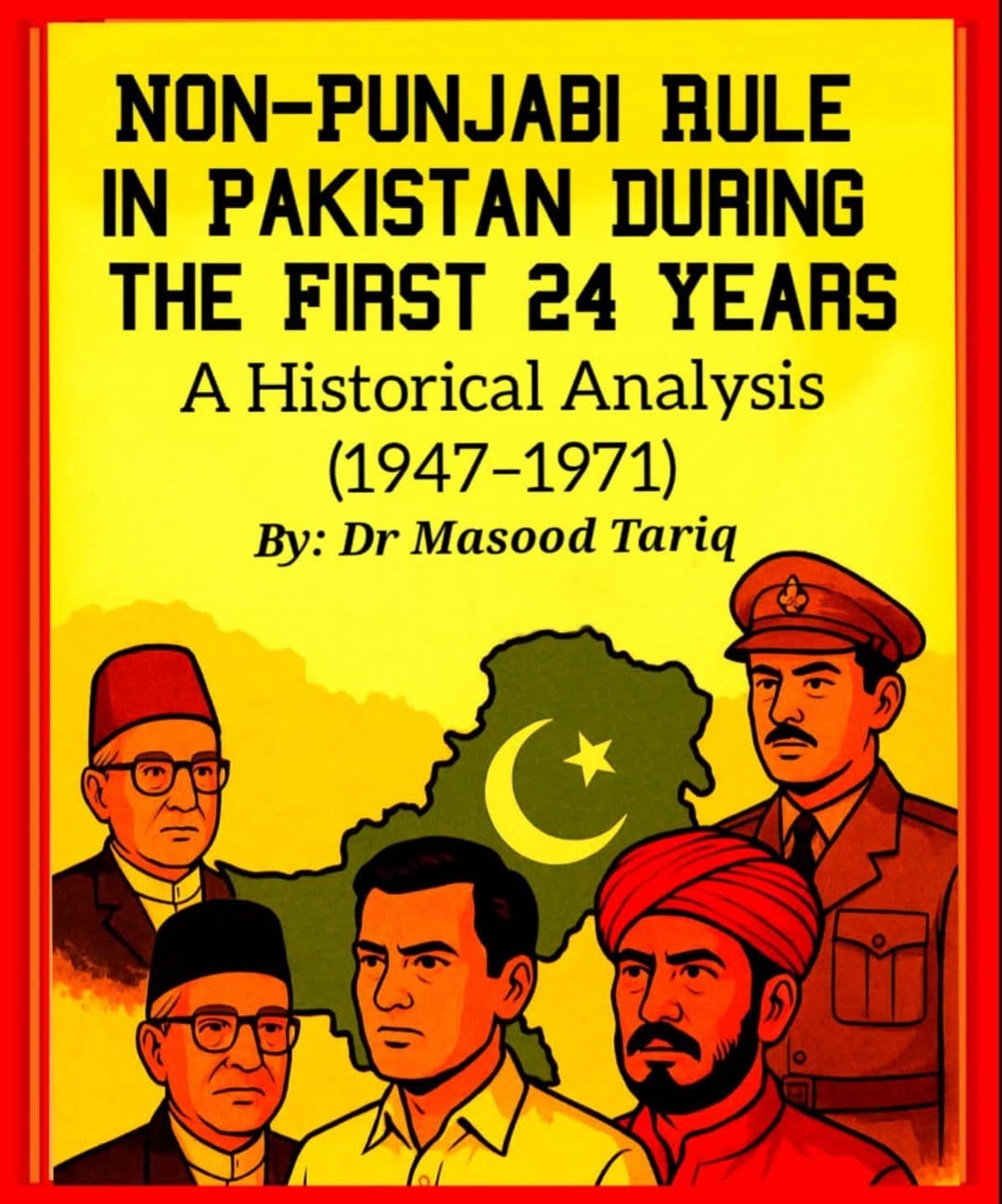
Non-Punjabi Rule in Pakistan During the First 24 Years: A Historical Analysis (1947–1971)
Dr. Masood Tariq
Independent Political Theorist
Karachi, Pakistan
drmasoodtariq@gmail.com
Date: August 10, 2025
——————————————–
Abstract
This study presents a political-historical analysis of the ethnic and regional composition of Pakistan’s political and military leadership from its inception on August 15, 1947, to the secession of East Pakistan and the creation of Bangladesh on December 16, 1971. Drawing on archival records, declassified government documents, and contemporary press sources, it demonstrates that over these 24 years, 4 months, and 6 days, leadership at the highest levels remained predominantly under non-Punjabi elites—a contrast to later narratives of Punjabi “Establishment” dominance. The absence of Punjabi representation during this formative phase shaped the trajectory of Pakistan’s civil-military relations, ethno-political conflicts, and eventual disintegration in 1971.
——————————————–
Keywords:
Pakistan political history, ethnic leadership, Punjabi marginalization, civil-military relations, 1947–1971, Bangladesh secession
——————————————–
Table of Contents
(1). Introduction
(2). Absence of Punjabi Political Leadership at the National Level
(3). Chronology of Pakistan’s Rulers (1947–1971)
(4). Ethnic Composition of Rule (1947–1971)
(5). Military Leadership and the Exclusion of Punjabis
(6). Conclusion
——————————————–
(1). Introduction
The formative decades of Pakistan (1947–1971) were marked by an absence of sustained Punjabi representation in the country’s highest political and military offices. This absence is striking given Punjab’s demographic dominance, geographic centrality, and economic significance. Existing scholarship often frames the post-1971 period as one of Punjabi “Establishment” dominance (Jalal, 1995; Shah, 2014), yet this overlooks the preceding quarter-century in which Punjabis were politically and militarily marginalized.
This paper reconstructs the chronology of political and military leadership in Pakistan during its first 24 years, examining the ethnic composition of officeholders and the broader implications for the state’s cohesion.
——————————————–
(2). Absence of Punjabi Political Leadership at the National Level
Between 1947 and 1971, national political leadership was dominated by non-Punjabi figures from the Muhajir, Bengali, Sindhi, Pashtun, and Baloch ethnic groups. Notably, no Punjabi leader held a sustained or influential national political office during this period.
Notable Political Leaders by Ethnic Group (1947–1971)
1. Muhajir: Liaquat Ali Khan, Abul A’la Maududi, Shah Ahmad Noorani
2. Bengali: Sheikh Mujibur Rahman, Abdul Hamid Khan Bhashani
3. Sindhi: Zulfikar Ali Bhutto, Pir Pagara, G. M. Syed
4. Pashtun: Khan Abdul Ghaffar Khan, Khan Abdul Wali Khan, Abdul Samad Khan Achakzai
5. Baloch: Khair Bakhsh Marri, Akbar Bugti, Ghaus Bakhsh Bizenjo, Ataullah Mengal
This underrepresentation of Punjabis at the political apex directly contradicted their demographic preeminence and foreshadowed future federal tensions (Sayeed, 1968).
——————————————–
(3). Chronology of Pakistan’s Rulers (1947–1971)
Chronology and Ethnic Background of Rulers
1. Liaquat Ali Khan (Muhajir) – August 15, 1947 – October 16, 1951
2. Khawaja Nazimuddin (Muhajir) – October 19, 1951 – April 16, 1953
3. Mohammad Ali Bogra (Bengali) – April 17, 1953 – August 10, 1955
4. Chaudhry Mohammad Ali (Punjabi) – August 11, 1955 – September 12, 1956
5. Huseyn Shaheed Suhrawardy (Bengali) – September 12, 1956 – October 18, 1957
6. I. I. Chundrigar (Muhajir) – October 18 – December 16, 1957
7. Malik Feroz Khan Noon (Punjabi) – December 16, 1957 – October 7, 1958
[Military rule began post-1958; COAS held major authority]
8 General Iskander Mirza (Muhajir) – October 7, 1958 – October 28, 1958
9. General Ayub Khan (Pathan) – October 28, 1958 – March 25, 1969
10 General Yahya Khan (Pathan) – March 25, 1969 – 20 Dec 1971
——————————————–
(4). Ethnic Composition of Rule (1947–1971)
Days in Power by Ethnic Group
Ethnic Group Days in Power and Percentage of Total Period
1. Pashtun: 4,805 days (~54.02%)
2. Muhajir: 2,154 days (~24.29%)
3. Bengali: 1,244 days (~13.99%)
4. Punjabi: 693 days (~7.79%)
These figures demonstrate that despite Punjab’s population size and strategic importance, Punjabi leaders accounted for less than 8% of the total governance period.
——————————————–
(5). Military Leadership and the Exclusion of Punjabis
Chiefs of Army Staff (1947–1971)
Name Ethnicity Tenure
1. General Sir Frank Messervy (British) – August 15, 1947 – February 10, 1948
2. General Sir Douglas Gracey (British) – February 11, 1948 – January 16, 1951
3. General Ayub Khan (Pathan) – January 17, 1951 – October 27, 1958
4. General Musa Khan (Hazara) – October 27, 1958 – September 17, 1966
5. General Yahya Khan (Pathan) – September 18, 1966 – December 20, 1971
Not a single Punjabi served as Pakistan’s Army Chief during this period, reinforcing the notion of their initial exclusion from both political and military power.
——————————————–
(6). Conclusion
The early exclusion of Punjabis from both political and military leadership challenges the prevailing perception of Punjabi dominance in Pakistan’s state apparatus.
This marginalization not only shaped the federal power balance but also influenced the trajectory of Pakistan’s political crises, including the eventual secession of East Pakistan.
The analysis suggests that
early civil-military dynamics and contributed to inter-ethnic tensions that culminated in the state’s disintegration. Punjabi nationalism thus emerged in a reactive mode—rather than proactive, posture due to its late integration into the national power structure.
——————————————–
References
Britannica. (n.d.). Liaquat Ali Khan. Retrieved from Britannica online
Britannica. (n.d.). List of prime ministers of Pakistan. Retrieved from Britannica online
Wikipedia. (n.d.). Liaquat Ali Khan. Retrieved from Wikipedia
Wikipedia. (n.d.). Assassination of Liaquat Ali Khan. Retrieved from Wikipedia
Wikipedia. (n.d.). Sayyid Akbar Babrak. Retrieved from Wikipedia
Reddit user. (2024, December 20). Interesting and very ironic: Pakistan never had a Punjabi Commander-in-Chief… Reddit
Sayeed, K. B. (1968). Pakistan: The formative phase 1857–1948. Oxford University Press.
Jalal, A. (1995). Democracy and authoritarianism in South Asia: A comparative and historical perspective. Cambridge University Press.
Shah, A. (2014). The army and democracy: Military politics in Pakistan. Harvard University Press.
——————————————–
Author Biography
Dr. Masood Tariq is a Karachi-based politician and political theorist. He formerly served as Senior Vice President of the Pakistan Muslim Students Federation (PMSF) Sindh, Councillor of the Municipal Corporation Hyderabad, Advisor to the Chief Minister of Sindh, and Member of the Sindh Cabinet.
His research explores South Asian geopolitics, postcolonial state formation, regional nationalism, and inter-ethnic politics, with a focus on the Punjabi question and Cold War strategic alignments.
He also writes on Pakistan’s socio-political and economic structures, analysing their structural causes and proposing policy-oriented solutions aligned with historical research and contemporary strategy.
His work aims to bridge historical scholarship and strategic analysis to inform policymaking across South Asia, Central Asia, and the Middle East.
Leave a Reply