
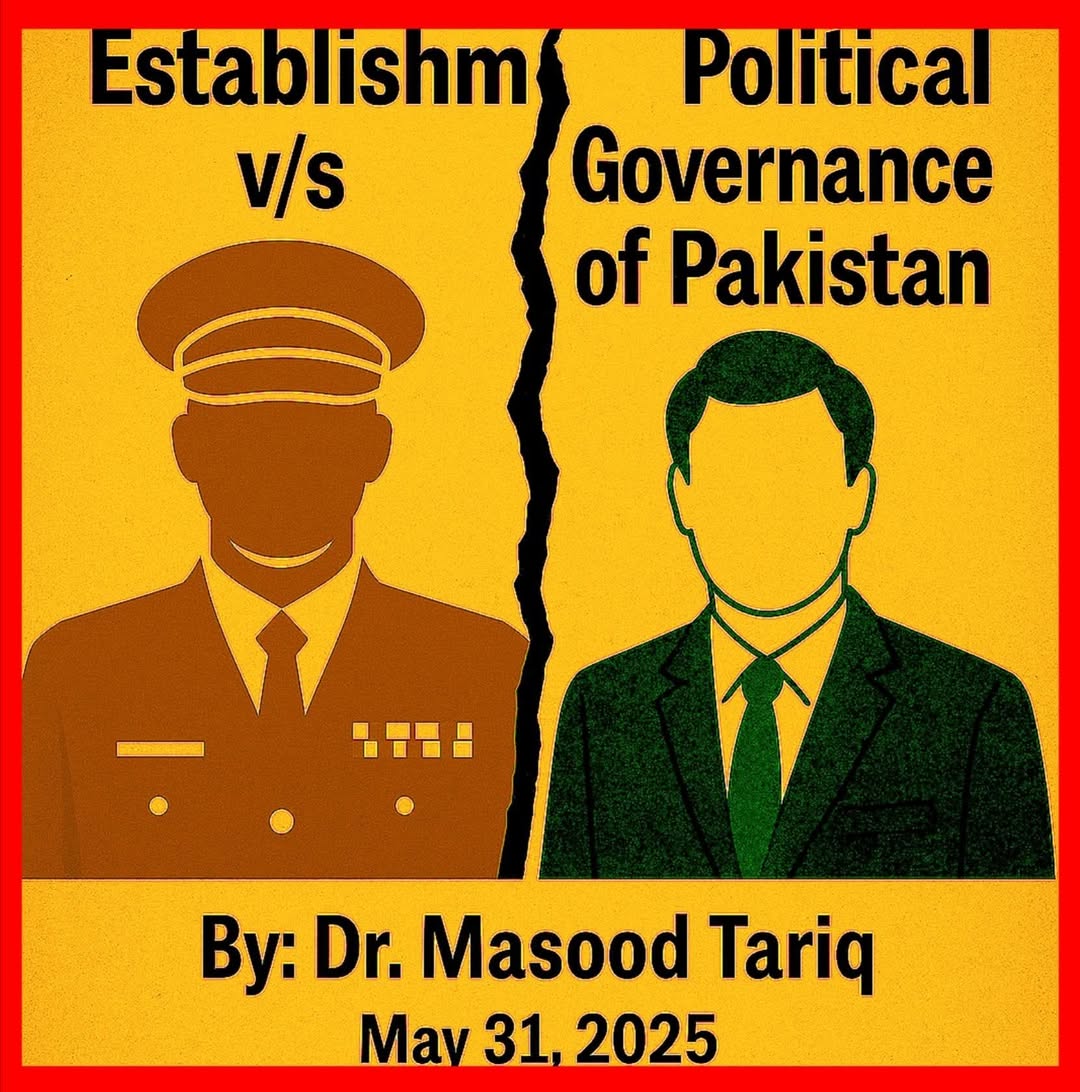
Establishment v/s Political Governance of Pakistan
Dr. Masood Tariq
Independent Political Theorist Karachi, Pakistan drmasoodtariq@gmail.com Date: May 31, 2025
Personality-based politics, driven by personal agendas and self-loyal individuals rather than party manifestos, results in non-systematized and unorganised party structures, unskilled and inexperienced leadership, and workers lacking political aptitude.
In contrast, the establishment is well-skilled, organized, experienced, and systematized in bureaucratic and administrative duties at the national, provincial, and local levels.
Therefore, politics without manifestos, fragile party structures, and pseudo-political coworkers compel political leaders either to subordinate themselves to or confront the establishment—rather than fostering a reciprocal, honourable, reliable, and productive institutional working relationship to carry out their duties as per the Constitution, laws, and rules of business.
In fact, political parties are supposed to:
1. Function like bureaucrats by preparing proper plans and programs through well-skilled individuals in relevant fields.
2. Act as an administrator by managing party affairs and addressing public grievances through experienced professionals.
3. Serve as social workers by interacting with party supporters and the general public through respected figures from local communities.
For this reason, political parties must be appropriately organized and systematized by establishing cadres at the union council, tehsil, district, provincial, and national levels:
a). The cadre of leaders or initiators
Must comprise individuals who possess the intellectual wisdom to prepare appropriate plans and programs.
b). The cadre of workers or motivators
Must comprise individuals with the organizational skills to structure and systematize the party.
c). The cadre of supporters or actors
Must comprise socially respected individuals who can effectively engage with the public.
However, in Pakistan, political parties have rarely, if ever, been organized and systematized by party owners following political ethics, manners, and party manifestos.
As a result, most political parties operate like private limited companies, complete with sole agents, distributors, and salesmen.
Consequently, many politicians maintain personal staff and paid workers. They treat party workers like customers and the general public like subordinates.
CONSEQUENCE:
The public becomes disappointed, dissatisfied, and disillusioned with both politicians and political parties.
This disillusionment allows opportunists, hypocrites, and individuals hungry for power and wealth to dominate governance and politics.
The outcome is social polarization, administrative inefficiency, financial disability, and economic destruction.
CONCLUSION:
The development of competent leadership at local, provincial, and national levels is impossible without well-organized and systematized political parties aligned with their manifestos and rooted in political ethics.
Otherwise, poorly groomed politicians and disorganized parties will continue to either subordinate themselves to or confront the establishment—rather than engaging in a reciprocal, honourable, and effective institutional relationship grounded in the Constitution, laws, and rules of business.
DRAWBACK:
The establishment, though highly skilled and experienced in bureaucratic and administrative duties, lacks political wisdom and aptitude—both essential in a democratic political environment.
Therefore, direct governance or proxy politics—in the form of sponsorship, facilitation, or the cultivation of pseudo-political leaders, workers, and supporters—creates an aggressive, arrogant, and authoritarian perception of the establishment among individuals, the public, and democratic institutions.
It creates the impression of dictatorial rule by the establishment, suppressing individual, public, and political freedoms.
It enables opportunists, hypocrites, and those driven by power or greed to dominate governance and politics.
It fuels ethnic, regional, and religious divisions, leading to disputes, distrust, conflicts, and confrontations.
It perpetuates personality-based politics based on personal agendas and self-loyal individuals, instead of party-based political frameworks—resulting in unorganized structures, unskilled leadership, and politically inept workers.
It destabilizes the governance system. It results in social polarization, administrative inefficiency, financial disability, and economic destruction.
SUGGESTIONS:
A systematized and organized party structure with skilled, experienced leadership and politically inclined workers is essential for political strength, stability, and a productive institutional working relationship grounded in the Constitution, laws, and rules of business.
Therefore, political parties should launch a “Political Brain Hunt Program” to identify and engage politically competent leaders and workers from:
Each district by the central-level leadership
Each tehsil by the provincial-level leadership
Each union council by the district-level leadership
This should be accompanied by a structured plan to groom political ethics and skills through regular meetings, seminars, and workshops.
NOTE:
For the establishment, skill is sufficient. But for those who hold political power, wisdom is the primary prerequisite.
QUOTE:
Mankind will never see an end of trouble until and unless lovers of wisdom come to hold political power or holders of power become lovers of wisdom. — Plato
Author Biography
Dr. Masood Tariq is a Karachi-based politician and political theorist. He formerly served as Senior Vice President of the Pakistan Muslim Students Federation (PMSF) Sindh, Councillor of the Municipal Corporation Hyderabad, Advisor to the Chief Minister of Sindh, and Member of the Sindh Cabinet.
His research explores South Asian geopolitics, postcolonial state formation, regional nationalism, and inter-ethnic politics, with a focus on the Punjabi question and Cold War strategic alignments.
He also writes on Pakistan’s socio-political and economic structures, analysing their structural causes and proposing policy-oriented solutions aligned with historical research and contemporary strategy.
His work aims to bridge historical scholarship and strategic analysis to inform policymaking across South Asia, Central Asia, and the Middle East.
Leave a Reply