
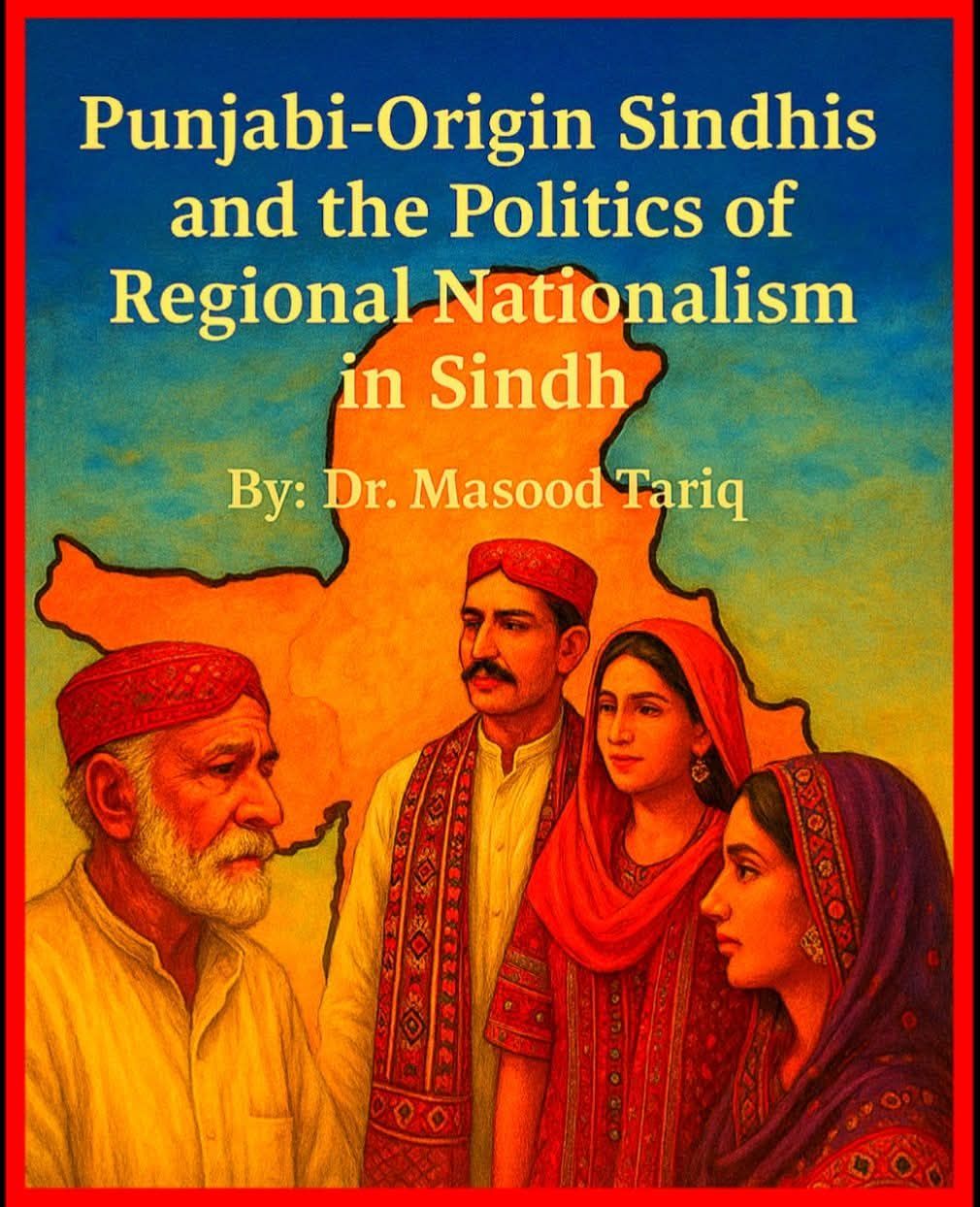
Punjabi-Origin Sindhis and the Politics of Regional Nationalism in Sindh
Dr. Masood Tariq
Independent Political Theorist
Karachi, Pakistan
drmasoodtariq@gmail.com
Date: August 6, 2025
——————————————–
Abstract
This paper explores the evolving political and regional identity of Punjabis residing in Sindh within the broader framework of regional nationalism.
It argues that Punjabis who have permanently settled in Sindh should be recognized—like Arab- and Baloch-origin Sindhis—as Punjabi-origin Sindhis rather than as outsiders.
Historically marginalized both by Punjab’s centralizing policies and by the dominance of Urdu-speaking migrants in urban Sindh, Punjabi-origin Sindhis have increasingly aligned their political and cultural interests with indigenous Sindhi communities.
The paper critically examines how Punjab’s ethno-political policies have contributed to this realignment and calls for a redefinition of identity based on permanent settlement, local integration, and regional solidarity.
——————————————–
Table of Contents
1. Introduction
2. Punjab’s Political Approach Towards Sindh
3. Punjabis in Sindh: From Migrants to Regional Stakeholders
4. The Rise and Impact of MQM Politics
5. Reconceptualizing Identity Through Regional Nationalism
6. Conclusion
7. References
——————————————–
1. Introduction
Since the partition of British India in 1947, Pakistan has grappled with the challenges of ethnic diversity and regional integration. Punjab, as the most populous and politically influential province, has historically projected a narrative of national unity that has often masked internal ethnic disparities and regional exclusions (Talbot, 1998).
Within Punjab itself, Pashtuns, Baloch, and Urdu-speaking migrants were gradually integrated into a broader “Punjabi” identity to preserve administrative cohesion. Yet, this inclusive strategy was not extended to Punjabis settled in Sindh, resulting in their social, cultural, and political marginalization.
——————————————–
2. Punjab’s Political Approach Towards Sindh
2.1 Social and Cultural Disruption
In the early post-independence period, Punjab’s political elite aligned itself with the Urdu-speaking migrant population. This alignment contributed to the sidelining of regional languages such as Sindhi (Rahman, 1996). Instead of supporting the Sindhi language to promote interethnic harmony, Urdu was upheld as the national language—leading to growing tensions with Sindhi nationalists (Akhund, 1992). This policy disrupted longstanding co-existence between Punjabis and Sindhis, particularly in rural areas of Sindh where Punjabi communities had settled long before Partition.
2.2 Administrative and Economic Marginalization
Punjab’s dominance in the federal bureaucracy—particularly in the post-Partition years—resulted in policies that often bypassed or undermined Sindh’s administrative and financial autonomy (Alavi, 1972). In urban Sindh, especially in Karachi, state investment and political patronage disproportionately favored Urdu-speaking migrants, sidelining both Sindhis and Punjabi-origin residents (Ahmed, 1998). This left Punjabi settlers in Sindh without strong institutional backing—excluded both from the indigenous Sindhi political framework and the federally supported Urdu-speaking structure.
——————————————–
3. Punjabis in Sindh: From Migrants to Regional Stakeholders
From the 1980s onward, Punjabis in Sindh began to gradually assimilate into the region’s linguistic and cultural milieu. They adopted the Sindhi language, participated in local traditions, and aligned themselves with Sindh’s developmental and political causes (Ansari, 2015). Much like Arab- and Baloch-origin Sindhis, Punjabi-origin Sindhis began to define themselves through shared regional experiences rather than ancestral ethnicity.
Punjabi-origin Sindhis now advocate:
3.1 Social Harmony – Strengthening peaceful coexistence among ethnic communities in Sindh.
3.2 Administrative Empowerment – Supporting devolution and greater provincial autonomy.
3.3 Equitable Resource Allocation – Calling for fair distribution of resources within the province.
3.4 Regional Development – Demanding inclusive infrastructure and social investment across Sindh.
This emerging identity contests the outdated perception that Punjabi settlers in Sindh inherently represent the political interests of Punjab.
——————————————–
4. The Rise and Impact of MQM Politics
The rise of the Mohajir Qaumi Movement (MQM) in the late 1980s fundamentally transformed the political landscape of urban Sindh. As a party representing primarily Urdu-speaking migrants, MQM consolidated political control in Karachi and Hyderabad while marginalizing other ethnic groups, including Punjabis and Pashtuns (Verkaaik, 2004).
Punjabis in Sindh—particularly those lacking strong institutional ties to Lahore—became vulnerable to discrimination in employment, housing, and public services (Gayer, 2007). While Urdu-speaking migrants gained political power through ethnic mobilization and federal patronage, Punjabi settlers found themselves politically orphaned. This dual exclusion catalyzed a growing sense of political consciousness among Punjabi-origin Sindhis.
——————————————–
5. Reconceptualizing Identity Through Regional Nationalism
Regional nationalism in Sindh has historically embraced a pluralist understanding of identity, incorporating Arab and Baloch-, origin communities as part of the broader Sindhi nation. Punjabi settlers, many of whom have lived in Sindh for generations, raised families, and contributed economically, are increasingly asserting their place within this regional framework (Shaikh, 2009).
This evolving identity is grounded not solely in ethnicity, but in a shared sense of territorial belonging and collective interest. Accordingly:
5.1 They oppose Punjab’s extractive influence over Sindh’s institutions and resources.
5.2 They advocate for the preservation and promotion of the Sindhi language and cultural heritage.
5.3 They support provincial autonomy in preference to centralized, Lahore-centric governance.
——————————————–
6. Conclusion
Punjabis who have lived in Sindh for decades—many even before Partition—are not mere transplants from Punjab. They are Punjabi-origin Sindhis, whose identity and political orientation are now deeply rooted in Sindh’s socio-political landscape. Systematic exclusion—initially through Punjab’s centralized governance and subsequently via MQM-led urban politics—has propelled this community toward regional alignment.
By embracing a Sindh-centric identity, Punjabi-origin Sindhis contribute to a more inclusive vision of regional nationalism—one that fosters cooperation across ethnic lines and strengthens democratic federalism. Recognizing and institutionalizing this political reality is essential for long-term ethnic harmony and sustainable governance in Pakistan.
——————————————–
7. References
Ahmed, Feroz. Ethnicity and Politics in Pakistan. Oxford University Press, 1998.
Alavi, Hamza. “Pakistan and Islam: Ethnicity and Ideology.” In State and Ideology in the Middle East and Pakistan, edited by Fred Halliday and Hamza Alavi, Monthly Review Press, 1988.
Ansari, Sarah. Life after Partition: Migration, Community and Strife in Sindh, 1947-1962. Oxford University Press, 2005.
Gayer, Laurent. Karachi: Ordered Disorder and the Struggle for the City. Oxford University Press, 2014.
Shaikh, Farzana. Making Sense of Pakistan. Columbia University Press, 2009.
Talbot, Ian. Pakistan: A New History. Hurst & Co, 2012.
Verkaaik, Oskar. Migrants and Militants: Fun and Urban Violence in Pakistan. Princeton University Press, 2004.
Zaidi, S. Akbar. Issues in Pakistan’s Economy: A Political Economy Perspective. Oxford University Press, 2015.
Kennedy, Charles H. “The Politics of Ethnicity in Sindh.” Asian Survey, vol. 31, no. 10, 1991, pp. 938–955.
Wilder, Andrew. The Pakistani Voter: Electoral Politics and Voting Behaviour in the Punjab. Oxford University Press, 1999.
——————————————–
Author Biography
Dr. Masood Tariq is a Karachi-based politician and political theorist. He formerly served as Senior Vice President of the Pakistan Muslim Students Federation (PMSF) Sindh, Councillor of the Municipal Corporation Hyderabad, Advisor to the Chief Minister of Sindh, and Member of the Sindh Cabinet.
His research explores South Asian geopolitics, postcolonial state formation, regional nationalism, and inter-ethnic politics, with a focus on the Punjabi question and Cold War strategic alignments.
He also writes on Pakistan’s socio-political and economic structures, analysing their structural causes and proposing policy-oriented solutions aligned with historical research and contemporary strategy.
His work aims to bridge historical scholarship and strategic analysis to inform policymaking across South Asia, Central Asia, and the Middle East.
Leave a Reply