
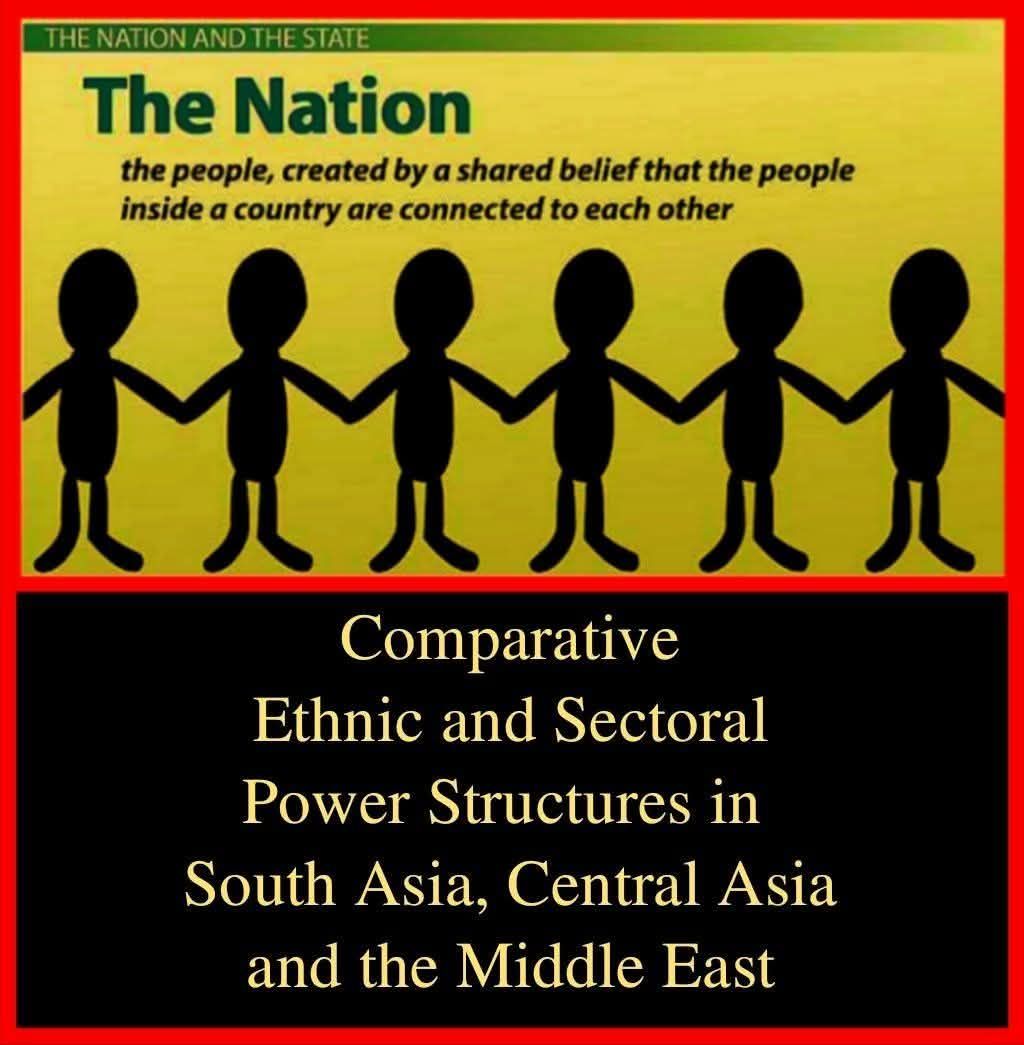
Comparative Ethnic and Sectoral Power Structures in South Asia, Central Asia, and the Middle East:
Author:
Dr. Masood Tariq
Independent Political Theorist
Karachi, Pakistan drmasoodtariq@gmail.com
Date: June 27, 2025
——————————————–
Abstract
This paper investigates the real centres of power in South Asia, Central Asia, and the Middle East by shifting focus from formal nation-states to the ethnic nations that dominate within them.
It argues that many of these states—unstable, externally influenced, or institutionally weak—act as shells through which powerful ethnic nations exercise control.
By examining key states across these regions, the study analyses demographic, military, bureaucratic, economic, and media sector dominance by specific ethnic groups.
It identifies the Punjabi Nation in Pakistan and the Jewish Nation in Israel as the most powerful ethno-national actors in their respective regions.
The paper concludes that accurate geopolitical assessments must prioritize ethnic nations, not countries when analyzing regional power dynamics in South Asia, Central Asia, and the Middle East.
——————————————–
Table of Contents
(1). Introduction
(2). Total Countries in South Asia, Central Asia, and Middle East
(3). Classification of Military Capacity
(4). Nations vs. States: The Ethnic Basis of Power
(5). Comparative Analysis of Ethnic Nations
(6). Comparative Country Profiles (Ethnic-Linguistic & Sectoral Analysis)
(7). Conclusion
( . References
——————————————–
(1). Introduction
Geopolitical analysis in South Asia, Central Asia, and the Middle East is often framed through the prism of state-based assessments. However, this approach obscures the realities of how power is exercised and by whom.
In most cases, the true custodians of institutional, military, and economic power are not the states themselves but the dominant ethnic nations operating within them (Anderson, 1983; Smith, 1991).
These ethnic nations define state policy, command military structures, monopolize economic assets, and shape ideological narratives.
This paper seeks to identify and compare the actual power structures in selected states across the three regions—South Asia, Central Asia, and the Middle East—through an ethnic-national lens.
It emphasizes that any serious understanding of regional security, governance, or foreign policy must focus on the internal ethnic architecture of power rather than mere territorial sovereignty (Brubaker, 1996).
——————————————–
(2). Total Countries in South Asia, Central Asia, and Middle East
1. South Asia (8): Afghanistan, Bangladesh, Bhutan, India, Maldives, Nepal, Pakistan, Sri Lanka
2. Central Asia (5): Kazakhstan, Uzbekistan, Turkmenistan, Kyrgyzstan, Tajikistan
3. Middle East (~18): Turkey, Iran, Iraq, Syria, Lebanon, Israel, Palestine, Jordan, Saudi Arabia, UAE, Bahrain, Qatar, Oman, Kuwait, Yemen, Egypt (partially), Cyprus (disputed)
——————————————–
(3). Classification of Military Capacity
Military power is not uniformly distributed across states. Countries with weak industrial bases, fragmented societies, or limited strategic depth struggle to maintain autonomy or regional deterrence (Buzan & Wæver, 2003).
1. Countries That Lack Capacity to Fight Regional Powers:
i). South Asia: Maldives, Bhutan, Nepal, Sri Lanka
ii). Central Asia: Kyrgyzstan, Tajikistan
iii). Middle East: Bahrain, Cyprus, Jordan, Kuwait, Lebanon, Oman, Palestine, Qatar, Yemen
2. Countries That Cannot Fight Global Powers But Can Challenge Regional Powers:
i). South Asia: Bangladesh, Afghanistan
ii). Central Asia: Kazakhstan, Turkmenistan, Uzbekistan
iii). Middle East: Saudi Arabia, UAE, Iraq, Syria, Egypt
3. Countries That Can Confront Global Powers:
i). South Asia: India, Pakistan (Tellis, 2001)
ii). Middle East: Iran, Israel, Turkey (Kroenig, 2010; Cordesman, 2014)
——————————————–
(4). Nations vs. States: The Ethnic Basis of Power
States in these regions do not hold power evenly across their populations. Instead, distinct ethnic nations dominate the power structures within each state (Connor, 1994).
1. South Asia:
i). Pakistan: Punjabi Nation (~60% of population) dominates the military, bureaucracy, agriculture, and media (Lieven, 2011)
ii). India: A fragmented structure where Hindi-speaking upper-caste North Indians, Punjabis, Marathis, Tamils, and Telugus dominate regionally (Chandra, 2004)
iii). Afghanistan: Pashtuns dominate political and military power despite multi-ethnic demographics; Tajiks and Hazaras have lesser influence (Barfield, 2010)
iv). Bangladesh: Bengali ethnicity is nearly homogenous; elite power is controlled by a small segment of urban, Westernized Bengalis in Dhaka (Riaz, 2016)
v). Sri Lanka: Sinhalese majority (~75%) dominates politics, military, and state media; Tamils marginalized post-civil war (Spencer, 2008)
vi). Nepal: Hill Brahmins and Chhetris dominate civil service and politics; Madhesis and Janajatis have limited power (Lawoti, 2005)
vii). Bhutan: Ngalops (ethnic Tibetan descent) hold most political power; Lhotshampas (ethnic Nepalis) have faced discrimination (Hutt, 2003)
viii). Maldives: Sunni Muslim Maldivians form a culturally and ethnically homogenous ruling majority (Maloney, 1975)
2. Central Asia:
i). Kazakhstan: Kazakhs dominate politically and culturally; Russians hold economic influence (Olcott, 2002)
ii). Uzbekistan: Uzbeks dominate; minorities marginalized (Collins, 2006)
iii). Turkmenistan: Turkmens monopolize power
iv). Kyrgyzstan: Kyrgyz dominant; ethnic Uzbeks marginalized
v). Tajikistan: Tajiks control the state; Uzbeks sidelined
3. Middle East:
i). Iran: Persians are dominant; Azeris hold elite roles; minorities like Kurds and Baloch are marginalized (Hiro, 2009)
ii). Turkey: Ethnic Turks monopolize state institutions; Kurds are politically and militarily excluded (Barkey & Fuller, 1998)
iii). Israel: The Jewish Nation (Ashkenazi and Mizrahi) controls all levers of power; Arabs are peripheral (Pappe, 2004)
iv). Iraq: Shia Arabs hold post-Saddam state power; Sunni Arabs and Kurds wield regional power in their zones (Dodge, 2013)
v). Syria: Alawite minority dominates the military and ruling elite under Assad; Sunni majority marginalized (Phillips, 2016)
vi). Lebanon: Maronites, Sunnis, and Shi’a share formal power, but Hezbollah (Shi’a) has growing dominance (Norton, 2007)
vii). Jordan: Hashemite monarchy supported by East Bank Jordanians; Palestinian-origin population underrepresented in state roles (Robins, 2004)
viii). Saudi Arabia: Najdi tribal elite (House of Saud) dominates over Shia minority and Hejazis (Al-Rasheed, 2010)
ix). UAE: Emirati Arabs are the political elite; South Asian and Arab expatriates dominate labour but lack rights (Davidson, 2005)
x). Qatar: Al-Thani family rules; Qatari nationals dominate wealth and institutions despite being a minority (Kamrava, 2013)
xi). Bahrain: Sunni monarchy governs a Shi’a majority population (Louër, 2008)
xii). Oman: Ibadi Muslim Arab tribes dominate; non-Ibadi and Baluchi communities marginalized (Valeri, 2009)
xiii). Kuwait: Kuwaiti citizens dominate politics; Bidoon (stateless people) and foreign workers excluded (Herb, 2009)
xiv). Yemen: Zaidi Shi’as (Houthis) dominate the north; Sunni tribes, Salafists, and southern secessionists compete regionally (Day, 2012)
xv). Egypt: Arab Sunni Muslims dominate; Coptic Christians and Nubians underrepresented (Abdelrahman, 2015)
xvi). Palestine: Power split between Hamas (Gaza, Islamist) and Fatah (West Bank, secular); internal factionalism limits central authority (Milton-Edwards, 2009)
xvii). Cyprus (disputed): Greek Cypriots control the internationally recognized south; Turkish Cypriots control the northern TRNC zone (Ker-Lindsay, 2005)
——————————————–
(5). Comparative Analysis of Ethnic Nations
This comparative analysis demonstrates that ethnic nations, rather than state institutions, define the operational dynamics of power across these regions. Ethno-national elites not only control coercive instruments but also shape ideological discourse, economic policymaking, and international posturing.
Most Powerful Ethnic Nations in the Region
1. South Asia: The Punjabi Nation in Pakistan is the most powerful due to its control over:
Nuclear-armed military (Siddiqa, 2007)
Agriculture and industrial sectors
Bureaucratic and ideological institutions
2. Central Asia: The Kazakh Nation has the greatest strategic autonomy due to:
Natural resource wealth (oil, gas, uranium)
Political control and multi-vector diplomacy (Stronski, 2020)
3. Middle East: The Jewish Nation in Israel is unmatched because of:
Technological supremacy
Nuclear deterrence (Cohen, 1998)
Western geopolitical alignment
——————————————–
(6). Comparative Country Profiles (Ethnic-Linguistic & Sectoral Analysis)
1. Pakistan
Dominance: Punjabi (~130 million) controls all state sectors
2. India
Fragmented but led institutionally by upper-caste North Indians; regional ethnic elites exert power locally
3. Turkey
Ethnic Turks dominate the state; Kurds excluded
4. Iran
Persians dominate; ethnic minorities marginalized
5. Israel
Jewish Israelis dominate; Arab minorities sidelined
——————————————–
(7). Conclusion
The conventional state-centric approach to assessing regional power in South Asia, Central Asia, and the Middle East is deeply flawed. It overlooks the crucial fact that ethnic nations—not countries—are the true drivers of military might, institutional authority, economic productivity, and geopolitical posture.
The most powerful ethnic nations in South Asia, Central Asia, and the Middle East region—the Punjabi Nation of Pakistan, the Jewish Nation of Israel, and the Kazakh Nation of Central Asia—command disproportionate influence over their respective states and beyond.
A realistic assessment of power in South Asia, Central Asia, and the Middle East regions must, therefore, account for ethnic-national structures. Any meaningful foreign policy, defence analysis, or peace-building strategy must recognize these nations as the fundamental units of power.
The state may be the actor on paper—but it is the ethnic nation that moves the pen. Understanding nations—not merely the states they inhabit—is essential to crafting realistic security frameworks, foreign policies, and peace strategies in South Asia, Central Asia, and the Middle East.
——————————————–
(. References
Abdelrahman, M. (2015). Egypt’s Long Revolution: Protest Movements and Uprisings. Routledge.
Anderson, B. (1983). Imagined Communities: Reflections on the Origin and Spread of Nationalism. Verso.
Barfield, T. (2010). Afghanistan: A Cultural and Political History. Princeton University Press.
Barkey, H. J., & Fuller, G. E. (1998). Turkey’s Kurdish Question. Rowman & Littlefield.
Brubaker, R. (1996). Nationalism Reframed: Nationhood and the National Question in the New Europe. Cambridge University Press.
Buzan, B., & Wæver, O. (2003). Regions and Powers: The Structure of International Security. Cambridge University Press.
Chandra, K. (2004). Why Ethnic Parties Succeed: Patronage and Ethnic Head Counts in India. Cambridge University Press.
Cohen, A. (1998). Israel and the Bomb. Columbia University Press.
Collins, K. (2006). Clan Politics and Regime Transition in Central Asia. Cambridge University Press.
Connor, W. (1994). Ethnonationalism: The Quest for Understanding. Princeton University Press.
Cordesman, A. H. (2014). Iran’s Military Forces and Warfighting Capabilities: The Threat in the Northern Gulf. Center for Strategic and International Studies.
Davidson, C. M. (2005). The United Arab Emirates: A Study in Survival. Lynne Rienner Publishers.
Day, S. W. (2012). Regionalism and Rebellion in Yemen: A Troubled National Union. Cambridge University Press.
Dodge, T. (2013). Iraq: From War to a New Authoritarianism. Routledge.
Herb, M. (2009). The Wages of Oil: Parliaments and Economic Development in Kuwait and the UAE. Cornell University Press.
Hiro, D. (2009). Inside Central Asia: A Political and Cultural History of Uzbekistan, Turkmenistan, Kazakhstan, Kyrgyzstan, Tajikistan, Turkey, and Iran. Overlook Press.
Hutt, M. (2003). Unbecoming Citizens: Culture, Nationhood, and the Flight of Refugees from Bhutan. Oxford University Press.
Kamrava, M. (2013). Qatar: Small State, Big Politics. Cornell University Press.
Ker-Lindsay, J. (2005). EU Accession and UN Peacemaking in Cyprus. Palgrave Macmillan.
Kroenig, M. (2010). Exporting the Bomb: Technology Transfer and the Spread of Nuclear Weapons. Cornell University Press.
Lawoti, M. (2005). Towards a Democratic Nepal: Inclusive Political Institutions for a Multicultural Society. SAGE Publications.
Lieven, A. (2011). Pakistan: A Hard Country. PublicAffairs.
Louër, L. (2008). Transnational Shia Politics: Religious and Political Networks in the Gulf. Columbia University Press.
Maloney, C. (1975). People of the Maldive Islands. Orient Longman.
Milton-Edwards, B. (2009). The Palestinian Political Crisis: Hamas, Fatah and the Future of the Palestinian National Movement. Polity.
Norton, A. R. (2007). Hezbollah: A Short History. Princeton University Press.
Olcott, M. B. (2002). Kazakhstan: Unfulfilled Promise?. Carnegie Endowment for International Peace.
Pappe, I. (2004). A History of Modern Palestine: One Land, Two Peoples. Cambridge University Press.
Phillips, C. (2016). The Battle for Syria: International Rivalry in the New Middle East. Yale University Press.
Riaz, A. (2016). Bangladesh: A Political History since Independence. I.B. Tauris.
Robins, P. (2004). A History of Jordan. Cambridge University Press.
Siddiqa, A. (2007). Military Inc.: Inside Pakistan’s Military Economy. Pluto Press.
Smith, A. D. (1991). National Identity. University of Nevada Press.
Spencer, J. (2008). Sri Lanka: History and the Roots of Conflict. Routledge.
Stronski, P. (2020). Kazakhstan’s Strategic Balancing Act. Carnegie Endowment for International Peace.
Tellis, A. J. (2001). India’s Emerging Nuclear Posture: Between Recessed Deterrent and Ready Arsenal. RAND Corporation.
Valeri, M. (2009). Oman: Politics and Society in the Qaboos State. Hurst Publishers.
——————————————–
Author Biography
Dr. Masood Tariq is a Karachi-based politician and political theorist. He formerly served as Senior Vice President of the Pakistan Muslim Students Federation (PMSF) Sindh, Councillor of the Municipal Corporation Hyderabad, Advisor to the Chief Minister of Sindh, and Member of the Sindh Cabinet.
His research explores South Asian geopolitics, postcolonial state formation, regional nationalism, and inter-ethnic politics, with a focus on the Punjabi question and Cold War strategic alignments.
He also writes on Pakistan’s socio-political and economic structures, analysing their structural causes and proposing policy-oriented solutions aligned with historical research and contemporary strategy.
His work aims to bridge historical scholarship and strategic analysis to inform policymaking across South Asia, Central Asia, and the Middle East.
Leave a Reply