
Comprehensive Profile of Middle Eastern Countries
Dr. Masood Tariq
Independent Political Theorist
Karachi, Pakistan drmasoodtariq@gmail.com
Date: June 23, 2025
——————————————–
Introduction
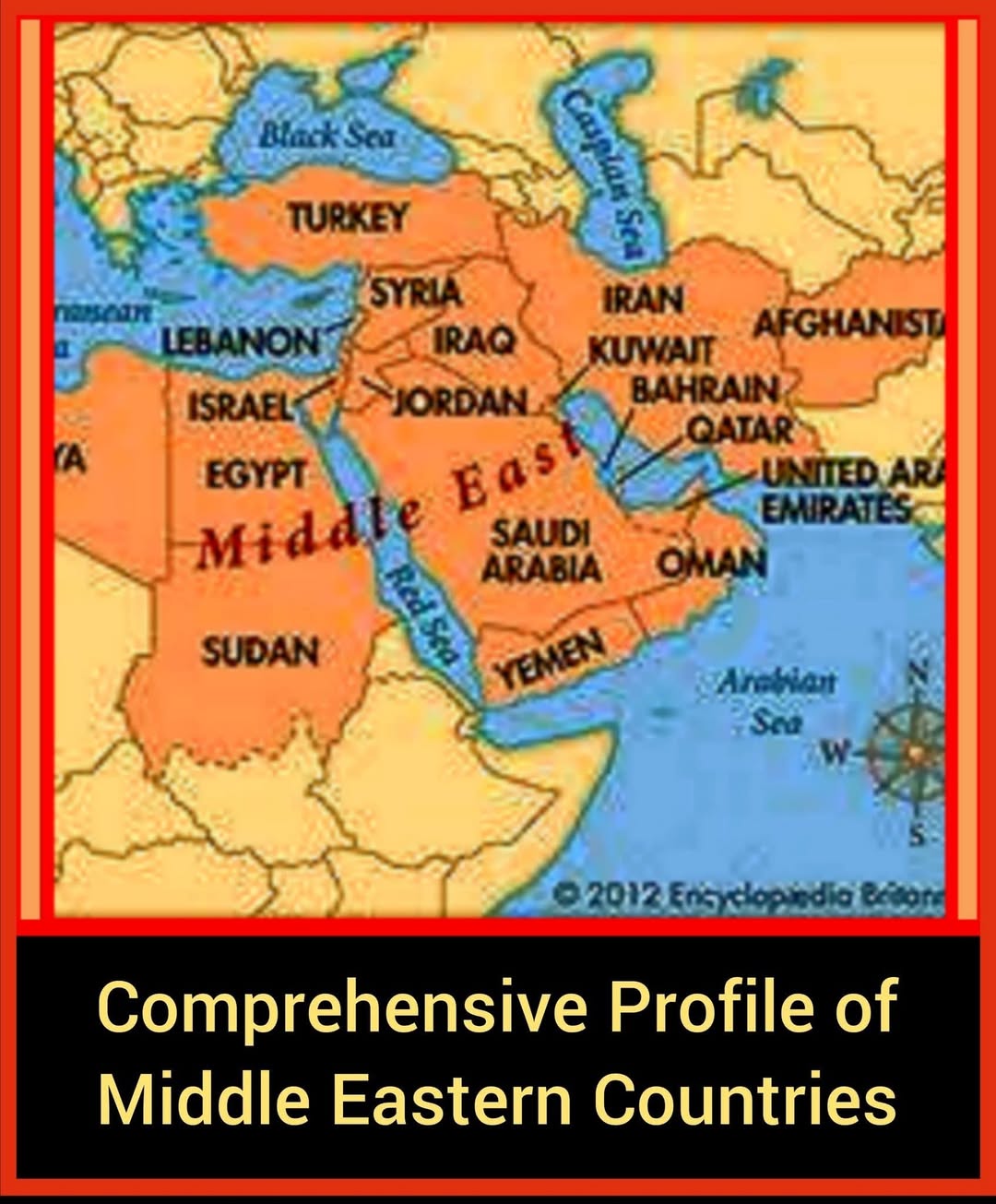
The Middle East is a strategically vital region, extending across Western Asia and parts of North Africa. Its significance stems from its historical legacy, religious centrality, vast energy resources, and geostrategic location bridging Asia, Africa, and Europe.
This document provides a detailed comparative profile of 18 widely recognised Middle Eastern countries, covering demographic, economic, and military dimensions.
——————————————–
(A) Summary Table (Rankings by Population in Middle Eastern Countries)– Total Population (2024–2025 Estimates)
1. Egypt – ~110 million — World Rank: 15th
2. Iran – ~89 million — World Rank: 17th
3. Turkey – ~87 million — World Rank: 18th
4. Sudan – ~48 million — World Rank: 33rd
5. Iraq – ~45 million — World Rank: 35th
6. Saudi Arabia – ~37 million — World Rank: 41st
7. Yemen – ~34 million — World Rank: 45th
8. Syria – ~23 million — World Rank: 57th
9. Jordan – ~11.6 million — World Rank: 83rd
10. Israel – ~9.8 million — World Rank: 92nd
11. United Arab Emirates (UAE) – ~9.6 million — World Rank: 93
12. Oman – ~5.5 million — World Rank: 121st
13. Lebanon – ~5.4 million — World Rank: 122nd
14. Kuwait – ~4.5 million — World Rank: 129th
15. Palestine – ~5.2 million — World Rank: 130th
16. Qatar – ~3.1 million — World Rank: 140th
17. Bahrain – ~1.6 million — World Rank: 152nd
18. Cyprus – ~1.25 million — World Rank: 156th
Note: Population figures include both nationals and resident expatriates (especially Gulf states). Egypt remains the first most populous Middle Eastern country, following Iran and Turkey; Cyprus, Bahrain, and Qatar are among the least populous sovereign states.
——————————————–
(B) Summary Table (Rankings by Economic Size in Middle Eastern Countries)– Total GDP, Nominal USD (2024–2025 Estimates)
1. Saudi Arabia – ~$1.13 trillion (Per Capita: ~$30,500) — World Rank: 17th
2. Turkey – ~$1.03 trillion (Per Capita: ~$11,800) — World Rank: 18th
3. Israel – ~$546 billion (Per Capita: ~$55,000) — World Rank: 25th
4. UAE – ~$543 billion (Per Capita: ~$56,500) — World Rank: 26th
5. Egypt – ~$450 billion (Per Capita: ~$4,000) — World Rank: 29th
6. Iran – ~$392 billion (Per Capita: ~$4,400) — World Rank: 38th
7. Iraq – ~$268 billion (Per Capita: ~$5,900) — World Rank: 47th
8. Qatar – ~$250 billion (Per Capita: ~$80,600) — World Rank: 48th
9. Kuwait – ~$180 billion (Per Capita: ~$38,500) — World Rank: 56th
10. Oman – ~$120 billion (Per Capita: ~$21,800) — World Rank: 68th
11. Jordan – ~$55 billion (Per Capita: ~$4,700) — World Rank: 88th
12. Bahrain – ~$47 billion (Per Capita: ~$29,000) — World Rank: 91st
13. Sudan – ~$34 billion (Per Capita: ~$700) — World Rank: 95th
14. Cyprus – ~$30 billion (Per Capita: ~$24,000) — World Rank: 98th
15. Lebanon – ~$21 billion (Per Capita: ~$3,900) — World Rank: 106th
16. Yemen – ~$19 billion (Per Capita: ~$560) — World Rank: 108th
17. Palestine – Low‑income economy; reliant on aid (Per Capita: <~$2,000 est.) — World Rank: ~110th
18. Syria – ~$14 billion (Per Capita: ~$600) — World Rank: 114th
Note: Rankings are based on nominal GDP from IMF, World Bank, and UN sources (accessed June 2025). Per capita GDP provides additional insight into individual prosperity, with Qatar, UAE, and Israel ranking highest by per capita income despite relatively smaller populations.
——————————————–
(C). Summary Table (Rankings by Per Capita GDP in Middle Eastern Countries) Nominal GDP Per Capita (USD, 2024–2025)
1. Qatar – ~$80,600 — World Rank: 6th
2. UAE – ~$56,500 — World Rank: 8th
3. Israel – ~$55,000 — World Rank: 10th
4. Kuwait – ~$38,500 — World Rank: 23rd
5. Saudi Arabia – ~$30,500 — World Rank: 27th
6. Bahrain – ~$29,000 — World Rank: 29th
7. Cyprus – ~$24,000 — World Rank: 38th
8. Oman – ~$21,800 — World Rank: 43rd
9. Turkey – ~$11,800 — World Rank: 61st
10. Iraq – ~$5,900 — World Rank: 81st
11. Jordan – ~$4,700 — World Rank: 88th
12. Iran – ~$4,400 — World Rank: 90th
13. Egypt – ~$4,000 — World Rank: 94th
14. Lebanon – ~$3,900 — World Rank: 95th
15. Palestine – <~$2,000 (est.) — World Rank: ~105th
16. Sudan – ~$700 — World Rank: 125th
17. Syria – ~$600 — World Rank: 128th
18. Yemen – ~$560 — World Rank: 130th
Note: These per capita GDP values are based on nominal terms and compiled from IMF, World Bank, and UN sources (2024–2025). Countries like Qatar, UAE, and Israel lead the region, while Yemen, Syria, and Sudan remain at the bottom due to conflict and economic fragility.
——————————————–
(D) Summary Table (Rankings by Military Power in Middle Eastern Countries)– Based on the Global Firepower Index 2024
1. Turkey – World Rank: 11th
2. Iran – World Rank: 14th
3. Egypt – World Rank: 15th
4. Israel – World Rank: 18th
5. Saudi Arabia – World Rank: 22nd
6. Iraq – World Rank: 49th
7. UAE – World Rank: 54th
8. Syria – World Rank: 63rd
9. Qatar – World Rank: 77th
10. Jordan – World Rank: 81st
11. Oman – World Rank: 85th
12. Kuwait – World Rank: 93rd
13. Cyprus – World Rank: 99th
14. Bahrain – World Rank: 106th
15. Lebanon – World Rank: 115th
16. Yemen – World Rank: 120th
17. Sudan – World Rank: 122nd
18. Palestine – Not ranked (No formal national army)
Note: Military rankings factor in manpower, equipment, budget, logistics, regional reach, and alliances. Smaller states tend to have limited militaries, while conflict‑affected nations show degraded readiness.
——————————————–
(E). Country Profiles
1. Bahrain
Area: ~760 km²
Year of Independence: 1971 (from British protectorate)
Population (2024 est.): ~1.52 million
Religious Demography: Shia ~65%, Sunni ~35%
Language Demography: Arabic (official; Bahraini dialect & MSA), English widely used
Economy: Oil refining, finance, banking, aluminium
Global Economic Position: GDP ~$44B; per capita ~$26,000
Military Power: ~14th in region; 122nd globally (GFP Index)
2. Cyprus
Area: ~9,251 km²
Year of Independence: 1960 (from Britain)
Population (2024 est.): ~1.25 million
Religious Demography: Greek Orthodox ~90%, Muslim (Turkish Cypriots) ~5%, others ~5%
Language Demography: Greek (official) ~80%, Turkish (official) ~18%, English widely spoken
Economy: Tourism, shipping, finance, energy
Global Economic Position: GDP ~$30B; per capita ~$24,000
Military Power: Minimal; internal security-oriented
3. Egypt
Area: ~1,001,450 km²
Year of Independence: 1922 (from Britain)
Population (2025 est.): ~113 million
Religious Demography: ~90% Muslim, ~10% Coptic Christian
Language Demography: Arabic (Egyptian dialect & MSA), English widely used
Economy: Agriculture, tourism, Suez Canal, energy, manufacturing
Global Economic Position: GDP ~$450B; per capita ~$4,000
Military Power: 3rd in Middle East; 15th globally
4. Iran
Area: ~1,648,195 km²
Year of Establishment: 1979 (Islamic Republic)
Population (2024 est.): ~85.96 million
Religious Demography: ~90–95% Shia, remainder Sunni & others
Language Demography: Persian (Farsi), Azeri, Kurdish, Luri, Balochi, Arabic
Economy: Oil, gas, manufacturing, agriculture
Global Economic Position: GDP ~$341B; per capita ~$3,900
Military Power: 2nd in Middle East; 14th globally
5. Iraq
Area: ~438,317 km²
Year of Independence: 1932
Population (2024 est.): ~40 million
Religious Demography: ~60–65% Shia, ~30–35% Sunni, minorities (Yazidis, Christians)
Language Demography: Arabic, Kurdish
Economy: Oil-dependent; rebuilding
Global Economic Position: GDP ~$250B; per capita ~$6,000
Military Power: 6th in region
6. Israel
Area: ~22,000 km²
Year of Independence: 1948
Population (2023 est.): ~10.2 million
Religious Demography: ~74% Jewish, ~18% Muslim, ~2% Christian, ~6% Druze & others
Language Demography: Hebrew, Arabic, English
Economy: High-tech, defence, pharma, tourism
Global Economic Position: GDP ~$500B; per capita ~$50,000
Military Power: 4th in region; ~15th globally
7. Jordan
Area: ~89,342 km²
Year of Independence: 1946
Population (2024 est.): ~10.2 million
Religious Demography: ~92% Sunni Muslim, ~6% Christian
Language Demography: Arabic, English
Economy: Services, tourism, phosphates
Global Economic Position: GDP ~$48B; per capita ~$4,700
Military Power: ~12th in region
8. Kuwait
Area: ~17,818 km²
Year of Independence: 1961
Population (2024 est.): ~4.26 million
Religious Demography: Sunni ~60%, Shia ~40%
Language Demography: Arabic, English
Economy: Oil, finance
Global Economic Position: GDP ~$120B; per capita ~$30,000
Military Power: ~10th in region
9. Lebanon
Area: ~10,452 km²
Year of Independence: 1943
Population (2024 est.): ~6.83 million
Religious Demography: Muslims ~60%, Christians ~35%, Druze ~5%
Language Demography: Arabic, French, English
Economy: Banking, tourism, services
Global Economic Position: GDP ~$60B; per capita ~$10,000
Military Power: ~15th in region
10. Oman
Area: ~309,500 km²
Year of Modernization: 1970
Population (2025 est.): ~5.49 million
Religious Demography: Ibadi ~75%, Sunni & Shia
Language Demography: Arabic, English
Economy: Oil, fisheries, tourism
Global Economic Position: GDP ~$104B; per capita ~$18,000
Military Power: ~11th in region
11. Palestine
Area: ~6,020 km²
Declaration of Statehood: 1988 (limited recognition)
Population (2024 est.): ~5.2 million
Religious Demography: ~93% Muslim, ~6% Christian
Language Demography: Arabic, Hebrew, English
Economy: Agriculture, remittances, foreign aid
Global Economic Position: Low-income; limited trade
Military Power: Paramilitary & security forces only
12. Qatar
Area: ~11,586 km²
Year of Independence: 1971
Population (2024 est.): ~2.9 million (90% expatriates)
Religious Demography: ~67% Muslim, ~13% Christian, ~14% Hindu/Buddhist/other
Language Demography: Arabic, English, Hindi, Urdu, Malayalam
Economy: Gas, oil, finance
Global Economic Position: GDP ~$220B; per capita ~$80,000
Military Power: 9th in region
13. Saudi Arabia
Area: ~2,149,690 km²
Year of Unification: 1932
Population (2025 est.): ~37 million
Religious Demography: Sunni ~85–90%, Shia ~10–15%
Language Demography: Arabic, English
Economy: Oil, Vision 2030 initiatives
Global Economic Position: GDP ~$1.1T; per capita ~$30,000
Military Power: 1st in Arab world; top 25 globally
14. Sudan
Area: ~1,861,484 km²
Year of Independence: 1956
Population (2024 est.): ~48 million
Religious Demography: ~97% Muslim (Sunni), ~3% Christian/others
Language Demography: Arabic, English, Nubian, Beja, Fur
Economy: Agriculture, gold, oil (pre-South Sudan), remittances
Global Economic Position: GDP ~$34B; per capita ~$700
Military Power: 13th in the region; hindered by internal conflict
15. Syria
Area: ~185,180 km²
Year of Independence: 1946
Population (2024 est.): ~20 million
Religious Demography: Sunni ~70%, Alawite ~10–15%, Christians ~10%, Druze ~3%
Language Demography: Arabic, Kurdish, Armenian, Aramaic
Economy: Post-war agriculture, energy
Global Economic Position: Fragile; GDP per capita ~$1,200
Military Power: 7th in region (pre-war); now reduced
16. Turkey
Area: ~783,356 km²
Year of Republic: 1923
Population (2025 est.): ~87 million
Religious Demography: ~99% Muslim
Language Demography: Turkish, Kurdish, Arabic, Laz, Circassian
Economy: Industry, tourism, agriculture
Global Economic Position: GDP ~$1.1T; per capita ~$13,000
Military Power: 1st in region; 11th globally
17. United Arab Emirates (UAE)
Area: ~83,600 km²
Year of Formation: 1971
Population (2024 est.): ~10.2 million (88% expatriates)
Religious Demography: ~76% Muslim, 9% Christian, 15% Hindu/Buddhist/other
Language Demography: Arabic, English, Hindi, Urdu, Tagalog
Economy: Real estate, oil, finance, logistics
Global Economic Position: GDP ~$510B; per capita ~$55,000
Military Power: 8th in region
18. Yemen
Area: ~527,968 km²
Unification Year: 1990
Population (2024 est.): ~35 million
Religious Demography: Sunni ~65%, Zaidi Shia ~35%
Language Demography: Arabic
Economy: Agriculture, remittances, conflict-affected
Global Economic Position: Poorest Arab state; per capita ~$1,100
Military Power: Severely weakened
——————————————–
Conclusion
The Middle East, though often perceived through the narrow lenses of oil wealth, sectarianism, or conflict, reveals upon closer examination a rich mosaic of civilizations, political trajectories, and strategic capabilities.
This comprehensive profile underscores the region’s immense heterogeneity—ranging from the technologically advanced, energy-exporting monarchies of the Gulf to the conflict-ravaged and aid-dependent states of Yemen, Syria, and Palestine.
Religiously, the region remains a complex patchwork of sectarian identities—Sunni, Shia, Alawite, Ibadi, Christian, Druze, and others—often interwoven with political allegiance, state legitimacy, and foreign alignments.
Linguistically, while Arabic remains dominant, the region hosts an array of languages including Turkish, Kurdish, Farsi, Hebrew, and several minority tongues—reflecting the area’s deep historical intersections with Africa, Asia, and Europe.
Economically, disparities are stark. Nations like Qatar, the UAE, and Israel boast some of the world’s highest per capita incomes and technological infrastructure, while countries like Yemen, Sudan, and Syria suffer from economic collapse and humanitarian crises.
Military capabilities also vary significantly—from Turkey, Iran, Egypt, and Israel with highly developed armed forces and regional ambitions, to smaller nations such as Cyprus and Palestine, which rely primarily on internal security mechanisms or external guarantees.
This diversity, however, is both a source of strength and vulnerability. Inter-state rivalries, ideological divides, external interventions, and the unresolved Israeli-Palestinian conflict continue to hinder regional cooperation.
Yet the economic interdependence among Gulf states, the emergence of new diplomatic realignments (such as the Abraham Accords), and evolving visions like Saudi Arabia’s Vision 2030 indicate potential pathways for a reconfigured regional order.
In conclusion, the Middle East stands at a pivotal crossroads—torn between enduring fault lines and emergent opportunities. Any comprehensive understanding of its future must acknowledge not only its conflicts and contradictions, but also its resilience, aspirations, and capacity for transformation.
This profile serves as a foundational reference for policymakers, academics, and strategists aiming to grasp the multilayered dynamics of one of the world’s most consequential regions in the 21st century.
——————————————–
Author Biography
Dr. Masood Tariq is a Karachi-based politician and political theorist. He formerly served as Senior Vice President of the Pakistan Muslim Students Federation (PMSF) Sindh, Councillor of the Municipal Corporation Hyderabad, Advisor to the Chief Minister of Sindh, and Member of the Sindh Cabinet.
His research explores South Asian geopolitics, postcolonial state formation, regional nationalism, and inter-ethnic politics, with a focus on the Punjabi question and Cold War strategic alignments.
He also writes on Pakistan’s socio-political and economic structures, analysing their structural causes and proposing policy-oriented solutions aligned with historical research and contemporary strategy.
His work aims to bridge historical scholarship and strategic analysis to inform policymaking across South Asia, Central Asia, and the Middle East.
Leave a Reply