
From Talpur Rule to Pakistan: The Political Transformation of Sindh, 1843–1947
Dr. Masood Tariq
Independent Political Theorist
Karachi, Pakistan
drmasoodtariq@gmail.com
Date: November 25, 2025
——————————————–
Abstract
This paper reconstructs the political and administrative transformation of the Sindhi states of Hyderabad, Mirpurkhas, and Khairpur during the nineteenth and twentieth centuries, beginning with their annexation by the British East India Company in 1843 and culminating in their integration into the Dominion of Pakistan in 1947.
Using archival material, colonial administrative reports, and contemporary legislative records, the study narrates how these Talpur-ruled domains were conquered, absorbed into the Bombay Presidency, liberated through Sindhi political mobilisation, and ultimately reconstituted as the Sindh Province—one of the foundational units of Pakistan. Moving beyond simplistic portrayals of conquest, the paper situates Sindh’s political evolution within the broader imperial, economic, and ideological dynamics of South Asia.
——————————————–
Table of Contents
1. The Fall of the Talpur Amirs and British Conquest of Sindh
2. Administrative Absorption into the Bombay Presidency
3. The Sindhi Campaign for Separation and Provincial Autonomy
4. Creation of the Sindh Province (1936)
5. Sindh and the Road to Pakistan
6. Conclusion
——————————————–
1. The Fall of the Talpur Amirs and the British Conquest of Sindh
By the early nineteenth century, the region corresponding to present-day Hyderabad, Mirpurkhas, and Khairpur was ruled by different branches of the Talpur dynasty. Hyderabad, under Mir Nasir Khan Talpur, functioned as the central seat of authority; Mir Sher Muhammad Talpur governed the Mirpurkhas domain; while Khairpur remained under the sovereignty of Mir Rustam Talpur and later Mir Ali Murad Talpur. This Talpur political constellation had remained stable since the late eighteenth century. However, the geopolitical disruption triggered by the First Anglo-Afghan War (1839–1842) abruptly brought Sindh into the forefront of British imperial strategy.
After suffering severe reverses in Afghanistan, the British East India Company prioritized securing the Indus River as a dependable military and commercial artery linking the Arabian Sea to the northwestern frontier. This strategic necessity required direct British control over Sindh. Consequently, British officials—most notably Sir Charles Napier—accused the Talpur Amirs of breaching earlier treaties. Modern scholarship widely views these allegations as pretexts deliberately crafted to legitimize annexation.
In February 1843, Napier initiated his military campaign. The first decisive engagement occurred at the Battle of Miani on 17 February 1843, where the Hyderabad Amirs were overwhelmingly defeated. A second confrontation followed a month later at Dubba on 24 March 1843, in which Mir Sher Muhammad Talpur mounted a determined but ultimately unsuccessful resistance. These defeats brought autonomous Talpur rule in Hyderabad and Mirpurkhas to an end.
Khairpur’s political fate unfolded differently. Rather than being overrun militarily, Khairpur had been coerced into signing a Subsidiary Alliance in 1839, placing the state under British “protection.” Although allowed to remain a princely state after 1843, its sovereignty became largely nominal, with real authority shifting to the British political administration.
On 26 March 1843, Sir Charles Napier proclaimed: “Sindh is conquered.” This declaration marked the beginning of a fundamentally new political order in the region and the incorporation of Sindh into the expanding architecture of British India.
——————————————–
2. Administrative Absorption into the Bombay Presidency
Following the annexation of Sindh, the British placed the newly conquered territory under the military governorship of Sir Charles Napier. For four years (1843–1847), Sindh was administered under a provisional and highly centralised military regime marked by direct rule, strict policing, and significant administrative experimentation. This system, though intended to stabilise the region after conquest, imposed heavy financial costs and generated persistent concerns within both the Court of Directors in London and the Government of India in Calcutta regarding its long-term viability.⁶
By 1847, the Governor-General determined that the continued maintenance of Sindh as an independent military governorship was neither administratively efficient nor financially sustainable. Consequently, a decision was taken to incorporate Sindh into the Bombay Presidency. This transfer of authority was executed through formal administrative directives issued in the Bombay Government Proceedings.⁷ Under this new arrangement, Hyderabad and Mirpurkhas were converted into civil districts under the Bombay Presidency’s bureaucratic framework, while Khairpur retained its princely status but was subordinated to the Sindh States Agency, which operated under Bombay’s political supervision.⁸
The integration of Sindh into the Bombay Presidency served several strategic and economic objectives of the East India Company. Bombay’s influential mercantile community pushed for access to the Indus trade network; Company officials sought to streamline governance and reduce expenditure; and military planners aimed to strengthen the western frontier through a more uniform system of civil administration. Yet, despite these imperial objectives, the administrative merger would, over time, become a central point of grievance among Sindhi political leaders and intellectuals, who viewed the arrangement as an erosion of Sindh’s historical autonomy.
——————————————–
3. The Sindhi Campaign for Separation and Provincial Autonomy
During the late nineteenth century, a politically conscious class of educated Sindhi Muslims and Hindus began voicing sustained objections to Sindh’s administrative subordination to the Bombay Presidency. From the 1880s onward, numerous petitions were submitted to the Government of India asserting that Sindh’s revenues were disproportionately diverted to Bombay, that the region constituted a culturally distinct unit, and that Sindhis—particularly Muslims—were structurally under-represented within Bombay’s Hindu-majority legislative and bureaucratic framework.⁹
By the early twentieth century, these dispersed grievances evolved into a structured political movement. Prominent leaders such as Hassan Ali Effendi, G. M. Syed, Sir Shahnawaz Bhutto, and Muhammad Ayub Khuhro emerged at the forefront of the campaign. Influential Hindu commercial elites from Shikarpur and Hyderabad—long dissatisfied with Bombay’s taxation and trade policies—also aligned themselves with the demand for fiscal and administrative autonomy.
The issue entered the national political arena in 1925, when the Central Legislative Assembly adopted its first resolution recommending the separation of Sindh from Bombay. The All-India Muslim League, recognising both the strategic and demographic significance of a Muslim-majority Sindh, formally endorsed the proposal in 1930.¹⁰ The deliberations of the Round Table Conferences (1930–1932) further reinforced the constitutional rationale for Sindh’s separation, highlighting its distinct historical identity and administrative needs.
These cumulative pressures culminated in the Government of India Act of 1935, which provided the formal constitutional basis for Sindh’s emergence as a separate province.¹¹
——————————————–
4. Creation of the Sindh Province (1936)
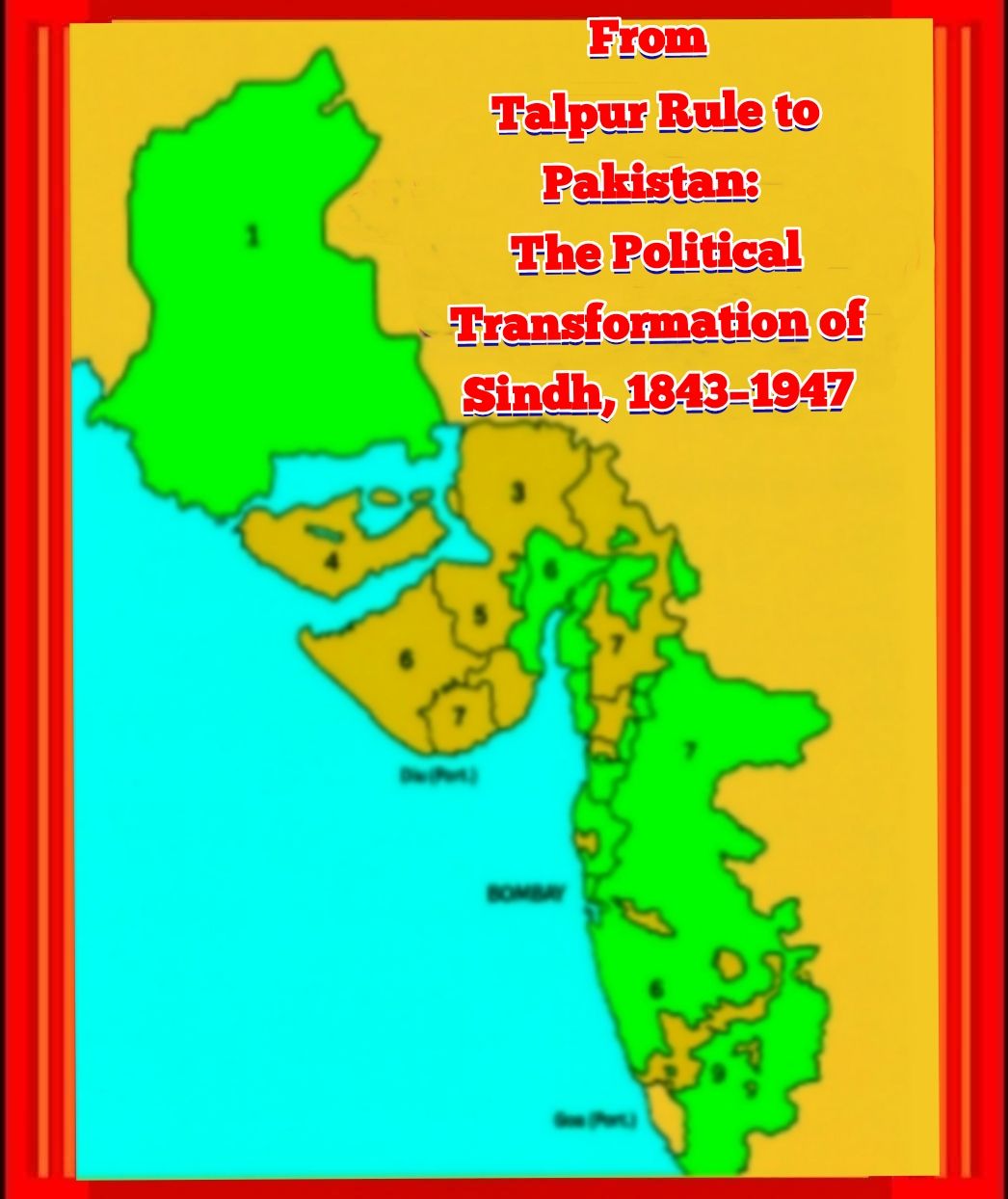
On 1 April 1936, Sindh was formally separated from the Bombay Presidency and constituted as an independent province within British India.¹² The new administrative unit comprised the districts of Hyderabad, Tharparkar (which included Mirpurkhas), Sukkur, Larkana, and Karachi—now elevated to the status of provincial capital. Khairpur, although geographically situated within Sindh, remained a princely state under the supervision of the Sindh States Agency; its internal administration continued to function with nominal autonomy.¹³
The reconstituted province was placed under the governorship of Sir Lancelot Graham. Sir Ghulam Hussain Hidayatullah assumed office as the first Premier of Sindh, marking the beginning of a distinct phase of provincial self-governance and the institutional development of Sindhi political leadership.¹⁴
——————————————–
5. Sindh and the Road to Pakistan
Sindh’s political evolution in the 1930s and 1940s aligned it strongly with the Pakistan movement. On 3 March 1943, the Sindh Legislative Assembly became the first legislature in all of India to formally endorse the Pakistan Resolution.¹⁵ This act distinguished Sindh as an early institutional backer of Muslim self-determination.
As independence approached, the Assembly convened on 26 June 1947 to vote on whether Sindh should join the newly proposed Dominion of Pakistan. After sharp debates, the resolution passed with a clear majority, cementing Sindh’s place in the future nation.¹⁶
With the formal end of the British Raj on 14 August 1947, Sindh entered Pakistan as one of its key founding provinces.¹⁷ Karachi would briefly become the federal capital, while Khairpur State acceded separately on 3 October 1947, integrating fully during the One Unit reforms of 1955.¹⁸
——————————————–
6. Conclusion
The history of Hyderabad, Mirpurkhas, and Khairpur from 1843 to 1947 is not merely a narrative of conquest and administration; it is a story of a regional society navigating the overlapping forces of empire, commerce, governance, and nationalism. British annexation disrupted Talpur authority, while the subsequent merger with the Bombay Presidency subordinated Sindh to distant bureaucratic control. Yet it was precisely this experience of marginalisation that catalysed Sindh’s political awakening and ultimately made it one of the earliest and most enthusiastic supporters of Pakistan.
Sindh’s journey—from battlefield conquest to provincial autonomy and then to statehood within Pakistan—reveals how regional identity, fiscal justice, and political activism shaped the emergence of modern South Asia. It also underscores Sindh’s foundational role in Pakistan’s creation, not merely as an administrative unit but as a province that consciously and democratically chose its future.
——————————————–
Archival Notes
1. H. T. Lambrick, Sindh Before the British Conquest (Karachi: Oxford University Press, 1970), 245–52.
2. Charles Napier, Defeats and Triumphs (London: J. Murray, 1857), 113–15.
3. Ibid., 207–10.
4. Sarah Ansari, Sufi Saints and State Power: The Pirs of Sind, 1843–1947 (Cambridge University Press, 1992), 31.
5. Napier, Defeats and Triumphs, 223.
6. Imperial Gazetteer of India, Vol. 22 (1908), 19–22.
7. Bombay Government Proceedings, 1847, IOR/R/2/1081, British Library Archives.
8. Ibid.
9. M. H. Panhwar, Chronological Dictionary of Sindh (Karachi: Institute of Sindhology, 1983), 517–21.
10. Proceedings of the All-India Muslim League, 1930–1935.
11. Government of India Act (1935), Sections 289–300.
12. Ibid.
13. Ansari, Sufi Saints and State Power, 144.
14. Panhwar, Chronological Dictionary of Sindh, 602.
15. Proceedings of the Sindh Legislative Assembly, 3 March 1943.
16. Ibid., 26 June 1947.
17. Pakistan Independence Act (1947).
18. Government of Pakistan, White Paper on States Integration (1955), 17–19.
——————————————–
Author Biography
Dr. Masood Tariq is a Karachi-based politician and political theorist. He formerly served as Senior Vice President of the Pakistan Muslim Students Federation (PMSF) Sindh, Councillor of the Municipal Corporation Hyderabad, Advisor to the Chief Minister of Sindh, and Member of the Sindh Cabinet.
His research explores South Asian geopolitics, postcolonial state formation, regional nationalism, and inter-ethnic politics, with a focus on the Punjabi question and Cold War strategic alignments.
He also writes on Pakistan’s socio-political and economic structures, analysing their structural causes and proposing policy-oriented solutions aligned with historical research and contemporary strategy.
His work aims to bridge historical scholarship and strategic analysis to inform policymaking across South Asia, Central Asia, and the Middle East.
Leave a Reply