
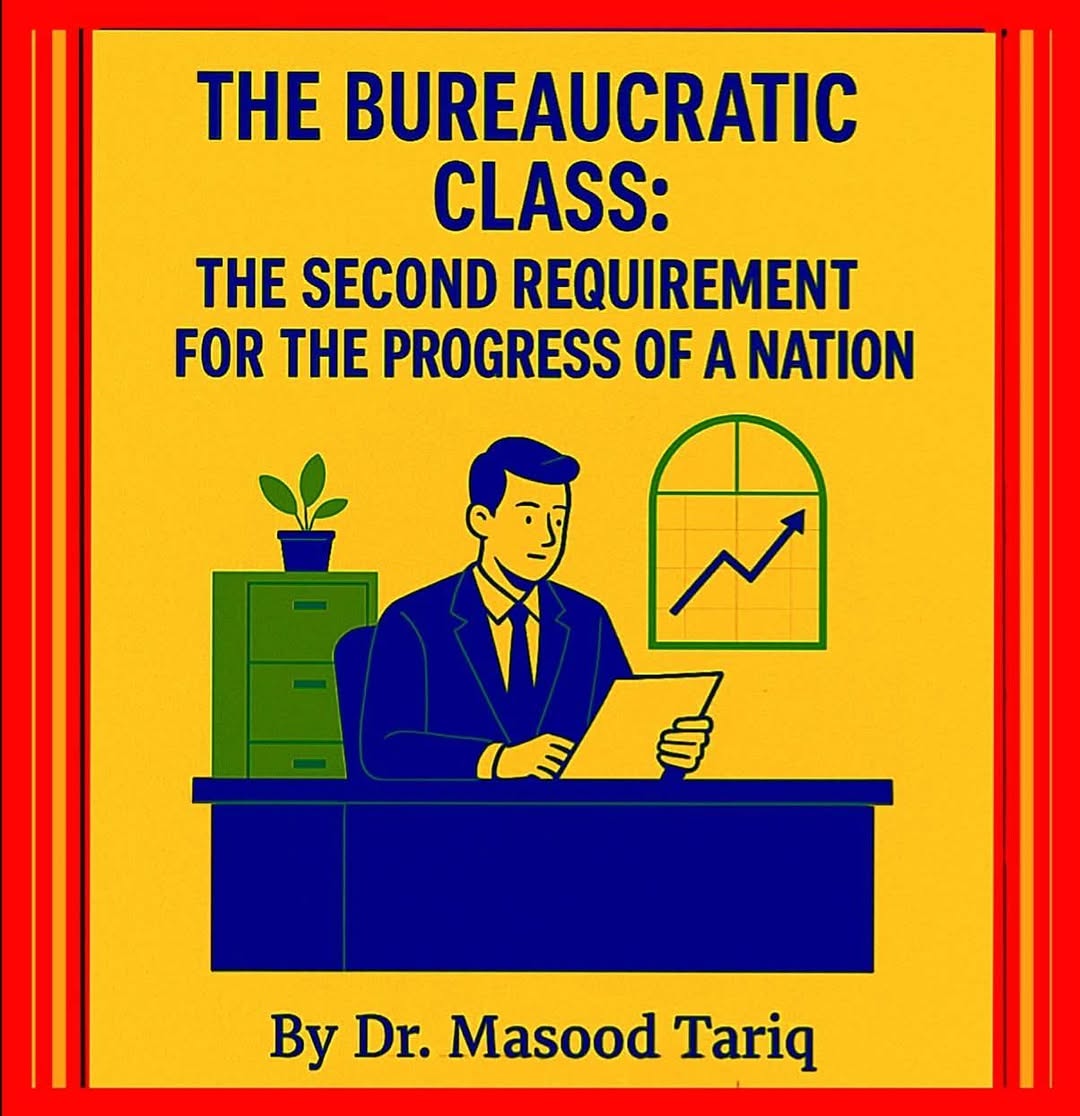
The Bureaucratic Class: The Second Requirement for the Progress of a Nation
Date: September 9, 2025
No vision, however brilliant, can succeed without effective administration. Once the intellectual class defines ideas and direction, it is the bureaucratic class that translates vision into governance. Bureaucrats — administrators, civil servants, planners, and institutional managers — form the backbone of a state’s machinery.
In Pakistan, however, the bureaucratic class has often failed to serve as a neutral and professional instrument of administration. Instead of implementing policies for the welfare of the people, it was captured by elites, militarized, or turned into a tool of centralization. This failure has been one of the central reasons why Pakistan’s state institutions remain fragile and distrusted even after seven decades of independence.
The intellectual class is the first requirement for the progress of a nation, but the bureaucratic class comes second. Without honest and efficient administration, ideas remain empty slogans and policies collapse before reaching the people.
The Nature of the Bureaucratic Class
The bureaucratic class is marked by professional training, technical expertise, and institutional responsibility. Its task is not to invent ideology but to administer the day-to-day life of the state — collecting revenue, delivering services, implementing law, and ensuring order.
In theory, the bureaucrat stands between rulers and citizens as a mediator: translating political vision into practical reality. Where intellectuals provide the compass, bureaucrats provide the machinery to follow the path.
Pakistan’s Bureaucracy After Partition
At independence, Pakistan inherited a very small bureaucratic corps: only about 1,200 officers out of India’s 4,000 ICS officers opted for Pakistan. In this vacuum, bureaucracy became disproportionately powerful. With weak political institutions and absent intellectual leadership, the civil service transformed into a ruling class of its own.
But instead of serving the indigenous peoples — Punjabis, Sindhis, Baloch, Pashtuns, and Bengalis — it was soon dominated by migrants from UP and CP. They monopolized key positions in the administration, reinforcing Ganga-Jumna Centric policies and alienating native populations.
The bureaucracy that should have been a neutral instrument of service instead became an instrument of control. This legacy still haunts Pakistan.
Bureaucracy and Centralization
A healthy bureaucracy strengthens federalism by ensuring fair distribution of resources and services. In Pakistan, bureaucracy often became a tool of centralized domination.
In East Bengal, bureaucratic neglect and discrimination fueled resentment that exploded in 1971.
In Sindh, bureaucrats from outside replaced local administrators, deepening the sense of dispossession after the loss of Sindhi Hindu intelligentsia.
In Balochistan and Pashtun areas, bureaucracy often worked hand in hand with the military, suppressing demands for autonomy instead of facilitating them.
This centralization weakened trust in the state and turned bureaucracy into a symbol of domination rather than service.
The Role of Integrity and Neutrality
In strong nations, bureaucracy functions with integrity, neutrality, and professionalism. It is not the servant of one class, ethnicity, or ideology but the servant of the entire people.
In Pakistan, bureaucracy has too often become partisan: serving the interests of ruling elites, political parties, or military dictators. This undermined its legitimacy and reduced it to a class seen as privileged, corrupt, and detached from the common citizen.
A nation cannot progress if its bureaucratic class is viewed as an oppressor rather than a facilitator.
The Need for Reform and Renewal
For Pakistan to progress, its bureaucratic class must undergo serious reform. The following are essential:
1. Merit over Patronage — appointments and promotions must be based on performance, not connections.
2. Decentralization — bureaucracy must serve provinces and districts, not just the center.
3. Accountability — civil servants must be answerable to law and people, not only to elites.
4. Cultural Sensitivity — administrators must respect the languages and identities of the nations they serve.
A reformed bureaucracy can become the engine of service delivery, economic planning, and stability. Without it, Pakistan will remain trapped in cycles of inefficiency and distrust.
Conclusion
No society can progress on ideas alone. After the intellectual class defines the vision, the bureaucratic class must ensure its honest implementation. In Pakistan, this sequence has been broken. Bureaucracy became a ruling class instead of a service class, alienating the very people it was meant to serve.
To move forward, Pakistan must build a bureaucracy that is professional, neutral, and rooted in the soil of its nations. It must deliver services with fairness, respect diversity, and strengthen federal harmony.
But even bureaucracy cannot stand alone. Once the intellectual class provides vision and the bureaucratic class ensures administration, the business class must generate wealth and opportunity. Only together — ideas, administration, and economy — can a modern nation rise.
Leave a Reply