
The Second Martial Law in Pakistan: Causes, Dynamics, and the Overthrow of Iskandar Mirza (1956–1958)
Dr. Masood Tariq
Independent Political Theorist
Karachi, Pakistan
drmasoodtariq@gmail.com
Date: November 27, 2025
——————————————–
Abstract
The imposition of Pakistan’s second martial law on 27 October 1958 represented a decisive rupture in the country’s constitutional and political evolution. Emerging only two years after the promulgation of Pakistan’s first constitution in 1956, the military takeover reflected deep structural weaknesses within the political system, chronic instability in the executive branch, the controversial One Unit scheme, and long-standing tensions between civilian and military elites.
This paper analyses the constitutional breakdown under President Major General Iskandar Mirza (an Indian refugee), the rapid turnover of prime ministers, the rise of General Ayub Khan (Pathan), and the final displacement and exile of Iskandar Mirza. It situates these events within Pakistan’s early institutional fragility and explores how political weakness and extra-constitutional ambitions created the conditions for military ascendancy.
——————————————–
Table of Contents
1. Introduction
2. Political Instability under Iskandar Mirza
3. The Crisis of One Unit and Weakening of Civilian Authority
4. Iskandar Mirza’s Martial Law of 7 October 1958
5. Ascendancy of General Ayub Khan
6. The Overthrow and Exile of Iskandar Mirza (27 October 1958)
7. Conclusion
——————————————–
1. Introduction
The early post-independence period of Pakistan was marked by administrative experimentation, ethnic disagreements, constitutional delays, and political uncertainty. After a prolonged process of constitutional drafting, the Constituent Assembly of Pakistan finally approved the first constitution of Pakistan in 1956, transforming the office of Governor General into that of an elected (though indirectly) President. Major General Iskandar Mirza, the last Governor General and an Indian refugee, became the first President of the new Republic.
Yet this constitutional transition did not resolve Pakistan’s systemic challenges. Instead, it exposed them. Between 1956 and 1958, Pakistan witnessed an unprecedented level of executive volatility, with four prime ministers serving in just two years. This instability enabled the deepening influence of the military and paved the way for the events of October 1958.
——————————————–
2. Political Instability under Iskandar Mirza
2.1 Rapid Turnover of Prime Ministers (1956–1958)
Under President Iskandar Mirza, Pakistan experienced four prime ministers in quick succession:
1. Chaudhry Muhammad Ali (Punjabi)
2. Hussain Shaheed Suhrawardy (Bengali)
3. Ibrahim Ismail Chandragar (Indian refugee)
4. Feroz Khan Noon (Punjabi)
This turnover reflected not only personal rivalries but also structural limitations of Pakistan’s parliamentary system, which lacked stable party alignments, constitutional clarity, and institutional maturity. Iskandar Mirza’s preference for manipulating coalitions contributed to the climate of instability.
2.2 The Precedent of Executive Overreach
Iskandar Mirza did not act in a political vacuum. Governor-General Malik Ghulam Muhammad (Pathan) had already set the precedent of dismissing prime ministers, dissolving assemblies, and ruling by decree. This normalised the belief within the bureaucracy and the armed forces that parliamentary government was inherently weak and that constitutional processes were flexible tools, not binding constraints.
——————————————–
3. The Crisis of One Unit and Weakening of Civilian Authority
The One Unit Scheme, implemented in 1955, sought to merge all of West Pakistan’s provinces into a single administrative unit to counterbalance East Pakistan’s demographic majority. Instead of resolving political tensions, the scheme:
Weakened provincial autonomy,
Patronised bureaucratic rule,
Exacerbated ethnic grievances (Punjabi, Sindhi, Baloch, Pashtun),
Complicated governance through a highly centralised administrative structure.
By 1958, One Unit had become a symbol of bureaucratic authoritarianism and administrative incoherence, amplifying public dissatisfaction and eroding confidence in civilian leadership.
——————————————–
4. Iskandar Mirza’s Martial Law of 7 October 1958
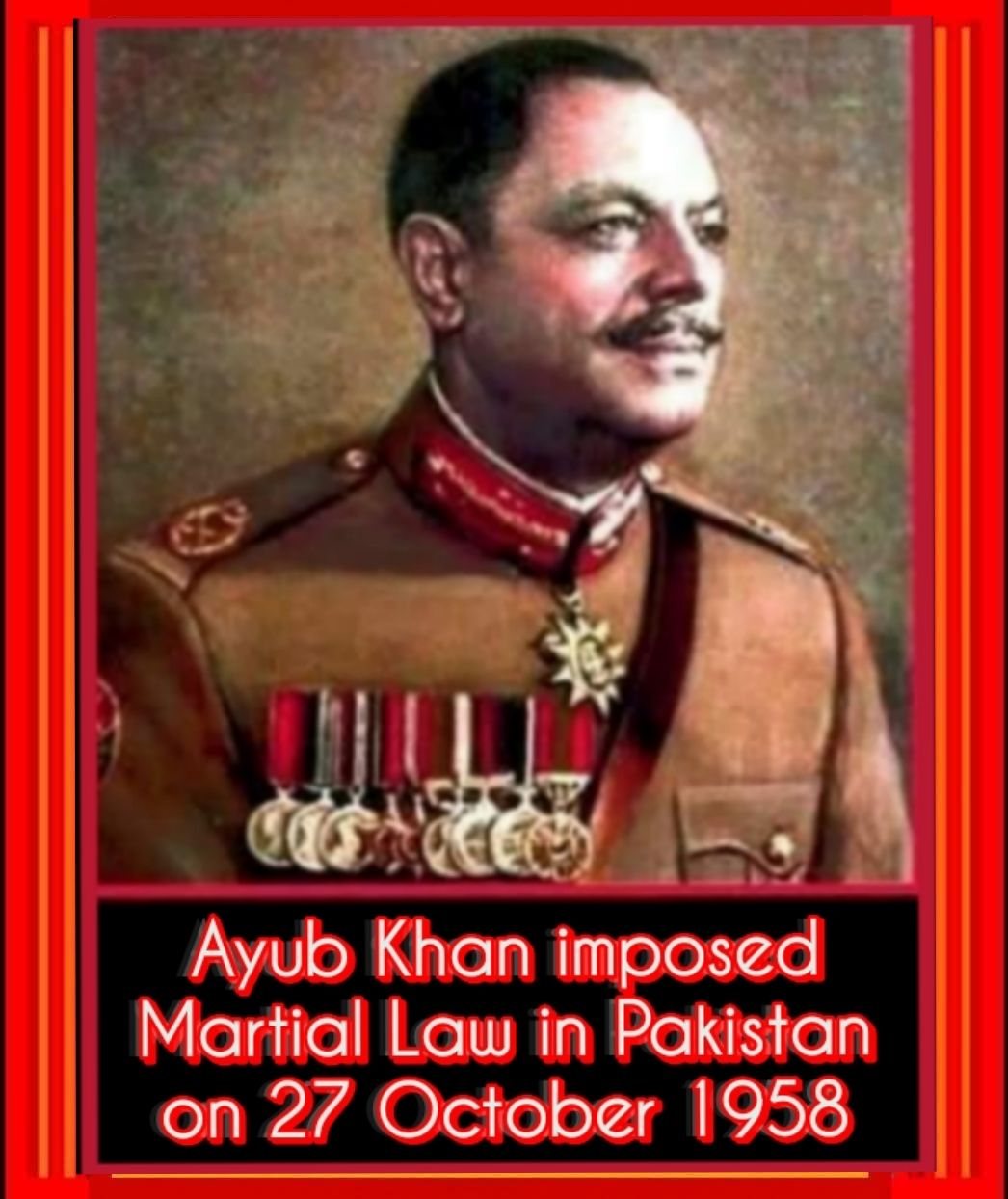
Facing political paralysis, Iskandar Mirza imposed martial law on 7 October 1958—Pakistan’s second authoritarian intervention after 1953.
He undertook the following measures:
1. Dismissed the government of Feroz Khan Noon (Punjabi) and dissolved the National Assembly and all Provincial Assemblies.
2. Abrogated the 1956 Constitution, calling it “unworkable” and full of “dangerous compromises.”
3. Banned all political parties, arguing that party politics had destabilised the country.
4. Appointed General Ayub Khan (Pathan)—the Commander-in-Chief of the Pakistan Army—as Chief Martial Law Administrator (CMLA) and Prime Minister, effectively transferring the governing authority to the military.
Although Iskandar Mirza believed he could rule through Ayub Khan, he underestimated the military’s resolve and the ambitions of its senior leadership.
——————————————–
5. Ascendancy of General Ayub Khan
General Ayub Khan gradually consolidated administrative, executive, and political authority after the imposition of martial law. As CMLA and Prime Minister, Ayub Khan held the actual levers of state power—control of the armed forces, the bureaucracy, and the coercive apparatus of the state.
Ayub Khan viewed Iskandar Mirza’s political manoeuvring as destabilising and feared that the President intended to manipulate the military for personal control. Meanwhile, senior military leaders increasingly aligned with Ayub Khan, regarding him as the stabilising alternative to Iskandar Mirza’s ambitions.
——————————————–
6. The Overthrow and Exile of Iskandar Mirza (27 October 1958)
Just twenty days after martial law was proclaimed, the balance of power shifted decisively in favour of the military. On the night of 26–27 October 1958, Ayub Khan ordered an army detachment to enter the Presidential Palace.
The operation was led and supported by senior military officers:
1. General Azam Khan (Pathan)
2. Lieutenant General Wajid Ali Khan Burki (Pathan)
3. Admiral Afzal Akram Rahman Khan (Pathan) – Commander-in-Chief, Pakistan Navy
4. Air Marshal Asghar Khan (Pathan) – Commander-in-Chief, Pakistan Air Force
These officers played key roles in compelling Major General Iskandar Mirza (Indian refugee) to resign.
Following the forced resignation, Iskandar Mirza was:
Detained briefly in Quetta, Balochistan,
Then deported to London on 27 November 1958,
Where he lived in political exile until his death in 1969.
Rejected by Pakistan’s political and military leadership, Iskandar Mirza was buried in Iran at his own request.
With Iskandar Mirza removed, General Ayub Khan appointed himself President of Pakistan, initiating a new era of military-led authoritarian governance.
——————————————–
7. Conclusion
The imposition of martial law in October 1958 and the subsequent overthrow of Iskandar Mirza represented a turning point in Pakistan’s political trajectory. The events were shaped by:
The fragility of the early parliamentary system,
Ethnic and political fragmentation,
Constitutional instability,
Bureaucratic manipulation,
The administrative failure of One Unit,
The emergence of a powerful, centralised military establishment.
The removal of Iskandar Mirza and the consolidation of power by General Ayub Khan entrenched the doctrine of military supremacy in Pakistan’s political order—a pattern that would continue to define the country’s governance for decades.
——————————————–
References
Ahmed, Mushtaq. 1963. Government and Politics in Pakistan. Karachi: Pakistan Publishing House.
Burki, Shahid Javed. 1986. Pakistan: A Nation in the Making. Boulder, CO: Westview Press.
Callard, Keith. 1957. Pakistan: A Political Study. London: Allen & Unwin.
Chaudhry, G. W. 1969. Pakistan’s Middle-Class Military Rule. New York: Asian Publishing House.
Immerman, Richard H. 2010. Empire for Liberty: A History of American Imperialism from Benjamin Franklin to Paul Wolfowitz. Princeton: Princeton University Press.
Jalal, Ayesha. 1990. The State of Martial Rule: The Origins of Pakistan’s Political Economy of Defence. Cambridge: Cambridge University Press.
Khan, Ayub. 1967. Friends Not Masters: A Political Autobiography. London: Oxford University Press.
Malik, Iftikhar H. 2008. The History of Pakistan. London: Greenwood Press.
Sayeed, Khalid B. 1967. The Political System of Pakistan. Boston: Houghton Mifflin.
Shafqat, Saeed. 1997. Civil–Military Relations in Pakistan: From Zulfikar Ali Bhutto to Benazir Bhutto. Boulder, CO: Westview Press.
Talbot, Ian. 1998. Pakistan: A Modern History. London: Hurst & Co.
Wolpert, Stanley. 1993. Zulfi Bhutto of Pakistan: His Life and Times. Oxford: Oxford University Press.
Zaidi, Akbar S. 2015. Issues in Pakistan’s Economy: A Political Economy Perspective. Karachi: Oxford University Press.
——————————————–
Author Biography
Dr. Masood Tariq is a Karachi-based politician and political theorist. He formerly served as Senior Vice President of the Pakistan Muslim Students Federation (PMSF) Sindh, Councillor of the Municipal Corporation Hyderabad, Advisor to the Chief Minister of Sindh, and Member of the Sindh Cabinet.
His research explores South Asian geopolitics, postcolonial state formation, regional nationalism, and inter-ethnic politics, with a focus on the Punjabi question and Cold War strategic alignments.
He also writes on Pakistan’s socio-political and economic structures, analysing their structural causes and proposing policy-oriented solutions aligned with historical research and contemporary strategy.
His work aims to bridge historical scholarship and strategic analysis to inform policymaking across South Asia, Central Asia, and the Middle East.
Leave a Reply