
Date: June 17, 2025
On December 16, 1971, after the fall of Dhaka, Pakistan’s President and Civil Martial Law Administrator, Zulfikar Ali Bhutto, established the Hamoodur Rahman Commission on December 26, 1971, to investigate the role of the Pakistan Army in East Pakistan from 1947 to 1971.
However, the government of Pakistan kept this report hidden for many years. Eventually, excerpts of the report were published in an Indian newspaper, which forced the Pakistani government to release the full report.
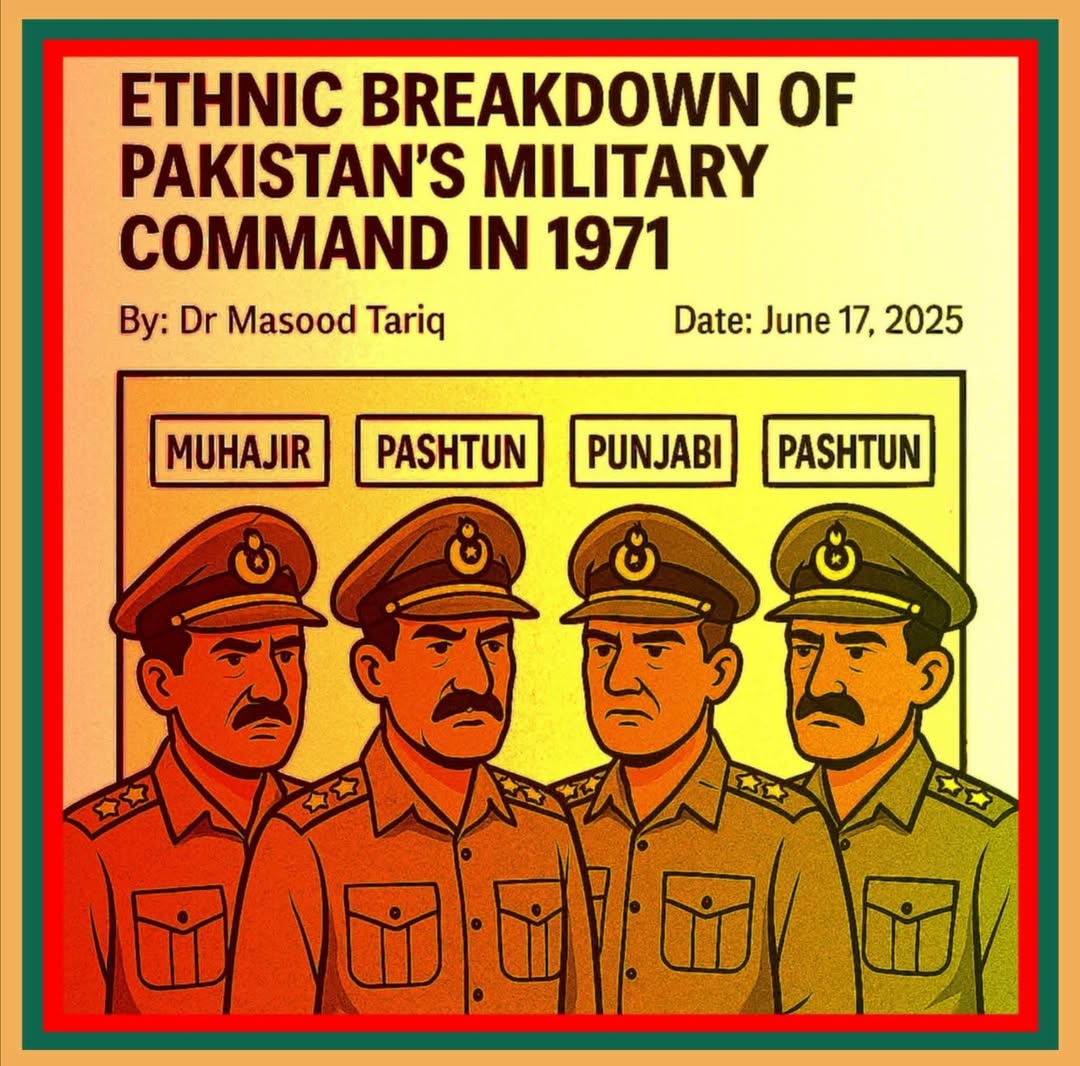
The report was not published earlier because the Hamoodur Rahman Commission had recommended action against 22 senior military officers, among whom 16 were non-Punjabis — including 11 Urdu-speaking Indian Muhajirs, 5 Pathans, and 6 Punjabis.
Due to Punjab comprising 60% of West Pakistan’s population and the majority of non-commissioned and junior-ranking soldiers in the army being Punjabis, a narrative was created by Urdu-speaking Muhajir-controlled media and Pashtun elements in the military suggesting that the Pakistan Army was a “Punjabi Army.” Thus, it was alleged that the Hamoodur Rahman Commission had recommended actions only against Punjabi officers and that Punjabis prevented the report from being made public.
However, the reality is that not a single Punjabi had ever been appointed as Chief of the Pakistan Army from the time of independence till the secession of East Pakistan.
When General Sir Douglas Gracey’s tenure ended on January 16, 1951, three senior officers were in line for promotion to four-star rank:
1. Major General Iftikhar Khan Rajput (Punjabi)
2. Major General Akbar Khan Minhas (Punjabi)
3. Major General N.A.M. Raza (Punjabi)
Initially, General Iftikhar Khan Rajput was promoted to four-star rank and appointed the first indigenous Chief of Army Staff. However, he died in a plane crash near Thatta while travelling from Lahore to Karachi to attend a course at the Imperial Defence College in Camberley, UK.
After his death, the senior-most officer was Major General Ashfaq Majeed (Bengali), who was senior even to Ayub Khan (Pathan).
Nevertheless, the then Secretary of Defence, Major General Iskander Mirza (a Bihari residing in Bengal) and Prime Minister Liaquat Ali Khan an Urdu-speaking Muhajir from UP, India) played a pivotal role in the promotion of Ayub Khan, bypassing Ashfaq Majeed.
Ayub Khan, only 43 years old at the time, became the Chief of the Pakistan Army and later the first military ruler. After declaring himself President, he took on the rank of Field Marshal and remained Army Chief for seven years, until his tenure ended on October 27, 1958.
From October 27, 1958, to September 17, 1966, General Musa Khan (Pashtun) served as Army Chief. He was in charge during the 1965 Indo-Pak War.
General Yahya Khan (Pathan) then became the Army Chief and also became President in 1969, remaining in office until December 20, 1971. He was the last Army Chief of United Pakistan.
After the creation of Bangladesh, General Gul Hassan Khan (Pashtun) became the first Army Chief of West Pakistan on December 20, 1971.
It wasn’t until March 3, 1972, 24 years and 6 months after Pakistan’s creation, that a Punjabi, General Tikka Khan, was appointed as the first Punjabi Army Chief.
In 2025, the Pakistan Army had 28 Generals and Lieutenant Generals, but during the 1971 Indo-Pak War, the number was 14, comprising:
1 Commander-in-Chief
13 Lieutenant Generals
Breakdown of their postings:
1. 4 were stationed at GHQ or CMLA HQ.
2. 4 were Corps Commanders.
3. 4 Served as Governors under Martial Law.
4. 1 was stationed at CENTO HQ in Ankara, Turkey.
Of these 14 generals, 9 were non-Punjabis:
4 Muhajirs
5 Pashtuns
5 Punjabis
Key Figures:
1. General Yahya Khan (Pathan) – Commander-in-Chief
2. Lt. Gen. Abdul Hameed Khan (Punjabi) – Deputy Commander-in-Chief
3. Lt. Gen. S.G.M.M. Pirzada (Muhajir) – PSO at CMLA HQ, Rawalpindi
4. Lt. Gen. Gul Hassan Khan (Pashtun) – Chief of General Staff
5. Lt. Gen. Khwaja Wasiuddin (Muhajir) – Master General of Ordnance
6. Lt. Gen. A.A.K. Niazi (Pathan) – Commander, Eastern Command
7. Lt. Gen. Irshad Ahmad Khan (Punjabi) – Commander, I Corps
8. Lt. Gen. Tikka Khan (Punjabi) – Commander, II Corps
9. Lt. Gen. Bahadur Sher (Pashtun) – Commander, IV Corps
10. Lt. Gen. Atiqur Rahman (Punjabi) – Governor Punjab
11. Lt. Gen. Rahman Gul (Pashtun) – Governor Sindh
12. Lt. Gen. K.M. Azhar (Muhajir) – Governor NWFP
13. Lt. Gen. Riaz Hussain (Muhajir) – Governor Balochistan
14. Lt. Gen. Muhammad Sharif (Punjabi) – Permanent Representative at CENTO HQ, Turkey
The Hamoodur Rahman Commission recommended action against 22 senior officers, including 11 Muhajirs, 5 Pathans, and 6 Punjabis.
Recommendations:
1. Public trial of 9 Generals: 5 Muhajirs, 2 Pathans, 2 Punjabis
2. Court-martial of 6 senior officers: 3 Pathans, 2 Muhajirs, 1 Punjabi
3. Dismissal of 4 Major Generals (3 Muhajirs, 1 Punjabi) deemed unfit for continued service
4. Departmental action against 3 officers: 2 Punjabis, 1 Muhajir
The 9 Generals recommended for public trial were:
1. Gen. Yahya Khan (Pathan) – Ex-Commander-in-Chief and Chief Martial Law Administrator
2. Lt. Gen. Gul Hassan (Pashtun) – Ex-Chief of General Staff
3. Lt. Gen. S.G.M.M. Pirzada (Muhajir) – Ex-PSO to CMLA
4. Maj. Gen. Ghulam Umar (Muhajir) – Former second-in-command NSC
5. Maj. Gen. A.O. Mitha (Muhajir) – Former Deputy Corps Commander
6. Maj. Gen. Abid Zahid (Muhajir) – Ex-GOC 15 Division
7. Maj. Gen. B.M. Mustafa (Muhajir) – Ex-GOC 18 Division
8. Lt. Gen. Abdul Hameed Khan (Punjabi) – Ex-Chief of Staff to C-in-C
9. Lt. Gen. Irshad Ahmad Khan (Punjabi) – Ex-Commander I Corps
The 6 senior officers recommended for court-martial were:
1. Lt. Gen. A.A.K. Niazi (Pathan) – Former Eastern Command Commander
2. Maj. Gen. M. Rahim Khan (Pashtun) – Ex-GOC 39 (Ad hoc) Division
3. Brig. Muhammad Aslam Niazi (Pathan) – Ex-Commander 53 Brigade (39 Div)
4. Maj. Gen. Muhammad Jamshed (Muhajir) – Ex-GOC 36 (Ad hoc) Division
5. Brig. G.M. Baqir Siddiqui (Muhajir) – Former COS, Eastern Command, Dhaka
6. Brig. Muhammad Hayat (Punjabi) – Ex-Commander 107 Brigade (9 Div)
The 4 Major Generals deemed unfit for continued service:
1. Maj. Gen. M.H. Ansari (Muhajir) – GOC 9 Division
2. Maj. Gen. Qazi Abdul Majeed (Muhajir) – GOC 14 Division
3. Maj. Gen. Rao Farman Ali (Muhajir) – Ex-Adviser to Governor of East Pakistan
4. Maj. Gen. Nazar Hussain Shah (Punjabi) – GOC 16 Division
The Hamoodur Rahman Commission recommended departmental action against two Punjabi and one Muhajir senior military officer. The three high-ranking officers were as follows:
Brigadier Manzoor Ahmad (Punjabi) – Former Commander, 57 Brigade, 9 Division
Brigadier Abdul Qadir Khan (Punjabi) – Former Commander, 93 Brigade, 36 Division
Brigadier S.A. Ansari (Muhajir) – Former Commander, 23 Brigade
Leave a Reply